
.webp)
How to Avoid GDPR Fines with Forms



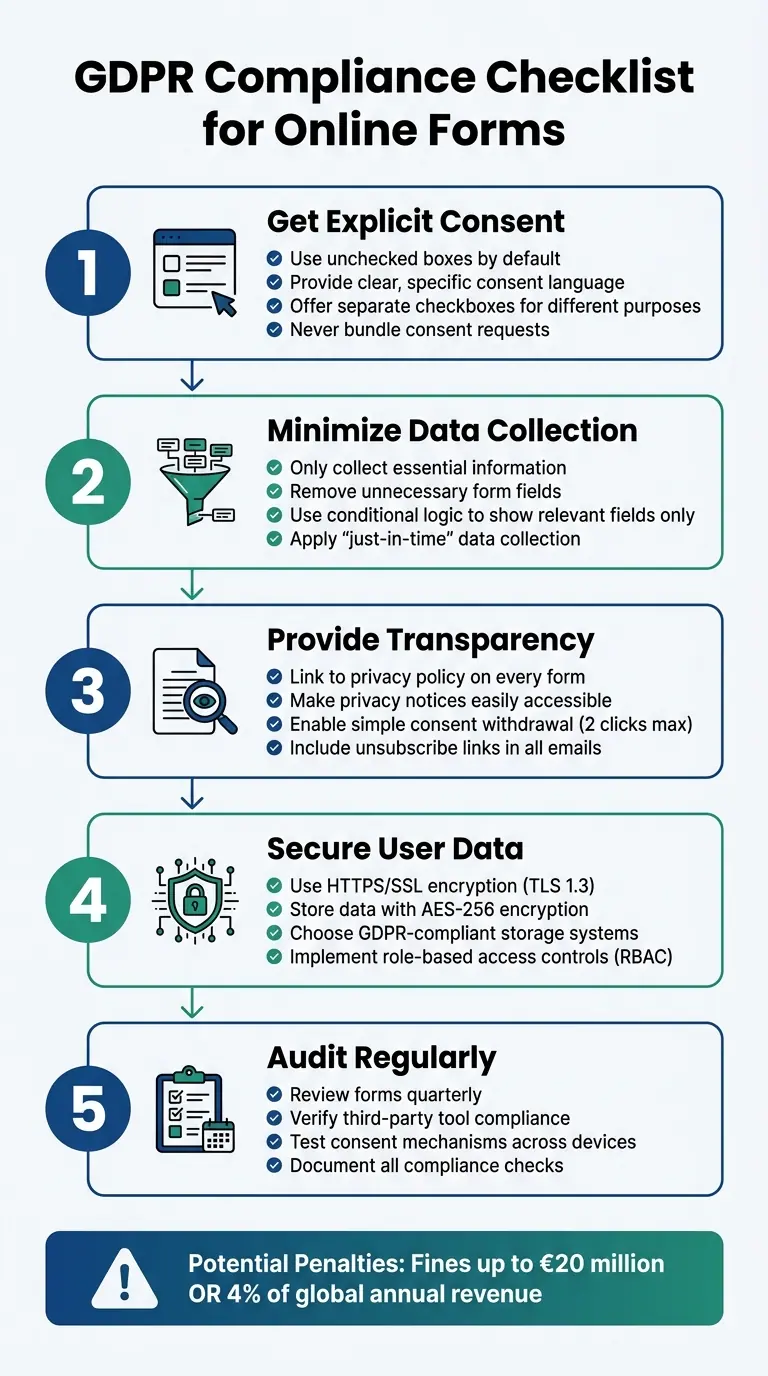
If your business collects data from EU residents, even if you're based in the U.S., you must comply with GDPR rules - or face steep fines. Here's how to keep your online forms compliant and avoid penalties:
- Get clear user consent: Use unchecked boxes and ensure users actively opt in. Avoid pre-checked boxes or vague consent language.
- Minimize data collection: Only ask for essential information. Avoid unnecessary fields like birthdays or phone numbers unless absolutely required.
- Provide transparency: Link to a detailed privacy policy on every form and allow users to easily withdraw consent.
- Secure user data: Encrypt data during transmission (use HTTPS) and store it securely with GDPR-compliant systems.
- Audit regularly: Test forms, review third-party tools, and update processes to ensure ongoing compliance.
GDPR fines can reach up to €20 million or 4% of global revenue, but following these steps protects your business from penalties and builds trust with users.
5 Essential Steps to Achieve GDPR Compliance with Online Forms
Getting started with GDPR compliance: Consent
sbb-itb-5f36581
Get Explicit Consent from Users
The GDPR requires consent to be freely given, specific, informed, and unambiguous. This means users must clearly understand what they’re agreeing to and actively opt in. Actions like silence, inactivity, or simply scrolling through a page do not qualify as valid consent.
To comply, users should actively check an unchecked box to confirm their consent. Whether you're collecting emails for a newsletter or requesting contact details, an explicit opt-in is essential. This approach not only aligns with GDPR guidelines but also helps avoid expensive penalties.
For example, in January 2019, French data protection authorities fined Google €50 million for failing to meet GDPR consent standards. Their process bundled multiple purposes into one consent request, making it unclear what users were agreeing to.
"Consent must be freely given, specific, informed and unambiguous. Pre-ticked boxes, bundled consent and vague purposes all fail the GDPR test." – Sarah Mitchell, Author
To meet these standards, use clear forms with distinct checkboxes to capture explicit consent.
Use Clear, Unchecked Consent Checkboxes
Every consent checkbox on your forms should always be unchecked by default. This ensures users take a clear, affirmative action, which is a core GDPR requirement.
The wording next to the checkbox should be specific and easy to understand. Avoid vague phrases like "I agree to the terms." Instead, clearly explain what users are consenting to. For instance: "We collect your name and email to respond to your inquiry. Your data will be stored securely for 12 months. Read our full Privacy Policy".
Position the checkboxes near the submit button to make them visible before users complete the form. If the consent is essential to your service - like processing a contact form - it can be marked as required. However, marketing opt-ins should always remain optional.
Never Use Pre-Checked Boxes
Pre-checked boxes are strictly forbidden under GDPR Recital 32. They fail to meet the requirement for active consent, as they presume agreement without a user’s clear action. Similarly, implied consent, such as scrolling or submitting a form, does not satisfy GDPR standards.
Article 7(1) of the GDPR also mandates that you prove consent was given. This means keeping records like timestamps, the exact language shown to users, and the relevant version of your privacy policy. Pre-checked boxes make it impossible to demonstrate genuine consent.
Following these rules ensures your consent process is transparent and compliant.
Offer Separate Consent Options for Different Purposes
The GDPR emphasizes granular consent, meaning users should have the freedom to choose which specific actions they agree to. Avoid combining multiple purposes into a single consent request.
Provide separate checkboxes for distinct activities. For example, offer options like "Send me your monthly newsletter" and "Share my details with partners for promotional offers." Users should be able to select or decline each option independently without it affecting their ability to submit the form.
Additionally, consent for marketing cannot be a condition for accessing your core service. GDPR Recital 42 states, "Consent should not be regarded as freely given if the data subject has no genuine or free choice or is unable to refuse or withdraw consent without detriment". This means you cannot force users to accept unnecessary data processing as part of using your service.
Finally, keep consent requests separate from terms and conditions. GDPR Article 7(2) specifies that consent requests should be clearly distinguishable, written plainly, and easy to access.
Collect Only the Data You Actually Need
GDPR Article 5(1)(c) emphasizes the principle of data minimization, stating that personal data should be "adequate, relevant and limited to what is necessary in relation to the purposes for which they are processed". This means you should only collect data that is essential to providing your service. To comply, focus on three key criteria:
- Adequacy: Gather enough information to meet your stated purpose. For instance, a delivery service might need a physical address.
- Relevance: Ensure every data field has a clear connection to your purpose. For example, don’t ask for a date of birth on a newsletter signup unless it’s required for age verification.
- Necessity: Collect data only when your purpose cannot be achieved without it.
Failing to justify your data collection practices can lead to severe penalties - up to €20 million or 4% of your annual global revenue.
"The 'just in case' mindset is a direct contradiction of data minimisation. Under GDPR, you cannot collect data speculatively." – Custodia Blog
This principle aligns with public sentiment: 86% of internet users are concerned about how their personal data is collected, with a similar majority supporting efforts to minimize unnecessary data collection. Adhering to these guidelines is a step toward building trust with your users.
Determine Which Form Fields Are Necessary
To ensure compliance, evaluate every form field by asking these questions: Is it essential to your process? Who will use it? What happens if it’s omitted? If you can’t provide a solid justification, it’s time to remove the field.
Avoid common mistakes like these:
- Asking for phone numbers on a newsletter signup form.
- Collecting company size on a free trial form when it’s not actively used.
- Requesting full addresses when a country or region would suffice.
For non-essential fields, make them optional and avoid pressuring users to fill them out.
Here’s a practical way to assess your forms:
| Field | Purpose | Necessary? | Action |
|---|---|---|---|
| Account login, transactional email | Yes | Keep | |
| Phone | SMS alerts (if opted in) | Conditional | Collect only if user opts in |
| Job Title | Sales segmentation | Review | Remove if not actively used by sales |
| Birthday | Birthday promotion email | Marginal | Remove unless proven campaign active |
| Address | Shipping/Delivery | Yes (for delivery) | Keep only for physical fulfillment |
Regularly audit your forms and CRM fields to eliminate unnecessary data collection.
Use Conditional Logic to Show Relevant Fields Only
Once you’ve determined which fields are essential, use conditional logic to display only the fields relevant to each user. For instance, show the "Phone Number" field only if the user opts into SMS alerts. If a user expresses no interest in a service, hide any follow-up questions to avoid collecting irrelevant data.
Conditional logic works by showing or hiding fields based on user responses. To further safeguard privacy, use "Ignore" actions for sections you don’t want to store or submit - ensuring such data never enters your system.
Another effective strategy is progressive data collection. Start by gathering only basic details during initial interactions. As your relationship with the user grows, request more detailed information when it becomes necessary. This "just-in-time" approach aligns with GDPR's principles and helps foster user trust.
"Necessary doesn't mean 'useful' or 'might be handy someday.' It means you cannot achieve the purpose without this specific data." – Custodia Blog
Link to Your Privacy Policy and Allow Consent Withdrawal
Under GDPR Article 13, privacy information must be provided at the point of data collection - not buried in footers or hidden links. This means every form should display a clear privacy notice that explains who is collecting the data, why it's being collected, how long it will be stored, and what rights users have.
In 2023, 15% of the 1,215 GDPR fines were related to transparency or consent issues, often because privacy links were either missing or hard to find. Beyond avoiding penalties, having clear and accessible privacy practices builds user trust, which can increase form completion rates. Just as obtaining consent is essential, providing accessible privacy details and easy ways to withdraw consent ensures compliance and protects your business. Article 7(3) also emphasizes that withdrawing consent must be as simple as giving it.
Add a Privacy Policy Link to Every Form
Make sure every form includes a visible and accessible privacy policy link near the submit button. Use mobile-friendly designs and contrasting colors to ensure the link stands out. Avoid vague labels like "Legal" or "Terms." Instead, use clear phrases such as "View our Privacy Policy" or "Read how we protect your data."
For example:
- On contact forms, include a statement like, "By submitting, you agree to our Privacy Policy," with a hyperlink.
- For newsletter signups, add footer text such as, "See how we protect your data," linked to the privacy policy.
- For multi-step forms, repeat the privacy link at each stage to ensure users can easily access it.
Avoid placing the privacy policy link solely in a site-wide footer or fine print. This fails the "easily accessible" requirement and can lead to fines. For instance, the Dutch DPA imposed a €150,000 penalty in 2023 for unclear privacy notices.
Your privacy policy should include all the elements required under Article 13, such as:
- Contact details of the data controller
- Purpose and legal basis for processing (e.g., consent)
- Categories of data collected
- Data retention periods
- User rights (e.g., access, deletion)
- Methods for withdrawing consent
- Procedures for filing complaints with supervisory authorities
Make it a habit to update and version your privacy policy annually to keep it current.
Make It Easy for Users to Withdraw Consent
When consent is your legal basis for processing data, users must be able to withdraw it easily and without penalty. One way to achieve this is by including an unsubscribe link in all confirmation emails sent after form submissions.
Provide multiple withdrawal options, such as:
- A dedicated email address
- A one-click opt-out link
- A user portal for managing preferences
Failure to simplify this process can lead to significant penalties. For instance, the French CNIL fined Google €150 million in 2021, and the UK ICO issued a €100,000 penalty to a retailer in 2022 for overly complicated consent withdrawal processes.
Test unsubscribe links quarterly across all devices to ensure they work seamlessly. Aim to make the process take no more than two clicks. Keep records of these tests for internal accountability. Once a user withdraws consent, immediately stop processing their data and remove them from marketing lists to comply with GDPR's storage limitation rules.
Protect Data with Proper Security Measures
According to GDPR Article 32, measures like encryption are necessary to safeguard personal data. To avoid hefty fines, it's crucial to adopt strong security practices for both data transmission and storage. Since 2018, over 1,400 GDPR fines have been issued, amounting to €2.7 billion, with 25% of these fines linked to poor storage security. A 2023 ENISA report highlights that 70% of breaches involve stored personal data collected through forms. Penalties for security breaches can climb as high as €20 million or 4% of global annual turnover, whichever is greater.
Use SSL Encryption for Data Transmission
SSL (commonly referred to now as TLS) encryption ensures the secure transfer of data from a user's browser to your server, shielding it from potential interception. Under GDPR Article 83, HTTPS is a compliance necessity.
A prime example of the consequences of neglecting encryption is the £20 million (€22 million) fine imposed on British Airways in July 2020 by the UK ICO. This penalty stemmed from a 2018 breach in which unencrypted customer data from forms was stolen during a Magecart attack. Without SSL enforcement on payment forms, 400,000 records were compromised. In response, the airline implemented full HTTPS and tokenization to address vulnerabilities.
To secure your site, install a free SSL certificate (such as those provided by Let's Encrypt) and ensure all forms operate on HTTPS URLs. Use .htaccess rules to redirect HTTP traffic to HTTPS and implement HSTS (HTTP Strict Transport Security) to enforce encryption site-wide.
Tools like SSL Labs can help you evaluate your encryption setup. Aim for TLS 1.3 for optimal security, and test your forms quarterly to ensure encrypted data transmission across all devices.
While encrypting data in transit is essential, safeguarding stored data is equally critical.
Store Data in Secure, GDPR-Compliant Systems
Storing data in compliance with GDPR requires systems equipped with access controls, AES-256 encryption, regular audits, and servers located in approved regions. Providers should back up their compliance with certifications like ISO 27001.
In September 2022, TikTok faced a €345 million fine from the Irish DPC for storing children's data insecurely. The data, collected through forms, was stored unencrypted on non-EU servers without adequate safeguards, affecting 530 million users. To address this, TikTok transitioned to encrypted, EU-based storage with pseudonymization.
Before selecting a storage solution, review Data Processing Agreements (DPAs), confirm GDPR certifications, and evaluate data retention policies.
To enhance security, implement Role-Based Access Control (RBAC) to restrict access to form data to authorized personnel only. Enable MFA (Multi-Factor Authentication) and conduct regular audits following the "need-to-know" and "least privilege" principles to limit exposure. Platforms like Reform offer secure, EU-based storage with features like end-to-end encryption, automatic data purging, and consent logging. They also integrate with GDPR-compliant CRMs like HubSpot.
Simulate data flows to confirm storage encryption is functioning correctly. Perform quarterly reviews of encryption logs to maintain GDPR compliance, and retain security logs for at least 12 months to demonstrate accountability during audits. Regular audits and access reviews, as outlined earlier, will further strengthen your compliance efforts.
Review Your Forms and Tools Regularly for Compliance
After implementing strategies to secure data and limit information collection, the next step is to regularly review your forms and tools to ensure they stay compliant with GDPR. Since tools and regulations can change over time, ongoing monitoring is essential.
Set up a quarterly audit process for your forms. During these reviews, check how data is collected, confirm consent mechanisms are functioning properly, and document any issues along with the steps you take to fix them. These regular checks help align your form management with your broader GDPR compliance strategy.
Check That Third-Party Tools Are GDPR-Compliant
Once you've audited your internal processes, it's time to examine the third-party tools connected to your forms. Whether you're using a CRM, analytics platform, or marketing tool, each must meet GDPR standards. Start by reviewing Data Processing Agreements (DPAs) with your vendors to ensure they comply with GDPR Article 28. Look for EU-approved Standard Contractual Clauses (SCCs) and confirm whether the vendor has a Data Protection Officer (DPO) if required.
A cautionary tale: In January 2021, H&M faced a €35.3 million fine ($38.5 million) from the Hamburg DPA due to non-compliance in handling employee data through third-party HR tools. Their failure to conduct regular audits led to unlawful data transfers. After introducing quarterly vendor reviews and updating DPAs, H&M managed to cut violations by 80% in follow-up audits.
Ask vendors for security audit reports or certifications like SOC 2. Verify that they support GDPR rights, such as data access, deletion, and portability, and that they can report breaches within the required 72-hour window. Keep an updated inventory of tools, noting any changes in compliance status. Tools like Reform, which offer secure EU-based storage with end-to-end encryption and integrate with GDPR-compliant CRMs like HubSpot, can simplify vendor management.
Test Your Forms to Confirm Proper Data Handling
Testing is critical to ensure your forms are functioning as intended under GDPR guidelines. Submit test data through each form to check for key compliance features: consent checkboxes must not be pre-checked, only necessary fields should appear, and privacy policy links must work properly. Also, confirm that SSL encryption is in place and data is stored in approved systems.
Run tests across different browsers and devices. Make sure users can easily withdraw consent, conditional logic limits unnecessary data collection, and access logs show that only authorized personnel can view submissions. These tests should follow "need-to-know" and "least privilege" principles to restrict data access.
According to ENISA's 2024 report, only 42% of organizations conduct quarterly audits on their integrated tools, which correlates with higher rates of GDPR violations. Create a testing schedule and assign responsibilities using the RACI framework (Responsible, Accountable, Consulted, Informed). Document each test thoroughly, noting what was checked, what issues were found, and how they were resolved. Keep these records for at least 12 months to show regulators your commitment to compliance.
Conclusion
Staying on the right side of GDPR regulations boils down to five key practices: getting explicit consent with clear, unchecked boxes; collecting only the data you truly need; providing easy access to your privacy policy and consent withdrawal options; securing data through encryption and safe storage; and regularly auditing your forms and any third-party tools. These steps don’t just help you avoid penalties - they also build trust and demonstrate accountability in how you handle user data.
The potential financial impact of non-compliance is no small matter. GDPR violations can lead to fines as high as €20 million or 4% of your global annual revenue, whichever is greater. But compliance offers benefits beyond avoiding penalties. It helps establish trust with your users and protects your business from the fallout of data breaches. By limiting data collection to what’s absolutely necessary and adopting strong security protocols, you can reduce risks during security incidents and strengthen your overall data protection strategy.
For businesses looking to simplify GDPR compliance, Reform offers a no-code solution with tools designed to make the process easier. Features like clear consent mechanisms and robust security measures ensure compliance without added complexity. Plus, its AI-powered enrichment turns basic contact details into detailed lead profiles, meaning you can gather less data upfront while still gaining valuable insights. With ISO 27001-certified access controls and role-based permissions, sensitive data stays protected at every level.
FAQs
When do I need GDPR consent on a form?
When collecting personal data from individuals in the EU - or if GDPR applies to your activities - you must obtain consent in certain situations. This is necessary when consent serves as the legal basis for processing the data. Importantly, this consent must meet specific criteria: it must be freely given, specific, informed, and unambiguous.
To comply, use clear and straightforward language to explain why you're collecting the data and how it will be used. Include explicit opt-in checkboxes (never pre-ticked) to ensure users actively agree. Additionally, make sure the consent request is easy to spot and separate from other information or terms.
What proof of consent should I store?
Under GDPR, it's essential to maintain proof of consent that clearly shows:
- Who consented: This could be a name, session ID, or another identifier.
- When they consented: Include a timestamp or dated record.
- What they were told: Keep a copy of the consent statement or privacy policy presented at the time.
- How they consented: Document the method, such as a checkbox, written agreement, or oral confirmation.
These records help ensure compliance and serve as verifiable evidence during audits or disputes.
How do I make consent withdrawal easy?
It's crucial to offer users a straightforward way to withdraw their consent - just as easily as they gave it. This means providing clear opt-out options or making settings easily accessible within forms or user accounts.
When a user decides to withdraw consent, you must act quickly: stop processing their data immediately and either delete it or anonymize it, unless there's another valid legal reason to retain it.
By designing simple, user-friendly processes, you not only meet compliance requirements but also show respect for user rights and build trust.
Related Blog Posts
Get new content delivered straight to your inbox

The Response
Updates on the Reform platform, insights on optimizing conversion rates, and tips to craft forms that convert.



Drive real results with form optimizations
Tested across hundreds of experiments, our strategies deliver a 215% lift in qualified leads for B2B and SaaS companies.
