
.webp)
Best Tools for GDPR Compliance Auditing


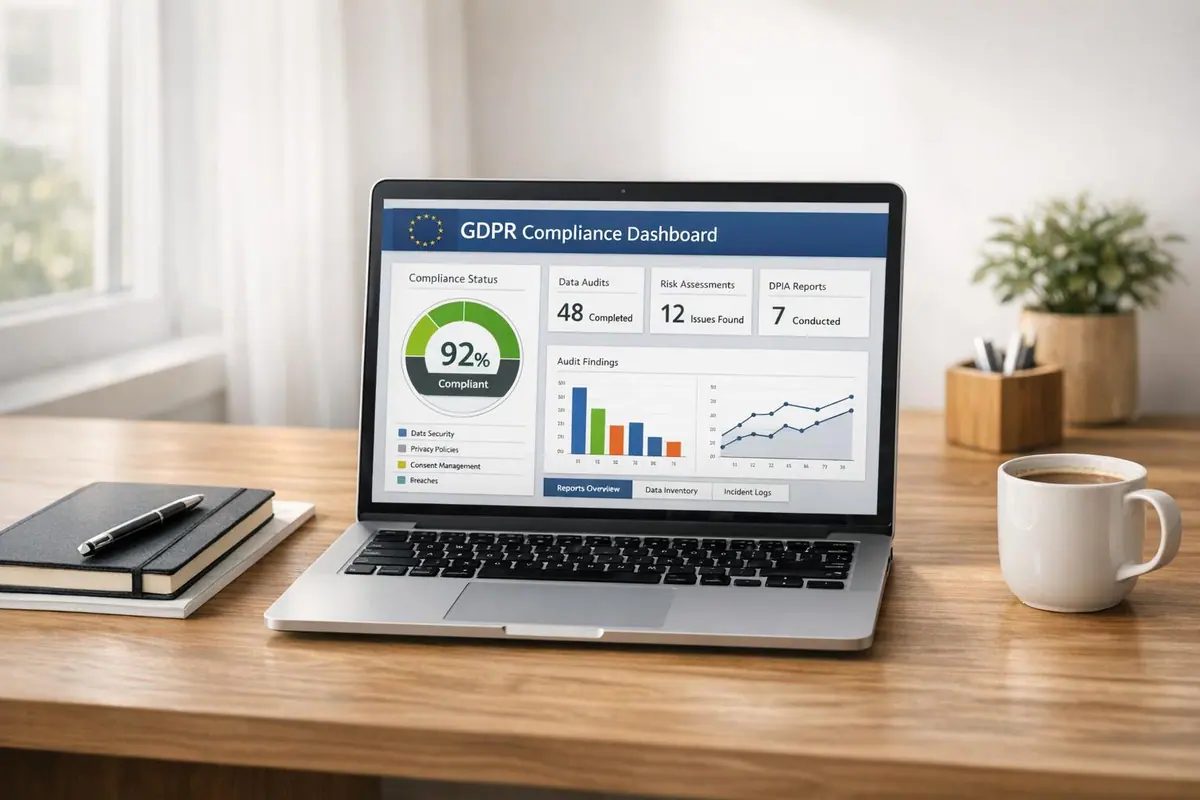
GDPR compliance is non-negotiable. With $1.2 billion in fines issued in 2024 alone and penalties reaching $5.88 billion by early 2025, businesses must adopt smarter tools to manage compliance and avoid costly mistakes. Manual methods like spreadsheets no longer suffice in today’s data-driven environment. Automated tools can reduce compliance workloads by up to 97%, save millions in breach costs, and ensure continuous monitoring.
Here are the top tools for GDPR compliance auditing:
- Scrut Automation: Pre-built templates for fast DPIAs and centralized evidence storage. Rated 4.9/5 on G2.
- Drata: Continuous monitoring with framework cross-mapping for GDPR, SOC 2, and ISO 27001. Rated 4.8/5.
- Sprinto: Real-time risk insights and unified compliance dashboards. Rated 4.8/5.
- Osano: Simplifies data mapping and cookie consent management.
- Netwrix Auditor: Strong integration with Microsoft environments for sensitive data visibility.
Quick Takeaway: Automated solutions streamline compliance, reduce risks, and save time. Choose the right tool based on your organization’s size, technical setup, and goals.
Top GDPR Compliance Auditing Tools
These tools replace the hassle of manual tracking with automated workflows that continuously monitor your GDPR compliance. Here's a closer look at each tool and what makes them stand out.
Scrut Automation
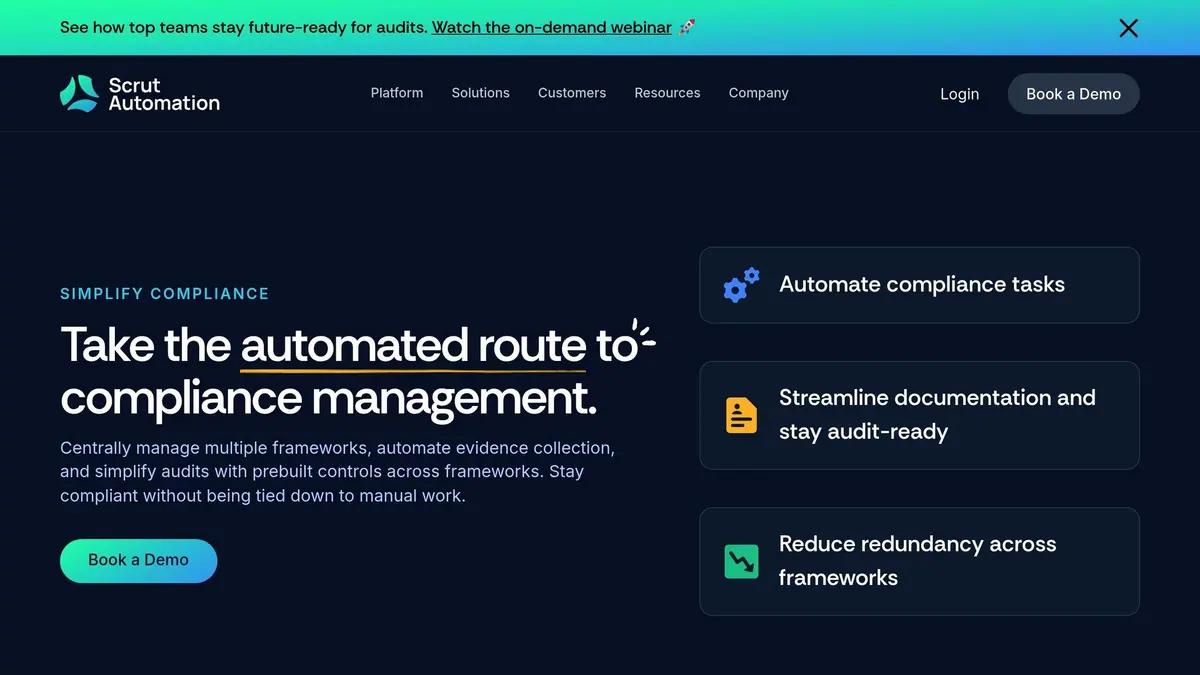
Scrut Automation simplifies GDPR compliance with pre-built risk frameworks tailored for GDPR Article 35 Data Protection Impact Assessments (DPIAs). With regulatory-ready templates, you can kick off DPIA assessments in just minutes.
The platform integrates seamlessly with your systems, automatically pulling logs and configuration snapshots into a centralized evidence repository. This eliminates the need to chase down documents before audits. Its daily cloud scans identify misconfigurations and notify you of any compliance gaps.
With a stellar 4.9/5 rating on G2 from 866 reviews, users frequently highlight its quick setup and reliable customer support.
Drata
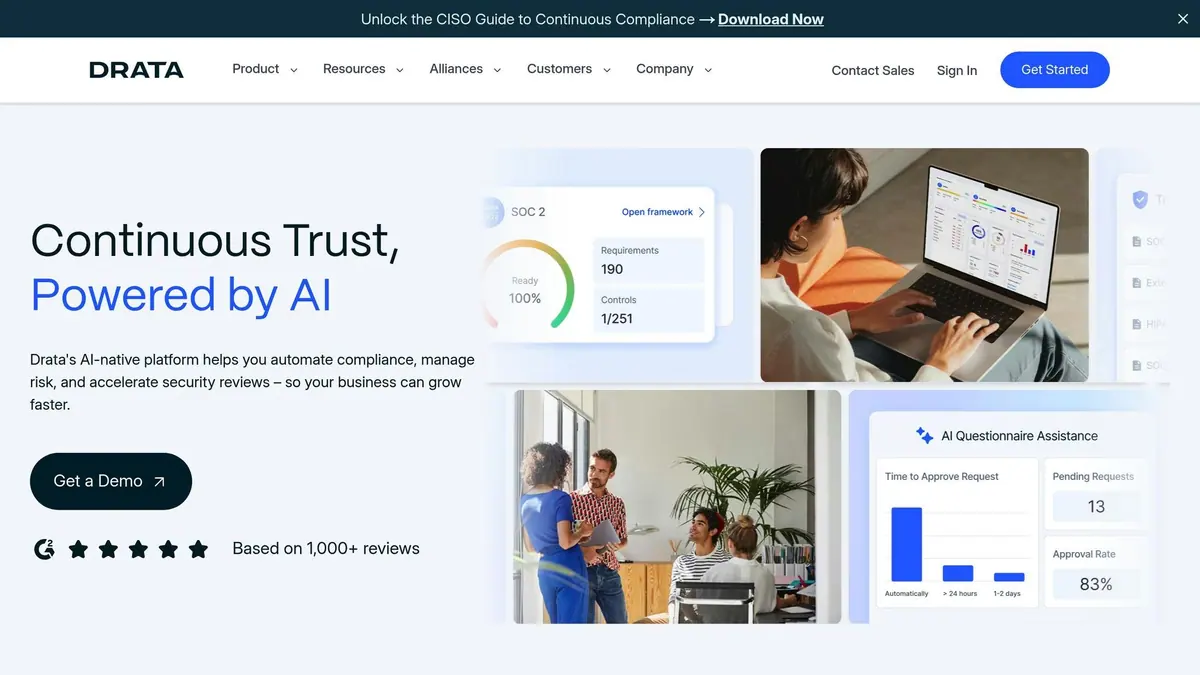
Drata supports over 7,500 customers, including one-third of the Cloud 100 companies. Its standout feature is a customizable GDPR control library, which maps compliance requirements to specific technical controls, making it clear what actions are needed.
The platform offers 24/7 continuous monitoring of your cloud environment, gathering evidence through integrations with HRIS, SSO, and cloud providers. This proactive approach replaces the outdated, point-in-time audits. Additionally, Drata's "Auditor Hub" provides external auditors with direct access to compliance data, simplifying the certification process.
"The promise of automation has long been discussed in the compliance world, but never truly realized. Drata has turned that into reality." - Jonathan Jaffe, Lemonade
Users report saving up to 90% of audit preparation time, earning Drata over 800 five-star reviews and a 4.8/5 rating on G2. Pricing starts at approximately $10,500 annually, with startup plans beginning around $7,500 and medium-sized companies often paying $15,000+ depending on employee count and framework complexity.
One of Drata's standout features is framework cross-mapping, which allows you to use a single piece of evidence to meet multiple certification requirements, including GDPR, SOC 2, and ISO 27001. This feature significantly reduces duplicate work for organizations pursuing multiple certifications.
Sprinto
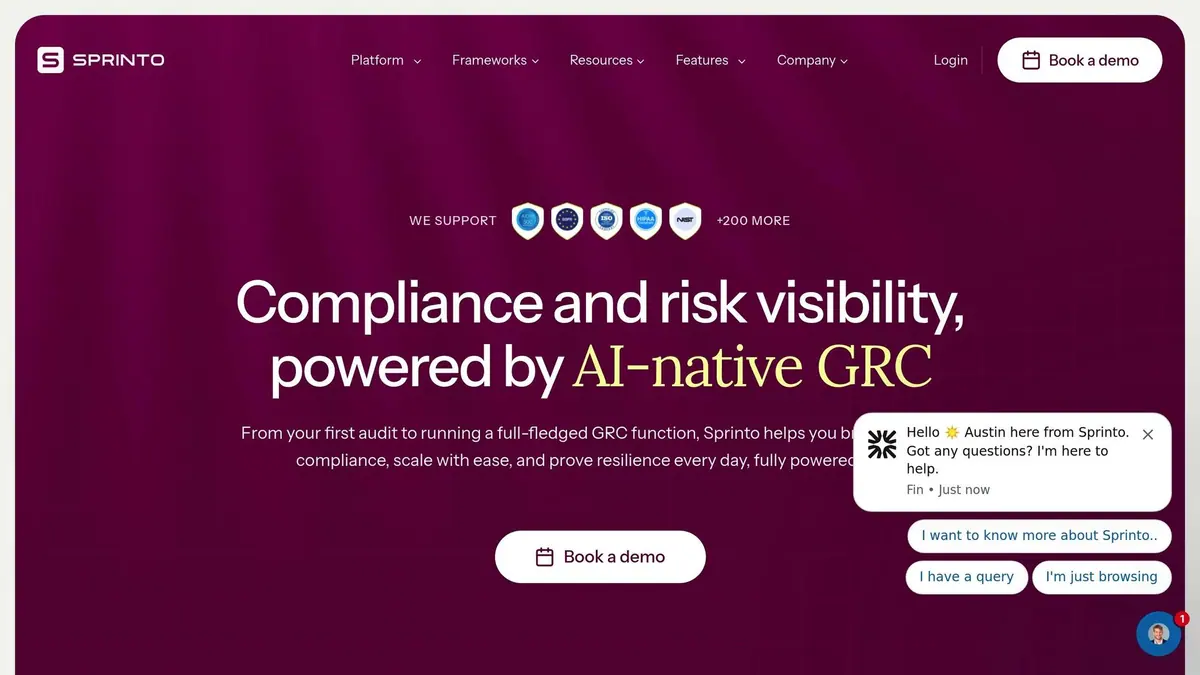
Sprinto boasts a 4.8/5 rating on G2 from 946 reviews and leads in user adoption and ROI. Its unified dashboard provides real-time risk insights, helping organizations achieve compliance up to 10 times faster. It also serves as a single source of compliance data for auditors.
Companies using Sprinto have reported a 70% reduction in manual compliance efforts. For instance, in 2025, OfficeBeacon achieved ISO 27001 compliance in just 10 weeks using Sprinto's platform. According to COO Perry Chahal, the tool dramatically improved their efficiency.
"Sprinto gave us a single source of truth for compliance. We could track everything in one place." - Perry Chahal, COO, OfficeBeacon
The platform excels in continuous control monitoring, sending alerts whenever non-compliance issues arise.
Osano
Osano simplifies secure data management by automating tasks like maintaining Records of Processing Activities (ROPA) and managing Data Processing Agreements (DPAs). It tracks the flow of personal data across your systems, ensuring your documentation remains current as your practices evolve.
Its user-friendly interface breaks down complex privacy requirements, making it easier for teams to stay on top of compliance without feeling overwhelmed.
Netwrix Auditor
Netwrix Auditor provides detailed sensitive data visibility across your IT environment, with real-time alerts that flag potential GDPR violations. It also generates detailed audit trails and documents the chain of custody, ensuring you have clear records to demonstrate compliance.
The tool integrates deeply with Microsoft environments, making it a strong choice for organizations that rely heavily on Microsoft tools. This native integration reduces setup time and ensures seamless data collection.
Summary of Key Features and Ratings
Here's a quick overview of the tools discussed:
| Tool | G2 Rating | Key Strength | Best For |
|---|---|---|---|
| Scrut Automation | 4.9/5 | Pre-built DPIA templates, risk assessment | Organizations needing fast DPIA deployment |
| Drata | 4.8/5 | Enterprise scale, framework cross-mapping | Companies pursuing multiple certifications |
| Sprinto | 4.8/5 | Speed of implementation, user adoption | Fast-growing businesses prioritizing ROI |
| Osano | N/A | Simplified privacy management | Small to mid-size businesses |
| Netwrix Auditor | N/A | Microsoft integrations, audit trails | Microsoft-heavy environments |
Next, we'll look at how these tools compare to solutions like Reform for GDPR-compliant form data collection.
GDPR Compliance Tools Comparison
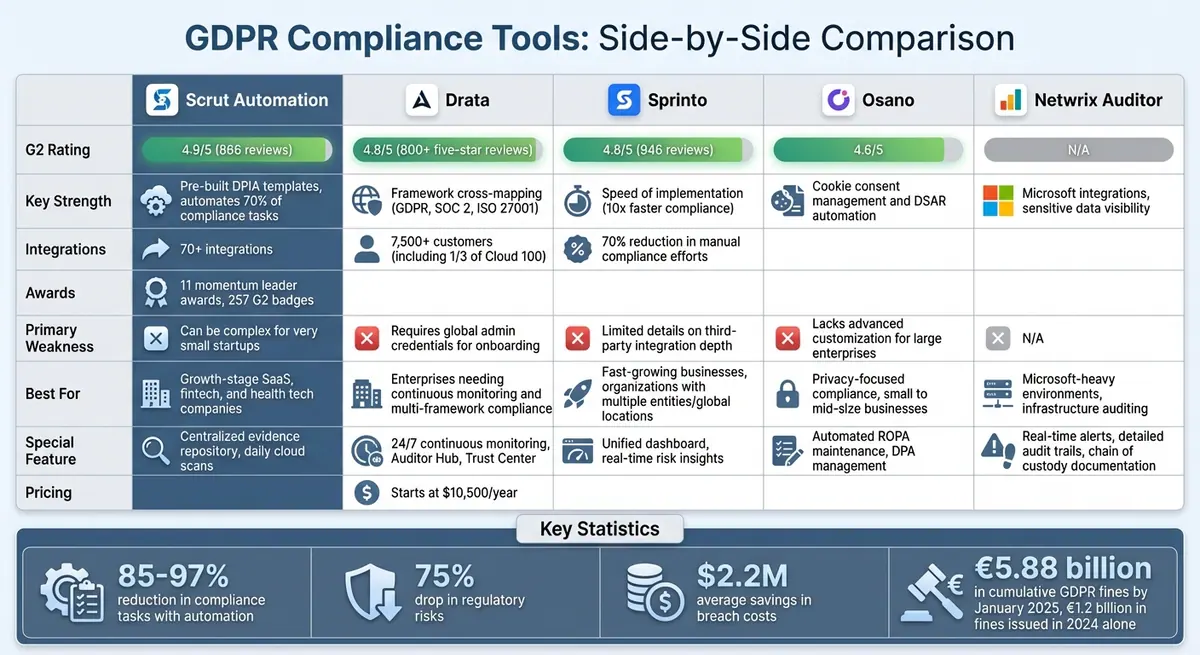
GDPR Compliance Tools Comparison: Features, Ratings, and Best Use Cases
Finding the right GDPR compliance tool depends on factors like your organization's size, technical setup, and specific compliance needs. Here's a breakdown of how key tools perform across various metrics:
| Tool | G2 Rating | Key Strength | Primary Weakness | Best Use Case |
|---|---|---|---|---|
| Scrut Automation | 4.9/5 | Automates up to 70% of compliance tasks with 70+ integrations | Can be complex for very small startups | Growth-stage SaaS, fintech, and health tech companies |
| Drata | 4.8/5 | AI-native platform with cross-mapping for SOC 2, ISO 27001, and GDPR | Requires global admin credentials for onboarding | Enterprises needing continuous monitoring and multi-framework compliance |
| Sprinto | 4.8/5 | Consolidates compliance across multiple entities and locations | Limited details on third-party integration depth | Organizations with multiple entities or global locations |
| Osano | 4.6/5 | Simplifies cookie consent management and DSAR automation | Lacks advanced customization for large enterprises | Privacy-focused compliance and cookie consent management |
| Netwrix Auditor | N/A | Strong threat detection and infrastructure security focus | N/A | Data security posture management and infrastructure auditing |
Noteworthy Features and Benefits
Scrut Automation stands out with its 11 momentum leader awards and 257 badges in G2's Winter 2025 report. It includes all essential modules in its base price - covering up to 5,000 users. Meanwhile, Drata's Trust Center feature lets companies share real-time security updates with stakeholders, a valuable tool for maintaining transparency.
Automated tools like these significantly reduce compliance workloads. Organizations report an 85–97% reduction in compliance tasks and a 75% drop in regulatory risks when using comprehensive GDPR automation. On top of that, companies adopting automated compliance solutions save an average of $2.2 million in breach costs. These numbers underscore the financial and operational value of selecting the right platform.
Key Considerations When Choosing a Tool
When evaluating tools, look for seamless API integrations. Platforms that offer out-of-the-box compatibility with systems like Microsoft 365, AWS, and Google Workspace can eliminate time-consuming manual data transfers. Additionally, tools providing GDPR auditor access and compliance consulting can help reduce legal risks and streamline the regulatory process.
Reform for GDPR-Compliant Form Data Collection
While auditing tools provide broad oversight for compliance, securing data right at the point of collection is just as important. Forms are one of the primary ways personal data is gathered, making them a potential hotspot for GDPR violations. Reform works alongside auditing tools by embedding GDPR compliance directly into the form creation process, ensuring data is collected responsibly and securely.
One standout feature is email validation, which filters out fake or invalid email addresses. This reduces the chance of processing incorrect data and helps maintain accuracy - a core GDPR requirement. Combined with spam prevention measures, these tools ensure that only genuine, reliable data is collected. Reform also includes conditional routing, which tailors the data collection process based on user responses. This approach supports GDPR’s principle of data minimization by only gathering the information you truly need.
With real-time analytics, you gain instant insights into how your forms are performing. Metrics like conversion rates, where users drop off, and overall submission patterns can be tracked without compromising privacy. Additionally, Reform’s CRM integrations - compatible with platforms like HubSpot and Salesforce - allow for secure, automated data transfers. This reduces manual handling and minimizes the risk of breaches or errors.
Automation is another key advantage. Reform’s no-code design simplifies the creation of GDPR-compliant forms, empowering marketing and sales teams to build forms quickly without relying on developers. This streamlined approach complements the efficiency of larger auditing platforms by making data collection faster and more secure.
The platform also supports progressive profiling, a method where you gradually collect user information over time instead of overwhelming them with lengthy forms. This not only improves conversion rates but also aligns with GDPR’s emphasis on transparency, making the data collection process feel more user-friendly and intentional. Progressive profiling integrates seamlessly with broader compliance efforts, creating a smoother and more compliant user experience.
sbb-itb-5f36581
Reform Pricing Plans
Reform offers pricing options designed to make GDPR-compliant form data collection accessible for businesses of all sizes. While traditional GDPR software can cost anywhere from $5,000 to $30,000 per year, Reform provides a much more budget-friendly alternative without compromising on essential features. With three distinct plans, you can choose the one that best fits your needs and budget.
The Basic Plan starts at just $15/month (or $150/year). It includes unlimited responses, conditional logic, custom thank-you pages, and integrations with tools like Google Sheets, Zapier, and Notion. This plan is perfect for small teams or startups looking for straightforward GDPR-compliant forms. It also removes Reform branding and comes with email support. However, it doesn’t include team access or advanced integrations, which might be a consideration for larger teams.
For businesses that need more advanced features, the Pro Plan is available for $35/month (or $350/year). This plan builds on the Basic Plan by adding team collaboration tools, file upload capabilities, incomplete response tracking, and support for custom CSS and JavaScript. It also includes professional integrations like HubSpot, with Salesforce integration on the way. The Pro Plan is an excellent choice for growing companies that require deeper CRM connections and tools for managing multiple team members.
For enterprises with complex requirements, the Done for You plan offers fully customized forms created by Reform’s experts. Pricing for this plan is tailored based on your specific needs and requires a consultation. This option is ideal for organizations looking to optimize form performance while maintaining GDPR compliance, especially if they have intricate lead generation processes or unique design requirements.
| Plan | Monthly Price | Annual Price | Key Features | Best For |
|---|---|---|---|---|
| Basic | $15 | $150 | Unlimited responses, conditional logic, basic integrations, email support | Small teams, startups |
| Pro | $35 | $350 | Team access, file uploads, custom CSS/JS, HubSpot integration, draft saving | Growing businesses, marketing teams |
| Done for You | Custom | Custom | Fully customized forms by experts | Enterprises, complex requirements |
Conclusion
Spreadsheets just don't cut it anymore when it comes to GDPR compliance. With €5.88 billion in cumulative fines projected by January 2025 and €1.2 billion in penalties issued in 2024 alone, the risks are simply too great to rely on manual processes. The tools highlighted here - Scrut Automation, Drata, Sprinto, Osano, and Netwrix Auditor - each offer distinct advantages, from automating up to 70% of compliance tasks to delivering real-time monitoring and audit trails.
The best tool for your business depends on your specific needs and scale. For example:
- Scrut Automation is ideal for growth-stage SaaS companies, thanks to its automation and cloud monitoring capabilities.
- Sprinto helps fast-moving tech teams become audit-ready in weeks with its AI-powered platform.
- Drata caters to enterprise organizations, particularly those with DevOps-heavy environments, offering continuous control monitoring.
- Osano focuses on privacy, providing specialized solutions like cookie consent management and data mapping.
These examples underline how important it is to choose a tool that aligns with your compliance needs.
"GDPR compliance is no longer optional - it is a business-critical obligation tied to brand trust, financial stability, and regulatory standing." - Devi Narayanan, Blog Author, VComply
This quote serves as a reminder that robust compliance measures are about more than avoiding fines - they're essential for protecting your brand and financial health. While auditing tools ensure backend compliance, tools like Reform address the frontline of GDPR adherence by managing consent and securing data from the very first interaction. At just $15/month, Reform offers an affordable way to maintain GDPR compliance where it matters most - at the point of data collection - delivering significant savings compared to traditional compliance methods.
Ultimately, selecting the right tools comes down to your technical capabilities, budget, and specific compliance requirements. Automated solutions can reduce compliance-related labor by 25% to 80%. Whether you need robust enterprise-level auditing or a focused solution for consent management, investing in reliable tools is key to safeguarding both your finances and your reputation.
FAQs
How can automated tools simplify GDPR compliance and save money?
Automated GDPR compliance tools simplify what can often feel like a maze of regulations, saving both time and effort. By continuously scanning systems for personal data, these tools keep records of processing activities automatically updated - no more juggling endless manual spreadsheets. Teams can effortlessly map out data flows without digging through countless databases, allowing them to focus on more strategic priorities.
These platforms also take the headache out of handling data-subject requests (DSRs). With AI-driven features, tasks like routing, verifying, and fulfilling requests are managed seamlessly, cutting down the need for extensive employee involvement. On top of that, automated systems monitor compliance measures in real time, eliminating the need for manual reviews. This not only saves labor hours but also reduces the risk of costly fines. In the end, these tools create a more streamlined, cost-efficient way to stay on top of GDPR requirements.
What should I look for in a GDPR compliance tool for my business?
When selecting a GDPR compliance tool, it's crucial to focus on features that make compliance easier and cut down on manual tasks. Key features to prioritize include automated data discovery for mapping personal data across systems, consent management to record and store user consents, and efficient data-subject request (DSR) workflows to manage access, correction, or deletion requests. The tool should also integrate smoothly with your existing platforms, like CRMs or marketing tools, to prevent data silos.
It’s also important to choose tools that help you demonstrate compliance. Look for options offering real-time evidence collection, automated monitoring, and audit-ready reporting. If your business operates in multiple regions, check whether the tool supports compliance with other privacy laws, such as CCPA or LGPD, to simplify global privacy management. Finally, evaluate the tool’s cost by considering its features, scalability, and overall value to ensure it aligns with your budget without compromising on functionality.
Why is GDPR compliance important for businesses beyond avoiding fines?
Meeting GDPR requirements isn’t simply about sidestepping penalties - it’s become a key part of running a modern business. By focusing on data protection, companies can lower the chances of expensive data breaches, legal troubles, and interruptions to their operations. Plus, using automated tools to handle consent tracking and data requests not only saves time but also ensures greater accuracy. This frees up your team to concentrate on growing the business instead of getting bogged down with tedious manual processes.
But there’s more to GDPR compliance than just efficiency. It plays a big role in building trust with customers and partners. When people know their privacy is taken seriously, they’re more willing to share their information, stick around, and even recommend your business to others. On top of that, following GDPR standards can make it easier to comply with other privacy regulations, like California’s CCPA, and open doors to expanding into new regions.
In essence, GDPR compliance isn’t just about avoiding fines - it’s about creating stronger security, smoother operations, and a better reputation for your brand. These advantages go far beyond just following the rules.
Related Blog Posts
Get new content delivered straight to your inbox

The Response
Updates on the Reform platform, insights on optimizing conversion rates, and tips to craft forms that convert.




Drive real results with form optimizations
Tested across hundreds of experiments, our strategies deliver a 215% lift in qualified leads for B2B and SaaS companies.
