
.webp)
GDPR-Compliant Forms for Travel Businesses


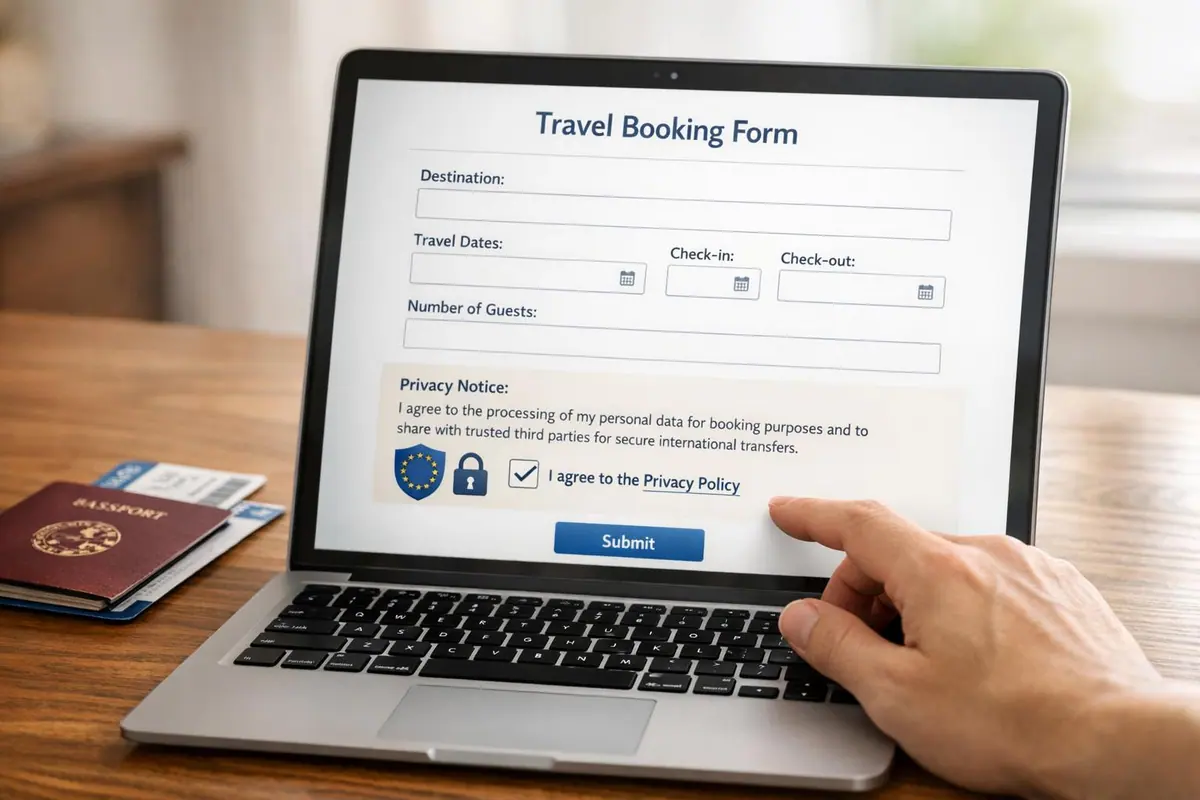
Handling customer data in the travel industry is serious business. If your company collects information from EU residents, GDPR compliance isn’t optional - it’s mandatory. Failing to comply can lead to fines up to €20 million or 4% of global revenue. Beyond penalties, mishandling data risks losing customer trust, with 90% of consumers steering clear of businesses that don’t prioritize data protection.
Here’s the bottom line:
- Consent must be clear and specific: Use unticked checkboxes and separate consent for marketing and bookings.
- Collect only necessary data: Every field on a form must have a defined purpose.
- Transparency is key: Include clear privacy notices and disclose all third-party data sharing.
- Make consent withdrawal simple: Provide easy ways for users to revoke permissions, like unsubscribe links.
- Secure data at all stages: Use encryption and limit data retention to what’s required.
Tools like Reform simplify compliance by offering features like conditional forms, encrypted submissions, and automated consent tracking. Regular audits, clear privacy policies, and secure third-party agreements are vital to staying GDPR-compliant while maintaining customer trust.
How to Create GDPR-Friendly Forms
sbb-itb-5f36581
GDPR Compliance Checklist for Travel Forms
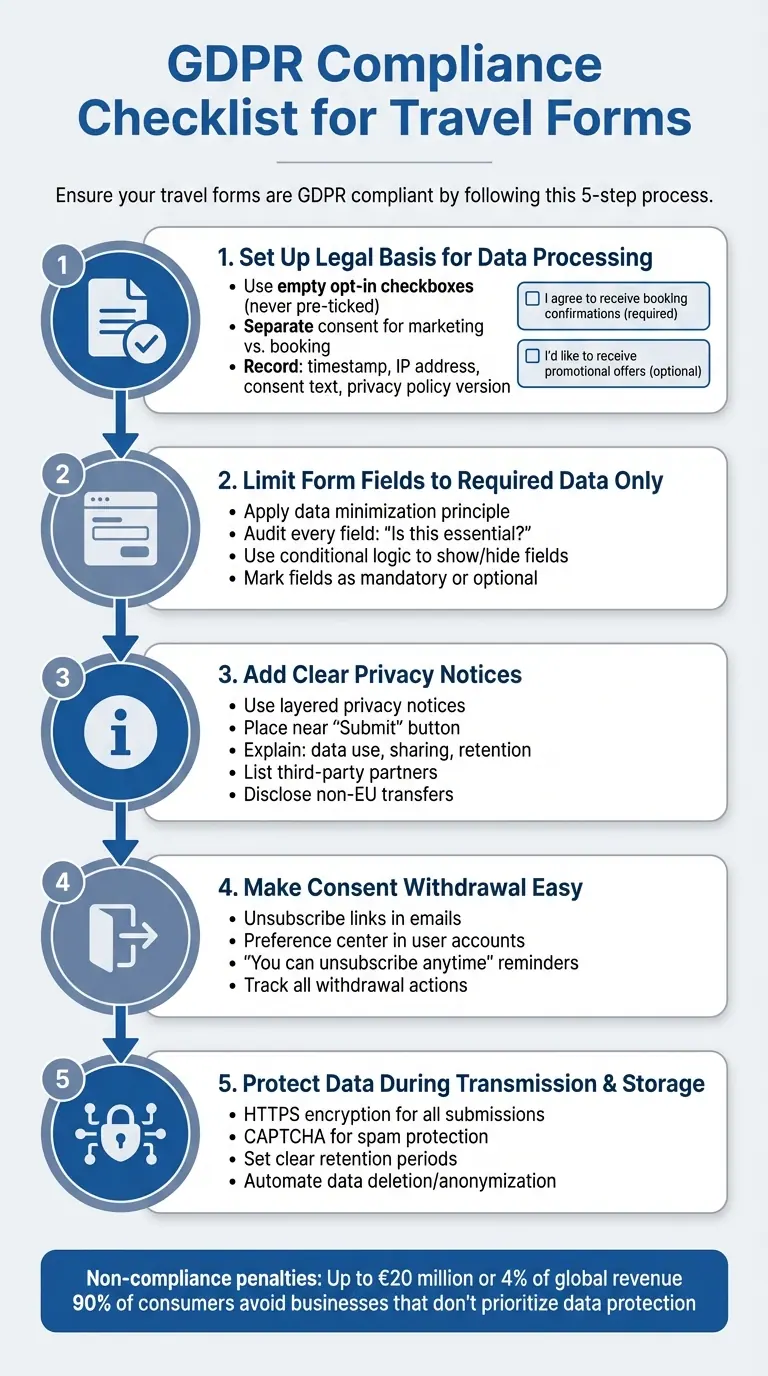
5-Step GDPR Compliance Checklist for Travel Business Forms
Creating GDPR-compliant forms requires careful planning and documentation. Every field should serve a clear and necessary purpose.
Set Up a Legal Basis for Data Processing
When collecting data, ensure you have a valid legal basis. For travel businesses, this often involves obtaining consent (e.g., for marketing) or relying on contractual necessity (e.g., for booking fulfillment). Keep these purposes distinct.
Use empty opt-in checkboxes - pre-ticked boxes, silence, or inactivity don’t count as valid consent. Allow users to agree to booking communications separately from marketing materials. For example:
- "I agree to receive booking confirmations and travel updates (required)."
- "I'd like to receive promotional offers and travel deals (optional)."
"Consent should be specific to a particular activity in order to be considered valid: when you ask for consent, this needs to be separate from other terms and conditions." - iubenda
Keep detailed records of consent actions, including the timestamp, IP address, the exact text shown, and the privacy policy version accepted.
Once this is in place, audit your forms to ensure every field is essential.
Limit Form Fields to Required Data Only
The GDPR's data minimization principle is simple: only collect what you need. Document the purpose of every form field. If a piece of data is not necessary for the service, remove it.
Start with a field audit. For each field, ask: Is this essential for the service? For instance, a full address is only needed if you’re shipping physical items. If delivering tickets digitally, skip this field.
To streamline forms, use conditional logic. Show or hide fields based on user responses so only the relevant ones appear. For example, a flight-only booking form doesn’t need fields for hotel preferences or car rentals. This approach not only ensures compliance but also improves the user experience.
| Data Type | Necessity Example (Travel Context) | GDPR Recommendation |
|---|---|---|
| Name/Email | Essential for booking confirmation and tickets. | Necessary; collect at the start. |
| Phone Number | Useful for urgent travel updates or MFA. | Optional unless required for security reasons. |
| Date of Birth | Required for age-restricted bookings or airline security. | Collect only if legally or operationally needed. |
| Full Address | Needed for billing or physical shipping. | Skip if delivering tickets digitally. |
| Marketing Opt-in | Not required for core booking services. | Must be a separate, un-ticked checkbox. |
Always mark fields as either mandatory or optional.
With unnecessary fields removed, focus on transparency by including clear privacy notices.
Add Clear Privacy Notices to Forms
Transparency is key. Use layered privacy notices - brief explanations near form fields with links to the full privacy policy. Place these notices close to the "Submit" or "Book Now" button to ensure visibility before users share their data.
The notice should explain, in plain language, how the data will be used, who it will be shared with, and how long it will be retained. Avoid legal jargon that might confuse users.
"If your users are not able to understand exactly what they're signing up for, they cannot give informed consent." - iubenda
List any third-party partners involved in delivering the service, such as airlines or local operators. If data will be transferred outside the EU or EEA, disclose this and mention safeguards like Standard Contractual Clauses.
Make Consent Withdrawal Easy
Users must be able to withdraw consent as easily as they give it.
"Withdrawing consent must be as easy as giving it. Provide clear mechanisms." - Michael T, Product Designer, Workform
Offer multiple ways to withdraw consent. Include unsubscribe links in marketing emails and a preference center in user accounts where customers can manage their data processing preferences. Add reminders near opt-in checkboxes, such as: "You can unsubscribe anytime."
Maintain a detailed backend record of all consent actions, including user ID, consent type (e.g., marketing emails, SMS alerts), timestamps, withdrawal dates, and the exact consent text. This helps you comply with GDPR's data subject request requirements.
Protect Data During Transmission and Storage
Once you’ve streamlined data collection, focus on securing it. GDPR mandates strong protections for data in transit and at rest.
- Use HTTPS encryption for all form submissions to protect data during transmission.
- Implement tools like CAPTCHA to block spam and automated attacks.
Set clear retention periods for different types of data and stick to them. For example, establish schedules based on legal or operational needs and automate data anonymization or deletion once those periods end.
Third-Party Data Sharing Requirements
Transparency is a cornerstone of data protection, especially when sharing customer information with third parties. In the travel industry, data often flows to partners like airlines, hotels, car rental companies, and tour operators. Under GDPR, businesses must clearly disclose these partnerships and ensure stringent safeguards for data transfers.
List All Third-Party Partners in Privacy Notices
Your privacy notice needs to explicitly name every third-party partner receiving customer data. Vague labels like "service providers" or "hotel partners" just don't cut it. Instead, include the partner's name, contact details, role, purpose for the data, and the specific data categories shared. For example:
- If sharing booking details with a hotel chain, name the chain and explain the purpose - such as confirming reservations.
- If passing payment information to a processor, identify the processor and specify the data shared (e.g., card details).
Also, clarify the type of data each partner receives, whether it's contact info, payment details, room preferences, or passport numbers.
"The processor has to provide the name(s) of the individual sub-processor(s) to the controller so that the latter is enabled to decide on the authorisation of the selected sub-processor(s). It is not sufficient for the processor to provide only the categories for the sub-processors." – European Commission
For optional data sharing, offer separate consent toggles rather than combining them with mandatory consents. Additionally, always sign a Data Processing Agreement (DPA) with vendors, such as booking systems or marketing platforms, as required by Article 28 of the GDPR. Keep these agreements up to date, especially when adding new partners.
Follow Rules for Data Transfers Outside the EU
When sharing data across borders, especially outside the EEA, GDPR imposes strict rules. Begin by checking if the destination country is on the European Commission's adequacy list. Countries like Canada, Japan, and the United States (for commercial organizations) are considered adequate, meaning data can flow without additional safeguards.
For countries not on the adequacy list, you must use Standard Contractual Clauses (SCCs). These are pre-approved legal templates that outline data protection responsibilities. Choose the appropriate module based on the relationship - Controller-to-Controller for sharing data with a hotel, or Controller-to-Processor for working with an overseas tech vendor.
You’ll also need to conduct a Transfer Impact Assessment (TIA) to ensure the destination country's laws align with EU data protection standards. If gaps exist, implement supplementary measures like encryption or pseudonymization. Include a docking clause in your SCCs to allow new sub-processors to join without renegotiating the entire agreement.
For occasional, non-repetitive transfers, derogations may apply. For instance, if a customer books a hotel in a non-EU country, you can share their data to fulfill the booking under the "necessary for the performance of a contract" exception. However, this should not become a regular practice. Always disclose such transfers in your privacy notice, detailing the safeguards in place and identifying the recipient.
How Reform Supports GDPR Compliance
Reform aligns with GDPR's principles of data minimization and transparency by providing tools that help businesses collect and manage data responsibly. With its no-code form builder, travel companies can design forms that comply with GDPR requirements. Features like conditional routing ensure that users only see fields relevant to their responses, preventing the collection of unnecessary data. This directly supports GDPR Article 5, which emphasizes limiting data collection to what is essential.
Reform also prioritizes security from the moment data is submitted. Built-in spam prevention blocks bots and malicious activity, while email validation ensures that only legitimate addresses are processed. These measures align with GDPR Article 32, which focuses on safeguarding the confidentiality and integrity of data processing, reducing risks associated with fraudulent submissions.
GDPR-Friendly Form Features
Reform's platform gives businesses precise control over how data is shared, helping meet GDPR standards. Secure CRM integrations encrypt data during transmission and allow you to decide exactly which fields are shared. For example, when sending booking details to airline partners or hotel chains, you can specify what information is transmitted and why, adhering to GDPR Articles 28 and 44, which regulate data processor responsibilities. This level of control helps prevent accidental exposure of unnecessary customer information.
Additionally, Reform's multi-step forms simplify the booking process while supporting GDPR compliance. Instead of overwhelming users with numerous consent options at the start, you can present specific consent requests at the appropriate stages. For instance, you might ask travelers for permission to share their preferences with hotels only after they’ve selected accommodations.
Consent Tracking and Management
Reform ensures businesses meet GDPR standards by maintaining detailed records of all consent actions. Every opt-in - whether for marketing emails, partner data sharing, or personalized offers - is logged individually, creating a clear audit trail. This approach satisfies GDPR Article 7, which requires consent to be specific and verifiable.
Reform also streamlines the withdrawal of consent. One-click revocation links in confirmation emails make it easy for users to withdraw their consent. Once consent is revoked, the system automatically updates your CRM and halts further data processing. This ensures compliance with GDPR’s requirement that withdrawing consent must be as simple as giving it.
These detailed consent logs feed directly into compliance analytics, offering continuous oversight of your data practices.
Monitor Compliance with Analytics
Reform's real-time analytics help businesses stay on top of GDPR compliance by identifying potential risks as they arise. Metrics like submission rates, field abandonment, and consent opt-in percentages allow you to address issues quickly. For instance, if EU travelers frequently drop off at your privacy notice or if consent rates dip below an acceptable level, you can adjust your form’s design or language to improve transparency and compliance. Conversion funnel insights highlight where users hesitate, while geolocation data helps you implement region-specific safeguards to meet local GDPR requirements.
Summary: Building GDPR-Compliant Travel Forms
Creating GDPR-compliant travel forms involves several key steps. First, ensure there’s a valid legal basis for processing data. Limit the data you collect to what’s absolutely necessary, provide clear privacy notices, and make withdrawing consent as straightforward as possible. Additionally, secure data both during transfer and storage. Transparency is crucial - list all third-party partners in your privacy notices and follow strict rules for transferring data outside the EU. These measures not only protect customers but also help avoid steep penalties, which can reach up to €20 million or 4% of your global annual revenue, whichever is higher.
Tools like Reform simplify compliance with features such as multi-step forms, conditional routing, built-in encryption, and automated consent tracking. These tools also generate detailed audit logs to verify consent, as required by GDPR Article 7. Features like one-click withdrawal links ensure that users can revoke their consent just as easily as they gave it.
Compliance doesn’t stop at form creation. Regular oversight is essential, especially as regulations change. Conduct quarterly audits of your consent logs, review your list of third-party partners, and update forms when new rules impact data transfers outside the EU. Reform’s real-time analytics can help by tracking metrics like consent opt-in rates, field abandonment, and submission trends by region. These insights allow you to tweak form design or wording to address compliance risks early.
It’s equally important to train your staff on GDPR responsibilities, including maintaining records under Article 30 and responding to data subject requests within one month. Staying proactive helps protect your business from liabilities tied to joint controllers and ensures breaches are reported within the required 72-hour window. With studies showing that 70% of companies lack proper third-party audits, vigilance in compliance is more critical than ever.
FAQs
Do I need GDPR compliance if my travel business is based in the U.S.?
If your travel business handles the personal data of EU citizens or offers goods and services to them, you are required to comply with GDPR (General Data Protection Regulation) - even if your business is based solely in the United States. This regulation applies whenever EU citizens' data is involved, regardless of where your operations are located.
What data can I ask for on a booking form without violating GDPR?
When handling bookings, you should only collect the personal data absolutely needed for the process - like a person's name, contact information, and payment details. To align with GDPR requirements, focus on three key principles: clear consent, transparency, and data minimization. This means being upfront about why you're collecting the data, obtaining permission in a straightforward way, and ensuring you only gather what's essential.
How do I document and prove customer consent for audits?
Maintaining thorough records of customer consent is crucial. These records should include timestamps, the purposes of consent, and the methods used to collect it. To stay aligned with GDPR requirements, it's important to review and update these records regularly.
Using automated tools, such as Reform, can make this process more manageable. These tools securely store consent data and log key actions like opt-ins, withdrawals, and updates. This not only provides a clear audit trail but also makes retrieving information during audits much easier.
By auditing these records on a regular basis, you can ensure they reflect current user preferences and comply with regulatory standards.
Related Blog Posts
Get new content delivered straight to your inbox

The Response
Updates on the Reform platform, insights on optimizing conversion rates, and tips to craft forms that convert.


Drive real results with form optimizations
Tested across hundreds of experiments, our strategies deliver a 215% lift in qualified leads for B2B and SaaS companies.
