
.webp)
Ultimate Guide to Real-Time Lead Enrichment 2026



Real-time lead enrichment transforms how businesses handle leads by instantly providing detailed, verified data. It eliminates manual research, speeds up qualification, and ensures data accuracy - helping sales and marketing teams engage prospects faster and more effectively. Here's what you need to know:
- What it does: Automatically adds data like company size, revenue, job titles, and tech stacks to leads in 1–3 seconds.
- Why it matters: 83% of B2B buyers complete 70% of their research before contacting sales. Fast, personalized responses are critical to winning deals.
- How it works: APIs pull data from multiple sources, validate it, and update your CRM instantly.
- Key benefits: Saves time, reduces data decay, boosts personalization, and improves lead conversion rates.
- Use cases: Inbound demo requests, outbound prospecting, ABM campaigns, and CRM database updates.
Tools like Reform simplify this process by integrating enrichment into high-converting lead forms, reducing friction and improving efficiency. Whether you're routing leads, scoring them, or creating personalized campaigns, real-time enrichment ensures your team always has accurate, actionable information.
Inbound Lead Enrichment with Clay (Core 4 Use Cases, Pt 4)
sbb-itb-5f36581
How Real-Time Lead Enrichment Works
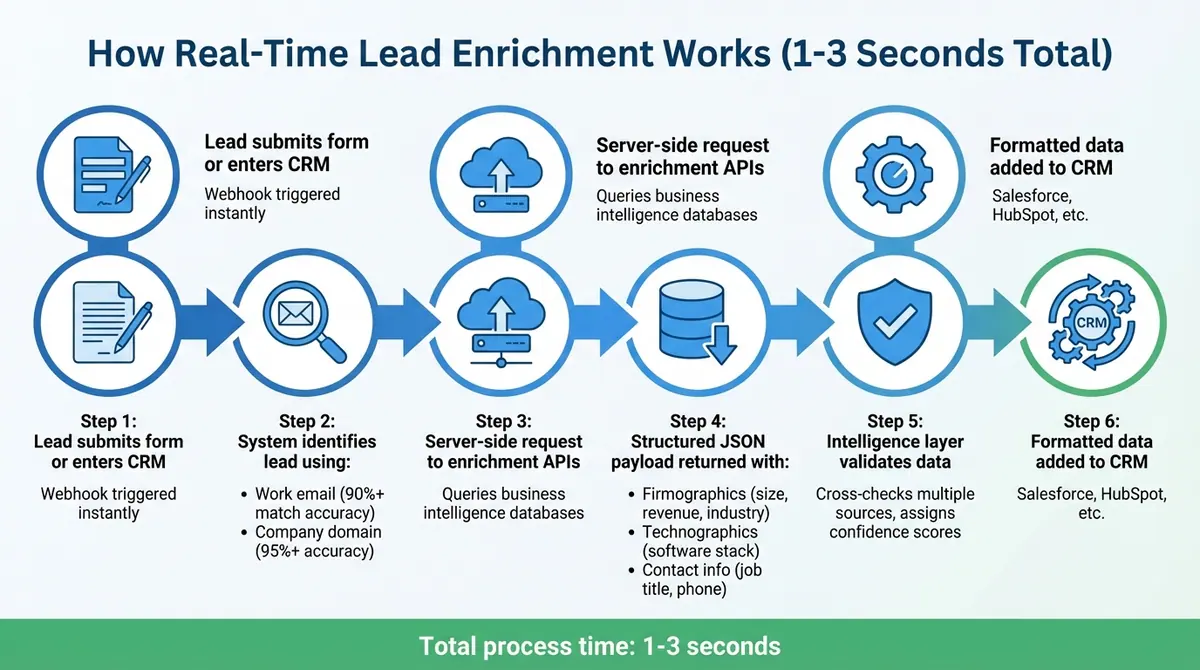
How Real-Time Lead Enrichment Works in 6 Steps
Key Steps in the Lead Enrichment Process
The lead enrichment process kicks off the moment a lead submits a form or is added to your CRM. A webhook is triggered instantly, starting the enrichment process before your team even sees the lead. The system then identifies the lead using a primary data point - most commonly a work email address (with over 90% match accuracy) or a company domain (boasting 95%+ accuracy).
This identifier is sent to third-party enrichment APIs via a server-side request. These APIs tap into business intelligence databases and return a structured JSON payload filled with details like firmographics (e.g., company size, revenue, industry), technographics (e.g., the company's software stack), and contact information (e.g., job title, phone number). An intelligence layer then compares, merges, and resolves any discrepancies between the incoming data and the original lead submission.
Before the enriched profile is added to your CRM, validation systems assign confidence scores to each piece of data by cross-checking multiple sources. This ensures that only accurate information makes it through. Finally, the JSON payload is formatted to fit your CRM's specific field structure - whether it’s Salesforce, HubSpot, or another platform. The entire process takes just 1–3 seconds, meaning your team gets access to enriched data almost instantly. This speed and precision are what make real-time lead enrichment so effective.
The Role of APIs and Databases
Once the enrichment process is underway, the technology behind the scenes takes center stage. Enrichment APIs act as a "just-in-time data supply chain". When they receive an identifier, these APIs query external sources like web crawlers, government filings, and social platforms to deliver structured data. This real-time, event-driven approach replaces the outdated bulk processing of nightly batch jobs, which often delayed data updates by 8–12 hours and caused up to 15% of marketing qualified leads to be misrouted or delayed. Immediate data availability is critical for making timely decisions.
To ensure comprehensive data coverage, many systems use a waterfall approach. If the primary API provider doesn’t return a complete profile, secondary providers are automatically queried to fill in any missing details. To keep costs down and avoid redundant charges, these systems often check a local cache first. If a record was enriched within the past 30–90 days, the system skips the API call altogether. This combination of efficiency and accuracy ensures that your team always has access to the most up-to-date information.
Benefits and Use Cases of Real-Time Lead Enrichment
Main Benefits for Marketers
Real-time lead enrichment can supercharge marketing and sales efforts by simplifying processes and improving outcomes. For instance, reducing form fields to just an email address significantly cuts down on friction and abandonment, as enrichment tools automatically fill in the missing details. This streamlined approach can boost conversion rates dramatically. Plus, companies that reach out to leads within five minutes are 100 times more likely to connect than those who wait 30 minutes - a clear advantage.
Another major perk? It combats data decay, ensuring your database stays accurate and actionable. Sales teams save up to 6 hours per week - or 312 hours annually - by automating prospect research, freeing up more time for actual selling. Enriched data also sharpens lead qualification by instantly prioritizing leads based on factors like company size, revenue, industry, or even the technologies they use. Real-time validation keeps email bounce rates under 1%, safeguarding your sender reputation.
Personalization becomes much easier with detailed, enriched data. Knowing things like recent funding rounds, hiring trends, or the software a company uses allows you to craft outreach that speaks directly to a lead's specific needs. This approach replaces generic messaging with tailored, relevant communication that drives engagement.
These benefits aren't just theoretical - they translate directly into practical applications.
Practical Use Cases
The advantages of real-time enrichment shine in real-world scenarios across sales, marketing, and account-based marketing (ABM). For B2B sales teams, real-time enrichment ensures they can engage prospects when interest is highest, skipping the time-consuming task of manual research. This is especially important considering that B2B data decays at a rate of 30% per year, as people frequently change roles or companies.
In marketing, automation platforms use enrichment to create precise segmentation. For example, a SaaS company could automatically tag leads based on their current CRM platform, then trigger email campaigns that highlight integration features or competitive benefits. Combining static enrichment with intent data - like content consumption patterns or hiring trends - makes it easier to identify prospects who are actively looking for solutions.
For ABM campaigns, enrichment enables highly personalized outreach at scale. Instead of sending generic messages, teams can reference specific details like a prospect's technology stack, recent funding milestones, or growth signals. This level of detail feels personal while being automated, making every interaction more impactful.
Here’s a breakdown of key use cases, the benefits they offer, and the data points that drive them:
| Use Case | Primary Benefit | Key Data Points Used |
|---|---|---|
| Inbound Demo Requests | Instant qualification and routing | Company size, revenue, industry, job title |
| Outbound Prospecting | Higher connect rates | Verified phone numbers, tech stack, LinkedIn profiles |
| Lead Scoring Models | Better prioritization | Funding status, employee count, intent signals |
| ABM Campaigns | Scalable personalization | Technology stack, hiring trends, growth metrics |
| CRM Database Hygiene | Reduced data decay | Job change alerts, updated contact details |
Reform's Real-Time Lead Enrichment Features
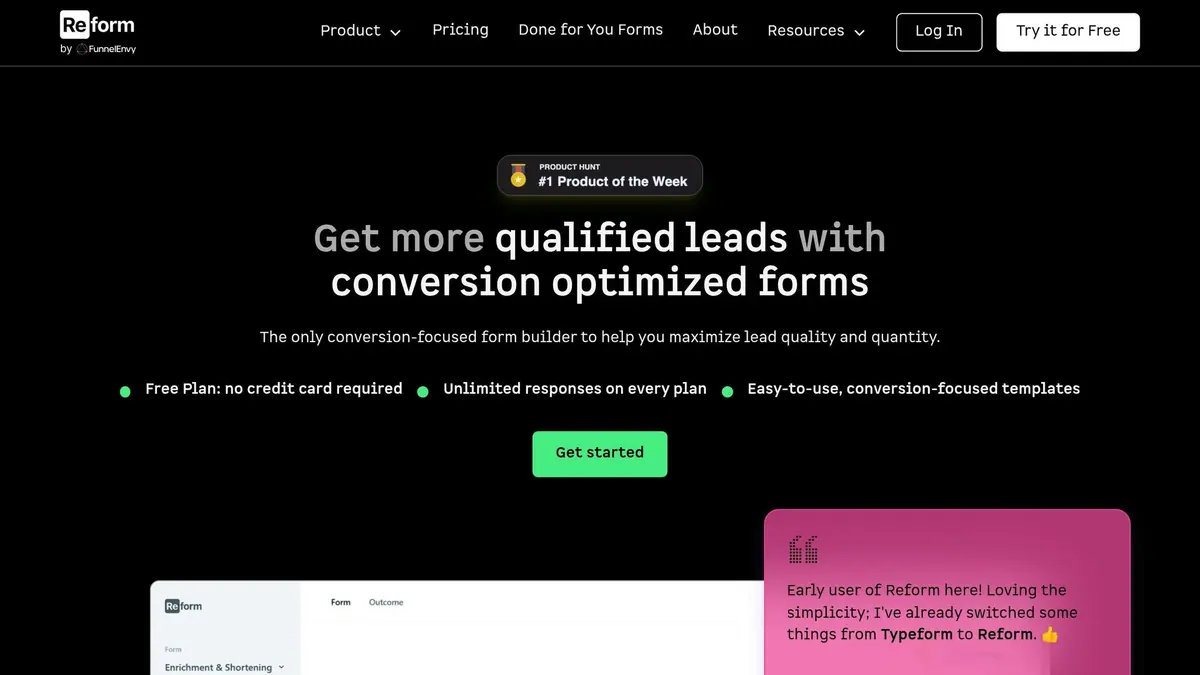
Reform offers a seamless way to streamline lead qualification by integrating real-time lead enrichment directly into its form-building process, ensuring that leads move efficiently from capture to your CRM.
Integrated Lead Enrichment in Reform
Reform's no-code form builder combines data capture with real-time lead enrichment, delivering actionable insights the moment a form is submitted. By leveraging real-time API integration, Reform replaces outdated batch processing methods, which often lead to delays. This setup allows enriched data - like job title and company name - to automatically route leads to the right team, cutting down on manual research and reducing errors.
For instance, if a prospect provides only their email address, Reform can instantly enrich that data by pulling in details like their job title, company name, and phone number. The enriched lead is then routed to the appropriate team member without requiring manual intervention.
Key Features Supporting Lead Enrichment
Reform's enrichment capabilities are powered by several standout features:
- Automatic Form Shortening: Reduces friction by hiding unnecessary fields when enrichment data is available.
- Real-Time Email Validation: Helps maintain low bounce rates by ensuring email accuracy.
- Multi-Step Forms: Dynamically reveal fields only when enrichment data isn't retrieved, optimizing the user experience.
When a prospect provides an email address, Reform's API can fetch additional details like company name, job title, and phone number. These fields are then hidden from the user while the data is securely stored in hidden fields for backend processes like lead scoring or CRM routing. This ensures a clean, uncluttered interface while still capturing all necessary information.
Reform also provides real-time analytics to help identify form fields that lead to abandonment, offering insights to improve form performance. The platform integrates smoothly with CRM tools like HubSpot and Salesforce (available on the Pro Plan), pushing enriched data directly into your workflows without extra steps.
Plans and Pricing for Lead Enrichment
Reform's real-time lead enrichment is available exclusively on the Pro Plan, priced at $35/month or $350/year. The Free and Basic Plans, starting at $15/month or $150/year, provide simple lead generation tools but do not include enrichment features.
The Pro Plan is ideal for scaling go-to-market teams that need advanced workflows. It includes features like team access, file uploads, tracking incomplete responses, custom CSS and JavaScript, and integrations with platforms like HubSpot and Salesforce. Enrichment can be powered through Reform's shared API (via ExactBuyer) or by using your own ExactBuyer API key. A 14-day Pro trial is also available, letting you test enrichment mappings with your CRM before committing.
"Reform is what Typeform should have been: clean, native-feeling forms that are quick and easy to spin up. Reform does the job without a bunch of ceremony"
- Derrick Reimer, Founder of SavvyCal
To maximize efficiency on the Pro Plan, enable the default "Shorten Forms" toggle. This automatically hides enrichable fields, reducing user effort. Additionally, map enriched data to hidden fields to streamline backend processes without cluttering the form interface.
Best Practices for Implementing Real-Time Lead Enrichment
Steps to Implement Real-Time Enrichment
Start by identifying which forms truly need real-time enrichment. Forms like demo requests and pricing inquiries are prime candidates because speed is essential here. In contrast, forms for top-of-funnel content, like eBook downloads, don’t benefit as much from immediate enrichment.
Next, define your qualification criteria. Focus on factors like company size, industry, and decision-maker roles. This ensures you're using enrichment credits wisely by targeting leads that match your ideal customer profile.
Here’s how to set up real-time enrichment:
- Connect your API provider: Link it at the team level.
- Map data fields: At the form level, align form blocks with the data fields. When a user submits their email, the platform extracts the domain, queries third-party databases through the API, and adds firmographic data to the lead record in milliseconds.
Enable Form Shortening to streamline the experience. If enrichment is successful, unnecessary fields can be hidden. If it fails, those fields remain visible for manual input. For backend processes like lead routing and scoring, use Hidden Fields to collect enrichment data without disrupting the user experience.
Before launching, thoroughly test your setup. Use email domains from a variety of sources - large enterprises, small startups, and international companies - to ensure your mapping and routing logic works as expected. Also, configure your CRM to map enriched data into specific custom fields. This prevents overwriting any existing, manually-entered high-quality data.
Once everything is set up, watch out for potential issues that could disrupt performance.
Common Pitfalls and How to Avoid Them
Even with a solid setup, some mistakes can compromise your enrichment efforts. Here’s how to steer clear of them:
- Protect your API keys: Never store API keys in frontend code or call enrichment APIs directly from the client side. Always proxy API calls through a backend server to keep your keys secure. Jesse Ouellette from LeadMagic emphasizes, "A poorly implemented integration will either burn through your budget or crash your application when you hit a spike in traffic".
- Avoid relying on just one data source: No single provider has complete data coverage. To fill gaps, use a waterfall enrichment strategy that queries multiple providers in sequence.
- Respect rate limits: If you hit "429 Too Many Requests" errors, use exponential backoff to prevent disruptions. A smart caching strategy can also help. For example, store enriched data in Redis for 24–48 hours and in your database for 30–90 days. This can cut API costs by 20–30%.
- Standardize data formats: Different APIs may return data in inconsistent formats (e.g., "US" versus "United States"). Standardize this data and use conditional routing to notify sales teams only about high-fit leads.
- Capture the original submission: Even if the enrichment API times out, always save the original form data. This ensures no lead information is lost.
Conclusion and Key Takeaways
Recap of Benefits and Strategies
Real-time lead enrichment has become a game-changer for marketers in 2026. With 61% of marketers identifying lead generation as a top challenge, and 85% of businesses reporting that poor-quality customer data hampers efficiency, the stakes are high. Add to that the fact that nearly 80% of new leads fail to convert into sales, and it’s clear why this approach is no longer optional. Real-time enrichment bridges these gaps by instantly improving data accuracy, refining lead qualification, and automating routing - ensuring high-value prospects are prioritized for sales teams.
Key strategies like form shortening (to reduce user fatigue), waterfall enrichment (achieving over 80% match rates), and trigger-based enrichment (focused on behavioral signals) have proven to deliver results. Among these, waterfall enrichment stands out, surpassing single-source methods that typically achieve only 40–50% match rates by using multiple data sources in sequence.
By adopting these strategies and the right tools, marketers can turn lead enrichment into a competitive edge, rather than just another operational hurdle.
Why Reform is the Right Solution
Reform simplifies lead enrichment by embedding it directly into the form-building process - eliminating the need for complex middleware or technical expertise. Its Pro Plan offers both real-time enrichment and form shortening, enabling you to reduce visible form fields while capturing detailed backend data through hidden fields for scoring and routing.
Reform’s design is both secure and flexible, with team-level security and form-level customization, making it suitable for businesses of all sizes. Setup is quick: connect data providers, map fields in minutes, and test before going live. Most importantly, Reform prioritizes conversion optimization over mere data collection. By reducing cognitive load and creating a smoother user experience, Reform helps boost lead conversions effortlessly.
FAQs
What lead data should I enrich first?
To get the most out of your lead qualification and outreach efforts, focus on refining data that truly matters. Start with the essentials: company size, industry, job title, and verified contact details like email and phone number. Once you’ve nailed these, take it a step further with firmographic details such as company revenue, location, and decision-making authority. Prioritizing these critical data points allows your team to move quickly on high-value leads, improving both efficiency and conversion rates.
How can I prevent enriched data from overwriting good CRM data?
To keep your CRM data intact while improving its quality, set up your enrichment process to update fields only when the new information is more accurate or fills in missing gaps. Use conditional logic within your CRM to ensure updates happen only if the existing data is outdated or incomplete. This approach preserves high-quality data while adding reliable, current details, following best practices for real-time lead enrichment.
How do I reduce enrichment API costs without losing accuracy?
To keep enrichment API costs under control while ensuring data accuracy, consider a few practical strategies. Start by caching data for frequently accessed or known contacts. This reduces the number of API calls you need to make. For updates that aren't time-sensitive, batch processing is a smart choice - it’s often more cost-efficient than handling requests individually. Save real-time APIs for situations where immediate updates are absolutely necessary. By blending these approaches, you can manage expenses efficiently without sacrificing the quality of your data.
Related Blog Posts
Get new content delivered straight to your inbox

The Response
Updates on the Reform platform, insights on optimizing conversion rates, and tips to craft forms that convert.



Drive real results with form optimizations
Tested across hundreds of experiments, our strategies deliver a 215% lift in qualified leads for B2B and SaaS companies.
