
.webp)
10 GDPR Data Protection Tips for E-Commerce



GDPR compliance is essential for e-commerce businesses, especially when handling data from EU customers. Non-compliance can lead to fines of up to $21.5 million or 4% of global revenue, whichever is higher. Here’s a quick rundown of the most important steps to protect customer data and meet GDPR requirements:
- Map and Audit Data Flows: Track where customer data is stored and how it moves across systems.
- Obtain Clear Consent: Use explicit opt-ins for collecting, processing, and sharing personal data.
- Create a Privacy Policy: Clearly explain how data is collected, used, and stored.
- Strengthen Security: Encrypt sensitive data, limit access, and use multi-factor authentication.
- Minimize Data Collection: Only collect data that is necessary for specific purposes.
- Support Customer Rights: Respond to requests for data access, correction, or deletion within one month.
- Vet Third-Party Vendors: Ensure all partners handling data are GDPR-compliant.
- Keep Records for Audits: Maintain detailed documentation of data processing activities.
- Train Staff: Educate employees on GDPR rules and proper data handling practices.
- Use Secure Form Builders: Choose tools with encryption and consent management features.
These steps not only help avoid penalties but also build trust with your customers, giving them confidence that their data is safe.
1. Map and Audit All Customer Data Flows
GDPR Compliance Impact
Knowing where your customer data is stored and how it moves through your business isn't just a smart practice - it’s a legal necessity under GDPR. This regulation requires businesses to show accountability and transparency in how they handle data. If you don’t have a clear understanding of your data flows, you’re exposing your business to significant compliance risks.
When GDPR violations are investigated, authorities will expect you to provide evidence that you know what data you collect, where it’s stored, and who can access it. Failing to document this information could lead to hefty fines.
Actionable Implementation
Start by creating an inventory of all personal data your business collects. Document the purpose for collecting each type of data, whether it’s names, email addresses, IP addresses, browsing habits, or device information.
Then, map out how this data moves through your organization. Trace the journey from the moment a customer lands on your site through checkout, payment processing, shipping, and follow-up marketing. Include every department that handles customer data, such as IT, marketing, customer service, fulfillment, and finance.
During this process, you might uncover areas where customer data is unnecessarily accessible. For example, fulfillment centers may have access to email addresses or past customer communications - information they don’t need. To align with GDPR’s data minimization principle, restrict access so that each department only sees the data necessary for their role.
Set up clear policies for data retention, deletion, and anonymization. Define how long you’ll store different types of data and automate processes to delete it when it’s no longer needed. This approach not only protects customer information but also simplifies your response to data-related requests.
Relevance to E-Commerce
For e-commerce businesses, mapping data flows is especially critical because customer data often spreads across a variety of systems and platforms. Your website, analytics tools, payment processors, shipping partners, email marketing software, and CRM systems all play a role in handling customer data. Each of these touchpoints could become a weak link if not properly documented and secured.
Take a typical customer journey as an example: a visitor browses your website (analytics data), creates an account (personal details), adds items to their cart (behavioral data), completes the checkout process (payment information), receives shipping updates (contact preferences), and later gets follow-up marketing emails (communication history). Every step likely involves different systems and third-party vendors, making thorough mapping essential.
Customer Data Protection
Detailed audits form the backbone of a strong GDPR strategy, offering peace of mind to both customers and regulators. By knowing exactly where sensitive data resides, you can apply targeted security measures - like encryption and strict access controls - at critical points.
This visibility also makes it easier to handle data subject requests. If a customer asks to see the information you hold about them or requests their data to be deleted, you’ll know exactly where to find it. Without proper mapping, fulfilling these requests could turn into a chaotic scramble, leaving some data overlooked.
Regular audits ensure your data maps stay accurate as your business evolves. While annual reviews are usually sufficient, you should update your mapping whenever you make significant changes to your technology or processes.
Beyond compliance, effective data mapping can save money. According to IBM, businesses with strong data protection measures reduce data breach costs by more than $200,000. In the long run, safeguarding customer information builds the trust that keeps people coming back to your business.
2. Get and Manage Clear Customer Consent
GDPR Compliance Impact
Under GDPR, obtaining customer consent isn’t just a recommendation - it’s a legal requirement with strict criteria. Consent must be "freely given, specific, informed, and unambiguous" before you collect or process any personal data. This means practices like pre-ticked boxes, implied consent, or bundling multiple permissions together are not allowed.
The stakes are high: businesses can face fines of up to €20 million or 4% of global annual revenue, whichever is greater, for non-compliance in consent management. Beyond the financial penalties, poorly managed consent can tarnish your reputation and erode customer trust, which is particularly damaging in the competitive e-commerce space.
Additionally, failing to offer simple ways for customers to withdraw consent could leave your business exposed during regulatory audits. Adhering to these principles creates a solid foundation for transparent and actionable consent practices.
Actionable Implementation
Start by reviewing every point where you collect data. Ensure that each interaction includes a clear, specific opt-in mechanism. For example, avoid vague language like "we may use your data for various purposes." Instead, use precise terms such as, "We will use your email address to send order updates and promotional offers."
Consider using a consent management platform (CMP) to streamline this process and maintain proper records. These tools can help you display consent banners, track when and how consent was given, and allow users to update their preferences at any time. Such documentation is invaluable during audits.
Break down consent options into separate choices for different types of data usage. For instance, have one checkbox for order notifications, another for marketing emails, and a third for analytics cookies. This granular approach not only ensures compliance but also gives customers more control, leading to higher-quality consent.
It’s also essential to offer easy ways for customers to manage and withdraw their consent. Provide accessible privacy settings on your website, such as links in the footer, account dashboards, or email communications, with a straightforward withdrawal process.
Relevance to E-Commerce
E-commerce businesses deal with particularly sensitive data, including payment details, shipping addresses, and browsing history. This makes proper consent management even more critical, especially since GDPR applies to any business interacting with EU residents, regardless of its physical location.
Your consent strategy should address multiple points in the customer journey. For example:
- Cookie consent when users first visit your site.
- Email marketing consent during checkout.
- Data sharing consent for third-party services like shipping, analytics, or customer support.
Take the checkout process as an example. Many e-commerce sites automatically sign customers up for newsletters or loyalty programs during purchases. Under GDPR, these boxes must be unchecked by default, and each program must have separate consent options. While this might reduce sign-ups initially, the customers who do opt in are likely to be more engaged.
A 2023 survey revealed that over 60% of e-commerce sites in the EU updated their consent mechanisms following GDPR enforcement. These updates not only helped businesses avoid fines but also strengthened customer trust and improved data quality.
Customer Data Protection
Clear consent management supports GDPR compliance while giving customers more control over their data. When people understand exactly what information you’re collecting and why, they’re more likely to trust your business. This transparency minimizes the risk of data misuse and aligns with GDPR’s data minimization principle.
When customers can easily view and adjust their preferences, they feel more confident sharing data, which can lead to stronger relationships and even higher lifetime value.
From an operational perspective, maintaining detailed consent records simplifies compliance. If a customer asks what data you have or requests its deletion, you’ll have the necessary information at your fingertips to respond efficiently.
Platforms like Reform can help automate consent collection, provide real-time analytics, and integrate with CRM tools. This not only ensures compliance but also enhances the quality of the data you collect.
| Requirement | GDPR-Compliant Practice | Non-Compliant Practice |
|---|---|---|
| Consent Collection | Unticked boxes, clear opt-in, granular choices | Pre-ticked boxes, bundled consent |
| Consent Withdrawal | Easy access, as simple as giving consent | Complicated processes, hidden options |
| Documentation | Store detailed records of all consent | No record-keeping or audit trails |
| Cookie Management | Display banner before setting cookies | Set cookies before obtaining consent |
3. Create and Share a Clear Privacy Policy
GDPR Compliance Impact
Having a privacy policy isn’t just a nice-to-have - it’s a core requirement under GDPR. This document ensures transparency by explaining what data your business collects, how it’s processed, and how it’s used. Without a well-crafted privacy policy, e-commerce businesses could face hefty fines and a damaged reputation.
A privacy policy also serves as a key piece of evidence during audits. By clearly documenting your data practices, you demonstrate to both regulators and customers that you prioritize data protection. This transparency lays the groundwork for implementing effective data management measures.
Actionable Implementation
A strong privacy policy should include:
- The types of personal data collected (e.g., names, email addresses, IP addresses, payment details).
- The legal basis for processing the data.
- Details on how the data is stored, processed, and safeguarded.
- Information about any third parties with whom the data is shared.
- Customer rights under GDPR and how they can exercise these rights.
- Security measures you’ve adopted to protect the data.
Be specific about why you’re collecting data. For instance, you might use it for processing orders, sending communications, or improving services. Clearly explain how the data will be used, who it’s shared with, and how long it will be retained.
Make your privacy policy easy to find. Link it in your website’s footer, display it during account creation, or highlight it at checkout. Use plain language - ditch the heavy legal jargon - so your customers can easily understand your data practices.
These steps not only help you meet GDPR requirements but also align your policy with the needs of an e-commerce business.
Relevance to E-Commerce
For e-commerce businesses, transparency about sharing customer data with third-party vendors is crucial. Vendors like payment processors, shipping companies, or marketing platforms must comply with GDPR standards. Clearly outline what data is shared and why.
Your privacy policy should be especially clear at critical moments in the customer journey. For example, during checkout, explain how payment and shipping information is handled. When customers create an account, detail what profile information is stored and for how long. If you use analytics or marketing tools, be upfront about how that data is used - it’s a great way to build trust.
Whenever you update your privacy policy, include the date of the latest revision and summarize any major changes. Notify your customers through emails or prominent website banners, particularly if the updates affect how their data is used or shared.
Customer Data Protection
A transparent privacy policy doesn’t just fulfill legal obligations - it builds trust and strengthens customer loyalty. When you clearly explain how data is handled, you empower customers to make informed decisions, reducing potential disputes or complaints.
Make it a habit to update your privacy policy regularly to reflect changes in your data practices or legal requirements. A well-maintained policy ensures customers can provide informed consent for data processing.
Tools like Reform can simplify this process. They offer branded, GDPR-compliant forms for data collection, complete with features like customizable templates, multi-step forms, conditional logic, real-time analytics, and seamless integration with marketing and CRM systems. These tools not only help with compliance but also enhance the overall user experience.
| Privacy Policy Element | GDPR Requirement | E-Commerce Example |
|---|---|---|
| Data Types Collected | List all personal data categories | "Name, email, billing address, payment card details, browsing history" |
| Purpose of Collection | Explain why each data type is needed | "Billing address for payment processing, email for order confirmations" |
| Data Sharing | Disclose all third-party recipients | "Payment processor (Stripe), shipping partner (FedEx), analytics (Google)" |
| Retention Period | Specify how long data is kept | "Order data retained for 7 years for tax purposes, marketing data until unsubscribe" |
| Customer Rights | Explain how to exercise GDPR rights | "Email privacy@company.com to request data access, correction, or deletion" |
4. Improve Data Security Measures
GDPR Compliance Impact
Data security isn't just a best practice - it's a legal requirement under GDPR. The regulation mandates that e-commerce businesses put in place "robust technical and organizational controls" to safeguard personal data. Falling short of these standards can lead to steep penalties, with fines reaching up to €20 million or 4% of annual turnover, whichever is greater.
But the financial risks don’t stop there. A 2023 IBM study revealed that the average global cost of a data breach hit $4.45 million, with retail and e-commerce sectors among the hardest hit. On the flip side, investing in proper encryption can save businesses over $200,000 per breach on average. Clearly, bolstering security measures is both a protective and cost-effective strategy.
Actionable Implementation
To strengthen your data security, consider these critical steps:
- Encrypt sensitive data both at rest and in transit to ensure it remains inaccessible without proper authorization.
- Implement role-based access controls, so employees only access the data essential to their roles.
- Require multi-factor authentication (MFA) for added layers of security when accessing sensitive systems.
- Conduct regular audits and vulnerability assessments to uncover and address potential security gaps.
- Ensure software and systems are up to date with automated updates and frequent reviews.
These steps are essential in managing the intricate security challenges e-commerce platforms face today.
Relevance to E-Commerce
E-commerce platforms deal with vast amounts of data spread across multiple systems and third-party vendors, making them particularly vulnerable to breaches.
Payment data is especially critical. Use secure payment processors that comply with PCI DSS standards, avoid storing full credit card details, and leverage tokenization services to reduce risk.
Customer account areas also require strong safeguards. These areas often house order histories, saved payment methods, and personal preferences. Implement features like session timeouts, strong password requirements, and monitoring for suspicious activity.
The checkout process is another high-risk area, as it involves collecting sensitive information. Use HTTPS encryption on these pages, display security badges to reassure customers, and minimize the data fields you request. Tools like Reform offer GDPR-compliant forms with built-in encryption, simplifying secure data collection.
Customer Data Protection
Beyond technical measures, thorough documentation and prepared staff are key to protecting customer data.
Strong security practices not only protect your business but also build customer trust, encouraging repeat purchases. Here’s how to enhance your approach:
- Document everything: Maintain clear policies, risk assessments, incident response plans, and evidence of regular staff training. This not only helps during audits but also demonstrates your commitment to GDPR compliance.
- Train your team: Educate employees on security best practices and GDPR requirements. They should know how to spot phishing attempts, handle data properly, and respond to potential security issues. Since human error is a leading cause of breaches, training is non-negotiable.
- Plan for incidents: Develop a detailed incident response plan. Outline the steps for detecting, containing, and reporting breaches. GDPR requires notifying authorities within 72 hours of discovering a breach, so having a predefined process ensures a swift and compliant response.
Security Measures at a Glance
| Security Measure | Implementation | GDPR Benefit |
|---|---|---|
| Data Encryption | Use AES-256 or similar standards for data at rest and in transit | Ensures data remains unreadable to unauthorized users |
| Access Controls | Role-based permissions to limit data access | Minimizes internal risks and demonstrates accountability |
| Multi-Factor Authentication | Add extra verification layers beyond passwords | Protects systems even if credentials are compromised |
| Regular Security Audits | Conduct monthly scans and annual penetration tests | Identifies and mitigates vulnerabilities proactively |
| Staff Training | Hold quarterly security and GDPR training sessions | Reduces human error and boosts compliance awareness |
5. Limit Data Collection and Storage
GDPR Compliance Impact
Under the GDPR’s data minimization principle, e-commerce businesses are required to collect only the personal data strictly necessary for specific purposes. Non-compliance can lead to severe penalties, such as fines reaching €20 million or 4% of global turnover. This means you can’t gather customer data “just in case” it might prove useful later. Every piece of information collected must have a clearly documented purpose, and once that purpose is fulfilled, the data should be deleted or anonymized.
By limiting data collection, businesses can significantly reduce the burden of compliance. With less data to manage, obligations like responding to data access requests, managing consent, and notifying about breaches become more straightforward. Focusing only on what’s necessary ensures more precise and manageable data practices.
Actionable Implementation
Start by conducting a detailed audit of all data collection points, such as checkout pages, registration forms, and customer support interactions. For each data field, verify whether it’s truly essential for completing transactions or providing services.
Remove any nonessential fields immediately. For instance, if a phone number isn’t critical for order fulfillment, it shouldn’t be collected. Stick to gathering only what’s required to process transactions - extra data increases your compliance workload without adding value.
Next, establish clear retention policies for different types of data. For example, order information might need to be kept for seven years to meet tax requirements, while abandoned cart data could be deleted after 30 days. Document these retention periods and use automation tools to handle deletions or anonymization once the data is no longer needed.
Relevance to E-Commerce
E-commerce businesses face unique challenges when it comes to data minimization because they interact with customers across various touchpoints - from browsing and checkout to post-purchase communications. During checkout, essential details like shipping address, billing information, and contact details for order updates are required. However, asking for unnecessary information, such as a customer’s date of birth or occupation, is often unwarranted. According to a 2023 Usercentrics survey, only 32% of e-commerce businesses regularly review and delete unnecessary customer data.
Reducing the amount of data you collect also lowers compliance risks. While marketing teams may be tempted to gather extensive demographic details for targeted campaigns, such data comes with ongoing regulatory responsibilities. Instead, focusing on behavioral data from website interactions can provide actionable insights with fewer compliance challenges.
Customer Data Protection
Limiting data collection not only simplifies compliance but also enhances security. With less sensitive information stored, the potential impact of a data breach diminishes. Fewer records mean reduced risks and lower costs associated with breaches.
This approach also conveys respect for customer privacy. When customers see that you’re only asking for what’s necessary, they’re more likely to trust your business, complete their transactions, and return in the future. Additionally, managing customer requests for data access, correction, or deletion becomes simpler because there’s less data to handle.
Tools like Reform can streamline this process by using conditional logic in forms, ensuring that additional data is only collected when it’s directly relevant to the customer’s situation. This helps maintain a smooth user experience while keeping data collection focused and compliant. By adopting these practices, you strengthen your GDPR compliance framework and enhance customer trust.
| Data Type | Typical Retention Period | Deletion Method |
|---|---|---|
| Order Information | 7 years (tax compliance) | Automated archival after fulfillment |
| Abandoned Cart Data | 30 days | Automatic deletion |
| Marketing Preferences | Until consent withdrawn | Immediate removal upon request |
| Customer Service Logs | 2 years | Anonymization of personal identifiers |
| Website Analytics | 26 months | Aggregation and de-identification |
6. Support Customer Rights and Data Access
GDPR Compliance Impact
The General Data Protection Regulation (GDPR) gives customers six key rights: access, correction, deletion, restriction, portability, and objection. Ignoring or mishandling these requests can damage your business's reputation and erode customer trust. GDPR mandates that companies respond to such requests within one month, making timely and accurate responses a legal requirement.
Actionable Implementation
To handle customer data requests effectively, create a clear and documented process for each type of request. Provide dedicated channels - like contact forms, specific email addresses, or customer service portals - where customers can easily submit their inquiries. Always verify the identity of the requester through secure methods to prevent unauthorized access or data breaches. For access requests, compile all personal data related to the customer, include details about its processing, and inform them of their rights.
Your customer service team plays a crucial role here. Train them to recognize GDPR-related requests, even when they're phrased informally. For example, phrases like "delete my account", "send me my data", or "stop using my information for marketing" should immediately trigger specific handling protocols. Keep concise records of actions taken and outcomes to ensure compliance and accountability.
These streamlined procedures are especially vital for e-commerce platforms, where customer data is often dispersed across multiple systems.
Relevance to E-Commerce
In the e-commerce world, managing GDPR compliance is particularly challenging because customer data is stored across various systems - order management, payment processing, marketing tools, and customer service platforms. When a customer requests their data, you’ll need to gather information from all these sources within the one-month deadline.
A 2023 survey found that 72% of consumers are more likely to buy from companies that are transparent about their data practices. This highlights how supporting customer rights not only ensures compliance but also builds trust and encourages customer loyalty.
Some common scenarios in e-commerce include customers requesting their order history before closing an account, parents asking for the deletion of a minor's account, or customers opting out of marketing emails after a purchase. Each of these situations can be handled efficiently with secure forms and a well-organized process, ensuring compliance while maintaining a high level of customer service.
Customer Data Protection
Empowering customers to exercise their rights enhances your overall data protection strategy. When customers can access and update their information, data accuracy naturally improves. Allowing them to delete unnecessary data reduces storage needs, lowering the risk of breaches and easing compliance efforts.
Research from IBM shows that implementing robust data protection measures - like encrypting customer communications - can cut the average cost of a data breach by over $200,000. This underscores how investing in customer rights infrastructure not only meets legal obligations but also delivers financial benefits.
Platforms like Reform offer secure, GDPR-compliant forms that simplify handling data requests. These tools maintain audit logs, encrypt data transmissions, and integrate seamlessly with your existing customer service systems, ensuring quick response times without compromising security.
The table below outlines the key customer rights, response requirements, and practical examples specific to e-commerce:
| Customer Right | Response Timeframe | Required Information | Common E-Commerce Example |
|---|---|---|---|
| Data Access | 1 month | All personal data, processing details, rights info | Customer requests order history before closing account |
| Data Correction | 1 month | Updated and accurate information | Customer updates shipping address in their profile |
| Data Deletion | 1 month | Confirmation of deletion, exceptions explained | Parent requests deletion of a minor's account |
| Marketing Objection | Immediate | Confirmation of opt-out | Customer opts out of promotional emails |
| Data Portability | 1 month | Data in a machine-readable format | Customer switches to a competitor platform |
7. Check Third-Party and Vendor Compliance
GDPR Compliance Impact
While strengthening your internal data protection strategies is essential, ensuring third-party compliance is just as critical. Under GDPR, your e-commerce business shares responsibility for data protection failures involving third-party vendors. This means that if your payment processor, email marketing tool, or shipping provider mishandles customer data, you could face the same penalties as if the breach occurred within your own operations - penalties that can reach up to $24 million or 4% of your annual revenue. GDPR's accountability principle makes vendor oversight not just a best practice but a legal obligation. A 2022 Ponemon Institute report revealed that 51% of organizations experienced data breaches caused by third parties, with the average cost exceeding $4.29 million.
Actionable Implementation
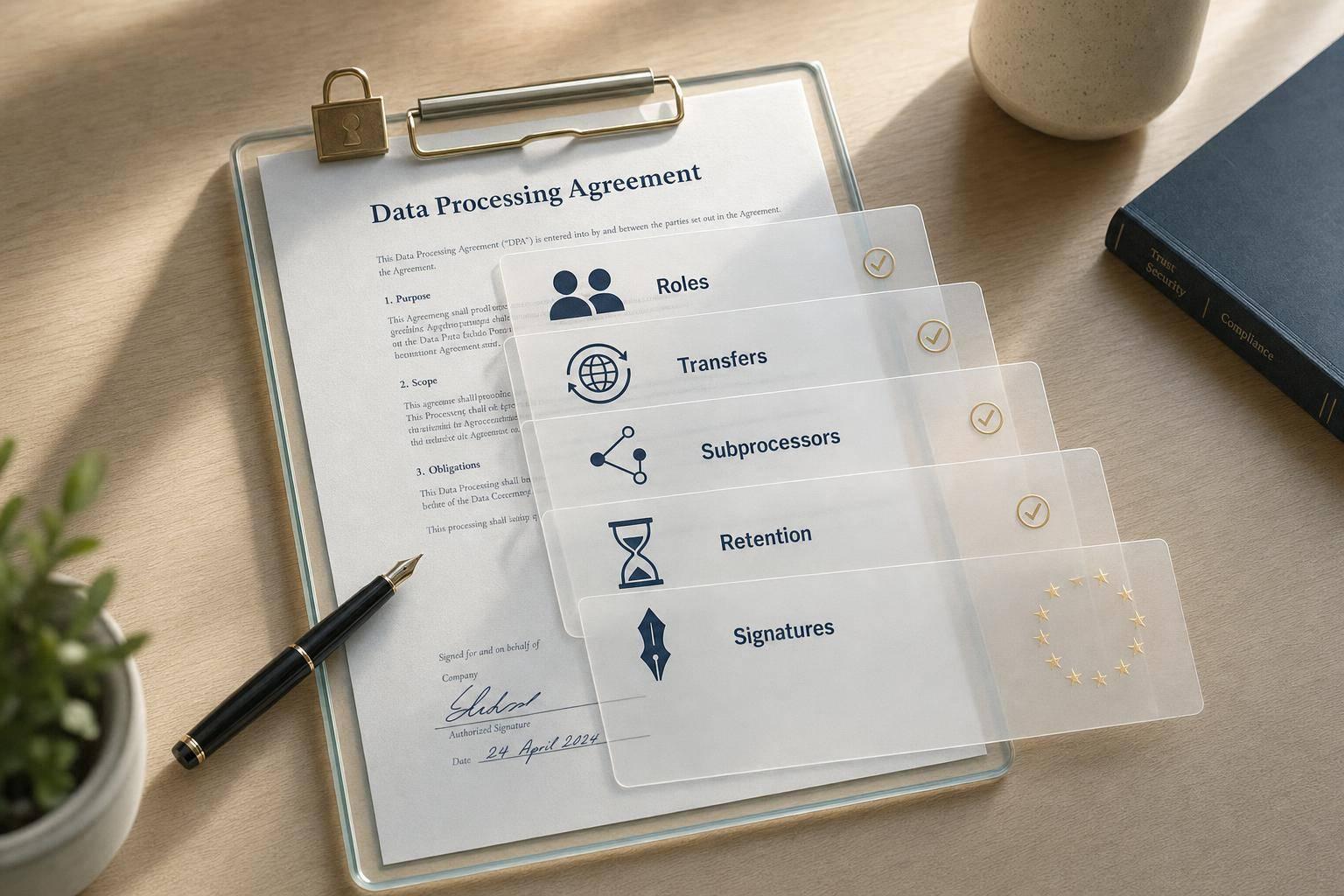
To minimize risks, start by conducting thorough due diligence before bringing any new vendor on board. Request GDPR compliance documentation such as Data Processing Agreements (DPAs), security certifications, audit reports, and privacy policies. Maintain a vendor register to track data flows and compliance statuses, updating it whenever you onboard new vendors or change existing relationships. This centralized record is invaluable during audits and helps you stay on top of who has access to customer data.
Your vendor contracts should include clear provisions for breach notifications, detailed data usage terms, and the right to audit vendor practices. Additionally, specify that you can terminate contracts if vendors fail to meet compliance standards.
Compliance isn't a one-and-done process. Schedule regular reviews of vendor compliance, requiring updated documentation annually and conducting periodic security audits. This proactive approach helps you identify and address potential gaps before they escalate into major issues. These measures work hand in hand with your internal data protection efforts, creating a stronger overall GDPR compliance framework.
Relevance to E-Commerce
E-commerce businesses often rely on a variety of third-party services to handle customer data. For example, payment gateways like Stripe and PayPal process sensitive financial information, email marketing platforms manage customer communication, and shipping providers handle delivery addresses. Each of these relationships introduces potential compliance risks.
Real-world cases highlight the importance of vendor oversight. In July 2022, British Airways was fined approximately $24 million after a third-party supplier's vulnerability led to a breach exposing the personal data of over 400,000 customers. Investigators found that British Airways had failed to properly vet and monitor the supplier's security practices.
Similarly, in March 2023, Ticketmaster UK faced a $1.5 million fine after a third-party–managed chatbot was compromised, resulting in the theft of payment data from 9.4 million customers. Regulators pointed to poor due diligence and weak contractual safeguards as key failings.
Customer Data Protection
Strong vendor compliance practices serve as an additional layer of defense for your customers' data. When all third-party providers adhere to GDPR standards, you significantly lower the chances of data misuse, unauthorized access, or security breaches across your business operations.
For vendors based outside the EU or handling international data transfers, ensure compliance through Standard Contractual Clauses (SCCs) or verify that the vendor operates in a country with an EU-approved adequacy decision. Your contracts should explicitly address cross-border data transfer requirements and compliance obligations.
To further simplify compliance, consider using GDPR-compliant platforms for data collection, like Reform. These tools come with built-in features such as consent management, data encryption, and detailed audit trails, ensuring your data collection processes meet GDPR standards from the outset.
| Vendor Compliance Step | Description | Frequency |
|---|---|---|
| Due Diligence | Evaluate vendor's GDPR compliance before onboarding | Before onboarding |
| Contractual Safeguards | Include GDPR clauses (e.g., breach notification) | At contract start |
| Ongoing Monitoring | Regularly review and audit vendor compliance | Quarterly/Annually |
| Vendor Register Maintenance | Maintain updated records of vendors and documentation | Ongoing |
sbb-itb-5f36581
8. Plan for GDPR Audits and Record Keeping
GDPR Compliance Impact
Under GDPR Article 30, detailed record keeping is a non-negotiable requirement for e-commerce businesses. This means you need to maintain meticulous records of all data processing activities to demonstrate compliance and avoid penalties that could climb as high as €20 million (around $22 million) or 4% of your annual global revenue. These records aren't just bureaucratic red tape - they're your strongest safeguard during regulatory investigations and proof of your commitment to protecting customer data.
To stay compliant, businesses must show how they adhere to GDPR principles at all times. Without thorough documentation, even the best-intentioned compliance measures might not hold up during an audit. These records work hand-in-hand with your earlier efforts, like mapping data flows and securing customer consent, to create a strong foundation for GDPR adherence.
Actionable Implementation
Once you've completed your data flow audits, the next step is to ensure your record keeping is airtight. Start by creating a Record of Processing Activities (ROPA) that outlines key details such as data types, purposes for processing, retention periods, access permissions, and storage methods. Assign a Data Protection Officer (DPO) to oversee this process and keep records up to date. Your ROPA should cover everything from customer names and email addresses to payment details, browsing behavior, and shipping information - along with the legal basis for processing each type of data.
Many businesses are turning to automated tools and platforms to handle GDPR documentation, consent records, and audit trails. These tools help reduce human error and make compliance more manageable.
Schedule quarterly audits to review and update your records. During these audits, check that customer consent records are complete, verify that data retention periods align with your privacy policy, and confirm that third-party vendor agreements include GDPR-compliant clauses. Use your data mapping efforts to trace the journey of customer data, documenting every step from collection to deletion.
Relevance to E-Commerce
E-commerce businesses deal with enormous amounts of customer data across various touchpoints, such as website forms, checkout pages, customer service interactions, email campaigns, and mobile apps. Each of these interactions generates GDPR documentation requirements, making systematic record keeping a critical part of your operations.
Take a typical online shopping experience as an example: a customer browses products (tracking data), creates an account (personal details), adds items to their cart (behavioral data), completes a purchase (payment and shipping information), and receives follow-up emails (marketing communications). Every step requires documentation of the legal basis for processing, proof of consent, and the security measures in place.
One mid-sized online retailer tackled these challenges by implementing a quarterly data audit schedule, adopting a centralized compliance management platform, and training their staff on GDPR basics. They also developed a vendor compliance checklist and maintained a detailed log of all customer consent interactions. When faced with a regulatory review, they were able to provide complete documentation within 48 hours, earning a positive outcome.
Customer Data Protection
Effective record keeping not only ensures compliance but also strengthens customer data protection. By maintaining detailed logs of who accessed customer data, when, and why, you can quickly identify and address any unauthorized access or suspicious activity.
Keep records of customer consent, data subject requests, breach responses, and regular security assessments. This approach not only meets GDPR requirements but also builds trust with your customers, showing them that their data is in safe hands.
For streamlining your processes, consider using platforms like Reform, which offer built-in audit trails and compliance features. These tools can automatically log consent interactions, secure data storage, and generate the necessary documentation for GDPR audits. This makes it easier to manage record keeping while ensuring all customer touchpoints are covered.
| Record Type | Required Information | Update Frequency |
|---|---|---|
| Processing Activities | Data types, purposes, legal basis, retention periods | Quarterly |
| Consent Records | Customer permissions, timestamps, withdrawal requests | Real-time |
| Security Measures | Encryption status, access controls, vulnerability assessments | Monthly |
| Data Subject Requests | Request details, response actions, completion dates | Per incident |
9. Train Staff on Compliance Requirements
GDPR Compliance Impact
Staff training is a cornerstone of maintaining GDPR compliance. Every employee handling customer data needs to understand their legal responsibilities and the potential consequences of failing to meet them. Even the most well-meaning employees can inadvertently cause data breaches without proper guidance, leading to hefty fines and reputational damage.
Training should focus on data protection practices, proper handling of sensitive information, and the serious implications of non-compliance. A workforce that understands these principles helps build a company culture centered on privacy and security, which can, in turn, strengthen customer trust and enhance brand reputation. Real-world examples highlight the risks: several major companies have faced significant penalties due to human errors in data protection. This makes employee training one of the top priorities for GDPR compliance.
Actionable Implementation
Creating an effective GDPR training program starts with tailoring the content to different roles within the organization. Training modules should cover key topics like data minimization, lawful data processing, consent management, breach reporting, and customer rights. To keep employees informed, schedule regular training sessions - ideally once a year - and include refresher courses whenever regulations change or internal processes are updated.
Using practical examples and real-world case studies can make the training more relatable and impactful. For instance, showing how a simple oversight can lead to a data breach helps employees understand the importance of their responsibilities. Keep a record of attendance and training topics to simplify compliance audits. These steps are especially critical for businesses with diverse roles, such as those in e-commerce.
Relevance to E-Commerce
In e-commerce, where vast amounts of personal data flow through customer service, marketing, logistics, and IT systems, targeted training is essential. Each team interacts with data differently, so their training needs to reflect those specific responsibilities. For example:
- Customer service teams should know how to verify a customer’s identity before sharing sensitive information.
- Marketing teams must understand consent requirements for email campaigns and other communications.
- Technical staff need to be well-versed in data security measures to protect against breaches.
Scenario-based training has become increasingly popular in e-commerce, as it engages employees and helps them retain key compliance principles. By aligning training with real-world situations, businesses can equip their teams to handle data responsibly and confidently.
Customer Data Protection
Proper training ensures employees can securely manage customer data, identify suspicious activities, and handle data subject requests, such as access or deletion, in line with GDPR requirements. A key focus should be on data minimization - collecting only what’s necessary for specific business purposes. Incorporating GDPR training into employee onboarding and ongoing professional development helps create a culture where data protection is a shared responsibility. This approach complements other compliance efforts, such as security measures and data minimization strategies, for a cohesive and effective framework.
10. Use Secure, Compliant Form Builders for Data Collection
GDPR Compliance Impact
When it comes to GDPR compliance, the forms you use for gathering customer data play a crucial role. Whether it’s a contact form, newsletter signup, checkout page, or survey, every form represents a potential risk if not properly secured. Secure, compliant form builders act as your first line of defense by ensuring that customer data is collected, processed, and stored in line with GDPR principles like transparency, data minimization, and lawful processing.
These tools often come equipped with features like encryption, consent management, and audit trails, which not only help demonstrate compliance during audits but also reduce the risk of breaches and fines. For instance, IBM's 2023 research revealed that companies using encryption and secure data collection tools saved an average of $200,000 in breach costs. Considering that GDPR fines can soar up to €20 million or 4% of annual global turnover, investing in a compliant form builder is a smart business move, not just a technical upgrade.
Actionable Implementation
Start by reviewing your existing forms to identify which ones collect personal data. Pay close attention to forms that require advanced GDPR features, such as consent management and encryption.
Opt for form builders that offer end-to-end encryption, access controls, customizable consent settings, data minimization options, and detailed audit logs. The platform you choose should integrate seamlessly with your existing marketing and CRM tools, ensuring secure data handling throughout the process. Features like built-in consent management simplify compliance and align with GDPR guidelines.
A great example is Reform, which provides tools like multi-step forms, conditional routing, spam prevention, and real-time analytics. These features not only support GDPR compliance but also help maximize conversion rates. Plus, its no-code approach makes it accessible even if you don’t have a technical background.
To maintain compliance, schedule regular audits of your form data flows. This ensures that each form collects only the information necessary for its specific purpose. By implementing these measures, your forms can securely capture data while fitting seamlessly into your broader compliance strategy.
Relevance to E-Commerce
E-commerce businesses face unique challenges because they handle sensitive customer data at multiple touchpoints. From contact details and payment information to shipping addresses and browsing preferences, these data points are collected through various forms throughout the shopping journey. Each of these points presents both an opportunity to strengthen customer relationships and a potential compliance risk.
According to a 2022 Usercentrics survey, 68% of e-commerce businesses updated their data collection forms to meet GDPR requirements. This effort led to a 23% increase in customer trust scores. Transparent practices not only help avoid fines but also foster trust among customers.
Think about the range of forms your e-commerce business uses: product inquiries, abandoned cart recovery emails, customer service requests, product reviews, and loyalty program signups. Each type of form requires specific compliance measures. For instance, marketing forms need clear opt-in consent, while customer service forms may process data under a different legal basis.
Customer Data Protection
Secure form builders do more than just collect data - they actively protect it. With multiple layers of security, such as encryption during data transmission and storage, they prevent unauthorized access. Built-in access controls ensure that only authorized personnel can view sensitive information. These safeguards work alongside transparent data collection practices, clearly explaining what data is being collected and why.
Additionally, compliant form builders simplify customer access and deletion requests. When customers want to review or delete their data, these platforms streamline the process, making it easy and efficient instead of a bureaucratic hassle.
On the flip side, insecure form builders can lead to data breaches, unauthorized access, and severe fines. Beyond financial penalties, such failures can erode customer trust and damage your reputation, ultimately hurting long-term business growth.
GDPR Compliance CHECKLIST: Are you compliant?
Comparison Table
Choosing the right GDPR-compliant form builder is a key step in safeguarding customer data. For e-commerce businesses, understanding how various platforms measure up in terms of compliance and security features can make all the difference.
Below is a comparison of leading form builders, focusing on critical factors like consent management, security features, integration options, and pricing. These elements are crucial for protecting sensitive information while ensuring smooth business operations.
| Tool | GDPR Compliance Features | Security Measures | Integration Options | Pricing (USD/month) | Notable Features |
|---|---|---|---|---|---|
| Reform | Explicit consent, data minimization, easy data export, granular consent options | End-to-end encryption, spam prevention, email validation, access controls | CRM, marketing tools, API integrations | $15 | Multi-step forms, conditional routing, real-time analytics, no-code builder |
| Typeform | Consent fields, data export, explicit opt-in mechanisms | SSL encryption, secure data storage | Zapier, CRM systems, Slack | $25+ | Conversational forms, logic jumps, user-friendly interface |
| Jotform | Consent widgets, data export, compliance templates | 256-bit SSL encryption, secure storage | CRM, payment processors, Zapier | $34+ | HIPAA compliance, extensive template library |
| Google Forms | Basic consent options, data export | SSL encryption | Google Workspace, limited third-party options | Free | Simple interface, basic functionality |
This table provides a clear side-by-side comparison of the top form builders, emphasizing the features that matter most for GDPR compliance. Among these, Reform stands out for its combination of robust compliance tools and user-friendly design, making it an excellent choice for e-commerce businesses. Its multi-step forms, conditional routing, and real-time analytics not only enhance lead quality but also ensure compliance with GDPR standards. Plus, its spam prevention and email validation features help maintain data accuracy while reducing fraud risks.
While Google Forms is a free option, it falls short when it comes to advanced compliance and security features. On the other hand, Reform offers a strong balance of affordability and functionality, with seamless CRM integrations and enhanced security measures for just $15 per month.
The integration options column highlights another key distinction. Reform’s ability to connect with CRM and marketing tools ensures a secure and efficient data flow across your entire tech stack, a vital feature for businesses managing large volumes of customer data.
Security is a cornerstone of GDPR compliance. Although all platforms listed offer basic SSL encryption, premium options like Reform provide additional layers of protection, such as end-to-end encryption and access controls. These features significantly reduce the risks and costs associated with data breaches.
When choosing a form builder, prioritize platforms with granular consent management. This feature allows customers to provide separate permissions for different uses of their data - like marketing, analytics, and order processing. Reform and Typeform excel in this area, offering the flexibility needed to maintain compliance while building trust with your customers.
Lastly, the Notable Features column underscores the unique advantages of each tool. For instance, Reform’s real-time analytics let you monitor form performance and address potential compliance issues proactively. Its no-code builder makes it accessible to business owners without technical expertise, eliminating barriers to effective data protection.
Conclusion
Meeting GDPR requirements isn’t just about avoiding fines - it’s a way to earn your customers’ trust and strengthen your business. The ten tips shared earlier offer a straightforward guide to protecting customer data while setting the stage for steady growth.
The stakes are high. Around 60% of small businesses that experience a major data breach shut down within six months. At the same time, 84% of consumers say they’re more loyal to companies with strong security measures and clear data policies. These figures make it clear: safeguarding customer data isn’t optional - it’s critical for survival and success.
The benefits of following these GDPR-focused steps are clear. Actions like mapping out how customer data flows through your business, keeping privacy policies up-to-date, and using secure tools such as Reform form builders not only lower risks but also simplify day-to-day operations. For example, IBM research reveals that using encryption can cut the average cost of a data breach by over $200,000. This shows that investing in preventive measures pays off, turning compliance into a smart business strategy.
By taking steps like training your staff and ensuring your vendors follow GDPR rules, your business will stay ahead of regulatory changes. Regular audits and updated policies will keep operations smooth and help you meet - and exceed - customer expectations. While regulations may evolve, one thing remains constant: customers want transparency and control over their personal information. This commitment to transparency builds the trust that keeps customers coming back.
Your customers are counting on you to protect their most sensitive information. By maintaining clear, reliable data practices, you’ll not only safeguard their trust but also create the loyal customer base that fuels long-term success in e-commerce.
FAQs
What steps can e-commerce businesses take to ensure their third-party vendors comply with GDPR?
To ensure your third-party vendors align with GDPR requirements, begin by thoroughly reviewing their data processing agreements. Pay close attention to whether they adhere to key GDPR principles, like limiting data collection to what's necessary and maintaining secure storage practices.
It's also essential to assess their security measures. Look into their encryption protocols, access controls, and other safeguards to confirm they effectively protect customer data. Make it a habit to monitor their operations regularly and update agreements whenever regulations or practices evolve. Taking these steps not only keeps you compliant but also strengthens trust with your customers.
What should an e-commerce site's GDPR-compliant privacy policy include?
A privacy policy that complies with GDPR for an e-commerce site needs to clearly communicate how customer data is gathered, used, and stored. It should specify the types of personal data being collected - such as names, email addresses, and payment details - along with the reasons for processing this information and how long it will be kept.
The policy must also explain the rights users have under GDPR. These include the ability to access, correct, or delete their data, along with instructions on how they can exercise these rights. Be upfront about sharing data with third parties, whether it’s with payment processors, marketing services, or analytics providers. Lastly, include contact details for your data protection officer (if applicable) or provide a designated contact for privacy-related questions.
Why should e-commerce businesses map and audit their data flows for GDPR compliance?
Mapping and auditing data flows is a critical step for e-commerce businesses aiming to maintain GDPR compliance. This process involves identifying where personal data is collected, tracking how it’s processed, and determining where it’s stored.
By gaining a clear picture of these data flows, businesses can uncover potential weak points, put stronger protections in place, and ensure they align with GDPR's data protection standards. Beyond compliance, it demonstrates a commitment to responsible data handling, which can go a long way in building trust with customers.
Related Blog Posts
Get new content delivered straight to your inbox

The Response
Updates on the Reform platform, insights on optimizing conversion rates, and tips to craft forms that convert.


Drive real results with form optimizations
Tested across hundreds of experiments, our strategies deliver a 215% lift in qualified leads for B2B and SaaS companies.
