
.webp)
AI Consent Management: Strategies for Compliance



AI consent management ensures users have control over how their data is used by AI systems. With strict regulations like the GDPR, CCPA/CPRA, and the EU AI Act, businesses must adopt advanced consent strategies to avoid penalties as high as €35 million ($37.6 million) or 7% of global revenue. Traditional cookie banners are no longer sufficient, as AI systems often evolve their data usage over time, making real-time consent enforcement critical.
Key takeaways:
- GDPR requires explicit, informed consent and easy withdrawal options.
- CCPA/CPRA focuses on opt-out models and mandates honoring Global Privacy Control (GPC) signals.
- The EU AI Act enforces stricter rules for high-risk AI systems starting August 2026.
- Businesses must integrate consent into AI infrastructure, not just browser-level tools.
To comply:
- Map data flows to identify where consent is needed.
- Design clear consent forms with detailed options for AI-related activities.
- Enforce preferences instantly using tools like Google Consent Mode or IAB frameworks.
- Monitor performance through dashboards to track opt-in rates and withdrawals.
Platforms like Reform simplify consent management with user-friendly tools for creating compliant forms and tracking performance. Staying ahead requires ongoing audits, clear communication, and adherence to evolving global regulations.
Enforcing customer consent & AI-ready data with policy orchestration in Unity Catalog & OneTrust
sbb-itb-5f36581
Key Regulations That Affect AI Consent
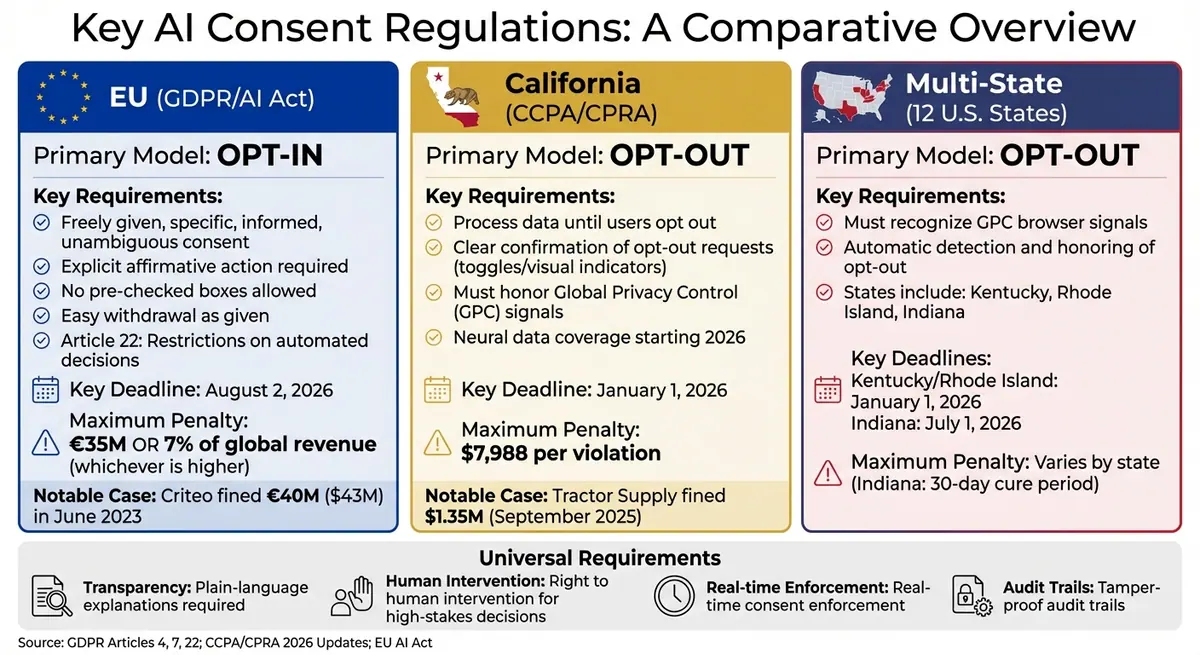
AI Consent Management Regulations Comparison: GDPR, CCPA, and EU AI Act Requirements
Navigating the legal landscape is critical when developing AI consent systems. Businesses must account for three major frameworks: Europe's GDPR, California's CCPA/CPRA, and a wave of new global laws rolling out by 2026. Let's start with the GDPR, known for its strict consent requirements.
GDPR Requirements for AI Systems
The General Data Protection Regulation (GDPR) sets rigorous standards for obtaining consent in AI systems. According to Articles 4 and 7, consent must be freely given, specific, informed, and unambiguous, requiring an explicit affirmative action from users. In practice, this rules out pre-checked boxes or passive acceptance through silence. Users must actively opt in before their data can be processed for AI training or automated decision-making.
Another key aspect is the right to withdraw consent as easily as it was given (Article 7(3)). This often means providing users with accessible tools, like multi-step consent forms or one-click settings, to revoke consent at any time. For AI systems that make automated decisions with "legal or similarly significant effects" - such as hiring or loan approvals - Article 22 further restricts processing. Explicit consent, contractual necessity, or a specific legal basis is required to proceed.
The cost of non-compliance is steep. In June 2023, French regulators fined Criteo €40 million ($43 million) for failing to verify user consent for tracking and for not offering a clear way to withdraw consent. This case highlights how vague or poorly implemented consent mechanisms can lead to severe penalties.
CCPA Compliance for AI Data Processing
California's approach under the California Consumer Privacy Act (CCPA) and the California Privacy Rights Act (CPRA) differs from the GDPR by using an opt-out model. Businesses can process data until users explicitly opt out of data sales, sharing, or automated decision-making technologies (ADMT).
Starting January 1, 2026, businesses must provide clear confirmation - through toggles or visual indicators - that an opt-out request has been processed. Silent or ambiguous processing will no longer comply. This shift follows enforcement actions like the September 2025 case against Tractor Supply, where the company was fined $1.35 million for failing to honor Global Privacy Control (GPC) signals and mishandling employment data.
California has also broadened its definition of sensitive personal information to cover neural data from brain-computer interfaces or EEG readings, effective in 2026. Users can limit the use of these sensitive data categories, imposing additional consent obligations on AI systems that handle biometric or health-related data.
New Privacy Laws Affecting AI Consent
The regulatory landscape continues to evolve, with new laws adding layers of complexity to AI consent requirements. The EU AI Act, set to take full effect by August 2, 2026, introduces a risk-based framework. High-risk AI systems, in particular, will face stricter requirements for human oversight and data governance. Non-compliance could result in fines of up to €35 million ($37.6 million) or 7% of global annual revenue.
In the U.S., 12 states will require recognition of Global Privacy Control (GPC) browser signals by 2026. States like Kentucky, Rhode Island, and Indiana mandate that businesses automatically detect and honor these opt-out signals, effectively making GPC support a national standard. Under the updated CCPA, violations can cost $7,988 per incident.
| Region | Primary Model | Key AI Deadline | Maximum Penalty |
|---|---|---|---|
| EU (GDPR/AI Act) | Opt-in | August 2, 2026 | €35M or 7% revenue |
| California (CPRA) | Opt-out | January 1, 2026 | $7,988 per violation |
| Kentucky/Rhode Island | Opt-out | January 1, 2026 | Varies by state |
| Indiana | Opt-out | July 1, 2026 | 30-day cure period |
Transparency is becoming a universal requirement, with regulations demanding clear, plain-language explanations of how AI decision-making works. Many laws also emphasize a "right to human intervention" for high-stakes decisions, making human-in-the-loop systems a critical component of compliance strategies. These evolving rules highlight the importance of flexible, well-tailored consent systems for AI operations.
How to Build an Effective AI Consent Management System
Creating a consent management system that complies with regulations involves three key steps: mapping your data flows, designing user-friendly consent forms, and enforcing preferences immediately. Each step plays a crucial role in meeting legal requirements while improving the overall user experience.
Map Your Data and AI Systems
Start by identifying the laws that apply to your organization, such as GDPR, CCPA, or the EU AI Act, and document every aspect of your data collection, storage, and access processes. This mapping exercise should also outline how data interacts with AI models and moves through different processing stages, ensuring that user consent applies to every part of the lifecycle.
If your organization transfers data across borders, conduct Transfer Impact Assessments (TIAs) to determine the safeguards needed. For those updating their Data Protection Impact Assessments (DPIAs), follow these five steps: identify new legal requirements, map current data flows, reassess risks, implement stronger safeguards, and involve stakeholders. During this process, audits often reveal unexpected tracking scripts, making thorough mapping essential for compliance.
Once you have a complete picture of your data flow, you can move on to creating transparent consent forms that meet regulatory standards.
Create Clear Consent Forms
Regulations like GDPR and CCPA require consent forms that give users detailed choices about how their data is used. Instead of a single "accept all" button, offer separate toggles for different purposes - such as analytics, marketing, or AI training. This approach aligns with GDPR Article 7, which emphasizes informed consent.
Use simple, straightforward language to explain how AI processes data, and avoid using pre-checked boxes or mechanisms that assume passive agreement. As businesses shift toward collecting first-party and zero-party data, it’s important to clearly separate essential data operations from optional AI-related activities.
Once your consent forms are set up, the next step is ensuring that user preferences are enforced without delay.
Enforce Consent Preferences in Real Time
Prevent non-essential scripts from running until users give explicit consent. This might involve intercepting script loading or adjusting your tag manager settings to delay activation until a positive user signal is received.
Adopt standardized frameworks like Google Consent Mode v2 or the IAB Transparency and Consent Framework (TCF) v2.2 to relay consent status to AI tools instantly. Use IP geolocation to apply the appropriate legal framework based on the user’s location - whether it’s GDPR’s opt-in model or CCPA’s opt-out approach. Additionally, include a persistent widget or footer link so users can update their preferences at any time. Ensure changes take effect within seconds, and keep tamper-proof logs with timestamps, user IDs, and banner versions to provide a reliable audit trail for regulators.
Building Consent Forms with Reform
Once real-time consent preferences are in place, the next step is creating forms that cater to your specific needs. Reform makes this process straightforward.
Creating Custom AI Consent Forms with Reform
Reform's no-code builder allows you to craft AI consent forms that comply with GDPR and CCPA without requiring any coding skills. Its drag-and-drop interface lets you design detailed consent options, such as separate toggles for AI model training and inference processing.
The platform’s multi-step form feature helps reduce consent fatigue by using a step-by-step approach. For instance, you can start with a high-level overview of how AI is used on the first page, followed by more technical details in later steps. This structure not only improves user understanding but also meets regulatory requirements for clear explanations of AI processing.
With conditional routing, you can display prompts based on user interaction with specific AI features. For example, if your AI models are updated, the system can automatically request re-consent. This ensures compliance without overwhelming users. Reform also prioritizes accessibility with features like WCAG compliance and screen reader support, making your forms usable for everyone.
To maintain the integrity of your consent records, Reform includes spam prevention and email validation tools. These features filter out bot submissions, ensuring your consent audit trail is reliable. This step is crucial when proving valid consent during regulatory audits, as it confirms permissions were given by real users.
These tools are offered across multiple pricing tiers, so businesses of all sizes can find a plan that fits their needs.
Reform Plans and Features for Consent Management
Reform provides two main pricing tiers, each designed to support AI consent management with varying levels of functionality:
| Plan | Monthly Price | Key Consent Features | Submission Limits |
|---|---|---|---|
| Basic | $15 ($150/yr) | Unlimited responses, conditional logic, custom thank-you pages, headless forms, email support | Unlimited responses |
| Pro | $35 ($350/yr) | Everything in Basic, team access, file uploads, save drafts, incomplete response tracking, custom CSS & JavaScript | Unlimited responses |
The Basic plan is ideal for smaller operations, offering tools like conditional logic for targeted consent requests and headless forms for seamless API integration with your existing systems. The Pro plan takes things further with features like team collaboration, custom CSS for branding, and tracking incomplete responses to identify where users drop off, helping you refine the form experience.
Both plans come with real-time analytics, enabling you to monitor opt-in rates, withdrawal trends, and form performance. These insights support A/B testing to optimize consent language and design. Plus, integration with CRMs and marketing tools ensures that consent preferences are updated across your systems instantly, preventing AI processing until valid consent is secured.
Tracking Consent Management Performance
Once you've implemented consent mechanisms, keeping tabs on their performance is critical for staying compliant. Monitoring helps ensure your strategy aligns with regulations and highlights any areas that might need attention.
Start by measuring consent rates - the percentage of users granting permission. For GDPR-compliant AI systems, rates typically range from 70% to 85% if interfaces are clear. Well-optimized forms can even push these numbers above 90%. Break down this data by AI feature, user location, and device type to pinpoint where your approach excels or falls short. For instance, a regional dip in consent rates might signal user confusion or compliance gaps.
Another key metric is withdrawal and re-consent rates. If more than 10% of users are withdrawing consent quarterly, it could indicate issues like unclear explanations or consent fatigue. When updating AI models, track re-consent completion rates - low numbers here might mean your prompts need to be clearer or better timed. Feeding these metrics into real-time analytics tools allows for continuous improvement.
Platforms like Reform provide dashboards that automatically monitor these metrics. They offer insights into conversion funnels, drop-off points, and user engagement trends. Using A/B testing to refine consent language can increase consent rates by as much as 40%. These tools also send automated alerts for major changes, like consent rates dipping below 80% or withdrawal rates exceeding 10%, so you can act quickly to address issues.
To stay ahead, conduct regular dashboard reviews - monthly assessments work well. This helps you adapt to new regulations, such as the EU AI Act, and maintain consistent performance across different regions.
Conclusion
Handling AI consent goes beyond ticking legal boxes - it's about earning trust from your users while safeguarding your organization against regulatory pitfalls. The steps outlined here serve as a guide: map out your data flows to pinpoint where consent is needed, design clear and user-friendly consent forms, and ensure those preferences are implemented across your AI systems in real time.
Compliance with regulations is at the heart of any solid consent strategy. Laws like GDPR demand explicit consent for AI processing, CCPA emphasizes opt-out rights, and emerging frameworks like the EU AI Act are introducing even stricter standards. Staying prepared means setting up systems that can adapt to these evolving rules. Using version-controlled consents tied to AI model updates and tailoring processes for specific jurisdictions ensures you're covered no matter where you operate.
On the technical front, tools like Reform simplify the process. With features like multi-step flows for detailed permissions, conditional routing based on user input, and real-time analytics, these platforms make it easier to build consent forms without needing coding skills. They also help you track performance and maintain high conversion rates, turning compliance into something manageable rather than daunting.
Consent management isn't a one-and-done task. Regular audits, monitoring performance through dashboards, and testing different consent approaches (like A/B testing) ensure your system stays effective. When users encounter clear explanations, intuitive controls, and genuine respect for their preferences, they’re far more likely to engage with your AI applications in a meaningful way.
FAQs
When do I need to ask for re-consent for an AI model?
You must ask for consent again if there are changes to how data is processed - whether it’s a shift in purpose, scope, or methods - or if the original consent has expired or been revoked. This helps ensure compliance with data privacy regulations and keeps interactions clear and honest with users.
How can I enforce consent across my AI stack in real time?
To ensure user consent is respected at every step, set up a system that actively tracks and manages permissions. Tools like Consent Management Platforms (CMPs) can help you gather explicit consent, keep comprehensive records, and align user preferences across all your AI systems. Make it a habit to update consent statuses regularly and verify them in real time before processing any data. To make compliance easier, consider using no-code tools to design interfaces that allow users to opt in or withdraw consent effortlessly.
What consent records should I keep for an AI compliance audit?
To comply with data privacy laws like GDPR and CCPA, it's crucial to maintain detailed records of user consent. This includes tracking timestamps for when consent was given, specifying the exact purposes for which the data will be used, and documenting withdrawal options available to users. Consent must be clear, informed, and regularly reviewed to ensure ongoing compliance. Keeping these records well-organized not only helps you stay compliant but also ensures you're prepared for audits when needed.
Related Blog Posts
Get new content delivered straight to your inbox

The Response
Updates on the Reform platform, insights on optimizing conversion rates, and tips to craft forms that convert.



Drive real results with form optimizations
Tested across hundreds of experiments, our strategies deliver a 215% lift in qualified leads for B2B and SaaS companies.
