
.webp)
API Penetration Testing: Step-by-Step Guide



APIs are critical for modern businesses but are also a major target for cyberattacks. Testing APIs for vulnerabilities is essential to protect sensitive data and comply with regulations like GDPR and HIPAA. This guide outlines how to effectively secure APIs through penetration testing, focusing on planning, identifying vulnerabilities, and implementing fixes.
Key Takeaways:
- Why it matters: APIs are a leading cause of data breaches, with 90% of web apps exposing more risks via APIs than user interfaces. The average breach cost is $4.5M.
- Testing process:
- Define scope, map endpoints, and gather documentation.
- Test for weaknesses like authentication flaws, BOLA, and injection attacks.
- Use a mix of automated tools and manual techniques for thorough analysis.
- Report findings with clear, actionable fixes prioritized by risk.
Regular testing is critical, as APIs evolve constantly, and shadow APIs often introduce risks. Addressing vulnerabilities proactively saves money and protects your business.
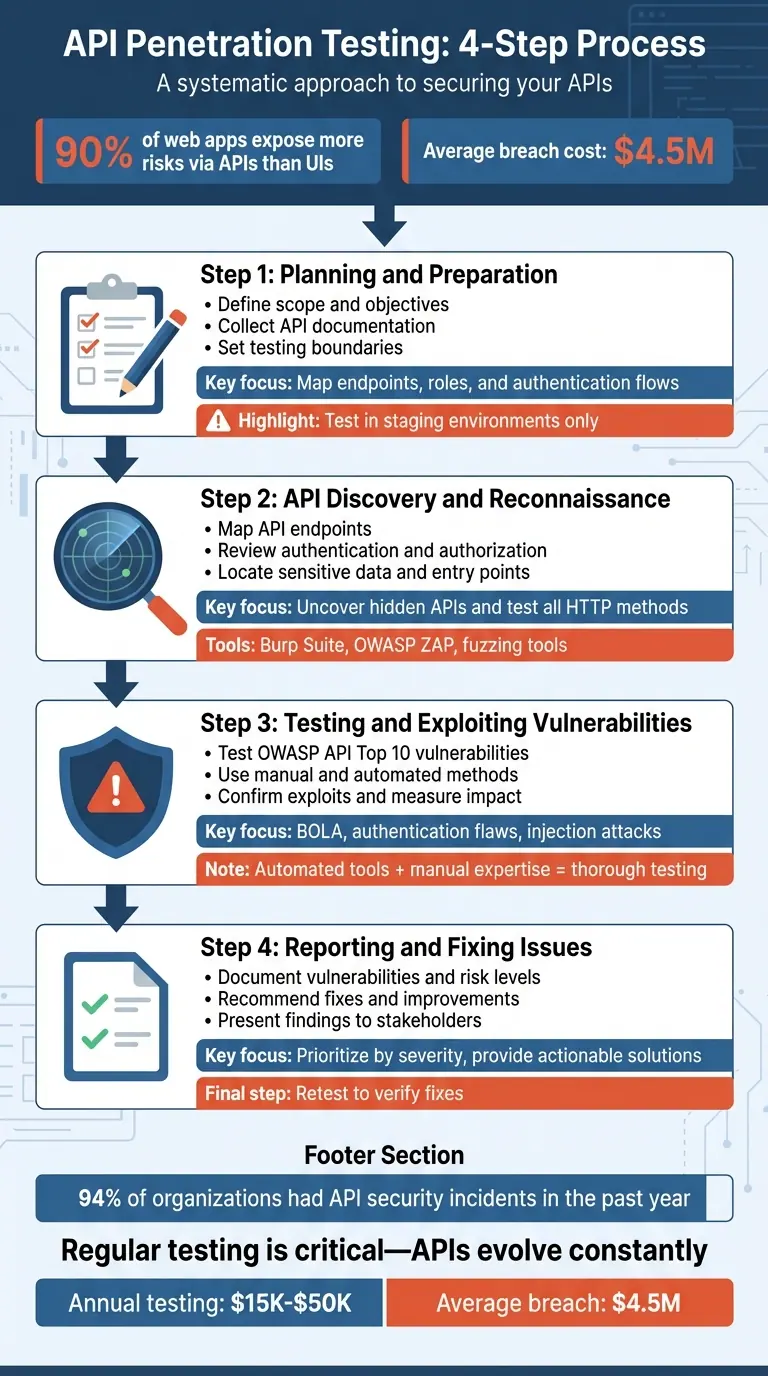
4-Step API Penetration Testing Process Guide
API Security & the OWASP API Top10 - API Penetration Testing - Part 4 of 4
sbb-itb-5f36581
Step 1: Planning and Preparation
A well-thought-out testing plan is the backbone of identifying security gaps during API penetration testing. Start by creating a roadmap that outlines which endpoints to examine, the necessary documentation, and the boundaries for testing.
Define Scope and Objectives
Begin by cataloging all exposed API endpoints, including both documented and "shadow APIs." These undocumented endpoints often lack updated security measures, making them attractive targets for attackers. It’s also essential to identify the API architecture - whether it’s REST, GraphQL, SOAP, or gRPC - since each type demands a unique testing approach.
Next, map out user roles and authentication flows to clarify who should have access to specific resources. Building an access control matrix can help define permissible actions and prevent unauthorized privilege escalation, whether horizontal or vertical. Pay special attention to endpoints that handle sensitive data, such as financial records, personal information, or healthcare-related details.
| Objective Category | Key Focus Areas |
|---|---|
| Scope Definition | Documented vs. undocumented endpoints, API versions (e.g., v1, v2), subdomains |
| Security Controls | Token lifecycle, session management, rate limiting, and encryption (TLS/HSTS) |
| Data Integrity | Input validation, sanitization, and error handling |
| Business Logic | Transactional integrity, sequential request exploitation, parameter manipulation |
Once you’ve mapped endpoints and roles, gather all relevant documentation to streamline the process.
Collect API Documentation
Gathering comprehensive API documentation is a crucial step. Look for Swagger/OpenAPI specifications, developer notes, and architecture diagrams. Common paths like /api-docs, /swagger.json, and /openapi.json on the target server can often provide valuable insights. Additionally, reviewing JavaScript files may reveal hidden endpoints or other sensitive details.
Don’t stop at official documentation - tools like the Wayback Machine can help you uncover older, potentially vulnerable API versions. Searching public repositories for accidentally exposed API keys or configuration files can also highlight security weaknesses. Lastly, securing test accounts with various privilege levels ensures you can thoroughly validate authorization controls for different user roles.
With the documentation collected, the next step is to define safe testing parameters.
Set Testing Boundaries
Establishing clear Rules of Engagement is critical to avoid harming production systems. Always test in a staging environment that closely mirrors production to prevent disruptions. Use cloned data and sandbox API keys to ensure the testing environment is isolated and safe.
Explicitly exclude third-party integrations, like "Login with Google" or "Login with Facebook", unless you have explicit permission to test them. Conduct tests during off-peak hours to minimize operational impact, and set strict limits for potentially destructive checks, such as denial-of-service tests, to maintain system stability.
"Often API developers focus on USE cases when they should focus on ABUSE cases. They test for success when they should be testing for anticipated failures like invalid data and inappropriate access - this is crucial for good API penetration testing." - Tom Pohl, Penetration Testing Team Manager, LMG Security
Step 2: API Discovery and Reconnaissance
Once your testing framework is up and running, the next step is all about mapping the API's attack surface. This phase helps you uncover vulnerabilities by identifying the API's endpoints, authentication methods, and data flows that could be exploited. Here's how you can systematically locate endpoints, evaluate authentication, and pinpoint high-risk entry points.
Map API Endpoints
Start by looking for API documentation files like Swagger/OpenAPI specs at common paths such as /api-docs, /swagger.json, or /openapi.json. These files provide a structural map of the API, though they might not always be up-to-date or complete. Proxies like Burp Suite or OWASP ZAP are excellent tools for capturing real-world endpoint data.
For hidden or undocumented routes, fuzzing tools like KiteRunner, FFUF, or GoBuster can be invaluable. Use targeted wordlists to probe for forgotten or undisclosed paths. Additionally, check client-side JavaScript for hardcoded API URLs. Tools like JSLuice, which rely on Abstract Syntax Trees, can extract these details more accurately than basic regex searches.
When testing endpoints, don’t stop at just one HTTP method. Use all HTTP methods - GET, POST, PUT, DELETE, and OPTIONS. An endpoint may seem secure with one method but expose vulnerabilities with another. For instance, PUT or DELETE requests could reveal administrative functions, while testing different content types (like JSON vs. XML) can highlight inconsistencies in request handling.
| HTTP Method | Security Testing Focus |
|---|---|
| GET | Checking for information leakage or unauthorized data access |
| POST | Verifying input validation and mass assignment issues |
| PUT | Testing for privilege escalation or unauthorized modifications |
| DELETE | Ensuring proper functional level authorization |
| OPTIONS | Uncovering hidden or unsupported methods |
Review Authentication and Authorization
Examine the authentication mechanisms in place - whether the API uses OAuth 2.0, JSON Web Tokens (JWT), API keys, or Basic Authentication. Each method requires tailored testing. For example, ensure that tokens with alg set to none are rejected. Also, test token expiration and revocation mechanisms to confirm that sessions cannot be reused indefinitely.
To test protected endpoints, try removing or altering authentication tokens. Building an access control matrix can help verify that permissions are enforced correctly across user roles. Pay special attention to common vulnerabilities like Broken Object Level Authorization (BOLA). For instance, swap resource IDs (e.g., /api/user/123 to /api/user/124) to ensure proper permissions are enforced.
"API attacks now represent the most frequent vector for enterprise data breaches - with 90% of web applications exposing more attack surface through APIs than user interfaces." - Synack
Locate Sensitive Data and Entry Points
Use Google dorking to search for exposed API documentation or credentials. Queries like site:example.com inurl:/api or inurl:apikey filetype:env can reveal sensitive information. Similarly, check public repositories like GitHub or GitLab for accidentally leaked API keys, passwords, or configuration files - a method often called GitDorking. Even the Wayback Machine can uncover outdated API versions that may still be accessible but lack modern security measures.
Pay attention to error messages as well. Verbose outputs could disclose internal stack traces, database details, or parameter names that help map the backend structure. Tools like Param Miner can test thousands of parameter names per request to find hidden inputs vulnerable to mass assignment. Prioritize endpoints that handle sensitive data like financial records, personal information, or healthcare data, as these are prime targets for attackers.
Step 3: Testing and Exploiting Vulnerabilities
Once you've mapped your API and tested authentication, it's time to dig into potential security weaknesses. This step focuses on identifying and testing vulnerabilities, using a combination of automated tools and manual techniques. The goal is to ensure any risks identified earlier are thoroughly addressed and validated.
Test for OWASP API Top 10 Vulnerabilities
The OWASP API Security Top 10 is an essential guide to the most critical API vulnerabilities. Begin by testing for API1:2023 - Broken Object Level Authorization (BOLA). This issue arises when APIs fail to verify whether a user is authorized to access specific objects. A common test involves altering object IDs in URLs or request bodies. For instance, changing /api/user/123 to /api/user/124 can reveal whether unauthorized access is possible. A real-world example occurred in January 2024, when Trello faced a breach where attackers exploited improper access controls, exposing private email addresses of over 15 million users.
Next, check for API2:2023 - Broken Authentication, focusing on token generation, session handling, and password validation. This includes testing for bypassing authentication, expired tokens, and weak password policies. For API3:2023 - Broken Object Property Level Authorization, examine whether sensitive fields (like isAdmin or password_hash) are exposed in API responses or if unauthorized updates can be made by manipulating parameters such as "isAdmin": true in PUT or PATCH requests.
To test API4:2023 - Unrestricted Resource Consumption, stress-test endpoints with high-frequency requests or oversized payloads to detect Denial of Service (DoS) vulnerabilities. For API5:2023 - Broken Function Level Authorization, simulate privilege escalation by attempting to access admin-level endpoints (e.g., /api/admin/delete_user) using low-privilege tokens. Lastly, for API7:2023 - Server Side Request Forgery (SSRF), supply internal or malicious URIs to see if the server makes unauthorized requests based on user input.
Use Manual and Automated Testing Methods
With reconnaissance complete, combine automated tools with manual testing for a thorough approach. Tools like OWASP ZAP and Burp Suite are great for identifying misconfigurations and testing parameter tampering. However, automated tools often miss complex logic flaws, which is where manual testing becomes crucial.
"Automated tools are fast, but human expertise adds the critical layer of insight. Machines may miss subtle flaws, but our specialists catch them." - Uproot Security
For manual testing, tools like Burp Suite's Repeater or Postman allow you to test scenarios such as removing authorization tokens or modifying user roles in headers. You can also use Burp Intruder with wordlists to uncover hidden endpoints. This combination of automated efficiency and manual precision ensures a robust testing strategy.
Confirm Exploits and Measure Impact
Once vulnerabilities are identified, the next step is confirming their severity through controlled exploitation. This involves creating reproducible Proof of Concepts (PoCs) that demonstrate how security measures fail. For example, you might show how changing a single parameter can exploit a BOLA vulnerability.
Always conduct these tests in isolated staging environments to avoid disrupting production systems or exposing real user data. Document payloads, headers, and responses to ensure reproducibility. Monitoring HTTP response codes is key - for instance, a 200 OK response when access should be denied indicates unauthorized data retrieval, while bypassing a 403 Forbidden suggests weak authorization controls.
When reporting vulnerabilities, frame them in terms of business impact. Instead of saying "Broken Object Level Authorization", explain it as: "An attacker could access and modify any customer's financial records by changing a single number in the URL." This approach helps stakeholders understand the tangible risks. With API attacks now being the most common entry point for data breaches - exposing more attack surfaces than traditional user interfaces - and the average breach costing $4.5 million, emphasizing the real-world consequences makes it easier to prioritize fixes effectively.
Step 4: Reporting and Fixing Issues
After completing thorough vulnerability testing, the next steps - reporting and remediation - are essential for strengthening API security.
Document Vulnerabilities and Risk Levels
Once vulnerabilities are identified, it's crucial to document them in a way that serves both decision-makers and technical teams. Your report should include:
- Executive Summary: Tailored for decision-makers, this section highlights business risks and the overall security posture without delving into technical jargon. For instance, instead of listing "API1:2023 - BOLA", explain how a small tweak to a URL could let attackers access sensitive financial data.
- Technical Details: This section is for developers and includes specifics for each vulnerability: the affected endpoint, HTTP requests and responses, and detailed reproduction steps. Classify findings into categories like Critical, High, Medium, or Low based on their impact and likelihood. Linking each technical issue to its potential business consequences - such as unauthorized data access, service interruptions, or regulatory fines (which under GDPR can exceed $20 million) - adds clarity and urgency.
| Report Component | Target Audience | Key Content |
|---|---|---|
| Executive Summary | Executives/Decision Makers | Business risks, overall risk rating, and high-level impacts |
| Technical Findings | Developers/IT Teams | Detailed descriptions, proof-of-concept steps, and exact payloads |
| Remediation Plan | Developers/Security Teams | Prioritized fixes, technical guidance, and relevant references |
| Risk Assessment | All Stakeholders | Analysis of likelihood, impact, and severity ratings |
Recommend Fixes and Improvements
Address vulnerabilities based on their severity, starting with critical issues like authentication bypasses or unauthorized data access. Provide clear, actionable solutions. For example, instead of a vague suggestion like "improve authentication", recommend specific measures: "Introduce token expiration after 15 minutes and implement multi-factor authentication for admin endpoints."
Where possible, include code-level guidance, refer to OWASP best practices, and ensure solutions align with compliance standards like GDPR, HIPAA, or PCI DSS. It's also worth considering the financial trade-offs: annual proactive testing costs between $15,000 and $50,000, while the average cost of a data breach is $4.5 million. Additionally, publicized breaches can lead to a 3–7% increase in customer churn.
Present Findings to Stakeholders
Once fixes are identified, communicate them effectively to all relevant parties. Developers need precise technical details - payloads, headers, and responses - for patching vulnerabilities. Meanwhile, executives require a clear understanding of the financial and reputational stakes. For example, you might explain to business leaders: "This vulnerability could expose a large volume of customer data, potentially leading to significant regulatory fines and a loss of customer trust."
Finally, after implementing patches, verify their effectiveness by retesting. Re-run the original proof-of-concept steps to confirm that the vulnerabilities are resolved and no new risks have emerged. As part of this process, update your organization's inventory of API endpoints and their associated security requirements to maintain an accurate and secure system.
Conclusion
Key Takeaways
API penetration testing is a structured process divided into four main stages: planning, reconnaissance, active testing, and reporting. Each phase plays a critical role in converting potential vulnerabilities into actionable security improvements.
- Planning focuses on defining the scope, gathering necessary documentation, and setting clear boundaries.
- Reconnaissance involves mapping endpoints, analyzing authentication methods, and identifying sensitive data flows.
- Testing targets vulnerabilities outlined in the OWASP API Top 10, using a mix of automated tools and manual techniques to assess their real-world impact.
- Reporting translates technical findings into actionable recommendations, ensuring fixes are implemented and verified through retesting.
These phases build upon one another, creating a thorough and effective security assessment. While reconnaissance reveals the attack surface, testing uncovers weaknesses, and detailed reporting ensures these gaps are addressed properly. This methodical approach goes beyond basic compliance, emphasizing the importance of a robust and proactive security strategy.
The Need for Ongoing API Security
API security isn’t a one-and-done task - it demands constant attention. As highlighted in the four-phase testing guide, threats evolve rapidly. A staggering 94% of organizations reported an API-related security incident in the past year. Factors like frequent updates from development teams and the presence of undocumented "shadow APIs" make continuous monitoring essential.
"The question isn't whether organizations can afford proper API testing - it's whether they can afford to skip it." – Zuplo
The financial case is undeniable. While annual testing costs are manageable, the expenses tied to breaches and regulatory penalties can be astronomical. Early detection through regular testing not only minimizes risks but also saves money - remediating vulnerabilities during development is far cheaper than addressing them in production, where costs can skyrocket to 100 times more.
FAQs
What are the most common vulnerabilities found during API penetration testing?
APIs often encounter vulnerabilities that can leave systems exposed to risks. Among the most prevalent are broken object-level authorization (BOLA), broken authentication, and broken function-level authorization. These problems typically stem from weak access controls or poorly designed authentication methods.
Other common issues include insecure input validation, mass assignment vulnerabilities, excessive data exposure, and missing or weak rate-limiting controls. If left unchecked, these flaws can result in sensitive data being leaked, unauthorized access to systems, or even denial-of-service attacks. Addressing these vulnerabilities is crucial to securing API functionality.
How can businesses maintain API security after completing a penetration test?
API security isn't a one-and-done task - it requires constant vigilance and ongoing efforts to stay ahead of potential threats. Here's how to keep your APIs secure over time:
- Conduct regular retests: Schedule penetration tests on a consistent basis, like every quarter or after major updates to your code. This helps uncover any new vulnerabilities that may have surfaced.
- Automate security checks: Incorporate security tools into your CI/CD pipeline to automatically scan for issues such as broken authentication or excessive data exposure with every build.
- Keep an eye on API activity: Use real-time monitoring to track traffic patterns, enforce rate limits, log requests, and detect any unusual or suspicious behavior.
- Stay ahead of vulnerabilities: Patch issues quickly, rotate credentials frequently, and revisit your API design and documentation whenever new business logic is introduced.
By blending regular testing, automation, and real-time monitoring, you can maintain a strong defense and ensure your APIs remain secure as your business evolves.
What are shadow APIs, and why do they pose a security risk?
Shadow APIs are those hidden, undocumented, or unmanaged APIs lurking within an organization's infrastructure. Often, they exist without the awareness of security teams. These APIs might emerge unintentionally during development or linger as remnants of outdated systems, making them hard to track and protect.
The security risks they bring are no small matter. Without regular oversight, shadow APIs become easy targets for attackers. They can expose sensitive data, sidestep security measures, and leave your system vulnerable to breaches. Ensuring the safety of your API ecosystem means taking the time to identify and address these shadow APIs before they become a gateway for threats.
Related Blog Posts
Get new content delivered straight to your inbox

The Response
Updates on the Reform platform, insights on optimizing conversion rates, and tips to craft forms that convert.




Drive real results with form optimizations
Tested across hundreds of experiments, our strategies deliver a 215% lift in qualified leads for B2B and SaaS companies.
