
.webp)
Conditional Routing for GDPR-Compliant Forms



Managing GDPR compliance for forms doesn’t have to be complicated. Conditional routing simplifies data collection by tailoring forms to individual users, ensuring you only gather what’s necessary while staying compliant. This approach helps transportation and logistics companies handle sensitive data like geolocation, shipment details, and driver records responsibly.
Key Takeaways:
- Conditional Routing: Dynamically adjusts forms based on user input, showing only relevant fields.
- GDPR Principles Covered:
- Data Minimization: Collect only essential data.
- Purpose Limitation: Use data solely for its intended purpose.
- Lawful Processing: Ensure every data field has a valid legal basis.
- Consent Requirements: Users must actively opt-in with clear, specific consent options.
- Practical Benefits:
- Reduces form complexity, improving completion rates by up to 30%.
- Ensures compliance with GDPR rules like Article 7 and Article 5.
By applying conditional logic, you can streamline complex workflows, protect user privacy, and avoid potential GDPR fines, which can reach up to €20 million or 4% of annual turnover.
GDPR Requirements for Transportation and Logistics Forms
Privacy Concerns in Transportation and Logistics
Transportation and logistics forms deal with a lot of sensitive information. From shipment tracking details and driver identification numbers to precise pickup and delivery locations, invoices, crew manifests, and employee records - these systems handle a wide array of data points. Under GDPR, any information that identifies an individual qualifies as personal data.
One area that needs special attention is geolocation data. As GDPR Advisor explains:
"Managing transportation fleets often involves geolocation data collected through telematics systems. Such data could be deemed personal if these systems track specific drivers regularly." - GDPR Advisor
For example, GPS coordinates can be considered personal data if they are linked to a particular driver.
The challenge of managing this data grows as it moves through supply chains. Manufacturers, freight forwarders, carriers, and customs agents often access the same shipment data, creating a web of interconnected systems. This increases the risk of unauthorized access or data breaches. A single international shipment could involve multiple companies, each handling personal data embedded in documents like bills of lading, waybills, and customs declarations. As GetTransport notes:
"Compliance obligations can change administrative workflows, increase documentation scrutiny at borders, and create new responsibilities for carriers that process personal data embedded in bills of lading, waybills, invoices, and crew manifests." - GetTransport
Obtaining Consent and Legal Basis for Processing
When consent is required, GDPR sets strict standards. Recital 32 states:
"Consent should be given by a clear affirmative act establishing a freely given, specific, informed and unambiguous indication of the data subject's agreement... Silence, pre-ticked boxes or inactivity should not therefore constitute consent." - Recital 32, GDPR
This means pre-checked boxes for marketing or notifications are not allowed. Users must actively check boxes to show their agreement.
However, consent isn't always the only legal basis for processing data. Under Article 6, companies can process data based on contract performance, legal obligations, or legitimate interests. The key is aligning the right legal basis with the specific data being processed. For instance, a driver's phone number used for delivery coordination falls under contract performance, while using the same number for marketing texts requires explicit consent. Forms must clearly communicate the legal basis for each data field. Articles 13 and 14 require companies to inform individuals - using plain language - about who is processing their data and why.
For high-risk activities like real-time GPS tracking or background checks, explicit consent is mandatory. Conditional routing can help here by displaying specific consent fields only when necessary. For example, a driver signing up for basic deliveries wouldn't see a GPS tracking consent field, but one opting for real-time dispatch would. It's also essential that all parties in the supply chain have clear contractual agreements outlining their roles as data controllers or processors.
Setting Up Conditional Routing in Reform for GDPR Compliance
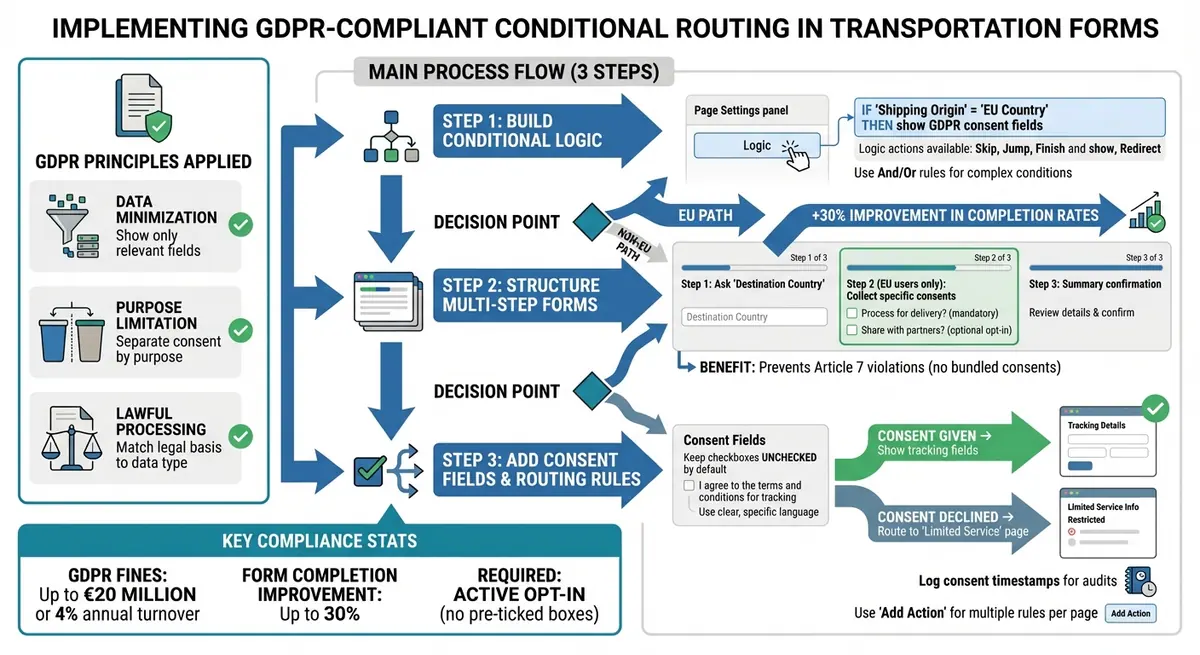
GDPR-Compliant Conditional Form Routing Process for Transportation Companies
To align with GDPR's data minimization principles, you can use Reform's conditional routing and multi-step forms to collect only the data that's necessary, tailored to specific user inputs.
Building Conditional Logic in Reform
Reform's conditional logic tools are located in the Page Settings panel on the right side of each form step. By clicking "Logic", you can create rules based on earlier responses. For instance, in a freight quote form, you might set a rule like: if the "Shipping Origin" field equals "EU Country", then display GDPR-required consent fields. This ensures compliance by adding consent fields only when working with data from EU residents.
Reform offers several logic actions - Skip, Jump, Finish and show, and Redirect - which you can combine using And/Or rules. For example, you could show a tracking consent field only when the user selects both "EU Country" and real-time dispatch options.
Studies on dynamic forms suggest that routing users who decline consent to a basic quote (without tracking) can improve completion rates by 30%. This method adheres to GDPR by focusing on collecting only the most essential data.
Using Multi-Step Forms for Better Compliance
Multi-step forms take compliance a step further by breaking data collection into clear, manageable sections. This approach not only reduces user fatigue but also helps separate data into categories that meet GDPR standards. Including a progress bar and descriptive labels like "Privacy Consent" and "Shipping Details" can make the process more transparent for users.
For example, in a global shipping form, Step 1 could ask for the "Destination Country." If the user selects an EU country, they would proceed to Step 2, where specific consents are collected, such as "Process for delivery? Yes/No" (mandatory) and "Share with partners? Opt-in" (optional). Non-EU users could skip directly to Step 3, which provides a summary. This structure avoids bundling consents - an Article 7 violation - and ensures a smoother user experience while maintaining compliance.
Adding Consent Fields and Routing Rules
When adding consent fields in Reform, keep checkboxes unchecked by default and use clear, straightforward language. In the logic settings, you can link consent responses to specific outcomes. For example, if a respondent selects "EU Resident: Yes" and provides consent, additional tracking fields could appear. If consent isn’t given, the form could route the user to a "Limited Service" confirmation page that collects only the minimum data required.
Reform also supports integrations that log consent timestamps, which is particularly useful for audits like Data Protection Impact Assessments in high-risk industries such as logistics. Using the Add Action feature, you can set multiple rules on the same page. For instance, users who decline mandatory consent can be redirected to an external Privacy Policy page, while those who consent can continue through the form.
For more advanced features like team access, file uploads, or custom CSS, Reform's Pro Plan is available for $35/month or $350/year, offering additional tools to enhance form functionality and compliance efforts.
sbb-itb-5f36581
Best Practices for Conditional Routing and GDPR Compliance
Reducing Data Collection with Logic Branches
To fine-tune your conditional routing setup, focus on logic branches to limit data collection - an essential aspect of GDPR compliance. By hiding fields that don't apply to a user's specific path, you ensure you're only gathering the data necessary for their transaction. For instance, if a user selects domestic shipping, skip irrelevant fields meant for international shipments.
Make fields required only when they're relevant and clearly explain their purpose (e.g., "Cargo details for shipment tracking"). If a user opts out of non-essential data processing, direct them to a simplified path that collects only the minimum information needed to complete their request. This method not only ensures compliance but also improves form completion rates by 30%.
Writing Clear Consent Options
Separate consent purposes into individual checkboxes, leaving them unchecked by default. Use straightforward, specific language, such as "I consent to processing my data for shipment tracking" for operational purposes or "I consent to receiving marketing emails about new services" for promotional communication. Avoid ambiguous terms like "may" or "possibly", as users must understand exactly how their data will be used.
Keep in mind that bundling consents violates GDPR Article 7(4), as it makes consent conditional rather than voluntary. Never require marketing consent for access to a service. Instead, route users who agree to marketing into a branch that gathers their communication preferences, while others proceed directly to the booking confirmation. Place consent checkboxes above the submit button with clear, site-specific text, like "I consent to [Your Company] storing my data to respond to this inquiry".
Testing and Monitoring Your Forms
Once your logic branches and consent options are set up, test every possible submission scenario to ensure compliance and optimize performance. Run tests for different cases, such as EU versus non-EU users, users who consent versus those who decline, and edge cases like partial opt-ins. Confirm that sensitive fields - like home addresses or phone numbers - only appear when absolutely necessary for the requested service. Also, check that your consent logging is functioning properly.
After launch, use tools like Reform's real-time analytics to monitor consent rates and data flow. Low consent rates could indicate that your language is too complex or your form is asking for excessive information. Regularly review your logic branches to ensure they align with your business needs and don't collect unnecessary data. Additionally, enable auto-delete features to remove form entries after transferring data to your CRM, reducing data retention obligations. For high-risk operations, such as managing health-related cargo, conduct Data Protection Impact Assessments to confirm your setup meets regulatory standards.
Conclusion: Simplifying GDPR Compliance with Conditional Routing
Conditional routing makes GDPR compliance more manageable, transforming potential risks into opportunities for transportation and logistics businesses. By tailoring forms to show only relevant fields based on user inputs - like displaying international shipping details only when needed - you ensure compliance with GDPR Article 5 by collecting only the necessary data. This not only safeguards your organization from violations but also keeps operations running smoothly.
This method significantly improves user experience, increasing form completion rates by up to 30% by removing irrelevant questions and reducing friction. Geo-based routing adds another layer of efficiency, allowing businesses to enforce GDPR requirements only when applicable, helping maintain conversion rates for non-EU traffic.
Reform's platform takes these benefits even further. With features like "Skip this page" logic and tailored consent steps available in the Pro Plan, compliance becomes easier to manage. Multi-step forms with progress indicators keep users engaged, even in sections heavy with compliance requirements. Plus, real-time analytics provide insights into consent rates, helping you pinpoint areas for improvement and refine the process.
FAQs
When do logistics forms need explicit GDPR consent?
When logistics forms collect personal data for activities such as marketing, profiling, or anything requiring user approval, explicit GDPR consent is mandatory. This consent must meet specific criteria: it must be freely given, specific, informed, and unambiguous to align with GDPR requirements.
How can I map each form field to a GDPR legal basis?
To ensure GDPR compliance, each form field should be linked to a specific lawful basis for data processing, such as consent, contractual necessity, or legitimate interests. Here's how you can approach this:
- Identify the purpose of each field: Understand why you're collecting the data and how it will be used.
- Match the field to a lawful basis: Align the purpose with the most appropriate legal basis. For example, fields required to fulfill a contract would fall under contractual necessity, while optional fields might rely on user consent.
- Document the mapping: Keep a clear record of how each field aligns with its legal basis for future reference.
For fields relying on consent, it's critical to use clear opt-in mechanisms. This means users should actively agree, such as by checking a box, rather than being automatically enrolled. Additionally, design your forms to clearly communicate the legal basis for data collection, ensuring transparency and trust with users. This approach not only supports compliance but also builds confidence in your data practices.
How can I prove and audit consent later?
To maintain and verify consent, it's essential to securely store detailed records. These should include timestamps, the specific purposes for consent, and any withdrawal options given. Regularly reviewing and updating these records ensures everything stays compliant with regulations.
Automated tools can simplify the process by organizing and safeguarding consent data. Adding layers of security - like encryption, strict access controls, and audit trails - not only protects this sensitive information but also makes audits smoother and more efficient.
Related Blog Posts
Get new content delivered straight to your inbox

The Response
Updates on the Reform platform, insights on optimizing conversion rates, and tips to craft forms that convert.




Drive real results with form optimizations
Tested across hundreds of experiments, our strategies deliver a 215% lift in qualified leads for B2B and SaaS companies.
