
.webp)
Conditional Routing for Privacy Compliance



Conditional routing is a smart way for government agencies to handle sensitive data securely and comply with federal privacy laws. By using logic-based workflows, forms can automatically direct submissions based on user input, ensuring data is only shared with authorized personnel. This reduces risks like over-collection, mishandling, or unauthorized access to personal information.
Key takeaways:
- What It Is: Conditional routing uses rules to customize form behavior and securely route data.
- Why It Matters: It helps agencies meet strict privacy laws like the Privacy Act, HIPAA, and FISMA.
- How It Works: Data is categorized by sensitivity, shown only when needed, and routed securely to the correct recipient.
Agencies can use platforms like Reform to simplify this process, ensuring compliance with privacy regulations while protecting sensitive information.
Federal Data Protection Laws and Compliance Challenges
Key Federal Data Protection Laws
Federal agencies operate under strict guidelines to ensure data protection, adhering to frameworks like FISMA, FedRAMP, HIPAA, FERPA, and Executive Order 13556. These regulations outline specific security and privacy requirements:
- FISMA (Federal Information Security Modernization Act): Focuses on safeguarding federal information systems through risk-based controls and continuous monitoring.
- FedRAMP (Federal Risk and Authorization Management Program): Establishes a standardized approach for security assessments and authorizations for cloud service providers, requiring adherence to NIST SP 800-53 controls and third-party evaluations.
- HIPAA (Health Insurance Portability and Accountability Act): Governs the handling of protected health information (PHI), emphasizing safeguards for data use, disclosure, minimal data collection, and breach notifications.
- FERPA (Family Educational Rights and Privacy Act): Protects the privacy of student education records.
- Executive Order 13556: Addresses the protection of Controlled Unclassified Information (CUI), which requires additional safeguards beyond standard personally identifiable information.
These frameworks demand stringent measures like encrypting data both at rest and in transit, maintaining detailed audit trails, enforcing secure HTTPS connections (including HTTP Strict Transport Security), and implementing robust role-based access controls. These requirements form the foundation for tackling compliance challenges in data collection.
Common Data Collection Compliance Problems
Traditional data collection methods often fall short when it comes to meeting modern compliance standards, exposing agencies to unnecessary risks. Here are some of the most common issues:
- Over-collection of Data: Many forms collect excessive information, lacking conditional logic to hide irrelevant fields. This increases the risk of exposing sensitive data unnecessarily.
- Inadequate Data Routing: Poor routing mechanisms can result in sensitive information being accessed by unauthorized personnel, violating security protocols.
- Lack of Role-Based Access Controls: Without proper access controls, all users may have visibility into sensitive data, undermining required security measures.
- Insufficient Encryption: Legacy systems often fail to encrypt data during transmission and storage, leaving information vulnerable to breaches.
- Weak Audit Trails: Without comprehensive audit logs, tracking data access becomes difficult, complicating breach investigations and compliance with guidelines like OMB Memorandum M-17-12.
- Consent and Transparency Issues: Traditional systems struggle to clearly obtain user consent or provide transparency about how data will be used, which conflicts with federal privacy regulations.
Addressing these gaps is critical for agencies to align with federal data protection standards and ensure the security and privacy of sensitive information.
How to Set Up Conditional Routing for Privacy Compliance
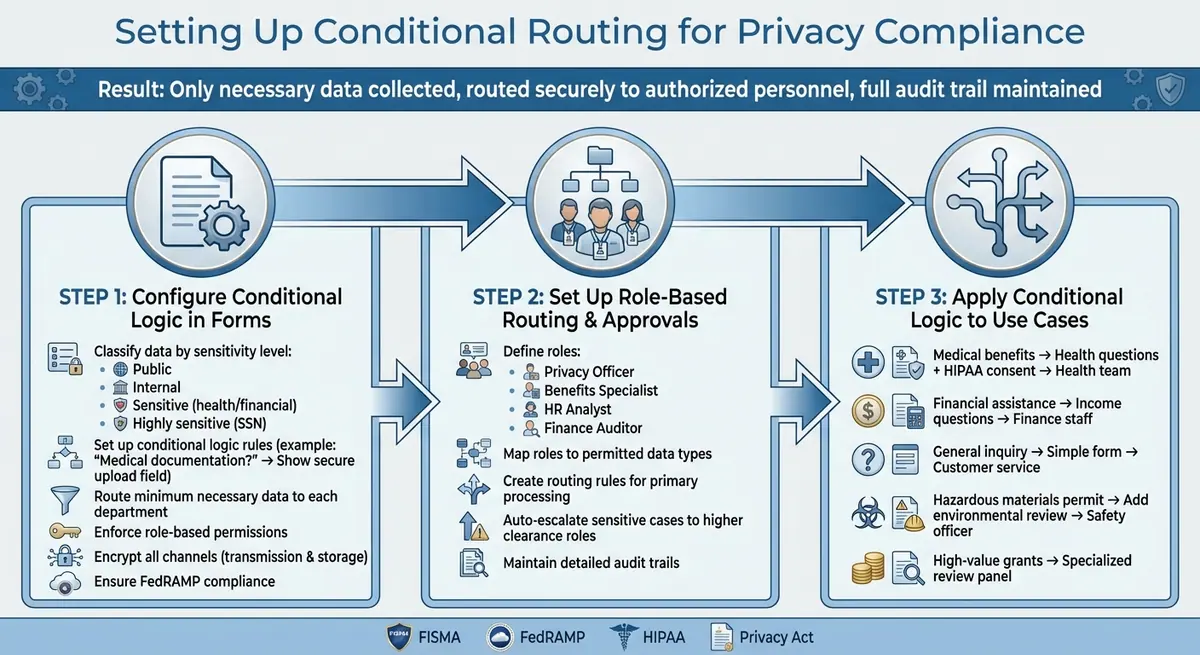
How to Set Up Conditional Routing for Privacy Compliance in Government Forms
Configuring Conditional Routing in Forms
Start by identifying and classifying each data element based on its sensitivity and the legal requirements it falls under. For instance, categorize data as public, internal, sensitive (like health or financial information), or highly sensitive (such as Social Security numbers) in line with regulations like the Privacy Act of 1974, HIPAA, and other relevant laws.
Set up conditional logic rules to dynamically adjust forms based on user input. For example, if a user answers "Yes" to "Are you submitting medical documentation?", the form should automatically display a secure upload field and a consent statement while hiding unrelated options. Configure routing to ensure only the minimum necessary data is sent to each department, and enforce role-based permissions to limit access to sensitive fields. This ensures that only authorized personnel can view specific information, adhering to the principle of limiting access to what is strictly required.
All submission channels - whether through emails, dashboards, or APIs - must be encrypted both during transmission and while stored. Additionally, ensure that any cloud services used comply with FedRAMP standards appropriate for your impact level. Once field permissions are secured, use role-based routing to further control who can access particular data.
Setting Up Role-Based Routing and Approvals
Define roles such as Privacy Officer, Benefits Specialist, HR Analyst, or Finance Auditor, and map these roles to the types of data they are permitted to access under your internal policies and applicable laws. Create routing rules so that initial submissions are directed to a primary processing role, while cases flagged as sensitive - like those involving medical or financial hardship - are automatically escalated to roles with higher sensitivity clearance. For example, complex contracts requiring legal review should trigger additional approvals or escalations only when necessary.
In 2023, a state health department implemented conditional logic and routing in a public health reporting form. Submissions related to infectious disease outbreaks were automatically routed to the Epidemiology Division, while non-urgent reports were sent to a general intake queue. This system improved response times and ensured that sensitive medical data was handled exclusively by trained public health staff, maintaining HIPAA and state privacy compliance. [SimpliGov Legal & Operations for Government, 2023]
Leverage a platform that supports multi-step workflows and conditional routing to build role-based processes. Use these tools to maintain detailed audit trails, which are invaluable for investigations and reporting requirements in the event of a privacy incident.
Conditional Logic Examples for Government Use Cases
Once roles are defined, use conditional rules to customize forms for specific government functions. For instance, create a branching structure where the user’s initial selection determines the following questions. If someone chooses "Medical benefits", display health-related eligibility questions, include a HIPAA-compliant consent statement, and route the form to a dedicated health team. For "Financial assistance", reveal income and asset-related questions and direct the submission to finance staff. If "General inquiry" is selected, keep the form simple and send it to a general customer service queue.
In permitting and licensing scenarios, route general business license applications to a licensing officer by default. However, if the applicant indicates they handle hazardous materials, add an environmental review step and notify a safety officer prior to approval. Similarly, for grant management, route applications exceeding a specific funding threshold or involving human subjects research to a specialized review panel or legal team, while routine grants go directly to program staff for approval. These practices align with federal guidelines emphasizing the collection of only the data necessary to fulfill a specific purpose.
Best Practices for Privacy Compliance with Conditional Routing
Collecting Only Necessary Data with Conditional Logic
When it comes to handling personally identifiable information (PII), less is more. Agencies are expected to follow the principle of data minimization, which means gathering only the bare minimum of information needed to fulfill a specific purpose. Conditional logic makes this easier by showing sensitive fields - like Social Security numbers, health details, or financial information - only when absolutely necessary based on a user's prior responses. For example, high-risk fields should only become required if a legitimate need is identified.
To stay organized, classify each field by its sensitivity level and ensure every conditional rule is backed by a documented purpose in the system's privacy assessment. If simpler alternatives exist, design alternate paths to avoid collecting high-risk data altogether. Regular reviews with privacy and security officers can help identify and remove unused or excessive fields, keeping the system aligned with legal frameworks like the Privacy Act and the Paperwork Reduction Act. These practices not only reduce unnecessary data collection but also set the stage for secure handling.
Securing Data Transmission and Storage
Protecting data during transmission and storage is non-negotiable. Conditional routing must operate within secure channels, meaning HTTPS with HSTS should always be enforced to guarantee encryption and block insecure protocols or weak ciphers, as outlined in federal guidelines. Data such as PII and Controlled Unclassified Information must also be encrypted at rest using federally approved algorithms and managed keys, adhering to FISMA and NIST standards.
Routing rules should never compromise these safeguards. For instance, sensitive details should never be included in email notifications. Instead, users should be directed to log into a secure system to access detailed information. Additionally, audit logs must be maintained to track access, modifications, and routing decisions, ensuring accountability and enabling thorough investigations when needed.
Getting User Consent and Maintaining Transparency
Once the data is securely transmitted and stored, the next step is ensuring users are informed and their consent is obtained. At the start of any form, provide clear notices explaining what data is being collected, why it’s needed, how it will be used (e.g., "Your application may be shared with the Grants Office and Finance Department to process your request"), and the legal authority behind these actions.
If conditional routing means data will be shared with additional parties - such as for legal or fraud investigations - users should be notified dynamically before submitting the form. For optional programs or communications, include explicit consent checkboxes, and make sure the system records timestamped consent tied to the specific version of the notice. Finally, ensure privacy policies are easy to find on every page of the form. This transparency fosters trust and demonstrates a commitment to respecting user privacy.
sbb-itb-5f36581
How Reform Supports Privacy Compliance with Conditional Routing
Reform Features for Privacy Compliance
Reform's no-code platform is designed to help agencies meet federal privacy requirements through its dynamic features like conditional logic, multi-step forms, and strong data protection measures. With conditional logic and routing, agencies can display sensitive fields only when legally required and direct submissions to the appropriate personnel based on risk levels. Multi-step forms allow for progressive disclosure, starting with basic details and revealing PII fields only when absolutely necessary. Additionally, field-level encryption and secure data transmission align with FISMA and NIST standards, ensuring confidentiality and data integrity.
To further safeguard sensitive data, Reform uses role-based access controls, limiting data visibility to authorized personnel. Detailed audit logs track every interaction, modification, and routing decision, which is essential for meeting Privacy Act requirements. Features like email validation and spam prevention block bots and malformed data, reducing the risk of storing incorrect or harmful information. Agencies can also customize or disable lead enrichment to avoid collecting unnecessary personal data beyond their legal scope.
These features collectively enable agencies to implement precise, role-based routing configurations tailored to their compliance needs.
Setting Up Conditional Routing in Reform
To configure conditional routing in Reform, agencies begin by defining sensitivity tiers based on the type of data being collected. Using Reform’s intuitive interface, routing rules can be established. For example:
- General inquiries can be directed to a public inbox.
- Applications involving income data can be routed to a restricted caseworker queue.
- Submissions containing health information can be sent exclusively to privacy-trained staff with HIPAA knowledge.
For FOIA requests, conditional logic can uncover identity-confirmation fields only when the requester specifies they are seeking records about themselves or another individual. These submissions can then be routed to a privacy officer, while general FOIA inquiries are sent to the standard FOIA team. The process involves building questions, applying logic to show or hide fields, mapping data categories to authorized recipients, testing each pathway, and documenting the configuration for review by a privacy officer.
Once the routing rules are in place, Reform’s analytics ensure complete oversight of submissions.
Tracking and Auditing Submissions with Reform
Reform provides real-time analytics and continuous logging, capturing details like submission timestamps, IP addresses, and the logic paths followed. This creates a comprehensive audit trail, which is invaluable for responding to Privacy Act access requests or conducting internal reviews. Agencies can trace exactly how and why data was routed, ensuring transparency and accountability.
Logs can be exported or integrated with SIEM tools to document compliance efforts. For records management, Reform’s reporting features support retention schedules by identifying submissions ready for disposal, helping agencies avoid storing data longer than necessary. This robust auditing capability demonstrates to oversight bodies that PII handling is actively tracked and managed responsibly throughout the entire lifecycle of the form.
Conclusion
Conditional routing plays a key role in helping agencies collect only the data they truly need while ensuring submissions are directed to the right personnel. By dynamically showing or hiding form fields based on user responses, this method reduces unnecessary data collection and limits the chances of unauthorized access or security breaches.
Reform takes these routing principles a step further by offering an intuitive way to configure conditional routing for sensitive data. With no technical expertise required, agencies can easily set up routing rules. Features like email validation and spam prevention help maintain high data quality, while real-time analytics and detailed audit logs provide the transparency necessary for Privacy Act compliance and incident management.
Moreover, strong role-based controls and thorough audit logs ensure every routing decision is documented. This creates a clear trail of accountability, which is essential for audits and reviews, showcasing responsible handling of personal information throughout its lifecycle. Such tracking not only supports compliance but also reinforces trust in the agency's data management practices.
FAQs
How can conditional routing in forms help government agencies ensure privacy compliance?
Conditional routing enables forms to adapt based on user inputs or choices, guiding them through tailored paths. This approach ensures that sensitive or protected information is only requested when absolutely required, helping government agencies stay aligned with federal data protection laws. By limiting data collection to what’s directly relevant, it reduces privacy risks and helps meet the requirements of regulations like the Privacy Act.
Tools like Reform make it simple for agencies to integrate conditional logic into their forms, offering users a seamless and secure experience while upholding compliance standards.
What challenges do government agencies face with traditional data collection methods?
Government agencies frequently face challenges with outdated data collection practices, which can complicate compliance with federal data protection laws. These older methods often rely on manual processes, increasing the risk of human error and improper handling of sensitive information. On top of that, traditional forms typically lack conditional routing, making it harder to gather only the necessary data based on user input.
Modern tools like Reform offer a solution by introducing conditional routing, which simplifies data collection, minimizes mistakes, and strengthens privacy safeguards. This not only ensures secure, regulation-compliant data handling but also creates a smoother, more efficient experience for users.
How does Reform help set up conditional routing to support privacy compliance?
Reform makes setting up conditional routing in forms straightforward, letting you direct responses based on specific rules or conditions. This ensures that sensitive information is managed properly, aligning with federal data protection laws.
By customizing how information flows, you can gather only the data you need from respondents while upholding privacy standards. Reform's user-friendly platform simplifies configuring these rules - no coding required - making the process smooth and compliant.
Related Blog Posts
Get new content delivered straight to your inbox

The Response
Updates on the Reform platform, insights on optimizing conversion rates, and tips to craft forms that convert.


Drive real results with form optimizations
Tested across hundreds of experiments, our strategies deliver a 215% lift in qualified leads for B2B and SaaS companies.
