
.webp)
How CCPA Impacts E-Commerce Marketing


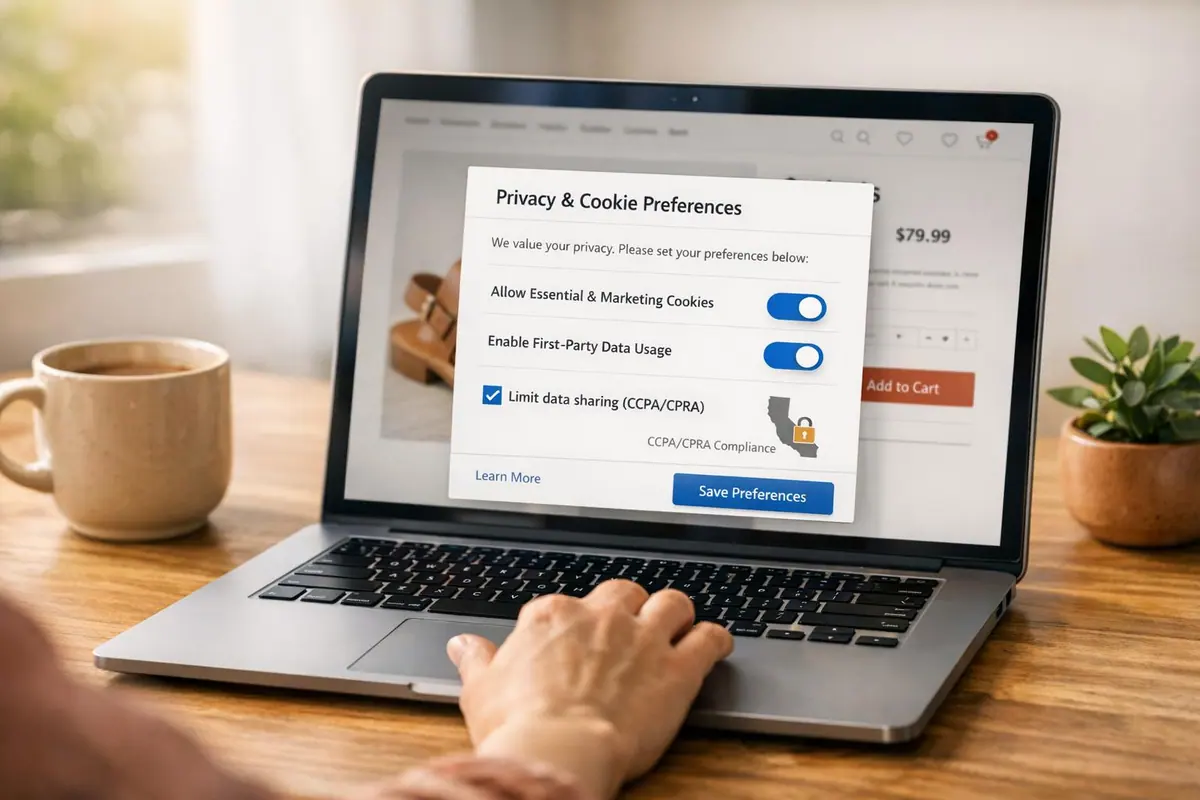
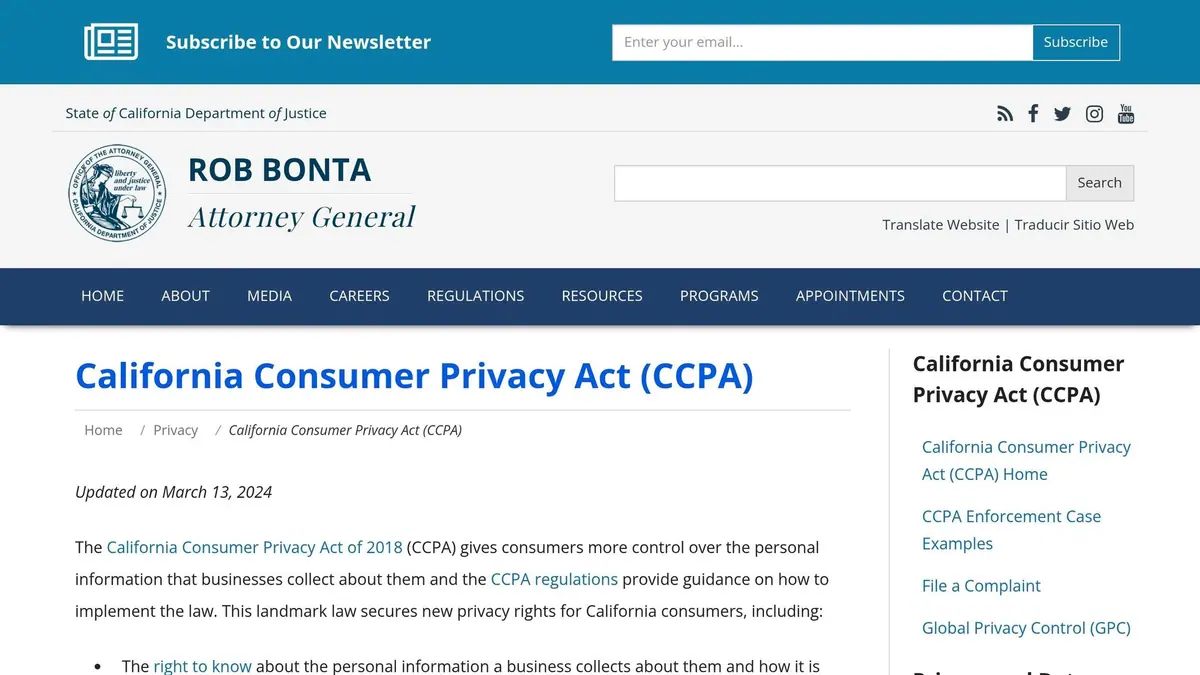
The California Consumer Privacy Act (CCPA), effective since 2020, has reshaped how e-commerce businesses collect, use, and share customer data. It grants California residents rights like knowing what data is collected, requesting its deletion, and opting out of its sale. Non-compliance can result in fines up to $7,500 per violation. In 2023, the California Privacy Rights Act (CPRA) introduced stricter rules, especially for sensitive data and behavioral advertising, pushing businesses toward transparency and consent-based practices.
Key takeaways:
- Data Collection: Businesses must minimize data collection and focus on first-party data instead of third-party sources.
- Consumer Rights: Californians can access, delete, or limit the use of their data. Websites must display clear "Do Not Sell or Share My Personal Information" links.
- Compliance Costs: Penalties for violations are steep, and businesses face increasing requirements, such as cybersecurity audits starting in 2026.
- Marketing Strategies: Marketers now rely on high converting forms and consent-aware tools, zero-party data (voluntarily shared by customers), and privacy-focused personalization.
The shift emphasizes building trust through clear privacy practices while balancing compliance with effective marketing.
California Consumer Privacy Act (CCPA) and Amendments (CPRA) | Exclusive Lesson
sbb-itb-5f36581
1. Marketing Before CCPA
To understand how the California Consumer Privacy Act (CCPA) changed the game, it’s important to look back at how marketing worked before it came into play.
Data Collection Practices
Before CCPA became law in 2020, e-commerce marketers operated in a world with almost no regulatory oversight. As Sayem Mustafa, Digital Marketing Director at Securiti, put it:
Up until the last 20 years, organizations had free rein and could collect any and all consumer data without any checks and balances.
The strategy was straightforward: gather as much data as possible, often without asking for permission.
Marketers routinely captured everything from browsing history and demographic details to social security numbers, biometric data, and even employment records. Tracking systems were designed to automatically collect user data - often before people even had the chance to opt out. With consumers spending an average of 6 hours and 42 minutes online each day, there was no shortage of data to fuel marketing efforts.
This unrestricted flow of information became the backbone for highly personalized marketing campaigns.
Targeting and Personalization
Before CCPA, marketing revolved around aggressive targeting and detailed user profiling. Marketers relied on behavioral data to create advanced personalization models, often without fully disclosing what was being tracked or how it was being used. Third-party data brokers were key players, enabling cross-platform profiling and sharing user data for retargeting campaigns.
Consent, when it was sought, was often treated as a one-time event. Businesses assumed that a single agreement covered all future data usage and integrations with external vendors. Privacy policies were often written to satisfy legal requirements but rarely reflected actual practices, as marketing and legal teams worked in isolation.
This lack of transparency left consumers with little control, setting the stage for the sweeping changes CCPA would bring.
Consumer Rights and Compliance Costs
Before CCPA, California consumers had few data protections. There were no legal requirements to notify users about cookies or offer opt-out options for data sales. Fundamental rights - like knowing what data was collected, requesting its deletion, or opting out of its sale - simply didn’t exist until CCPA enforcement began. With limited regulations, businesses faced minimal compliance costs and could collect and share data with few restrictions.
2. Marketing After CCPA
Data Collection Practices
The introduction of the CCPA has dramatically changed how e-commerce marketers collect and use data. Two key principles now govern data practices: data minimization and purpose limitation. This means businesses can only gather data that's strictly necessary for its stated purpose. For example, if a customer provides their email for a newsletter, that email can't later be used for promotional campaigns without obtaining new consent.
The law also expanded the definition of "sharing" to include any disclosure of personal information for advertising purposes, even if no money is exchanged. This includes activities like retargeting or creating lookalike audiences. As a result, many e-commerce brands are stepping away from third-party data brokers and tracking technologies, focusing instead on first-party data - information collected directly through customer interactions and CRM systems.
Another layer of complexity involves Sensitive Personal Information (SPI), which includes details like precise geolocation, race, and health data. Companies must now offer consumers the option to "limit use" of such information. Starting in 2026, businesses using AI or machine learning for decisions like dynamic pricing or eligibility determinations will need to provide clear notices and allow users to opt out under Automated Decision-Making Technology (ADMT) regulations. Additionally, businesses are required to respond to verified consumer data requests within 45 days and keep records for at least 24 months.
These changes have forced marketers to rethink their strategies, prioritizing compliance while maintaining effective targeting.
Targeting and Personalization
Marketers now face the challenge of balancing personalized targeting with CCPA compliance. Tools like tracking tags and pixels must wait until a user's consent is explicitly captured. To address this, many businesses are adopting consent-aware analytics that prevent non-compliant tracking from occurring.
Interestingly, adopting transparent privacy practices can yield benefits. For instance, clear privacy policies have been shown to reduce consumer opt-out rates by up to 40%. Anders Uhl, Chief Marketing Officer at ClickPoint Software, highlighted this advantage:
Privacy clarity doesn't reduce leads - it improves them.
Compliance also extends to honoring Global Privacy Control (GPC) signals, which require opt-out requests to be implemented across all platforms within 15 business days. This has encouraged brands to shift toward collecting "zero-party" data - information that customers voluntarily share in exchange for value - rather than relying on inferred data from user behavior.
Consumer Rights and Compliance Costs
Enhanced consumer rights under the CCPA have significantly increased compliance costs for businesses. California residents now have the right to access, delete, correct, and limit the use of their personal data. E-commerce websites must prominently display "Do Not Sell or Share My Personal Information" links, with 72% of users expecting to find these links in website footers or privacy policy headers.
Failure to comply can be costly. Administrative penalties can reach $2,663 per unintentional violation and $7,988 per intentional violation, with higher fines applying to cases involving minors. As of January 2025, businesses with annual gross revenue exceeding $26.625 million are subject to the law, and those handling data from 10 million or more California consumers must include annual data request metrics in their privacy policies.
Looking ahead, mandatory cybersecurity audits will become a requirement for certain businesses starting in 2026. Companies earning over $100 million annually must comply by April 1, 2028, while smaller businesses face deadlines in 2029 and 2030, depending on their revenue. Anders Uhl summed up the shift, stating:
Where the CCPA focused on telling consumers what happens to their data, the CPRA demands proof. Compliance becomes a test of operational integrity.
Pros and Cons
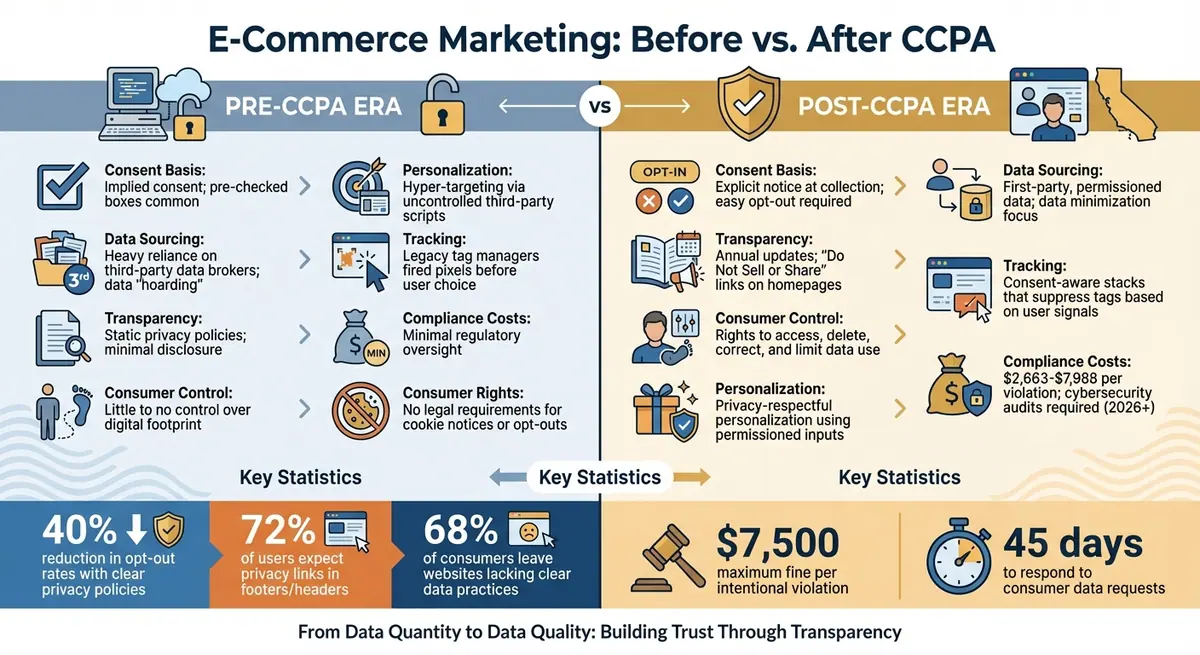
E-Commerce Marketing Before and After CCPA: Key Differences
The transition from pre-CCPA marketing practices to CCPA-compliant strategies has brought a mix of challenges and advantages. While the old methods allowed for unrestricted data collection, the new framework emphasizes building trust and prioritizing data quality over sheer volume.
Pre-CCPA marketing leaned heavily on implied consent, often using pre-checked boxes to gather data without explicit user permission. This approach created an environment where businesses could stockpile customer data "just in case" it might be useful later. However, this led to issues like poor data management, declining consumer trust, and minimal regulatory oversight - leaving companies exposed when laws like the CCPA came into effect.
In contrast, post-CCPA strategies focus on gathering only the data that is necessary, and only with explicit user consent. As Marc Parrish from pii.ai put it:
Privacy is becoming part of growth strategy. Brands that treat it that way will win.
This approach results in cleaner, more actionable data and stronger relationships with customers. However, it also introduces operational complexities and the risk of fines, which range from $2,500 to $7,500 per violation.
The table below highlights the key differences between the pre- and post-CCPA eras:
| Feature | Pre-CCPA | Post-CCPA |
|---|---|---|
| Consent Basis | Implied consent; pre-checked boxes were common, unlike multi-step forms that prioritize engagement. | Explicit notice at collection; easy opt-out required. |
| Data Sourcing | Heavy reliance on third-party data brokers and "hoarded" data. | Focus on first-party, permissioned data and data minimization. |
| Transparency | Privacy policies were often static "legal copy" with minimal disclosure. | Clear, annual updates; "Do Not Sell or Share" links on homepages. |
| Consumer Control | Consumers had little to no control over their digital footprint. | Rights to access, delete, correct, and limit sensitive data use. |
| Personalization | Hyper-targeting based on uncontrolled third-party scripts. | Privacy-respectful personalization using permissioned inputs. |
| Tracking | Legacy tag managers fired pixels before choice was captured. | Consent-aware stacks that suppress tags based on user signals. |
The shift from focusing on data quantity to prioritizing data quality reflects a broader change in marketing philosophy. Adam Bertram, an experienced IT professional, summed it up well:
Privacy regulations like GDPR and CCPA aren't roadblocks - they're guardrails helping us build better, more trustworthy marketing practices.
This evolution lays the groundwork for understanding how Reform supports businesses in meeting CCPA requirements.
How Reform Supports CCPA Compliance

Reform's no-code form builder helps e-commerce businesses meet CCPA requirements while improving lead generation efforts. With its conditional routing feature, businesses can collect only the necessary personal information by customizing form fields based on user responses. This approach aligns with CCPA's data minimization rules.
When California consumers exercise their rights under CCPA - such as requesting access to or deletion of their data - Reform's CRM integrations become invaluable. The law requires businesses to respond to such requests within 45 calendar days, with a possible 45-day extension if the consumer is notified in advance. By integrating with platforms like HubSpot and Salesforce, Reform allows businesses to efficiently track and manage personal data categories, ensuring smooth and systematic handling of deletion requests across service providers. These integrations also help maintain a timely and organized response to consumer data inquiries.
Reform also enhances compliance with its lead enrichment and email validation tools, ensuring the data you collect is accurate and reducing the risk of compliance issues.
To accommodate businesses of all sizes, Reform offers flexible pricing plans. The Basic Plan costs $15 per month (or $150 annually) and includes features like conditional logic and basic integrations. The Pro Plan, at $35 per month (or $350 annually), adds team access, advanced integrations, and support for custom CSS and JavaScript.
Looking ahead, new regulations effective January 1, 2027, will address automated decision-making technologies. If conditional routing influences significant automated decisions, businesses must provide pre-use notices explaining the logic, purpose, and outcomes of these decisions. Reform's Pro Plan customization options make it easy to include these disclosures directly in your forms, helping you stay prepared for future compliance needs.
Conclusion
The California Consumer Privacy Act (CCPA) has fundamentally changed how e-commerce businesses approach data collection and usage. By shifting from third-party tracking to permission-based, first-party data strategies, companies can build stronger customer trust while avoiding steep penalties of up to $7,500 per intentional violation.
To navigate these changes effectively, businesses must find the right balance between compliance and performance. This means implementing clear "Do Not Sell or Share My Personal Information" links, respecting Global Privacy Control signals, and adopting data minimization practices to collect only what’s necessary for improving customer experiences. With 68% of consumers leaving websites that lack clear data practices, transparency can serve as a competitive edge rather than just a legal requirement.
E-commerce marketers who embrace privacy as a core part of the customer experience will have an advantage. Using tools like Consent Management Platforms to automate preference handling, auditing vendor contracts to ensure third-party compliance with privacy signals, and offering preference centers where customers can personalize their experience - such as choosing content recommendations over ad targeting - are all vital steps forward.
Rather than viewing privacy regulations as obstacles, businesses should see them as opportunities to create more trustworthy and customer-focused practices. With thoughtful planning and the right tools, companies can achieve privacy-first personalization, setting themselves up for long-term success in an ever-changing regulatory landscape.
FAQs
Does CCPA apply to my e-commerce store?
If your e-commerce store operates in California, the California Consumer Privacy Act (CCPA) might apply to your business. This law kicks in if your store meets at least one of these criteria:
- Generates over $25 million in annual revenue.
- Collects personal data from 100,000 or more consumers, households, or devices.
- Earns more than 50% of its annual revenue from selling consumer data.
If your business falls under any of these categories, you'll need to ensure compliance with CCPA to avoid potential penalties.
What counts as “selling” or “sharing” data under CCPA?
Under the California Consumer Privacy Act (CCPA), "selling" or "sharing" personal data goes beyond literal sales. It also includes sharing personal information for purposes such as cross-context behavioral advertising or other forms of monetization. To comply, businesses are required to provide consumers with a straightforward option to opt out of these practices.
How can I keep personalization without third-party tracking?
To keep personalization effective without relying on third-party tracking, shift your focus to first-party data collection methods that emphasize user consent. For instance, you can use branded forms, customer surveys, or loyalty programs to gather information directly from your audience.
You can also tap into contextual data, such as on-site behavior or purchase history, to tailor experiences for your customers. This strategy not only respects user privacy but also aligns with regulations like the California Consumer Privacy Act (CCPA). By prioritizing transparency and user trust, you can maintain impactful marketing efforts while honoring privacy concerns.
Related Blog Posts
Get new content delivered straight to your inbox

The Response
Updates on the Reform platform, insights on optimizing conversion rates, and tips to craft forms that convert.



Drive real results with form optimizations
Tested across hundreds of experiments, our strategies deliver a 215% lift in qualified leads for B2B and SaaS companies.
