
.webp)
GDPR vs. CCPA: Consent in Lead Scoring



When it comes to automated lead scoring, GDPR and CCPA set different rules for how businesses can collect and process personal data. GDPR requires explicit opt-in consent for profiling, while CCPA allows data processing by default unless a user opts out. Both laws aim to protect personal data, but their approaches differ significantly:
- GDPR (EU): Opt-in model, stricter consent requirements, and transparency about automated decisions.
- CCPA (California): Opt-out model, with a focus on providing clear ways for users to stop data sharing.
Key takeaways:
- GDPR requires clear, unambiguous consent before processing data for lead scoring.
- CCPA mandates an easy-to-find "Do Not Sell or Share My Personal Information" link for California residents.
- Non-compliance can lead to heavy fines: up to €20M under GDPR and $7,500 per violation under CCPA.
- Businesses must handle data deletion and opt-out requests within specific timeframes (30 days for GDPR, 45 days for CCPA).
To comply, businesses can use geo-targeted forms and unified data management systems to handle both GDPR and CCPA requirements efficiently. By aligning with GDPR's stricter standards, companies can meet most CCPA obligations while ensuring legal compliance across regions.
GDPR Consent Requirements for Lead Scoring
How GDPR Defines Consent
Under GDPR's Article 6, organizations must establish a lawful basis before processing personal data. When it comes to lead generation and automated profiling, this typically means obtaining explicit consent. "Legitimate interest" is not usually appropriate here, as it applies more to existing customer relationships, particularly in B2B settings.
For consent to be valid under GDPR, it must meet four key criteria: it needs to be freely given, specific, informed, and unambiguous. This means using active, unchecked checkboxes for each specific processing purpose. Combining marketing consent with Terms of Service is not allowed, nor is using vague phrasing like, "By submitting this form, you agree to our policies."
"GDPR demands traceability. Consent, purpose, retention, and transfer safeguards must travel with the data itself." - ClickPoint Software
How GDPR Affects Lead Scoring
Lead scoring falls under the category of automated profiling, which is governed by Article 22. This provision grants individuals the right to avoid decisions made solely through automated processing when those decisions have significant effects. For businesses using lead scoring workflows, this introduces two key requirements: transparency about the logic behind the scoring system and the ability for individuals to request human review of automated decisions.
In addition to transparency, GDPR emphasizes data minimization. For example, if a field like "phone number" or "company revenue" doesn’t play a direct role in scoring or routing decisions, collecting it violates GDPR - not just best practices. If a lead withdraws consent or requests data deletion, this action must be reflected across all systems, such as CRMs, enrichment tools, and email platforms. Moreover, organizations are required to respond to Subject Access Requests (SARs) within 30 days. These requests can include a lead's score and the behavioral data used to calculate it. These rules should guide how you design your consent forms. Using a multi-step lead gen template can help organize these requirements without overwhelming the user.
Applying GDPR Consent in Forms
To comply with GDPR's consent and transparency requirements, your forms need to follow specific practices. Each consent field should be distinct, ensuring that consent is clear and defensible.
Every lead record must include a consent log, which should contain a timestamp, the lead source, and a reference to the exact version of the privacy policy the individual agreed to. Without this metadata, proving compliance is nearly impossible. The table below highlights the differences between compliant and non-compliant form setups:
| Form Element | GDPR-Compliant | Non-Compliant |
|---|---|---|
| Checkboxes | Unchecked by default; active opt-in required | Pre-ticked or implied by form submission |
| Consent scope | Specific to each processing activity | Bundled with Terms of Service |
| Data collected | Only fields used for scoring or routing | Excessive "just in case" fields |
| Record keeping | Timestamped log with policy version | Simple true/false flag, no metadata |
Equally important, withdrawing consent should be as straightforward as giving it. Include a visible unsubscribe link or a dedicated privacy email address at the point of data collection. If someone opts out, your lead scoring system must immediately stop processing their data, rather than simply tagging the record and continuing to process it as usual.
sbb-itb-5f36581
CCPA Consent and Opt-Out Requirements for Lead Scoring
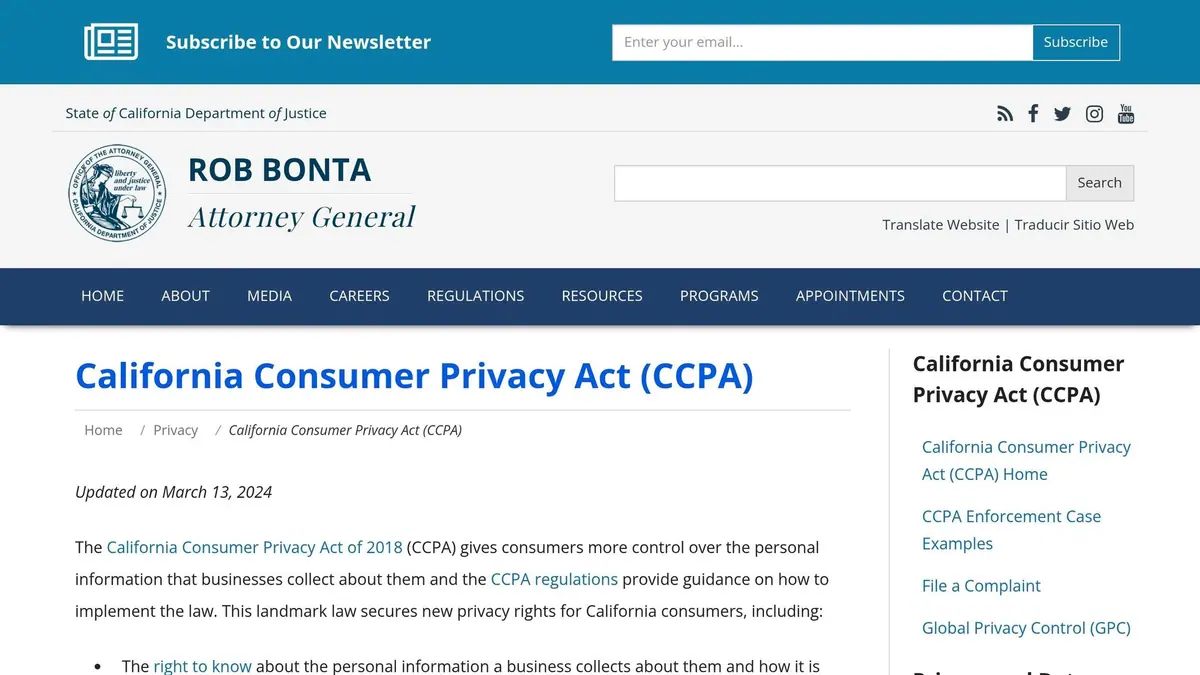
How the CCPA Opt-Out Model Works
The CCPA takes a different approach to consent compared to GDPR. Instead of requiring explicit consent upfront, the CCPA allows data processing by default but mandates that businesses provide a clear and easy way for California residents to opt out of having their personal information processed.
To comply, businesses must prominently display a "Do Not Sell or Share My Personal Information" link on their homepage and at data collection points. When a consumer uses this link, companies have 15 business days to stop sharing their data with third parties, including any systems that contribute to lead scoring.
The CCPA's interpretation of "sharing" is broader than many marketers realize. It includes disclosing personal data for purposes like cross-context behavioral advertising, retargeting, and audience matching.
"The CPRA's definition of 'sharing' includes retargeting, audience matching, and cross-context behavioral advertising - activities nearly all digital marketers engage in." - Anders Uhl, CMO, ClickPoint Software
This opt-out model directly impacts lead scoring by changing how businesses collect and process data.
How CCPA Affects Scoring Workflows
Lead scoring systems often rely on behavioral data and third-party enrichment, both of which can fall under the CCPA's definition of "sharing." If your lead scoring uses data from enrichment vendors, those vendors must qualify as "service providers" under contracts that limit their use of data strictly to the agreed services. Without such contracts, even non-monetary data transfers could be considered a "sale" under the CCPA.
Additionally, lead scoring systems that influence contact prioritization or routing might be regulated as Automated Decision-Making Technology (ADMT). California's finalized regulations in 2025 require disclosures and opt-out options for such systems, with full compliance expected by January 1, 2027.
A notable example of non-compliance occurred in 2025 when Healthline faced a $1.55 million settlement. The company was found to have shared data about users' health conditions and browsing activity with third-party advertisers without providing an adequate opt-out mechanism. This violation underscores the importance of aligning lead scoring models with CCPA requirements.
Steps to Meet CCPA Requirements
To ensure your lead scoring practices comply with the CCPA, consider the following steps:
- Optimize your lead forms: Include a clear notice at collection on all forms targeting California residents. This notice should briefly explain what data is being collected and its purpose.
- Honor opt-out preferences: Update your systems to recognize Global Privacy Control (GPC) signals, which indicate when a user opts out of data sharing.
"Dark patterns invalidate consent; the opt-out option must be as accessible as the sign-up form." - Puntt AI
Both the CCPA and GDPR prohibit the use of "dark patterns" - designs that make opting out harder than opting in. Your "Do Not Sell or Share" link must be as simple and user-friendly as your sign-up process.
- Maintain accurate records: Keep detailed logs of consumer requests and your responses for at least 24 months. Ensure that you respond to data requests within 45 days, with an optional 45-day extension if needed.
CCPA vs. GDPR: What’s the Difference?
GDPR vs. CCPA: Side-by-Side Comparison for Lead Scoring
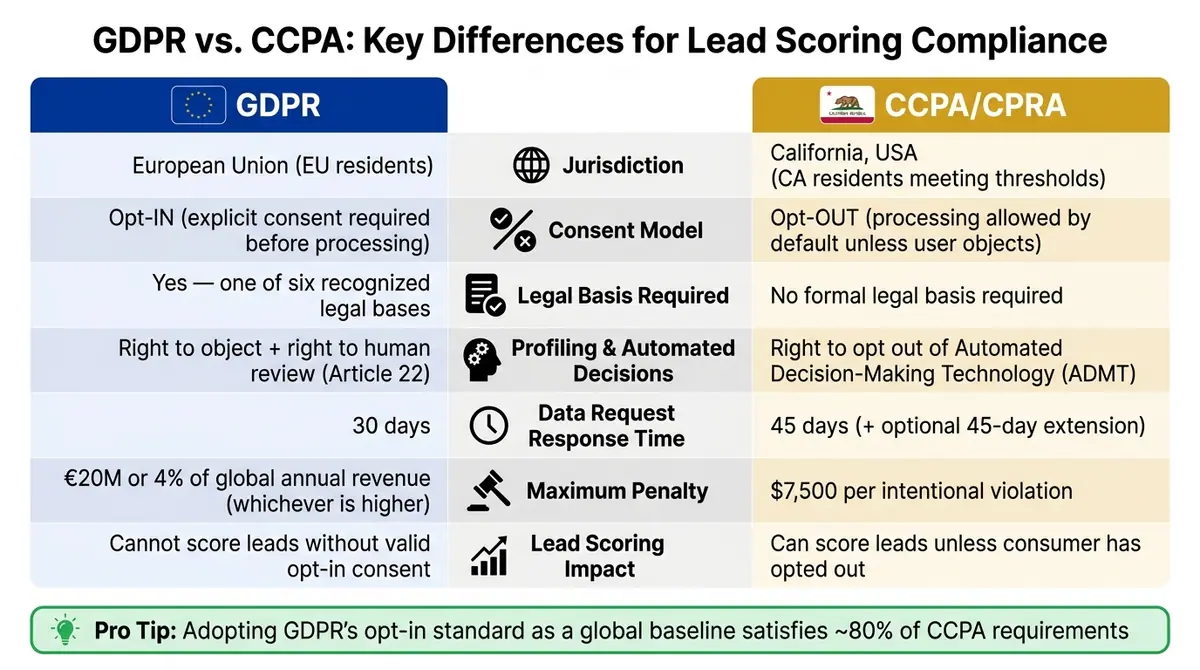
GDPR vs. CCPA: Key Differences for Lead Scoring Compliance
Key Differences and Overlaps
The main distinction between GDPR and CCPA lies in how consent is handled. GDPR operates on an opt-in framework, meaning you can’t score leads without a valid legal basis. In contrast, CCPA uses an opt-out framework, allowing lead scoring by default unless a California resident explicitly objects.
This difference fundamentally influences how you design and implement your lead scoring workflows.
| Aspect | GDPR (EU) | CCPA/CPRA (California) |
|---|---|---|
| Consent Model | Opt-in | Opt-out |
| Legal Basis Required | Yes - one of six recognized bases | No formal legal basis required |
| Profiling Rights | Right to object to profiling and automated decisions | Right to opt out of automated decision-making |
| Data Request Response | 30 days | 45 days |
| Max Penalty | 4% of global revenue or €20M, whichever is higher | $7,500 per intentional violation |
| Who It Covers | All organizations handling EU resident data | Businesses meeting revenue or data volume thresholds |
"GDPR restricts outreach to cases where legitimate interest or explicit consent exists, while CCPA emphasizes quick compliance with opt-out requests." - Artemis Leads
Understanding these distinctions is crucial for creating lead scoring systems that comply with both frameworks while maintaining operational efficiency.
Managing EU and California Leads in One System
Designing a system that handles leads from both the EU and California requires a thoughtful approach. Since GDPR imposes stricter requirements, using its framework as a baseline is a practical starting point. By doing so, you automatically address about 80% of CCPA’s requirements. From there, you can add CCPA-specific elements, such as the "Do Not Sell or Share My Personal Information" link and recognition of Global Privacy Control (GPC) signals.
To avoid forcing all leads through GDPR’s more stringent processes, leverage geo-targeting. For EU visitors, implement an explicit opt-in process, while California residents receive an opt-out notice. This ensures the correct workflow is triggered at the moment a landing page form is submitted.
Streamlining further, a unified Data Subject Request (DSR) intake portal can simplify compliance. This portal can automatically route GDPR access requests (due within 30 days) and CCPA deletion requests (due within 45 days) through a single system. Pairing this with a Consent Management Platform (CMP) ensures accurate tracking of timestamps, legal bases, and opt-out events in real time, helping you stay compliant across both regions.
Building a Consent-Aware Lead Scoring System
Collecting Consent Through Forms
Lead capture forms are your business's first handshake with a potential lead - and the moment where consent compliance either shines or falters. Under GDPR, these forms must collect explicit opt-in consent for lead scoring workflows. Pre-checked boxes? They don’t make the cut. Meanwhile, CCPA requires a clear notice at the point of data collection, explaining exactly what data categories are being gathered and their purpose.
If your scoring model processes data for multiple purposes - like behavioral profiling and newsletter targeting - GDPR mandates separate opt-ins for each purpose. Combining them into one checkbox is a common misstep that can void consent entirely.
Tools like Reform make managing these complexities easier. With conditional routing, Reform customizes consent prompts based on a visitor's location. For example, EU visitors see an explicit opt-in flow, while California visitors receive an opt-out notice - all within the same form. Each submission is meticulously logged with the timestamp, policy version, and consent details, ensuring you’re ready for audits. Plus, withdrawing consent is just as simple as giving it, thanks to Reform’s seamless integrations with CRMs and marketing tools. When a lead withdraws consent, their record is flagged downstream automatically.
This consent data feeds directly into adjustments in your scoring logic.
Adjusting Scoring Logic Based on Consent
Consent status should act as a gating variable in your scoring model. For instance, EU leads should only proceed after providing valid opt-in consent, while California leads can be scored unless they’ve opted out. By mapping consent fields from your forms directly to your CRM or marketing automation platform, these adjustments can happen automatically, eliminating the need for manual intervention.
Sensitive data requires extra caution. GDPR’s "Special Category Data" and CCPA’s "Sensitive Personal Information" - such as precise geolocation or inferred demographics - must be excluded from scoring unless the user has explicitly authorized its use. Screening enrichment data for sensitive attributes before it enters your scoring model is a smart safeguard to implement early on.
This adaptive approach ensures your scoring remains compliant as privacy preferences evolve, tying directly into broader data governance practices.
Keeping Data Governance in Order
Once data is captured and processed, maintaining proper data governance is crucial. This includes strict retention policies, thorough audits, and clear data mapping.
Data mapping involves documenting where personal data enters your systems (like forms, pixels, or third-party tools) and where it’s processed for scoring (CRMs, CDPs, or marketing platforms). This level of transparency is essential for responding to deletion requests or explaining a lead’s score - rights that regulators are increasingly enforcing under Automated Decision-Making Technology (ADMT) rules.
Automated triggers for deletion or anonymization are key to staying compliant. For example, GDPR requires erasure requests to be handled within 30 days, while CCPA allows 45 days for deletion requests. Set up systems to delete or anonymize lead records after their retention window expires. Additionally, limit data access to only those who need it. For instance, sales reps may only need basic contact details, while demand generation teams might require the full scoring profile. This minimizes risk and reduces the impact of potential breaches.
If your scoring system processes over 100,000 leads monthly, GDPR may require you to conduct a Data Protection Impact Assessment (DPIA) before scaling further.
"The accountability principle applies. Organizations self-govern data practices and must demonstrate due diligence when audited." - Improvado
Conclusion
Both GDPR and CCPA aim to empower individuals by giving them control over their personal data. However, they approach this goal differently. GDPR requires explicit opt-in consent, while CCPA permits data processing by default unless the consumer opts out. These distinctions influence how lead generation forms are designed and how CRM systems handle data deletion.
The financial penalties for non-compliance are steep. GDPR fines can reach up to €20 million or 4% of global revenue, whereas CCPA violations may result in fines of $7,500 per incident. While the numbers differ, both represent significant costs, and compliance often involves substantial operational changes.
"The checkbox is 5% of the compliance work. The other 95% is operational: building systems that handle consent, storage, and data rights automatically." - Camellia, Principal Product Marketing Strategist, Rework
Key Takeaways
Understanding the differences between GDPR and CCPA can guide businesses toward better compliance strategies and improved lead quality. For many, adopting GDPR’s stricter opt-in standard as a global practice is the most efficient solution. Since GDPR typically meets CCPA’s transparency and data rights requirements, this unified approach can simplify compliance efforts.
FAQs
Can we use lead scoring under GDPR without opt-in?
GDPR mandates obtaining explicit consent before collecting or processing personal data, which includes activities like lead scoring. If users haven't opted in, employing automated lead scoring systems would breach GDPR regulations.
What counts as “selling or sharing” under CCPA for lead scoring?
Under the California Consumer Privacy Act (CCPA), “selling or sharing” personal information goes beyond just exchanging data for money. It also includes sharing data with third parties for other forms of value, like targeted advertising or other commercial benefits.
Businesses are required to honor opt-out requests from consumers who don’t want their personal information sold or shared. Additionally, they must be transparent about their data practices, ensuring consumers know how their information is being used.
How do we handle GDPR and CCPA in one lead form?
To align with both GDPR and CCPA requirements in a single lead form, you’ll need to address their specific consent and opt-out rules:
- For GDPR: Include a clear, explicit opt-in consent mechanism. Use checkboxes (unchecked by default) for users to agree to data collection and processing. Also, provide a link to your privacy policy for transparency.
- For CCPA: Add a 'Do Not Sell My Personal Information' opt-out option. This ensures users can easily opt out of the sale of their data.
By combining GDPR’s opt-in approach with CCPA’s opt-out rules, you can meet the standards of both regulations. Make sure your privacy policy clearly outlines how data is collected, processed, and stored, as well as users' rights to access, delete, or opt out of data usage.
Related Blog Posts
Get new content delivered straight to your inbox

The Response
Updates on the Reform platform, insights on optimizing conversion rates, and tips to craft forms that convert.


Drive real results with form optimizations
Tested across hundreds of experiments, our strategies deliver a 215% lift in qualified leads for B2B and SaaS companies.
