
.webp)
How Cookieless UX Impacts Lead Generation


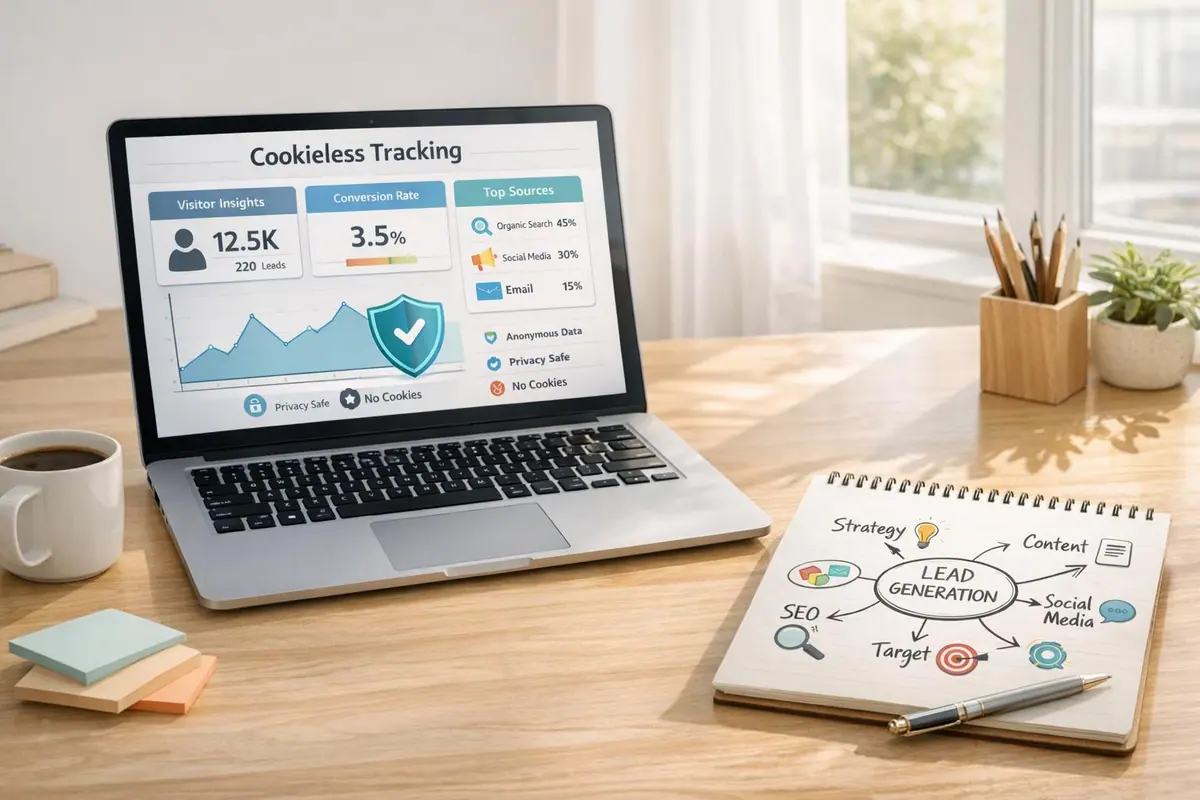
The shift away from third-party cookies is changing how businesses generate leads. With browsers like Safari, Firefox, and now Google Chrome blocking or limiting cookies, marketers face challenges in tracking users, personalizing experiences, and managing ad campaigns. This impacts lead generation by increasing costs, fragmenting customer data, and complicating attribution.
Here’s what you need to know:
- Third-party cookies are being phased out: Safari and Firefox started blocking them years ago, and Google Chrome is following suit. Fewer than 10% of users are expected to opt into tracking.
- Privacy concerns are growing: 86% of users worry about data privacy, and 78% feel uneasy about how much data is collected. Regulations like GDPR and CCPA demand more transparency.
- Lead generation costs are rising: Without cookies, ad targeting and attribution become less precise, leading to higher acquisition costs.
- First-party data is key: Collecting data directly from users through forms, surveys, and CRM systems is now essential for effective marketing.
Businesses need to focus on privacy-compliant tracking, smarter form designs, and strategies like server-side tracking and progressive profiling to maintain lead generation in a cookieless world. The article explores these challenges and solutions in detail.
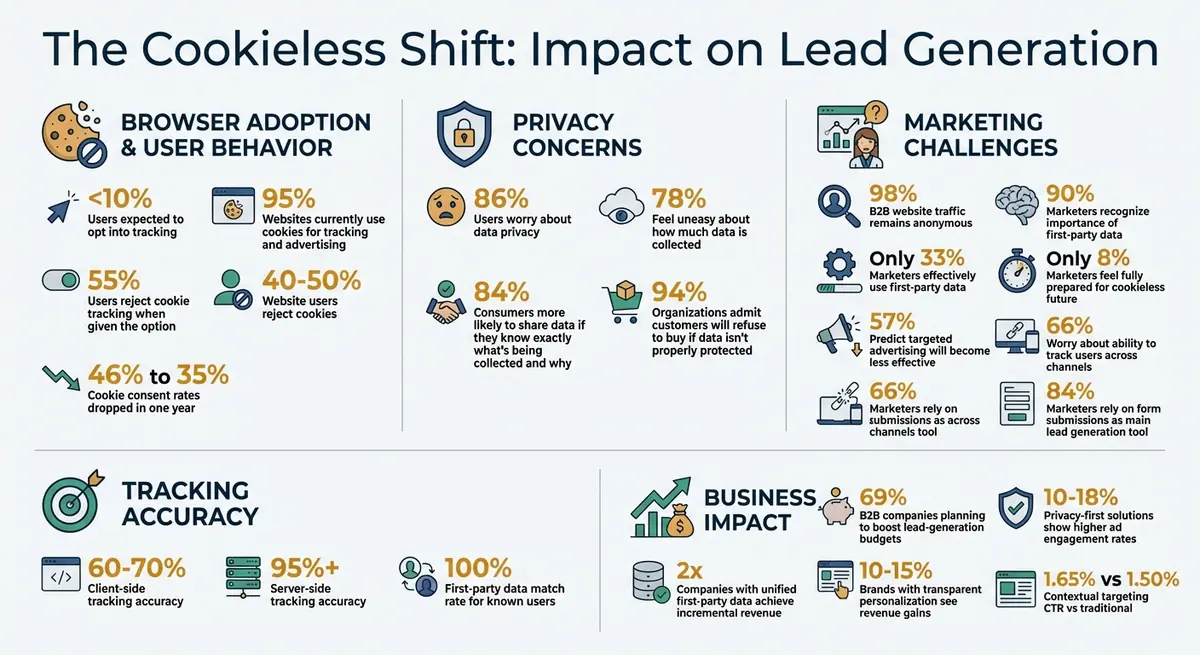
Cookieless Lead Generation: Key Statistics and Impact on Marketing
Surviving the Cookie Apocalypse: Acquiring Customers in a Cookieless World
How Third-Party Cookie Loss Disrupts Lead Generation
The disappearance of third-party cookies has created significant challenges for lead generation. It affects how businesses connect with their audiences, understand user behavior, and manage their advertising budgets. Here's a closer look at how these disruptions play out in areas like personalization, conversion tracking, and cost management.
Loss of Cross-Site Personalization and Retargeting
Third-party cookies have long been the backbone of tracking users across multiple websites. Without them, businesses lose the ability to fully understand user interests and behaviors. Retargeting campaigns, which rely on following users across the web, become far less precise. Currently, about 95% of websites use cookies for tracking and advertising purposes.
Adding to the challenge, Safari's Intelligent Tracking Prevention (ITP) limits first-party cookies set by advertising platforms to just one day, while analytics cookies expire after seven days. This shortens the personalization window, especially for businesses with longer sales cycles.
"This shift away from third-party to first-party cookies is not just a technical update; it represents a fundamental change in how customer data is collected and utilized." - Alan Morte, President & Co-Founder, ThreeVentures
Difficulty Tracking Conversions Across Sessions
Cookie restrictions also fragment the customer journey. When a single user visits a site multiple times, these visits might be recorded as separate sessions. This fragmentation makes it harder to accurately attribute conversions, often forcing marketers to rely on last-click attribution models. These models can undervalue the role of early-stage awareness campaigns.
Although 90% of marketers recognize how crucial first-party data is for their digital strategies, only one in three report using it effectively.
Rising Lead Acquisition Costs
The inability to track users effectively doesn’t just complicate attribution - it also drives up costs. Without reliable conversion signals, ad platforms struggle to optimize campaigns. This incomplete tracking skews lookalike and retargeting audiences, which can significantly increase lead acquisition costs.
For instance, businesses may end up paying for ads shown to users who’ve already converted, wasting resources. It’s no surprise that 57% of marketers predict targeted advertising will become less effective, while 66% worry about their ability to track users across channels.
| Tracking Method | Dependency | Privacy Level | Impact of Cookie Loss |
|---|---|---|---|
| Third-Party Pixel | Browser/Cookies | Low | High (Blocked by most browsers) |
| First-Party Cookie | Browser/Domain | Medium | Moderate (Shortened lifespans) |
| Server-to-Server | Private Server | High | Low (Resilient to browser blocks) |
| Enhanced Conversions | User Data (Email/Phone) | High | Low (Uses identity matching) |
User Experience Challenges in Cookieless Lead Capture
Moving away from third-party cookies doesn’t just disrupt tracking - it reshapes how users engage with lead capture forms. These changes bring new challenges that directly affect lead generation efforts. Without cookies, personalization takes a hit, and lead capture forms often become less effective.
More Users Abandon Forms Without Personalization
When session tracking disappears, every visitor looks like a first-timer. This forces businesses to rely on generic forms that overlook previous interactions. Without cookies, your website can't distinguish between someone visiting for the first time and a returning user. As a result, returning visitors often face the frustration of filling out the same long forms repeatedly, creating unnecessary friction. In B2B industries, around 98% of website traffic remains anonymous because traditional tracking methods fail to identify visitors.
"Marketers... should focus on how they're going to be more effective at delivering content tailored to their unknown prospects based on a smaller set of information in a narrower window of time." – Asa Whillock, Head of Product Operations and Strategy, Adobe Digital Experience
Growing Privacy Concerns Reduce Form Submissions
People are increasingly cautious about how their data is collected and used. While cookie consent banners and stricter privacy regulations make data collection more transparent, they can also create barriers if users don’t fully understand how their information will be used. Here’s what the numbers show: 84% of consumers are more likely to share their data if they know exactly what’s being collected and why. On the flip side, 55% of users reject cookie tracking when given the option. Even more striking, 94% of organizations admit that customers will refuse to buy if they feel their data isn’t properly protected.
In 2024, the global beauty brand Clarins tackled this issue by introducing a gamified experience on its website. This approach encouraged visitors to willingly share first-party data through interactive features, boosting their lead capture rate by 45%.
"Acquiring first-party data becomes impossible without a positive user experience that keeps audiences coming back and offering information." – Asaf Shamly, CEO and Co-founder, Browsi
These privacy concerns add to the challenges caused by fragmented user journeys across multiple sessions.
Incomplete Data from Multi-Session Journeys
When users encounter generic forms repeatedly, it fragments their experience and creates major data gaps. Modern browser restrictions have slashed cookie lifespans - for instance, Safari limits some first-party cookies to just 24 hours, while others expire in 7 days. For businesses with longer sales cycles, this creates blind spots. A prospect might research your product today, compare features tomorrow, and request a demo next week, but without persistent identifiers, these actions appear as unrelated, anonymous sessions. This disconnect makes it nearly impossible to link touchpoints and track conversions effectively.
Client-side tracking typically achieves only 60–70% accuracy, but server-side tracking can push accuracy above 95% by bypassing browser limitations. A great example of this comes from June 2025, when a major Swiss bank partnered with publisher Goldbach to use first-party data in "Lookalike Clean Rooms." Their A/B test for a new product launch saw impressive results: a 129% increase in click-through rates, a 57% rise in page views, and a 44% reduction in cost per page view compared to cookie-based tracking.
| Challenge | Impact on Forms | User Behavior |
|---|---|---|
| No Personalization | Generic forms for all users | Higher abandonment rates |
| Privacy Concerns | Users reject data collection | 55% reject cookie tracking |
| Session Fragmentation | Incomplete lead profiles | Disconnected multi-visit journeys |
How to Generate Leads Without Third-Party Cookies
Moving away from third-party cookies doesn’t spell the end for effective lead generation. Instead, it opens the door to strategies that focus on building direct, privacy-conscious connections with your audience. Here’s how you can successfully capture leads and track conversions without relying on third-party cookies.
Collect First-Party and Zero-Party Data
First-party data comes directly from your website, app, or CRM interactions, while zero-party data is information users willingly share, like their preferences or interests. Both types are more accurate and privacy-friendly than third-party cookies.
Although 90% of marketers recognize the value of first-party data, only one in three use it effectively. The key is consolidating data from various touchpoints - such as your website, email campaigns, point-of-sale systems, and customer support - into one unified view of your customer.
Take the example of Thai property developer Sansiri. In December 2023, they teamed up with media agency iProspect to integrate Salesforce CRM data with Google Ads using enhanced conversions for leads. Under the guidance of Planning Director Artitaya Pansuwan, Sansiri linked offline home purchases to online search ads. The result? A 43% boost in qualified lead volume and a 48% drop in cost per acquisition.
"First-party data acts like premium fuel for AI tools - a high-quality input that generates better output."
– Karen Stocks, VP of Global Measurement Solutions, Google
To gather this data, use lead magnets like checklists, webinars, or exclusive guides. Tools like surveys, quizzes, and custom qualifying questions can also encourage users to share details that help you pre-qualify leads for more tailored follow-ups.
Design Forms for Better Engagement
Once your data collection strategy is in place, your forms need to keep users engaged. Without cookies to personalize experiences, your form design becomes critical to reducing drop-offs and encouraging completion.
Keep forms simple by asking for only the essentials - usually a name, email, and one key qualifier like industry or company size. If the process is longer, break it into multi-step forms to make it more manageable and less overwhelming.
Swap out generic "Submit" buttons for action-driven ones like "Get My Free Guide" or "Start My Free Trial" to clearly communicate the value users will receive. With over 50% of web traffic now coming from mobile devices, make sure your forms are mobile-friendly.
In December 2023, Hong Kong-based online lending platform WeLend paired enhanced conversions for leads with AI-powered value-based bidding. This approach led to a 12% increase in conversion rates and a 17% rise in total conversion value.
To further refine your forms, add custom qualifying questions to segment leads automatically. Make non-essential fields optional to reduce friction for users in the early stages of engagement. Regular A/B testing can help strike the right balance between collecting useful data and maintaining a smooth user experience - especially since 84% of marketers rely on form submissions as their main lead generation tool.
Use Privacy-Compliant Tracking Methods
As third-party cookies fade out, privacy-compliant tracking methods are essential to bridge attribution gaps and manage rising costs. With browser-based tracking becoming less reliable, server-side tracking offers a strong alternative by processing data on your server, bypassing browser restrictions.
The Conversions API (CAPI) enables server-to-server connections, securely sending conversion data - like form submissions - to platforms such as Meta, Google, and LinkedIn without relying on cookies. This is especially important for mobile tracking, which accounts for about 63% of global web activity.
Enhanced conversions for leads use hashed first-party data, like email addresses, collected from your website forms. This data securely matches offline CRM outcomes to online ad interactions, helping advertisers achieve an average of 10% more conversions compared to standard offline conversion tracking.
To stay compliant with regulations like GDPR and CCPA, use consent management tools that automatically filter data based on user preferences. Additionally, sitewide tagging tools like Google Tag Manager can provide consistent measurement across your web properties. While client-side tracking typically offers 60–70% accuracy, server-side tracking can push accuracy above 95% by avoiding browser limitations.
Setting up these privacy-compliant tracking methods may require some technical expertise, but the payoff is clear: better data accuracy, stronger user trust, and a lead generation strategy built to last.
sbb-itb-5f36581
How Reform Supports Cookieless Lead Generation
Reform makes it easy to gather first- and zero-party data through interactive forms that seamlessly connect with your marketing tools. By addressing challenges like fragmented user tracking and rising acquisition costs, Reform provides practical solutions for a cookieless lead generation strategy. Let’s dive into how its features tackle these obstacles head-on.
Multi-Step Forms and Conditional Routing
Reform’s multi-step forms simplify the process of collecting detailed user information. Instead of overwhelming potential leads with a lengthy form, questions are broken into smaller, manageable steps using progressive profiling. This gradual approach helps build trust while gathering valuable insights.
Why does this matter? Because 40-50% of website users reject cookies, making direct data collection through forms one of the few reliable ways to understand your audience. Without browser-based tracking, personalization depends on the information users willingly provide.
Conditional routing takes personalization a step further by replacing cookie-based tracking with user-driven responses. By tailoring questions based on previous answers, Reform creates a custom experience powered by data users intentionally share. This is particularly important in today’s landscape, where 93% of consumer journeys are unique, requiring precise, user-supplied details instead of broad assumptions.
To ensure this valuable data doesn’t get lost, Reform integrates directly with CRMs like HubSpot. This connection safeguards lead information from browser-related data loss, making it immediately actionable.
Lead Enrichment and Real-Time Analytics
Reform doesn’t stop at basic data collection - it enhances it. By adding demographic, location, and behavioral details, the platform builds comprehensive customer profiles that can significantly boost conversion rates. This process, often called lead enrichment, turns minimal inputs into powerful insights. As Shalini Vijayakumar from CustomerLabs describes it, it’s like a "magical wand" for first-party data.
And the results speak for themselves. Companies that unify their first-party data sources can achieve double the incremental revenue from a single outreach compared to those with fragmented data. For platforms like Google, first-party data can deliver a 100% match rate for known users, far outperforming the capabilities of third-party cookies.
Reform’s real-time analytics also play a critical role. By giving instant feedback on form performance, you can make quick adjustments to optimize conversion strategies. This agility is essential in a cookieless environment, where retargeting pixels are no longer an option. Combined with seamless integrations, Reform ensures every lead is ready for immediate follow-up.
Direct Integrations with Marketing and CRM Tools
Reform’s server-to-server integrations with tools like HubSpot, Salesforce, and Zapier enable direct data transfer without relying on the user’s browser. This server-side approach ensures data capture remains reliable, even when users have ad blockers or strict privacy settings enabled.
These integrations create a centralized view of customer data, preserving records long after cookies expire. The benefits are clear in real-world scenarios. For instance, property developer Sansiri saw a 43% increase in qualified lead volume and a 48% drop in cost per acquisition after integrating first-party data from Reform’s forms with Salesforce CRM and Google Ads tools in late 2023.
"With enhanced conversions for leads, we could get better insights for optimizing Sansiri's Search campaigns toward high-quality leads, consistently, and at scale."
– Artitaya Pansuwan, Planning Director, iProspect
Reform also simplifies compliance with regulations like GDPR and CCPA. Automated consent management ensures that privacy preferences collected through forms are instantly synced across all connected tools. This is crucial, especially when 86% of consumers express concerns about data privacy. With cookie consent rates dropping from 46% to 35% in just one year, Reform’s privacy-first approach helps maintain trust while staying compliant.
Practical Steps for Cookieless Lead Generation
Use Contextual Targeting and Progressive Profiling
Contextual targeting focuses on analyzing real-time page content - like keywords, topics, and sentiment - to serve ads that match the context. This approach delivers a 1.65% click-through rate, outperforming the 1.50% rate of traditional tracking methods. With an annual growth rate projected at 10.5%, contextual targeting is quickly becoming a preferred strategy for privacy-friendly advertising.
Progressive profiling takes a more gradual approach to collecting user data. Instead of asking for everything upfront, it gathers information over time, often by offering perks. For example, 90% of consumers are willing to share their personal details in exchange for benefits like exclusive content, early access, or tailored recommendations. A case in point: Open Universities Australia integrated offline conversion data directly into their Google campaigns in 2022. This strategy led to a 30% drop in cost per new prospect and a 49% boost in total provider revenue.
These methods highlight the importance of consolidating data effectively, laying the groundwork for more comprehensive tools like Customer Data Platforms.
Centralize Data with Customer Data Platforms
Once you've gathered targeted data, the next step is centralizing it to maximize its potential. Customer Data Platforms (CDPs) bring together first-party data from various sources like CRM systems, websites, apps, and forms. This is crucial, especially since only 33% of marketers effectively use first-party data. The real challenge isn't a lack of data - it’s the fact that it often gets stuck in departmental silos across Sales, Marketing, and Finance.
When unified, first-party data can significantly boost outcomes. For example, it’s been shown to double the incremental revenue from a single campaign. In November 2023, The North Face utilized Google Tag Manager 360 to capture real-time consumer behavior. By renaming products based on trending search terms identified through this data, they achieved a 3x increase in both conversions and revenue overnight. Bethany Evans, VP of Americas Marketing, credited centralized data paired with AI tools for this success, likening it to "premium fuel" that powers high-quality results.
Build Trust Through Transparency and Compliance
Trust is the cornerstone of effective lead generation, especially in a cookieless world. Transparency in privacy practices not only ensures compliance but also enhances the quality of leads. A whopping 86% of consumers prioritize data privacy and want greater control over how their information is used. To build trust, use clear and straightforward language in your privacy policies, and consider adding visuals to make your data practices easier to understand.
Consent Management Platforms (CMPs) can automate compliance with regulations like GDPR and CCPA, while also giving users control over their preferences. Timing matters too - ask for consent only when it's relevant. For instance, request location data when a user searches for a nearby store, not during their first visit.
"Being clear with customers builds trust and encourages them to provide more data, not less, in addition to helping companies meet data privacy requirements".
Brands that excel in transparent personalization can see revenue gains of 10% to 15%. Additionally, businesses investing in privacy-first solutions often experience 10-18% higher ad engagement rates compared to those relying on outdated tracking methods.
Conclusion
Shifting to a cookieless world isn’t just about adopting new technology - it’s about rethinking how businesses approach lead generation altogether. According to recent industry reports, only 8% of marketers feel fully prepared for this change. That leaves the majority of companies still navigating how to adjust their strategies. The silver lining? Approaches like first-party data collection, contextual targeting, and transparent privacy practices often outperform traditional tracking methods.
This change highlights the importance of building stronger, more direct connections with customers. By focusing on first-party data and maintaining clear, honest communication about how information is used, businesses can reshape their lead generation strategies to break free from outdated limitations.
Success in this new era depends on fostering trust-based relationships with your audience. This involves creating user-friendly forms people are willing to complete and being upfront about data usage. Reform’s specialized features simplify data collection and integration, turning potential challenges into opportunities for growth.
The cookieless future has already arrived, with 69% of B2B companies planning to boost their lead-generation budgets in the next year to keep pace. The real question is: how quickly can your business adapt?
FAQs
How can businesses adapt to collect first-party data in a cookieless world?
As third-party cookies are being phased out and privacy laws grow stricter, businesses are turning to first-party data as a cornerstone for their strategies. First-party data is any information that users voluntarily share during direct interactions on your website or app. This type of data not only respects privacy regulations but also supports personalization, lead nurturing, and attribution - without depending on external tracking tools.
To make the most of first-party data, businesses should integrate data collection into the user experience as smoothly as possible. For example, conversion-focused forms are a great alternative to cookie-based tracking. Tools like Reform, a no-code form builder, allow you to create branded, multi-step forms with features such as conditional routing, email validation, and real-time analytics. These features ensure you collect high-quality, consent-based data with every submission.
Beyond forms, businesses can generate leads by offering gated content, hosting webinars, or providing free trials. These campaigns give users something of value in exchange for their contact information. Building trust is equally important - transparent privacy notices and personalized experiences can encourage users to share more detailed information. Always stay compliant with regulations like GDPR and CCPA by securely storing data, offering clear opt-out options, and clearly explaining how the data will be used.
What are the best ways to track user behavior without relying on third-party cookies?
To monitor user behavior while prioritizing privacy, consider using first-party event tracking. Pairing this with server-side tagging can add an extra layer of data security. Another effective approach is contextual advertising, which targets users based on the content they interact with rather than relying on personal data.
You can also explore techniques like identity resolution - whether deterministic or probabilistic - and privacy-preserving data clean rooms. These methods allow businesses to work with aggregated data, ensuring individual privacy remains intact.
By leveraging these strategies, businesses can stay compliant with privacy regulations while still gaining valuable insights to refine their lead generation efforts.
How does the removal of third-party cookies affect ad targeting and lead generation costs?
The phase-out of third-party cookies has significantly impacted the ability to track users across different websites, making ad targeting less precise. To adapt, businesses are now leaning more on first-party data and contextual advertising to connect with their audience effectively.
This change, however, can make acquiring leads more challenging and push up the cost-per-lead (CPL). Advertisers are finding themselves investing in new strategies and tools to maintain their campaign performance. To navigate this shift, the focus needs to be on cultivating direct customer relationships and using high-quality, consent-driven data.
Related Blog Posts
Get new content delivered straight to your inbox

The Response
Updates on the Reform platform, insights on optimizing conversion rates, and tips to craft forms that convert.



Drive real results with form optimizations
Tested across hundreds of experiments, our strategies deliver a 215% lift in qualified leads for B2B and SaaS companies.
