
.webp)
Cross-Border Data Disputes: Mediation Explained



Cross-border data transfers are essential for global business but come with complex legal challenges. Disputes often arise due to differing regulations, cybersecurity issues, or data breaches. Litigation can be slow, expensive, and risky for sensitive information. Mediation offers a faster, private, and cost-effective way to resolve these disputes.
Key points:
- Why disputes happen: Conflicting regulations (e.g., GDPR), data breaches, and sovereignty issues.
- Why mediation works: Confidentiality, technical expertise, and quicker resolutions compared to litigation.
- Regulations to know: GDPR, EU-U.S. Data Privacy Framework, and Transfer Impact Assessments (TIAs).
- Mediation process: Involves selecting a neutral mediator, private sessions, and potential agreements enforceable under the Singapore Convention.
- Benefits: Lower costs, privacy, and preserving business relationships.
For businesses, understanding mediation and compliance is critical to navigating cross-border data issues effectively.
Regulations Governing Cross-Border Data Transfers
Major Regulations Affecting Data Transfers
The General Data Protection Regulation (GDPR) requires that personal data leaving the EU or EEA must receive the same level of protection as it would within those regions. To facilitate these transfers, the EU relies on several mechanisms: Adequacy Decisions, which confirm that a country's data protection laws are sufficient; Standard Contractual Clauses (SCCs), which are pre-approved legal agreements; and Binding Corporate Rules (BCRs), designed for use within multinational organizations.
Currently, the European Commission has granted adequacy status to a select group of countries, including Andorra, Argentina, Canada, Japan, New Zealand, the Republic of Korea, Switzerland, the United Kingdom, and the United States (but only for organizations participating in the EU-U.S. Data Privacy Framework). In contrast, the U.S. primarily depends on state-level regulations like the California Consumer Privacy Act (CCPA).
In the Asia-Pacific region, initiatives like ASEAN's Model Contractual Clauses and collaborative EU-ASEAN guidance aim to establish shared standards. Following the Schrems II ruling, organizations must also conduct Transfer Impact Assessments (TIAs) to ensure that the legal environment in the destination country does not undermine the safeguards provided by SCCs.
These frameworks are not just procedural checkboxes - they carry serious implications for organizations that fail to comply.
Consequences of Non-Compliance
Non-compliance with cross-border data regulations can lead to fines of up to €20 million or 4% of a company’s global annual revenue, whichever is higher. Beyond financial penalties, companies risk having their data flows suspended and suffering damage to their reputation. A 2019 privacy governance survey revealed that 88% of participants used SCCs as their primary tool for international data transfers.
Failure to implement the correct mechanisms - whether due to incomplete SCCs, missing TIAs, or reliance on invalid adequacy decisions - can result in regulatory scrutiny, legal challenges, and prolonged mediation processes. Proper compliance not only reduces these risks but also simplifies dispute resolution when conflicts arise.
sbb-itb-5f36581
Preparing for Cross-Border and International Mediation
How Mediation Works for Data Disputes
Mediation offers a flexible way to resolve cross-border data disputes. The process begins when one party submits a written Request for Mediation to an alternative dispute resolution (ADR) center like WIPO or JAMS. This request outlines the parties involved, a brief summary of the dispute, and any specific qualifications needed for the mediator.
Selecting the right mediator is critical, especially someone with expertise in cybersecurity standards such as ISO/IEC 27017:2015 and data protection laws. JAMS, for instance, has a global panel of over 400 neutrals experienced in handling complex international disputes. Mediation follows established rules - like the JAMS International Mediation Rules - that prioritize confidentiality and cooperation.
The Mediation Process Step-by-Step
The mediation process typically unfolds in five key stages:
- Agreement to Mediate: Both parties agree to resolve their dispute through mediation, either through a pre-existing contract clause or a new submission agreement.
- Request for Mediation: One party formally submits the request to an ADR center, detailing the dispute and any mediator qualifications.
- Mediator Selection: Both parties collaboratively choose a neutral mediator with relevant expertise in data protection and cybersecurity.
- Initiation of Mediation: The ADR center notifies all parties of the mediation's start date.
- Confidential Sessions: The mediator facilitates private discussions to help the parties reach a settlement. If an agreement is reached, it’s documented in writing and can be enforced internationally under the Singapore Convention, effective since August 7, 2019.
For U.S. organizations participating in the EU-U.S. Data Privacy Framework (effective July 10, 2023), mediation is a key mechanism for resolving unresolved complaints. These organizations must register with an ADR provider before self-certifying with the International Trade Administration.
This structured process highlights both the strengths and challenges of mediation in handling data disputes.
Advantages of Mediation for Data Disputes
Mediation offers several clear benefits for resolving data disputes. One major advantage is cost efficiency. For example, JAMS charges an initial non-refundable fee of $300 per party for the first 10 hours of professional time, with additional hours billed at 13% of the mediator's professional fees. In cases under the Data Privacy Framework, the respondent company covers all ADR fees, meaning consumers pay nothing:
"In compliance with the EU, UK, and Swiss data protection initiatives, 100% of ADR fees associated with a DPF matter brought by a consumer will be the responsibility of the respondent company." - JAMS
Another advantage is speed and flexibility. Unlike litigation, mediation allows parties to tailor the process, use Redfern schedules for efficient document production, and focus on key technical evidence. This often leads to faster resolutions while preserving business relationships - essential for companies with ongoing data transfer agreements.
Confidentiality is another key benefit. Mediation keeps sensitive details, such as data security vulnerabilities or encryption issues, out of public court records.
"Confidential arbitration can hinder threat actors, geopolitical adversaries, regulators, competitors, or the public from gleaning sensitive information as they could from public court filings." - Crowell & Moring LLP
This privacy extends to mediation proceedings, protecting both parties from unnecessary exposure.
However, mediation isn’t without its challenges.
Limitations of Mediation
Despite its advantages, mediation has some drawbacks. The most notable is that outcomes are non-binding. If parties can’t reach an agreement, the mediation ends without resolution. This contrasts with arbitration, which results in enforceable awards recognized under the New York Convention, signed by 173 countries.
Another limitation is the need for mediators with specialized knowledge of cybersecurity and regional regulations like GDPR. Not all jurisdictions have enough qualified professionals. Additionally, for disputes involving human resources data from the EU, UK, or Switzerland, companies must often cooperate with national Data Protection Authorities instead of relying solely on private mediation.
While the Singapore Convention supports enforcement of mediated agreements, its framework isn’t as established as the New York Convention for arbitration awards. To address this, organizations should include detailed mediation clauses in their contracts, specifying the venue, governing law, and enforcement mechanisms.
Mediation Compared to Other Dispute Resolution Methods
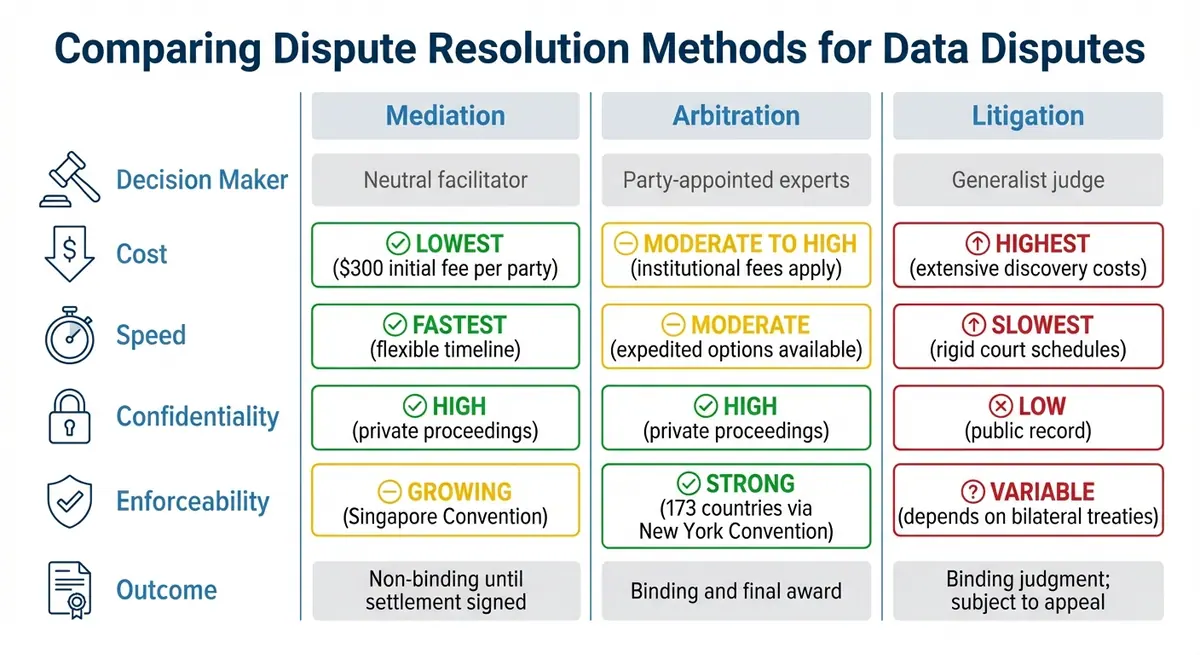
Mediation vs Arbitration vs Litigation for Cross-Border Data Disputes
Mediation, Arbitration, and Litigation Compared
When it comes to resolving cross-border data disputes, organizations typically consider three main approaches: mediation, arbitration, and litigation. Each method affects factors like cost, speed, confidentiality, and enforceability differently.
Litigation involves formal court proceedings overseen by generalist judges who often lack specialized knowledge in cybersecurity. These proceedings are public, meaning details about data security practices, trade secrets, and potential vulnerabilities can become part of the public record. Additionally, litigation often includes a burdensome and expensive discovery process, requiring extensive document production.
Arbitration offers a more tailored approach. Parties can appoint arbitrators with expertise in cybersecurity, data protection, and cloud systems. Arbitration proceedings are private, and decisions (arbitral awards) are enforceable in 173 countries under the New York Convention. Unlike litigation, arbitration uses "Redfern schedules" to streamline document production, limiting it to relevant evidence. For smaller disputes under $3,000,000, the ICC even provides an expedited procedure with reduced fees. These features make arbitration a practical choice for resolving complex data disputes.
Mediation, however, provides the most flexibility and control. As described by the International Chamber of Commerce, "Mediation under the ICC Mediation Rules is a flexible procedure aimed at achieving a negotiated settlement with the help of a neutral facilitator". Unlike arbitration, which results in binding awards, or litigation, which produces court judgments, mediation focuses on reaching settlements that help preserve business relationships. For disputes under the Data Privacy Framework, mediation fees are typically covered by the respondent company.
Here’s a quick comparison of these methods, highlighting key differences:
| Feature | Mediation | Arbitration | Litigation |
|---|---|---|---|
| Decision Maker | Neutral facilitator | Party-appointed experts | Generalist judge |
| Cost | Lowest; $300 initial fee per party | Moderate to high; institutional fees apply | Highest; extensive discovery costs |
| Speed | Fastest; flexible timeline | Moderate; expedited options available | Slowest; rigid court schedules |
| Confidentiality | High; private proceedings | High; private proceedings | Low; public record |
| Enforceability | Growing via Singapore Convention | Strong; 173 countries via New York Convention | Variable; depends on bilateral treaties |
| Outcome | Non-binding until settlement signed | Binding and final award | Binding judgment; subject to appeal |
This comparison highlights why many organizations are turning to multi-tiered dispute resolution clauses, which often require mediation before escalating to arbitration. While arbitration benefits from the well-established New York Convention, mediation is gaining ground with the Singapore Convention, which has been in effect since August 7, 2019. Research from Padjadjaran University supports this shift, stating, "The Singapore Convention has the potential to become an effective legal mechanism to assist in resolving cross-border personal data disputes". By incorporating mediation as a first step, businesses can balance the need for speed and confidentiality with the enforceability provided by arbitration.
Best Practices for Successful Mediation
How to Choose the Right Mediator
Picking the right mediator can make or break the resolution of your cross-border data dispute. According to the SIDRA 2022 Final Report, 94% of users highlight dispute resolution experience and ethical standards as crucial, while 89% value industry-specific knowledge and language skills. Yet, only 56% report satisfaction with mediators' technical expertise.
For data disputes, it's essential to find a mediator who understands both the technical and legal aspects of the issue. Look for professionals with knowledge of privacy frameworks like the Data Privacy Framework or GDPR and an understanding of cybersecurity standards such as ISO/IEC 27017:2015. A mediator who can bridge both cultural and technical communication gaps will be more effective in resolving disputes.
Make sure the mediator is registered under the relevant Data Privacy Framework and has proven experience in handling data disputes. Many leading ADR providers offer mediators with these qualifications. Additionally, cost arrangements under these frameworks often ensure that financial burdens on consumers are minimized.
How to Prepare for Mediation
Once you've chosen the right mediator, preparation becomes the next critical step. Proper organization can streamline the mediation process and reduce unnecessary delays. Focus on gathering essential documents, such as contracts, financial records, and technical evidence. Prepare digital forensic reports, system access logs, and security configuration documentation early to ensure your evidence is clear and persuasive.
Having continued access to key data, including metadata and cloud service logs, is vital. As the UNCITRAL secretariat emphasizes, "During the dispute resolution phase, continued access by the customer to its data, including metadata and other cloud service–derived data, may be vital... to substantiate a claim or counterclaim". To avoid complications, include clear data access clauses in your cloud contracts to guarantee data retention during disputes.
Internal alignment is equally important. Ensure decision-makers are on the same page regarding legal risks and business goals. Assign a lead negotiator with full authority to settle the dispute. If the negotiator's authority is limited, let the mediator know in advance to structure the process accordingly. Sharing position papers or case summaries ahead of time allows all parties to assess risks and digest key details. Pre-mediation conferences can set ground rules, outline the process, and identify critical issues. Details like language, venue, and session duration should also be decided early to avoid unnecessary delays.
This preparation sets the stage for smooth and constructive discussions during mediation.
How to Maintain Cooperation During Mediation
Mediation thrives on collaboration, and maintaining cooperation among parties is key to reaching a resolution. Unlike arbitration or litigation, mediation shifts the focus from legal rights to broader commercial interests. As the ICC Mediation Guidance Notes explain, "Whilst the adjudicative processes focus on the parties' legal rights, mediation helps parties also to take into consideration commercial and other interests". This approach can lead to creative solutions, such as renegotiating contracts or revising data processing terms, which may preserve business relationships better than formal legal proceedings.
A skilled mediator may use private caucuses to facilitate dialogue or even co-mediation for particularly complex disputes, helping to bridge cultural or technical divides. The ICC also notes that mediation is generally less disruptive to ongoing relationships compared to litigation or arbitration. If arbitration has already begun, pausing those proceedings to focus on mediation can be a smart move. Throughout the process, transparent communication about negotiation limits helps maintain trust and fosters a smoother path to settlement.
Conclusion
Avoiding costly litigation or drawn-out arbitration in cross-border data disputes is crucial for businesses. Mediation offers a practical and efficient alternative, focusing on achieving mutual agreement. As highlighted by the UNCITRAL Secretariat:
"In case of smaller claims, ODR-assisted negotiations or mediation may offer fast and cost-effective methods for the parties to reach consensual agreement online".
Mediation not only keeps sensitive security practices out of the public eye but also allows parties to select neutral experts with specialized knowledge in data privacy and cybersecurity. Under the EU-U.S. Data Privacy Framework, all mediation fees are covered by participating organizations. Additionally, the Singapore Convention provides a legal pathway to enforce mediation settlements internationally, ensuring outcomes are reliable and enforceable across borders.
To make the most of mediation, preparation is key. Start by choosing a mediator with expertise in privacy standards, such as ISO/IEC 27017:2015. Gather essential documents - contracts, forensic reports, system logs, and security configurations - to support your case. Ensure your contracts include data retention clauses that guarantee access to metadata and cloud service data during disputes. This access can be critical for substantiating claims.
Collaboration is equally important. Mediation shifts the focus from strict legal rights to broader business interests, paving the way for creative solutions like contract renegotiations or updates to data processing terms. Transparent communication, pre-mediation sessions, and aligning decision-makers ahead of time can lead to smoother and more productive negotiations.
FAQs
When should we choose mediation instead of arbitration or court?
Mediation works best when maintaining relationships, ensuring confidentiality, and achieving a quicker, cooperative resolution are top priorities. This approach offers room for flexible, business-oriented solutions without the rigid structure of arbitration or court proceedings. It's particularly suitable for disputes involving sensitive information or intricate relationships where collaboration is essential. On the other hand, arbitration or court might be more appropriate when a binding decision or specific legal judgment is required.
What makes a mediated settlement enforceable across countries?
A mediated settlement can be enforced internationally if it aligns with frameworks like the Singapore Convention on Mediation, which provides a standardized approach for recognition and enforcement. To qualify, the settlement must meet specific criteria, such as being in writing and voluntarily agreed upon by the parties involved. Additionally, it needs to adhere to the legal requirements of the country where enforcement is pursued, often guided by international treaties and the UNCITRAL Model Law on International Commercial Mediation.
What evidence should we bring to a cross-border data mediation?
When getting ready for cross-border data mediation, it's crucial to gather evidence that demonstrates compliance with data protection laws and clearly outlines the dispute's details. This includes documentation of data transfer mechanisms, such as adequacy decisions or binding corporate rules, as well as certifications like the EU-U.S. Data Privacy Framework.
Additionally, bring along relevant agreements, such as data processing contracts, to strengthen your case. Your documentation should highlight adherence to key principles like fairness, lawfulness, and transparency. These materials not only provide a clear legal foundation but also help set the factual context needed for resolving the dispute effectively.
Related Blog Posts
Get new content delivered straight to your inbox

The Response
Updates on the Reform platform, insights on optimizing conversion rates, and tips to craft forms that convert.



Drive real results with form optimizations
Tested across hundreds of experiments, our strategies deliver a 215% lift in qualified leads for B2B and SaaS companies.
