
.webp)
How to Document Third-Party Breaches


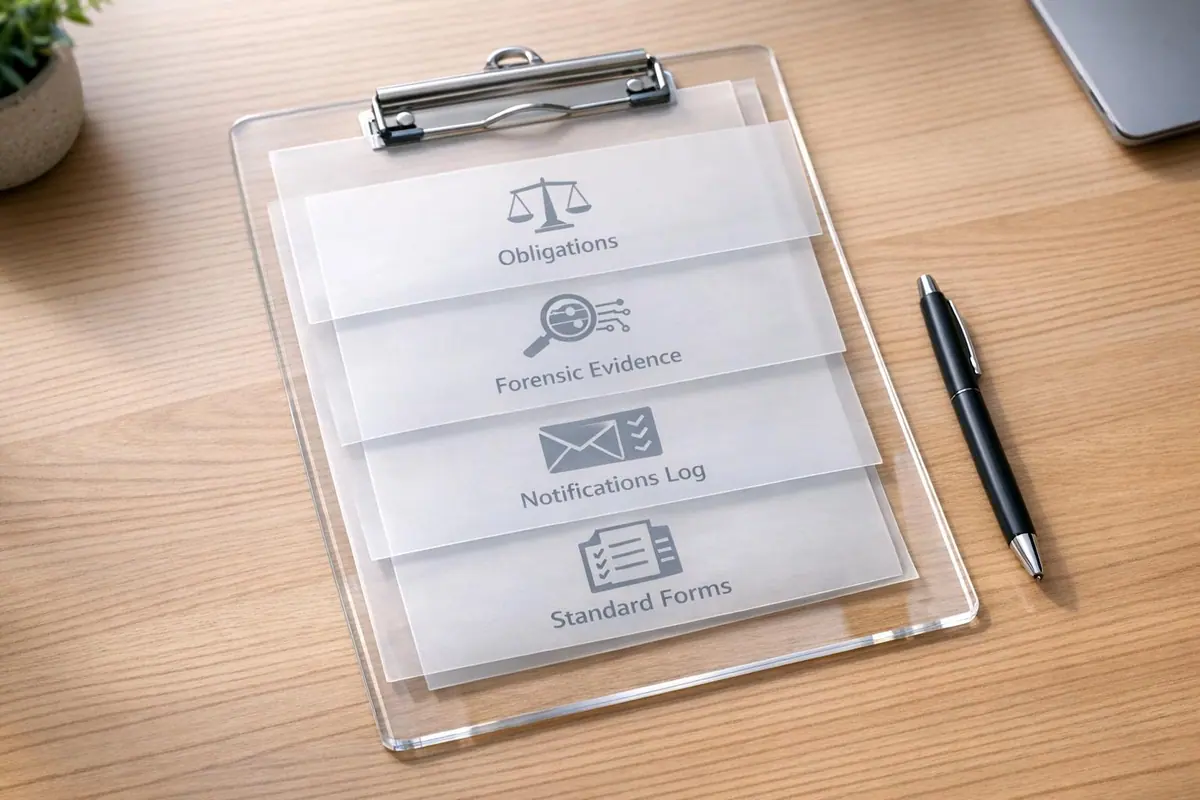
Third-party data breaches can put your organization at risk, even if the incident occurs outside your control. Proper documentation is key to managing the aftermath, meeting legal requirements, and protecting your business. Here's what you need to know:
- Understand your obligations: Regulations like HIPAA, FTC Safeguards Rule, and state laws have specific deadlines (e.g., 30–60 days) for breach notifications. Vendor contracts may impose even shorter timelines.
- Document the incident thoroughly: Record key dates, affected data types, and actions taken. Maintain logs of communications, forensic findings, and notification decisions.
- Preserve evidence: Collect and secure system images, logs, and other artifacts. Avoid actions that could destroy critical data.
- Track notifications: Log all communications with regulators, affected individuals, and vendors. Ensure compliance with deadlines and document decisions clearly.
- Use standardized workflows: Create standardized forms and processes to ensure consistency and avoid missing critical details.
Proper documentation transforms a chaotic breach response into an organized, defensible process. Following these steps ensures compliance and reduces potential risks.
Data Breach Response: Legal & Compliance Guide
sbb-itb-5f36581
Understanding Regulatory and Contractual Obligations
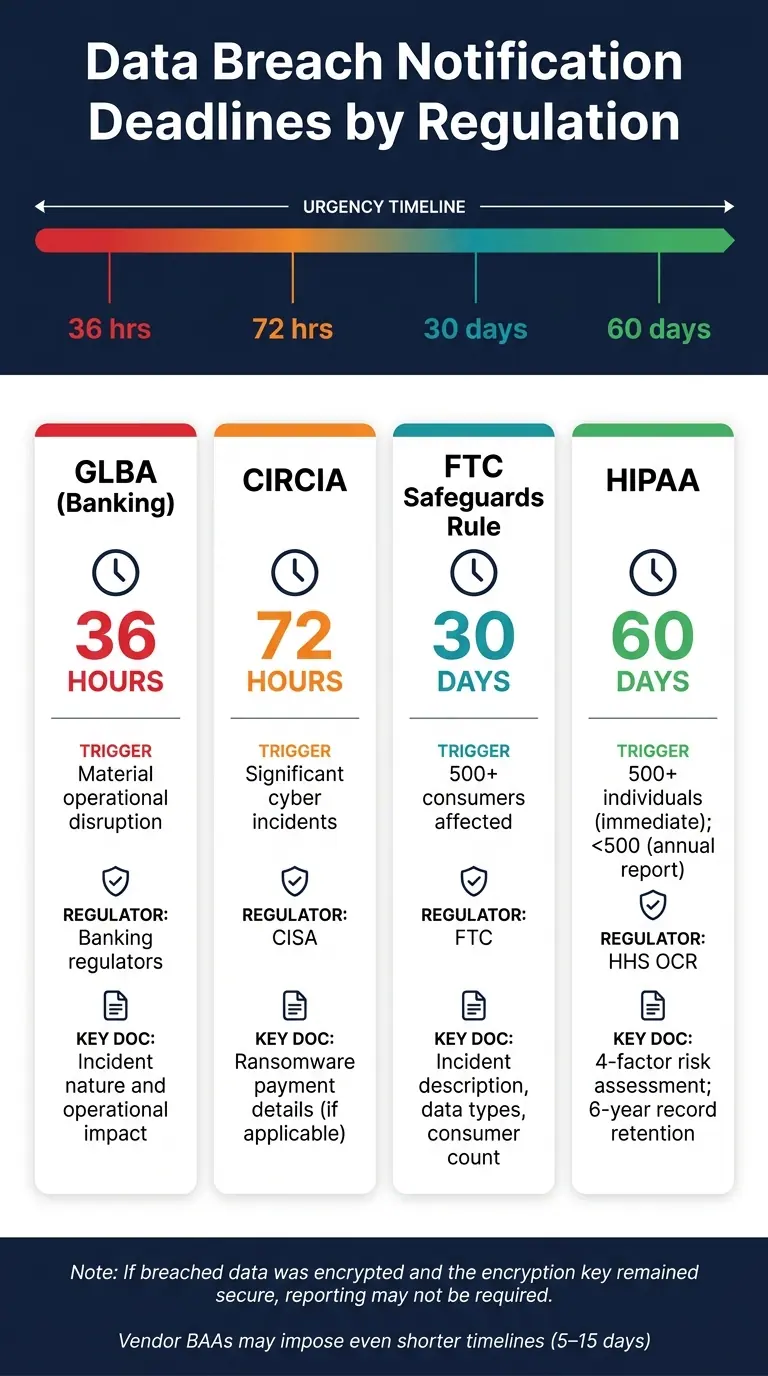
Data Breach Notification Deadlines by Regulation
Before documenting a breach, it’s crucial to grasp the legal and contractual obligations at play. Regulatory requirements and contract terms can sometimes conflict, and missing even one can lead to serious compliance issues. Clear knowledge of these expectations ensures accurate and thorough documentation.
Identify Relevant Laws and Frameworks
The regulations governing breach reporting depend on the type of data involved and the residency of those affected. For example, when it comes to health data, HIPAA's Breach Notification Rule (45 CFR §§ 164.400–414) is the key guideline. This rule mandates a written, four-factor risk assessment that evaluates:
- The nature of the protected health information (PHI)
- Who accessed the data
- Whether the data was actually viewed or acquired
- The extent of mitigation efforts
If the incident qualifies as a reportable breach, all documentation related to it must be retained for at least six years.
For financial institutions, the timelines are different. The FTC Safeguards Rule requires non-bank entities like mortgage brokers and auto dealers to notify the FTC within 30 days if a breach affects 500 or more consumers. Meanwhile, under the GLBA Interagency Rule, banks must notify regulators within 36 hours if an incident disrupts operations materially. For critical infrastructure, CIRCIA sets a 72-hour deadline for reporting significant cyber incidents to CISA.
Adding to the complexity, all 50 states have their own breach notification laws. These laws are based on the residency of the affected individuals, not the location of your business. Some states impose deadlines as short as 30 days, which can create overlapping obligations. To stay compliant, maintaining a state-law matrix mapping victim residency to relevant deadlines is a practical solution.
Here’s a quick summary of key regulatory frameworks, their deadlines, and documentation requirements:
| Regulatory Framework | Notification Deadline | Regulator Threshold | Key Documentation Requirement |
|---|---|---|---|
| HIPAA | 60 days from discovery | 500+ individuals (immediate); <500 (annual) | 4-factor risk assessment; 6-year record retention |
| FTC Safeguards Rule | 30 days from discovery | 500+ consumers | Incident description, data types, consumer count |
| CIRCIA | 72 hours from discovery | Significant cyber incidents | Ransomware payment details, if applicable |
| GLBA (Banking) | 36 hours to notify regulators | Material operational disruption | Incident nature and operational impact |
Note: If the breached data was encrypted and the encryption key remained secure, reporting may not be required.
Review Vendor Contracts
Regulatory requirements set the baseline, but vendor contracts often impose stricter conditions. Business Associate Agreements (BAAs) and Data Processing Agreements (DPAs) frequently demand shorter timelines - often between 24 and 72 hours - to ensure broader compliance.
"A business associate must provide notice to the covered entity without unreasonable delay and no later than 60 days from the discovery of the breach." - HHS.gov
While the 60-day limit might seem like a buffer, waiting that long can increase compliance risks. The HHS OCR has noted that many BAAs require notification within 5 to 15 days.
Contracts also outline what must be documented and shared, such as access to logs or forensic artifacts under cooperation clauses. It’s equally important to confirm whether vendor agreements include subcontractor flow-down provisions. These clauses ensure vendors impose the same notification and security requirements on their subcontractors. A breach at a fourth-party level can still trigger your reporting obligations.
"Service organizations should map their breach notification procedures to each regulatory regime and contract. A matrix that lists jurisdictions, notification triggers, timelines and reporting channels ensures nothing is overlooked." - Konfirmity
To streamline compliance, build a matrix that details each vendor's notification deadlines and contact information. Having this ready allows you to start documenting immediately after an incident, instead of scrambling to locate the relevant contract terms under pressure.
Standardizing Incident Documentation
Once you’ve identified your regulatory and contractual obligations, the next step is ensuring every breach is documented in a consistent way. Inconsistent records can lead to compliance gaps - especially when dealing with multiple regulators or vendors. A standardized approach ties together regulatory requirements with clear, defensible record-keeping.
Document Core Incident Details
Start each incident report with the breach occurrence date and the discovery date, as this helps identify any delays in detection. HIPAA specialist Kevin Henry explains:
"The 60-day clock starts on the date the breach is discovered - or the date it reasonably should have been discovered with diligent monitoring."
Include essential details such as key incident dates, vendor information (names, contacts, roles, accessed data, and systems), and maintain a detailed log of actions. This log should cover containment steps, escalations, and communications with vendors. Such documentation creates a clear narrative that can be presented to regulators if questions arise about what actions were taken and when.
If law enforcement requests a delay in notifying affected individuals, be sure to document the request in writing. Include the official’s name and the duration of the requested delay in your records.
Classify Exposed Data and Affected Individuals
After documenting the core details, classify the exposed data to determine its regulatory implications. Whether the data involves PHI, PII, financial information, or biometric identifiers will dictate which federal and state regulations apply, as well as whether notifications are required. Additionally, note the encryption status of the exposed data. If the data was encrypted and the decryption key wasn’t compromised, you might qualify for safe harbor provisions, potentially avoiding mandatory notifications.
Track affected individuals by their state of residence rather than simply by total numbers. This ensures you meet state-specific deadlines - some of which can be as short as 30 days - and helps determine whether a media notice is required. For example, if 500 or more residents of a single state are affected, media notification may be necessary. The table below illustrates an effective way to organize this information:
| Data Category | Specific Identifiers | Encryption Status | Estimated Record Count |
|---|---|---|---|
| Personal Information (PII) | Names, Addresses, SSNs, DOB | Unencrypted | 1,200 |
| Protected Health Information (PHI) | Diagnoses, Medications, Lab Results | Encrypted (Key not taken) | 450 |
| Financial Data | Credit Card Numbers, Bank Accounts | Unencrypted | 85 |
| Biometric Data | Fingerprints, Facial Recognition Data | Unencrypted | 12 |
Document the reasoning behind your notification decision, including any approvals and the regulatory or contractual basis for your actions. This decision log not only supports you during audits but also shows that your response was carefully planned rather than rushed or reactive.
Recording Technical and Forensic Findings
After classifying the exposed data and documenting your notification decisions, the next step involves recording the technical aspects of the incident. This includes detailing the attack method, the evidence collected, and how that evidence was preserved. As the National Data Protection Authority notes:
"Forensic investigation establishes: what data was accessed or exfiltrated, which systems were affected, the attack vector, and the time window of unauthorized access. This phase produces the evidentiary record that regulatory notifications and legal filings depend upon."
Preserve Evidence and Catalog Artifacts
Your first priority is to preserve evidence while minimizing further damage. The Federal Trade Commission advises:
"Take all affected equipment offline immediately - but don't turn any machines off until the forensic experts arrive."
Shutting down machines too early can result in the loss of volatile memory, which includes active processes, temporary session data, and other artifacts that only exist while the system is running. Forensic experts should handle this step, capturing bit-for-bit disk images of affected systems and gathering network, access, and API usage logs covering the breach timeline.
Every piece of evidence collected should be recorded in a chain-of-custody log. This document tracks who handled the evidence, when, and why. It's not just procedural - it ensures the evidence remains admissible in court or during regulatory audits. For instance, under HIPAA (45 CFR §164.414), breach documentation must be retained for at least 6 years from its creation date.
| Evidence Type | Preservation Method | Purpose |
|---|---|---|
| Volatile Memory | Use memory capture tools; avoid powering down | Capture active processes and temporary data |
| System Images | Bit-for-bit forensic imaging | Preserve system state for offline analysis |
| Network Logs | Export and hash log files | Identify entry/exit points and data exfiltration |
| API/OAuth Tokens | Revoke and document metadata | Pinpoint compromised integration points |
| Chain of Custody | Maintain detailed handling log | Ensure evidence is admissible in legal cases |
Be cautious not to let remediation efforts destroy critical evidence. For example, patching vulnerabilities or cleaning infected systems before forensic imaging can erase vital data, making it impossible to understand how the attack unfolded.
Once all evidence is secured and properly logged, focus on documenting the sequence of the attack. With the artifacts cataloged, you can move on to mapping the attack path.
Document the Attack Path and Indicators of Compromise
After preserving the evidence, it's time to map out the breach's progression. This involves documenting the entry point, how attackers moved laterally, and any pivots they made from the vendor's environment into your systems.
A notable example is the August 2025 Salesloft breach. Attackers, identified as UNC6395, exploited a compromised Salesloft GitHub account to acquire AWS credentials and OAuth tokens. Over ten days (August 8–18, 2025), these credentials were used to infiltrate corporate Salesforce instances via the Drift AI live-chat tool. Data from Cases, Accounts, and Opportunities objects was exfiltrated. Salesloft detected the activity on August 20, 2025, revoked access, and Salesforce suspended the affected tool from its AppExchange. This attack path - from GitHub compromise to OAuth token theft to Salesforce data exfiltration - was only traceable because technical evidence was preserved and thoroughly mapped.
When a vendor provides indicators of compromise (IOCs) - like malicious IP addresses, file hashes, or unauthorized user accounts - compare them against your environment logs. Review SIEM alerts, API logs, and SSO integration logs to identify any lateral movement into your network. Look for red flags such as logins from unusual locations, large data exports, or unexpected user permission changes. Use frameworks like NIST SP 800-61r2 to categorize the attack vector (e.g., web, email, impersonation). This standardization can make your documentation easier to align with regulatory requirements.
Documenting Communications and Notifications
Once you've mapped out the technical evidence, the next step is to document every communication. This creates a clear and defensible breach narrative. Without thorough records, even the most effective technical response can lose credibility with regulators.
"A data breach doesn't have to be catastrophic - but a botched response almost always is. Regulators look at two things: what happened, and what you did about it." - ComplianceStack Editorial Team
Log Vendor Communications
Maintaining a detailed log of vendor communications strengthens your technical evidence and demonstrates a coordinated response. Each interaction should be recorded in a centralized log, not scattered across email inboxes. Include:
- Date, time, and method (e.g., email, phone, portal)
- Participant names
- Details of the discussion and any shared information
- Copies of forensic findings or reports
This log should also track the vendor’s containment efforts, their proposed timeline for remediation, and their overall cooperation during the investigation. Additionally, document any responsibilities outlined in your Business Associate Agreement (BAA) or service contract, such as notification timelines and liability clauses. Make a note if the vendor meets - or fails to meet - these obligations.
If your usual communication channels are compromised, switch to out-of-band channels for sensitive discussions. This avoids both security risks and potential issues with evidence collection.
Track Notifications to Regulators and Individuals
Building on the vendor communication log, you’ll also need to meticulously document all external notifications. Regulatory deadlines begin the moment a breach is confirmed. Below is a summary of key notification requirements for major frameworks:
| Regulation | Regulatory Deadline | Individual Notification Deadline |
|---|---|---|
| GDPR | 72 hours from awareness | Without undue delay (if high risk) |
| HIPAA | 60 days from discovery | 60 days from discovery |
| GLBA (FTC) | 30 days | As soon as possible |
| CCPA/CPRA | AG notice if 500+ CA residents | "Most expedient time" |
| Colorado HB 21-1119 | 30 days (500+ residents) | Most expedient time |
For each notification, document the delivery method, timestamp, and any confirmation receipts (such as submissions to the HHS breach portal). Maintain a decision register that explains why notifications were sent - or why they weren’t required. This should include who approved the decision and what regulatory triggers applied. If law enforcement requests a delay in public notification, ensure their request is documented in writing, along with the specified hold period.
"Clear, timely documentation turns a chaotic event into a defensible narrative. Robust reporting also accelerates learning and reduces regulatory exposure." - Kevin Henry, Incident Response Expert, Accountable
In cases where contact information is missing for 10 or more affected individuals, substitute notice rules under HIPAA come into play. This might involve posting a notice on your website (active for at least 90 days) or issuing a media notice. Be sure to document these actions as evidence of compliance.
Using Tools and Workflows to Manage Documentation
Consistent documentation is essential, but it’s only as effective as the workflows supporting it - especially when managing third-party breaches. When regulators request a complete, timestamped audit trail, ad hoc records simply won’t cut it. That’s why creating structured workflows, including standardized forms, is a critical next step.
Create Standardized Forms for Incident Reporting
A properly designed form ensures that incident reporting is both consistent and thorough. Without a standard format, team members may document breaches in varying ways, leading to gaps in critical information. A structured form eliminates this issue by prompting for the same data points, in the same order, every time.
Instead of overwhelming users with a long, unstructured page, forms should be broken into logical sections, each with a clear compliance purpose:
| Form Section | Key Data Points | Compliance Purpose |
|---|---|---|
| Incident Details | Discovery date/time, attack vector, affected systems | Starts the "awareness" clock for GDPR and SEC deadlines |
| Data & Impact | PII/PHI categories, record count, encryption status | Determines if the breach meets harm thresholds |
| Risk Assessment | Likelihood of harm, potential consequences | Supports the "low probability of compromise" exception |
| Notifications | Authorities notified, dates sent, individual notices | Tracks compliance with statutory deadlines |
| Lessons Learned | Root cause, identified vulnerabilities, remediation steps | Required for SOC 2 Type II and post-incident audits |
Each incident should be assigned a unique reference number (e.g., DCI-SEC-2026-0023). This makes it easier to track multiple incidents, retrieve specific records during audits, and maintain an organized system. Standardizing forms also sets the stage for automation, which can simplify the reporting process even further.
Use Reform to Build Forms and Automate Documentation Steps

Platforms like Reform make it easy to create multi-step incident reporting forms without needing any coding skills. One standout feature is conditional routing, which dynamically adjusts the form based on user input. For instance, if a responder selects "Personal Health Information" as the exposed data type, the form can automatically reveal HIPAA-specific fields while hiding irrelevant ones. This keeps the process streamlined and ensures no critical details are overlooked.
"Security that looks good on paper but fails under incident pressure is a liability." - Amit Gupta, Founder & CEO, Konfirmity
Reform also offers real-time analytics, allowing compliance teams to monitor form completion and ensure all required fields are filled. With file upload support (available on the Pro plan for $35/month), responders can attach key evidence like forensic screenshots, communication logs, and vendor reports directly to the incident record. The save drafts feature enables responders to document preliminary findings and finalize reports only when all information is complete, reducing the risk of premature submissions.
Conclusion
Third-party breaches now make up 30% of all data breaches - almost twice the rate compared to last year. This sharp rise highlights the importance of structured documentation in transforming a breach response from disorganized to defensible. Proper documentation ensures you meet overlapping notification deadlines, whether it's GDPR's 72-hour requirement or HIPAA's 60-day limit, while maintaining compliance with regulatory standards.
Kevin Henry put it best: "Clear and prompt documentation defends against chaos".
The steps outlined in this guide - like identifying regulatory requirements, standardizing incident records, preserving forensic evidence, logging vendor communications, and tracking notifications - form a cohesive system. Skipping even one of these can create vulnerabilities that regulators or opposing counsel could exploit.
Tools such as Reform simplify this process significantly. Features like multi-step forms, conditional routing, and file upload support minimize the time spent chasing down missing information. This allows your team to focus on managing the breach itself. With a standardized workflow in place, you can ensure no critical details are overlooked when the next breach occurs.
FAQs
What’s the fastest way to figure out which breach notification deadlines apply?
The fastest way to pinpoint breach notification deadlines is by using a real-time tracker that brings together federal, state, and international regulations. It’s also helpful to review the specific laws that apply to your jurisdiction and the type of data involved. For instance, HIPAA requires notifications to be sent within 60 days, while certain states may have stricter timelines, ranging from 30 to 60 days. Leveraging compliance tools or legal resources can make navigating these requirements much easier.
What evidence should we preserve first to avoid destroying forensic data?
The first step in preserving evidence is creating a forensic image of the affected systems or data. This process ensures that the original data stays unaltered and intact, which is crucial for any investigation. Keeping data in its original state is vital to maintain its integrity and ensure it can be used as admissible evidence during forensic analysis.
How do we prove we made the right call if we decide not to notify?
To show that your decision was well-founded, make sure to thoroughly document your assessment process. Clearly outline your reasoning for concluding that the breach did not pose any risk of harm. Keep detailed records of your analysis and decision-making process, as advised by regulatory guidelines. This approach helps maintain transparency and ensures you're prepared if your decision is ever questioned or reviewed.
Related Blog Posts
Get new content delivered straight to your inbox

The Response
Updates on the Reform platform, insights on optimizing conversion rates, and tips to craft forms that convert.



Drive real results with form optimizations
Tested across hundreds of experiments, our strategies deliver a 215% lift in qualified leads for B2B and SaaS companies.
