
.webp)
Does CAPTCHA Reduce Spam Effectively?



CAPTCHAs can block basic bots but struggle against advanced ones. AI tools, CAPTCHA farms, and other techniques allow bots to bypass challenges with up to 99.8% success rates, making CAPTCHAs less reliable for spam prevention. They also frustrate users, causing up to a 40% drop in conversion rates and 29% task abandonment. Businesses are moving toward layered defenses like behavioral analysis, honeypots, and email validation to block spam without sacrificing user experience. These methods are more effective, seamless, and less disruptive than CAPTCHA systems.
How Well Does CAPTCHA Block Spam?
CAPTCHA Success Rates
CAPTCHAs are effective at blocking 70-80% of simple spam traffic. However, when it comes to more advanced bots, the numbers tell a different story. Sophisticated bots successfully solve 70.78% of reCAPTCHA challenges, and in about 50% of cases where challenges are passed, it's bots - not humans - doing the solving. Advanced AI tools push these bypass rates even higher, reaching an astonishing 99.8% success rate, with accuracy levels ranging from 85-100%, compared to human accuracy, which lags at 50-85%.
"Humans are slower than bots at solving CAPTCHAs." - Andrew Searles and Gene Tsudik, Researchers, USENIX
The rise of "CAPTCHA farms" has made bypassing these systems even easier. Services like 2Captcha charge about $0.77 per 1,000 solved challenges, while Death By Captcha costs roughly $1.39 per 1,000. These services rely on either human labor or advanced AI to solve CAPTCHAs at scale, making it both affordable and efficient for spammers to get around these protections.
Despite these vulnerabilities, CAPTCHAs remain a popular choice for combating spam, as they still serve critical roles in various applications.
Common Use Cases
Even with their limitations, CAPTCHAs are widely used for essential tasks. They help businesses protect user registration forms from bots that create fake accounts, secure login pages against credential stuffing attacks, and prevent "carding" at e-commerce checkouts, where bots test stolen credit card numbers. In fact, over 30 million websites currently use reCAPTCHA technology.
A notable example is GoFundMe, which implemented reCAPTCHA Enterprise to enhance the security of its donation platform. Matthew Murray, Director of Risk at GoFundMe, emphasized its impact:
"Combining Google's rich security expertise with GoFundMe's focus on fraud prevention is already showing promising results as we strive to keep our platform the safest place to give online".
CAPTCHAs are also commonly deployed in contact forms, online polls, and ticketing systems to ensure data accuracy and prevent automated submissions. These measures are particularly valuable in scenarios where bots could exploit CAPTCHA bypasses to deplete inventory or manipulate results.
CAPTCHA Limitations and Advanced Threats
How Advanced Bots Bypass CAPTCHA
Modern bots have come a long way from basic automation scripts. Using machine learning models and advanced optical character recognition (OCR) tools, they can decode CAPTCHA challenges with success rates ranging from 85% to 100%. To put that into perspective, human accuracy typically falls between 50% and 85%. Back in 2014, Google discovered that bots could bypass its reCAPTCHA system a staggering 99% of the time.
Attackers have also turned to clever techniques like session replay, where they record and mimic user actions - such as mouse movements and click patterns - to fool behavioral analysis systems. Adding to the arsenal, fraudsters often exploit legitimate tools like Google's Speech Recognition API to solve audio-based reCAPTCHA challenges.
"CAPTCHA fraud [is] a cottage industry in which humans play the role of Mechanical Turks to power the bot ecosystem." - Stytch Team
When automated methods hit a wall, attackers rely on CAPTCHA farms. These operations employ human workers to solve CAPTCHA challenges in real time, enabling large-scale bypasses.
While bots continue to outsmart CAPTCHA systems, these measures also create significant hurdles for genuine users.
User Experience Problems
Although CAPTCHAs are designed to block bots, they often frustrate legitimate users. On average, it takes users about 32 seconds to complete a CAPTCHA, and only 66% succeed on their first try. This delay has real consequences for businesses, with CAPTCHAs linked to a 40% drop in conversion rates and a 30% abandonment rate during account creation.
Accessibility is another major concern. For blind users, success rates with audio CAPTCHAs hover around 43%, and in one study, participants solved only 46% of audio challenges, taking an average of 65 seconds per attempt. Mobile users also face difficulties due to small screens and touch interfaces, which often lead to even higher abandonment rates compared to desktop users.
"A CAPTCHA without an accessible and usable alternative makes it impossible for users with certain disabilities to create accounts, write comments, or make purchases on such sites." - W3C
Globally, solving CAPTCHAs consumes an estimated 500,000 man-hours every day. For businesses, this represents not just lost time but also a significant barrier to customer engagement and conversions.
How Do You Stop Spam Bots When Even CAPTCHA Isn't Enough Anymore? (2025/625)
sbb-itb-5f36581
CAPTCHA vs. Other Spam Prevention Methods
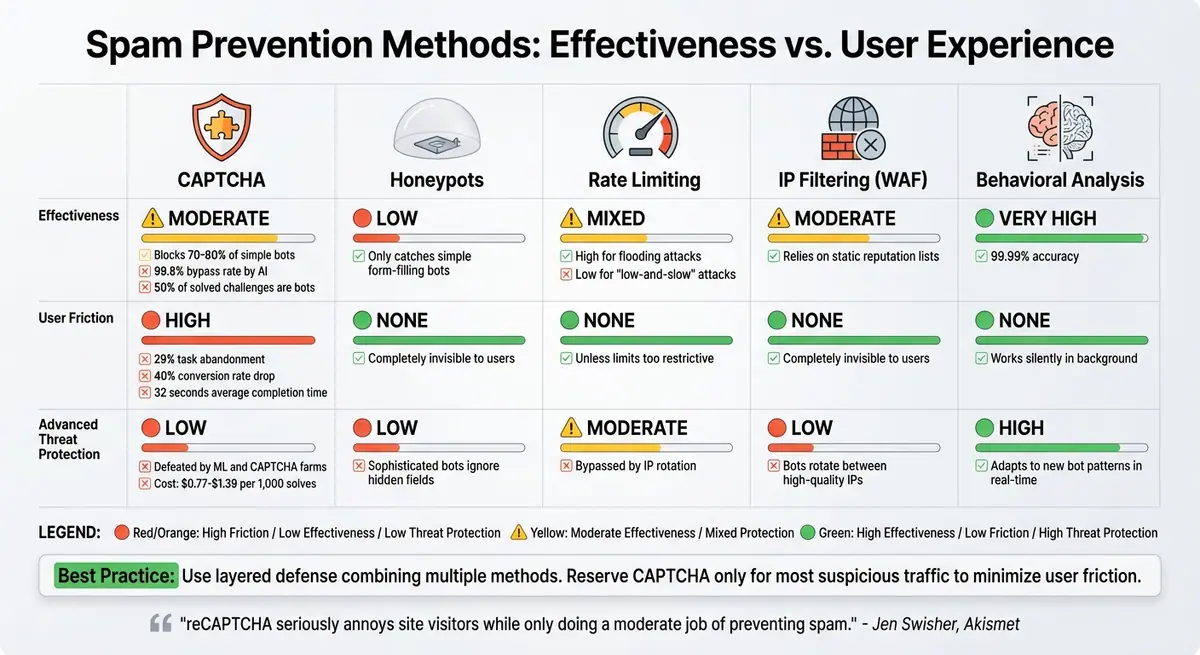
CAPTCHA vs Alternative Spam Prevention Methods Comparison
While CAPTCHA is widely used, its limitations have led to the adoption of other spam prevention techniques to bolster defenses. For instance, honeypots rely on hidden fields that bots tend to fill out but remain invisible to human users. This method creates no inconvenience for legitimate users but is only effective against basic form-filling bots. Similarly, rate limiting controls the number of requests an IP address can make, which helps mitigate flooding attacks. However, bots that frequently rotate IP addresses can easily bypass this approach. IP filtering, often implemented through Web Application Firewalls (WAF), blocks requests based on IP reputation. Yet, this method can be outsmarted by bots using high-quality, rotating IPs.
Each of these methods offers a unique way to tackle spam, addressing different vulnerabilities in the process.
Behavioral analysis, on the other hand, takes a more dynamic approach. It monitors user interactions - like mouse movements, typing speed, and scrolling behavior - to differentiate between humans and bots. Tools such as Akismet operate silently in the background, analyzing content submissions with impressive accuracy rates of 99.99%, all while eliminating friction for genuine users.
"reCAPTCHA seriously annoys site visitors while only doing a moderate job of preventing spam." - Jen Swisher, Author, Akismet
The best way to secure a site is by combining multiple methods into a layered defense strategy. No single solution is perfect, as advanced bots can often bypass individual measures. This is why security experts advocate for a "defense in depth" approach, which involves using several techniques together. For example, honeypots can act as the first line of defense, rate limiting can prevent floods, and behavioral analysis can detect more sophisticated threats. CAPTCHA challenges can then be reserved for only the most suspicious traffic, minimizing user frustration.
Comparison Table
| Method | Effectiveness | User Friction | Protection Against Advanced Threats |
|---|---|---|---|
| CAPTCHA | Moderate; blocks basic bots but bypassed by AI (99.8% accuracy) and farms | High; causes 29% abandonment and 40% conversion drop | Low; easily defeated by machine learning and human solvers |
| Honeypots | Low; only catches simple form-filling bots | None; completely invisible to users | Low; sophisticated bots ignore hidden fields |
| Rate Limiting | High for flooding; Low for "low-and-slow" attacks | None (unless limits are too restrictive) | Moderate; bypassed by IP rotation |
| IP Filtering (WAF) | Moderate; relies on static reputation lists | None | Low; bots rotate between high-quality IPs |
| Behavioral Analysis | Very High (99.99% accuracy) | None; works silently in background | High; adapts to new bot patterns in real-time |
Best Practices for Preventing Form Spam
Using Multiple Spam Prevention Methods
To effectively block spam without inconveniencing users, it’s smart to combine several invisible defenses. Techniques like honeypots, rate limiting, email validation, behavioral analysis, and geolocation filtering work together to keep your forms secure.
Start with honeypot fields, which are hidden via CSS. Bots often fill these fields automatically, so any submission with data in these fields can be rejected outright. Add rate limiting to cap the number of submissions from a single IP address, making it harder for bots to launch flooding attacks. Email validation is another key layer - around 95% of bot-driven submissions use invalid email addresses. Real-time checks can flag disposable domains and ensure only valid contacts make it into your CRM.
Behavioral analysis tools help identify suspicious activity by spotting patterns typical of bots. For instance, bots often complete forms in seconds and show no natural mouse movements or scrolling behavior. If your business targets specific regions, geolocation filtering can block submissions from high-risk areas that fall outside your target market. Similarly, blocking traffic from data centers, TOR exit nodes, and known proxy services can cut down on botnet activity.
"Sites that care about the user experience and maximizing conversion rates should almost always choose a solution... that stops contact form spam without annoying site visitors." - Jen Swisher, Akismet
By integrating these defenses early on, you can stop spam before it becomes a problem. Reform, for example, incorporates these layers seamlessly to ensure a smooth user experience while keeping spam at bay.
How Reform Prevents Spam

Reform takes a multi-layered approach to spam prevention, aligning with the best practices outlined above. Its built-in email validation checks submitted addresses in real time, filtering out disposable domains and invalid formats before they even enter your system. This ensures your sales team only sees high-quality leads worth pursuing.
Reform also includes lead enrichment features, which verify submission quality by cross-referencing data with trusted sources. This reduces the time spent manually filtering spam, allowing you to focus on genuine prospects. Plus, Reform integrates smoothly with third-party validation tools and CRM platforms, giving you the flexibility to tailor your defenses to your needs.
What sets Reform apart is its focus on maintaining a balance between security and user experience. Invisible protection methods replace intrusive challenges, ensuring your forms remain easy to use while effectively blocking automated threats. Additionally, the platform offers analytics to monitor submission patterns and flag suspicious activity - all without requiring technical expertise.
Conclusion: Is CAPTCHA Effective?
CAPTCHA can stop basic bots, but it falls short against more advanced threats. Modern AI systems have made bypassing reCAPTCHA almost effortless, and about half of all solved CAPTCHA challenges are completed by bots using low-cost CAPTCHA farms. What was once a strong line of defense is now much easier to overcome.
The issue goes beyond just technical weaknesses. CAPTCHAs also impact user experience, often driving users away. For instance, implementing CAPTCHA can lower conversion rates by as much as 40%, with around 29% of users abandoning tasks to avoid dealing with these puzzles. Jen Swisher from Akismet sums it up well:
"reCAPTCHA seriously annoys site visitors while only doing a moderate job of preventing spam"
For businesses prioritizing lead generation, this trade-off between security and user engagement no longer makes sense.
A better solution lies in layered defenses. Techniques like background filtering, honeypots, email validation, and behavioral analysis can effectively reduce spam without the frustration of interactive CAPTCHAs. In June 2025, the email marketing platform Kit (formerly ConvertKit) demonstrated this by switching to Akismet's background filtering. This change saved them 20 hours of administrative work per customer each month and avoided the 40% conversion drop typically linked to CAPTCHA challenges.
Reform takes it a step further by integrating email validation, lead enrichment, and invisible spam protection, all backed by real-time analytics. This approach keeps automated threats at bay without compromising the user experience, offering a balance between strong security and high conversion rates.
FAQs
Why are CAPTCHAs still widely used if they aren't foolproof?
CAPTCHAs remain a go-to solution for preventing spam because they act as a solid first barrier against simple automated bots. While it's true that some advanced AI systems can get past certain CAPTCHAs, they still manage to filter out a large volume of basic spam. This makes them an affordable and straightforward option for many websites.
On top of that, CAPTCHAs are simple to set up and work seamlessly across various platforms. This ease of use makes them an appealing choice for businesses aiming to block basic threats without overcomplicating things for users or developers.
How does combining multiple defenses improve spam prevention compared to just using CAPTCHAs?
When it comes to stopping spam, relying on just one method - like CAPTCHAs - might not be enough. Sure, CAPTCHAs can handle many basic bots, but as AI-driven bots get smarter, even the toughest CAPTCHAs can be bypassed. This makes forms that lean solely on CAPTCHAs more vulnerable to spam attacks.
A smarter approach is to layer multiple defenses. Techniques like IP reputation checks, behavioral scoring, proof-of-work puzzles, honeypot fields, and real-time email validation work together to create a stronger barrier. If one layer fails, another can step in to catch the spam. This not only improves detection but also minimizes the need for annoying challenges, so legitimate users enjoy a smoother experience.
Reform’s form builder takes this layered approach seriously. It includes features like email validation, real-time analytics to spot suspicious behavior, and conditional routing to weed out low-trust submissions. The result? A system that blocks spam effectively while keeping forms easy and welcoming for real users.
How do CAPTCHAs affect user experience and business conversions?
CAPTCHAs aim to keep spam at bay, but they often come at a cost - frustrating users. On average, it takes about 10 seconds to solve a CAPTCHA, and this brief interruption can have a big impact: 29% of visitors abandon the page entirely. Even worse, failure rates hover around 8%, and for case-sensitive tests, they can spike to 29%, potentially leading to lost sales and lower conversion rates.
While CAPTCHAs do their job in blocking spam, the trade-off in user experience and business performance is hard to ignore. It might be worth considering alternative spam prevention tools that strike a better balance between security and a seamless user experience.
Related Blog Posts
Get new content delivered straight to your inbox

The Response
Updates on the Reform platform, insights on optimizing conversion rates, and tips to craft forms that convert.



Drive real results with form optimizations
Tested across hundreds of experiments, our strategies deliver a 215% lift in qualified leads for B2B and SaaS companies.
