
.webp)
Key Elements of DPIA Documentation Standards


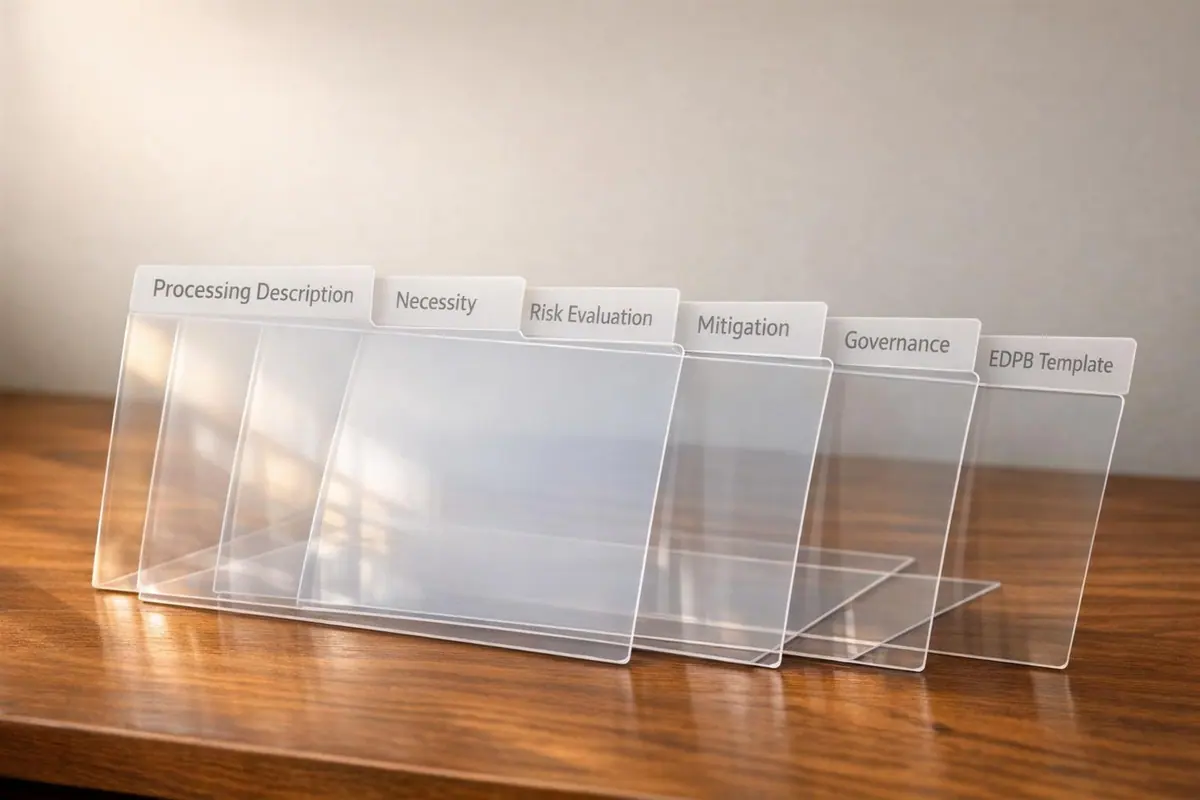
DPIA (Data Protection Impact Assessment) documentation is critical for meeting GDPR and UK GDPR requirements and safeguarding privacy in high-risk data processing activities. Without proper documentation, companies risk regulatory fines of up to £8.7 million or 2% of global annual revenue.
Here’s what you need to know:
- What is a DPIA? A structured process to identify and minimize privacy risks, required for high-risk data processing activities.
- Why it matters: It provides proof of compliance during audits and reduces financial and legal risks.
- Core elements of DPIA documentation:
- Systematic Description: Details data flows, scope, and purpose.
- Necessity & Proportionality: Justifies processing and ensures it's limited to what’s required.
- Risk Assessment: Analyzes potential harm to individuals.
- Mitigation Measures: Lists safeguards to reduce risks.
- Governance Records: Includes input from Data Protection Officers (DPOs) and consultation feedback.
In 2026, the European Data Protection Board (EDPB) introduced a unified DPIA template, streamlining compliance across the EU. The template separates design risks (e.g., data retention flaws) from incident risks (e.g., breaches) and provides structured sections for thorough documentation.
To stay compliant:
- Start DPIAs early in projects to embed privacy safeguards.
- Use tools like no-code platforms to streamline documentation.
- Maintain a centralized DPIA register for tracking and updates.
Key takeaway: DPIAs are not just regulatory requirements - they’re tools to manage data protection risks effectively. Proper documentation ensures accountability, reduces risks, and meets global privacy standards.
Maturing your GDPR compliance program: Data protection impact assessment (DPIA)
sbb-itb-5f36581
Core Regulatory Requirements for DPIA Documentation
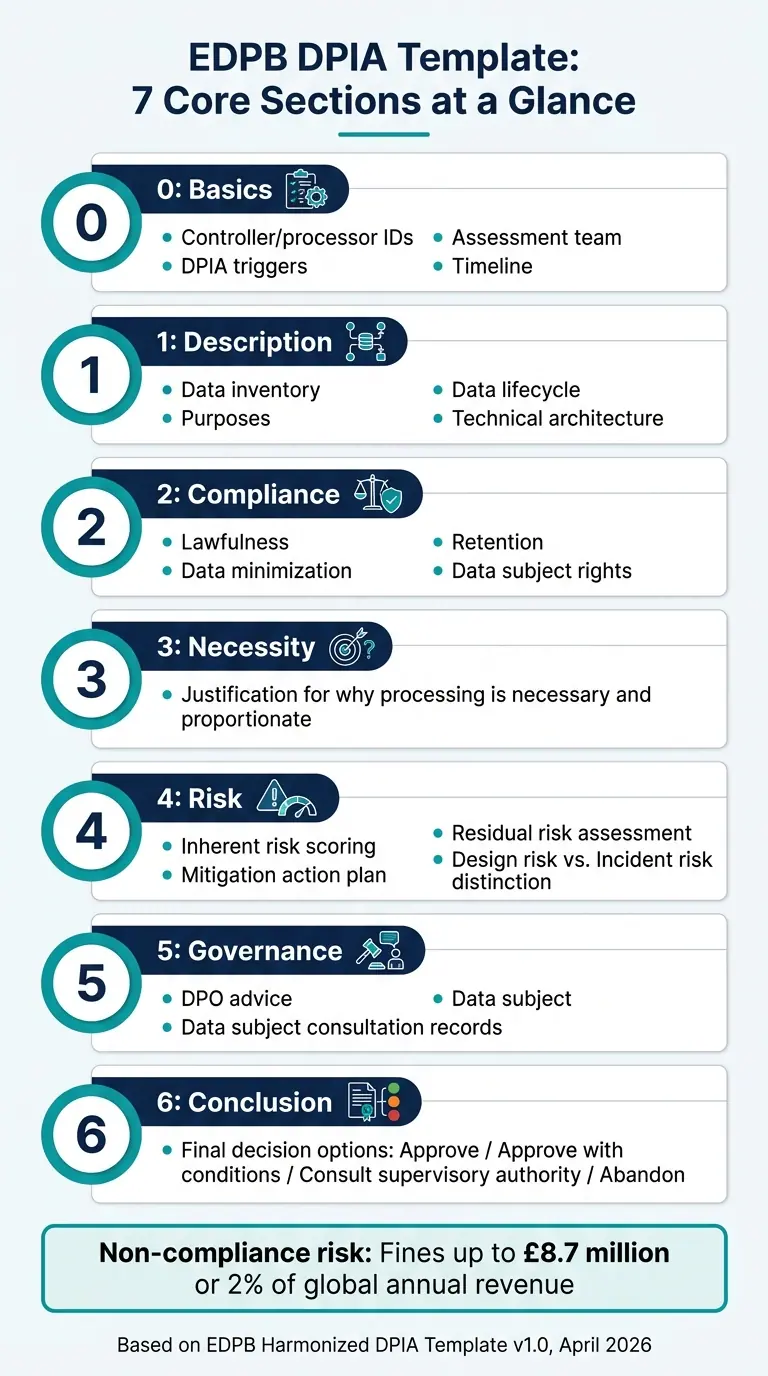
EDPB DPIA Template: 7 Core Sections Explained
GDPR Article 35(7) Requirements
GDPR Article 35(7) lays out the essential elements every DPIA document must include. The regulation specifies:
"The assessment shall contain at least: (a) a systematic description of the envisaged processing operations and the purposes of the processing... (b) an assessment of the necessity and proportionality... (c) an assessment of the risks to the rights and freedoms of data subjects... and (d) the measures envisaged to address the risks." - GDPR Article 35(7)
These four elements are non-negotiable. Additionally, the regulation requires incorporating advice from the Data Protection Officer (DPO) and, where appropriate, the views of data subjects. Each component must be thoroughly documented to ensure compliance under regulatory review.
This framework, established by GDPR, has become a reference point for privacy regulations worldwide.
Global Regulatory Alignment
For U.S.-based companies operating internationally, there's some relief in knowing that GDPR's core structure is mirrored in most major privacy frameworks. For instance, the UK GDPR retains the same Article 35 provisions as the EU version. However, the UK's Information Commissioner's Office (ICO) takes a more adaptable approach, providing a 7-step guidance process rather than mandating a rigid documentation format.
A significant development came on March 10, 2026, when the European Data Protection Board (EDPB) introduced a harmonized DPIA template (Version 1.0), officially released on April 14, 2026. This new template replaced older national tools like France's CNIL model and Germany's Standard Data Protection Model, offering a single standard accepted across all EU supervisory authorities.
"The EDPB's template aims to... [provide] a minimum documentation standard that all supervisory authorities across the EU are expected to accept." - Lukas Willecke, Associate, ReedSmith
One standout feature of the EDPB template is its separation of "design risk" and "incident risk." Design risk refers to vulnerabilities built into the processing system, such as overly long data retention periods. Incident risk, on the other hand, focuses on operational threats like cyberattacks or accidental breaches. This distinction requires organizations to justify how their processing activities are structured before explaining how they plan to safeguard them.
With this harmonized template setting the standard, organizations must now integrate these guidelines into their documentation practices.
Building Standardized Templates
To consistently meet regulatory expectations, organizations should develop a standardized internal DPIA template. While no single legally mandated format exists, relying on a structured template reduces the risk of inconsistencies across teams and projects.
The EDPB's 2026 template provides a practical framework, divided into seven sections:
| Section | Key Documentation Requirements |
|---|---|
| Section 0: Basics | Controller/processor IDs, DPIA triggers, assessment team, timeline |
| Section 1: Description | Data inventory, purposes, data lifecycle, technical architecture |
| Section 2: Compliance | Lawfulness, data minimization, retention, data subject rights |
| Section 3: Necessity | Justification for why processing is necessary and proportionate |
| Section 4: Risk | Inherent risk scoring, mitigation action plan, residual risk assessment |
| Section 5: Governance | DPO advice, data subject consultation records |
| Section 6: Conclusion | Final decision: approve, condition, consult supervisory authority, or abandon |
Using the EDPB structure is a smart move, as it not only aligns with EU regulations but is also likely to satisfy UK requirements. To strengthen your documentation, consider adding status tiers (e.g., planned, partially implemented, implemented) to compliance tables. This creates a clear audit trail that demonstrates not just what measures are planned but also the progress made toward implementation.
Essential Elements of DPIA Documentation
Systematic Description of Processing
The systematic description forms the backbone of any DPIA. It lays out exactly how personal data is handled. As Google Cloud emphasizes, "you are expected to offer a detailed explanation of your organization's data processing". This goes beyond a brief overview - it's about painting a clear picture of what data is collected, who it is collected from, how it moves through systems, and when it is ultimately deleted.
A strong description should cover four key areas: nature (how data is gathered, used, stored, and erased), scope (the types of data, the volume, and the individuals affected), context (the relationship between your organization and the data subjects, including whether data is sourced directly from individuals or third parties), and purpose (the specific business objective for processing). Visual tools like data flow diagrams can help illustrate the data lifecycle, simplifying audits and ensuring transparency. This detailed mapping lays the groundwork for evaluating whether the processing is justified and proportional.
Assessing Necessity and Proportionality
After describing the processing activities, the DPIA must explain why they are necessary. This section should establish the legal basis for processing, confirm that only essential data is collected, and outline how data subject rights - such as access, correction, and deletion - are protected. It’s important to directly link each processing decision to its legal justification.
Once this foundation is established, the focus shifts to identifying and evaluating potential risks.
Risk Evaluation and Threat Documentation
With the processing description and necessity assessment in place, the next step is to analyze potential threats. The EDPB template separates risks into two categories: design risks and incident risks. Design risks stem from the architecture of the processing itself - examples include collecting unnecessary data fields, using identifiers that could lead to re-identification, or retaining data longer than needed. Incident risks, on the other hand, arise from operational issues like software misconfigurations, insider misuse, or external breaches.
"The EDPB template's separation of design risk from incident risk is its strongest feature... It forces controllers to justify the processing architecture before they move to operational safeguards." - Rob Bratby, Managing Partner at Bratby Law
Each risk should be documented with its likelihood and potential impact. Structured scoring systems, such as numerical scales or traffic-light indicators, can clarify risk levels. Always consider risks from the perspective of the data subjects, factoring in issues like identity theft, discrimination, misuse of their data, or loss of control over their personal information.
Mitigation Measures and Residual Risk
Once risks are identified, the DPIA must outline the measures taken to address them and assess any residual risks. If mitigation efforts reduce a high risk to an acceptable level, clearly explain how this was achieved. However, if a high risk persists, it’s essential to consult the appropriate supervisory authority. Each mitigation measure should align with compliance requirements, including principles under Article 5, data subject rights, and the concept of data protection by design and default.
Governance and Consultation Records
Accountability is the final piece of the puzzle. The DPIA should document all contributors and their inputs. If your organization has a Data Protection Officer, their advice should be included, along with any concerns they raised and how those were addressed. Where relevant, feedback from data subjects or their representatives should also be noted. Additionally, record the involvement of internal teams (such as legal, IT security, and product development) and any external processors or third parties consulted. This thorough governance record ensures the DPIA reflects a collaborative, well-rounded evaluation - not a mere formality.
Putting DPIA Documentation Standards into Practice
Integrating DPIA Documentation into Workflows
A DPIA becomes meaningful only when it’s seamlessly integrated into your team’s everyday processes - not treated as a last-minute formality. As the ICO emphasizes:
"A DPIA is not simply a rubber stamp or a technicality as part of a sign-off process. It's vital to integrate the outcomes of your DPIA back into your project plan."
Start DPIA activities at the earliest stages of a project. Under Article 25 of the GDPR, "data protection by design and default" mandates that DPIAs should begin before systems are built or data flows are finalized. Once the DPIA is complete, immediately adjust project elements like data scope, retention timelines, or technical architecture as needed. Beyond initial implementation, specific triggers - such as new security vulnerabilities, updates in regulatory guidance, or significant changes in data use - should prompt a DPIA review. These steps ensure that your team is prepared to maintain accurate and consistent documentation, even as circumstances evolve.
Using No-Code Tools for Structured Documentation
Automated tools can simplify and standardize the DPIA process. Managing DPIAs consistently across projects is challenging when relying on static Word documents or spreadsheets. No-code platforms like Reform provide an efficient way to structure and manage DPIAs without requiring advanced technical knowledge.
The 2026 EDPB template outlines seven key sections (0–6) for DPIA documentation, covering everything from processing details and legal analysis to risk assessments and final approvals. Reform’s multi-step forms align naturally with this structure, breaking down the process into manageable steps rather than presenting it as a single, overwhelming document. Features like conditional routing are particularly helpful during the screening phase. For example, if a respondent flags high-risk activities - like large-scale profiling or processing special category data - the form can automatically guide them into a more detailed DPIA workflow. This approach mirrors the ICO’s 7-step process and reduces the chance of skipping critical steps.
Dedicated fields for DPO recommendations, stakeholder input, and final decisions (e.g., whether to proceed, consult further, or modify processing) ensure that all essential details are captured.
Creating and Managing DPIA Registers
Once documentation is structured, maintaining a centralized DPIA register becomes crucial for long-term compliance. A centralized DPIA register allows organizations to track every assessment, its outcomes, and when reviews are due. Without this, demonstrating accountability to regulatory authorities becomes a challenge.
An effective register should include key details like the project or system name, the date the DPIA was completed, the final decision, DPO advice and whether it was followed, and the next review date. High-risk AI systems, for instance, may require quarterly reviews, while standard systems should be reviewed at least annually. Static files are ill-suited for managing these schedules. A well-designed digital form, integrated with governance or project management tools, can help track responses in real time, flag overdue reviews, and maintain a dynamic, up-to-date record.
"A DPIA filed pre-deployment and never revisited is a compliance liability, not an asset." - Knowlee Team
For organizations juggling multiple systems, the register should also link DPIAs to related compliance documents, such as Fundamental Rights Impact Assessments (FRIAs) for AI systems. This shared documentation avoids duplicated effort and ensures a more streamlined compliance process.
Maintaining and Reviewing DPIA Documentation
Review Triggers and Update Schedules
Once DPIA documentation is in place, it’s essential to review it regularly to ensure compliance and address emerging risks. A DPIA isn’t static - it evolves as processing activities, technologies, external threats, or incidents change. Knowing when to review it is just as crucial as knowing how to create it. These reviews are usually triggered by four main categories:
- Internal processing changes: Examples include introducing new data categories, handling larger data volumes, or modifying retention policies.
- Technical changes: Such as implementing AI or machine learning models or onboarding new sub-processors.
- External factors: For instance, addressing newly identified security vulnerabilities or adapting to changes in encryption standards.
- Operational incidents: Including data breaches, system misconfigurations, or unauthorized access events.
The 2026 EDPB template introduces a clear distinction between design risk (risks tied to the architecture of the processing system) and incident risk (risks from operational failures like software glitches or insider misuse). This separation helps clarify the need for updates based on different types of risks.
Linking DPIA Outcomes to Risk Management
A DPIA’s findings are most effective when integrated into broader organizational risk management. Simply storing the results in a compliance folder limits their impact. Instead, leading organizations incorporate DPIA findings into corporate risk registers and incident response plans, ensuring that data protection risks are visible to senior leadership alongside other operational risks.
The 2026 EDPB template provides a practical framework for this integration. Its Action Plan (Section 4.2) categorizes mitigating measures into three stages - planned, partially implemented, or fully implemented - and ties these directly to project work plans. Additionally, the template offers a four-option decision matrix for final approval: abandon processing, consult the supervisory authority, approve without conditions, or approve with conditions. This approach transforms DPIA conclusions into actionable governance steps rather than vague sign-offs.
Rob Bratby, Managing Partner at Bratby Law, highlights the value of this approach:
"The EDPB template's separation of design risk from incident risk is its strongest feature... It forces controllers to justify the processing architecture before they move to operational safeguards."
This structured risk monitoring also lays the foundation for continuous improvement through training and feedback.
Improving DPIA Processes Through Training and Feedback
Each completed DPIA is an opportunity to improve future processes. By documenting lessons learned - whether successes, oversights, or inefficiencies - you can refine templates and update internal guidance over time. These insights should directly shape updates to your DPIA workflows and documentation.
Including training records within the DPIA file strengthens its credibility and demonstrates a commitment to thoroughness. Responsibility for completing and updating DPIAs should rest with individuals who have the authority to act on the findings, such as project leads or senior managers. While the DPO plays an advisory role, the ultimate accountability lies with the controller.
Conclusion
Key Takeaways
Creating effective DPIA documentation requires a detailed processing description, a clear explanation of necessity and proportionality, a structured approach to risk evaluation, and well-documented mitigation measures. These components work together to establish a strong compliance framework, demonstrating accountability throughout the processing lifecycle. Importantly, these are not merely suggestions - they are legal obligations under Article 35 of the GDPR.
The trend toward standardization is gaining momentum. On April 14, 2026, the EDPB introduced a harmonized DPIA template, signaling a shift in expectations. Regulators now demand more than basic checklists. As Lukas Willecke, Associate at ReedSmith, explains:
"A single, accepted template has the potential to significantly reduce this compliance burden while simultaneously raising the quality floor for DPIA documentation."
Inadequate documentation poses serious financial and regulatory risks. Non-compliance can lead to costly penalties, making thorough DPIA documentation a practical requirement, not just a regulatory box to check.
Final Thoughts on Applying DPIA Standards
DPIA should be seen as a dynamic process embedded into project cycles, rather than a one-time task. As the ICO emphasizes: "A DPIA is a 'living' process to help you manage and review the risks of the processing and the measures you've put in place on an ongoing basis." Assigning clear ownership, acting on findings, and regularly reviewing outcomes ensures that DPIA remains a proactive tool rather than an afterthought.
Using no-code platforms can simplify and enhance this ongoing process. Tools like Reform allow teams to create customizable intake forms and workflows without needing to write code. This ensures that every DPIA begins with accurate, comprehensive information and stays organized over time. By integrating strong documentation practices with the right tools, organizations can make DPIA compliance a seamless part of their operations rather than a rushed, last-minute effort.
FAQs
When do I need to do a DPIA?
A Data Protection Impact Assessment (DPIA) is necessary when data processing activities could significantly impact individuals' rights and freedoms. Examples include handling large volumes of sensitive data, systematically analyzing personal characteristics (like profiling), or conducting widespread surveillance in public areas. The goal is to identify potential risks and ensure adherence to privacy laws, safeguarding personal information effectively.
What’s the difference between design risk and incident risk?
Design risk involves spotting potential hazards during the development phase of a product or process. The goal? To address these risks early, before they have a chance to cause problems once the product or process is operational. This type of risk is assessed by considering two key factors: how likely the hazard is to occur and how severe the consequences could be.
On the other hand, incident risk deals with harmful events that happen during the actual operation. These events stem from hazards that weren’t fully addressed or eliminated during development. Managing incident risk focuses on responding to these events and working to reduce their impact.
When should a DPIA be reviewed or updated?
When there are major changes to processing activities - like adjustments in scope, purpose, or technical setup - a DPIA needs to be reviewed or updated. It's also important to revisit the DPIA if new risks come to light, ensuring that compliance is maintained and risks are effectively managed.
Related Blog Posts
Get new content delivered straight to your inbox

The Response
Updates on the Reform platform, insights on optimizing conversion rates, and tips to craft forms that convert.




Drive real results with form optimizations
Tested across hundreds of experiments, our strategies deliver a 215% lift in qualified leads for B2B and SaaS companies.
