
.webp)
5 Steps to Update DPIAs for New Regulations



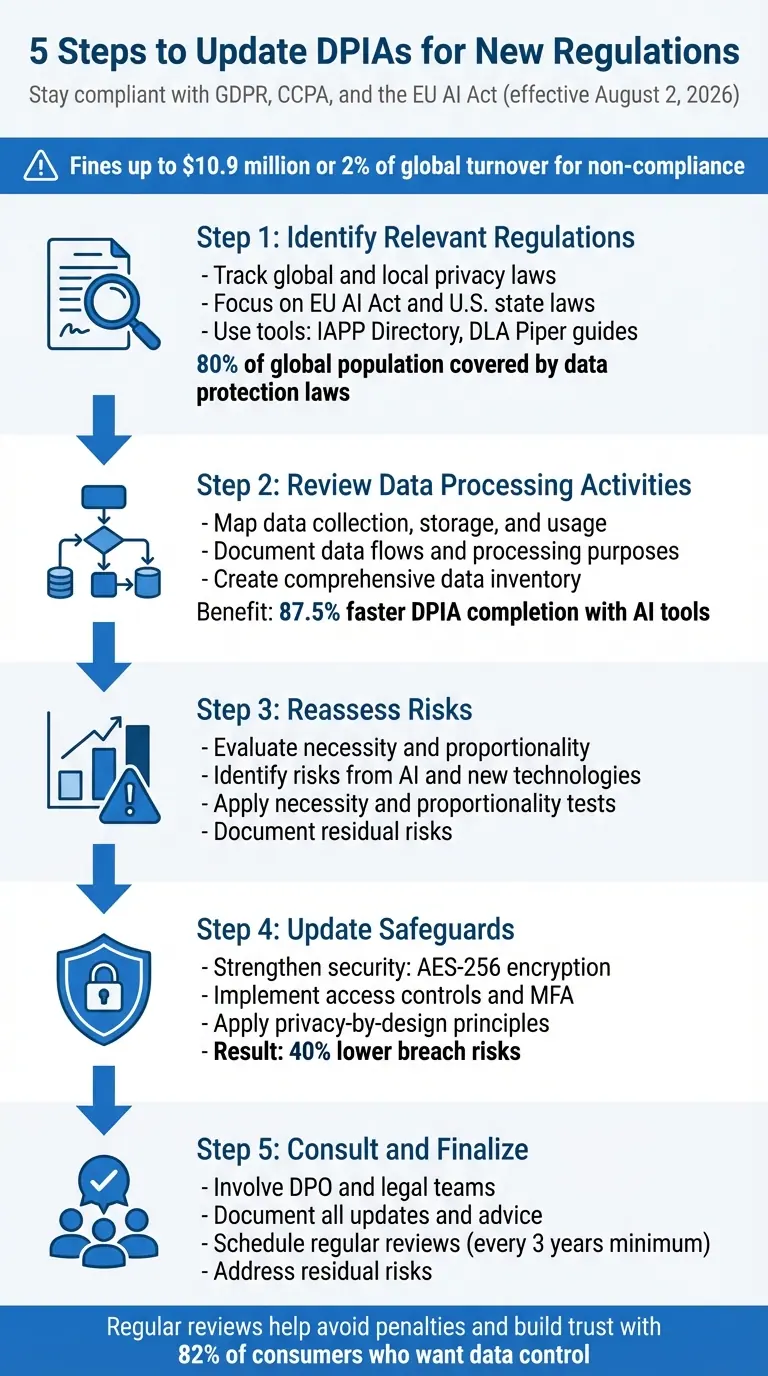
Updating your Data Protection Impact Assessment (DPIA) is critical to staying compliant with evolving privacy laws like GDPR, CCPA, and the upcoming EU AI Act (effective August 2, 2026). Neglecting this can result in fines of up to $10.9 million or 2% of global turnover. Here's a quick breakdown of the five steps to ensure your DPIA meets new regulatory requirements:
- Identify Relevant Regulations: Track global and local privacy laws affecting your data processing. Focus on updates like the EU AI Act or U.S. state-specific laws (e.g., California CCPA amendments).
- Review Data Processing Activities: Map out how your organization collects, stores, and uses data. Document data flows, processing purposes, and compliance gaps under new rules.
- Reassess Risks: Evaluate whether your processing is still necessary and proportionate. Identify risks from new technologies like AI and implement mitigation strategies.
- Update Safeguards: Strengthen security measures such as encryption, access controls, and privacy-by-design principles. Use tools to streamline compliance.
- Consult and Finalize: Involve stakeholders like your Data Protection Officer (DPO) and legal teams. Document updates, address residual risks, and schedule regular DPIA reviews.
These steps not only help avoid penalties but also demonstrate a commitment to protecting personal data in an ever-changing regulatory landscape.
5 Steps to Update DPIAs for New Privacy Regulations
Step 1: Identify Which Regulations Affect Your DPIA
Keep Tabs on Global and Local Data Protection Laws
Data protection laws now cover a whopping 80% of the global population. With privacy regulations constantly evolving, staying on top of these changes is essential. But how do you keep up without drowning in information? A systematic tracking approach can make all the difference.
Start by using global resources that compile regulatory updates. Tools like the IAPP Global Privacy Law Directory, DLA Piper's Data Protection Laws of the World, and the ICLG Data Protection Laws and Regulations guide provide detailed insights into current laws and any recent updates. For region-specific developments, check out platforms like Norton Rose Fulbright's Data Protection Report, which delves into nuances like the "two GDPRs" dynamic between the EU and UK.
Your Data Protection Officer (DPO) can help interpret these updates and their impact on your operations. If things get complicated - especially with cross-border issues - consider bringing in external privacy consultants. Subscribing to newsletters from sources like the IAPP and Future of Privacy Forum can also keep you informed about draft legislation and enforcement trends.
If your organization operates across multiple jurisdictions, automated monitoring tools can save time and effort. These platforms streamline privacy workflows and ensure compliance by syncing real-time data from your security systems to maintain accurate data maps. Such tools are even known to cut Data Subject Access Request response times by 60–80%.
Once you’ve tracked the latest updates, focus on the regulations that specifically impact your data processing activities.
Assess If Updates Apply to Your Processing Activities
Not every regulatory change will affect your DPIA. To figure out which ones do, consider factors like geographic scope, the volume of data you handle, and the nature of your processing activities. Here’s a quick overview of upcoming regulatory milestones that may require DPIA updates:
| Region | Law/Regulation | Key 2026 Milestone | DPIA/Assessment Requirement |
|---|---|---|---|
| United States | Kentucky, Rhode Island, Indiana | Effective Jan 1 & July 1, 2026 | Requires data minimization and GPC recognition |
| California | CCPA Amendments | Effective Jan 1, 2026 | Needed for high-risk processing (e.g., AI training) |
| European Union | EU AI Act | Full Enforcement Aug 2, 2026 | AI Impact Assessments for high-risk systems |
| Australia | Privacy Act Amendments | Effective Dec 10, 2026 | Transparency for automated decision-making |
| India | DPDP Act | Phase 2 Nov 13, 2026 | Consent manager registration, parental consent |
Next, check if you handle data from residents in regions with new or updated laws. For instance, the laws in Kentucky, Rhode Island, and Indiana apply to businesses managing data on 100,000 or more local consumers. Meanwhile, California's CCPA amendments, effective January 2026, mandate cybersecurity audits for businesses with annual revenues of $26.625 million or more.
Also, watch for updates to sensitive data categories. Some U.S. states now classify neural data, precise geolocation within 1,750 feet, and data from minors under 16 as sensitive, requiring extra safeguards.
High-risk processing activities are another trigger for DPIA updates. For example, the EU AI Act, fully enforceable by August 2, 2026, requires AI Impact Assessments for high-risk systems. If your organization uses advanced technologies like AI, blockchain, or IoT, a DPIA update is likely on the horizon.
Finally, don’t overlook cross-border data transfers. If your data flows to countries without adequacy decisions, you might need Transfer Impact Assessments and updated Standard Contractual Clauses to stay compliant.
This targeted analysis lays the groundwork for reevaluating your processing risks in Step 3.
sbb-itb-5f36581
Step 2: Review Your Current Data Processing Activities
Document Data Flows and Processing Purposes
To update your DPIA effectively, you first need a clear understanding of how data moves within your organization. Start by mapping out your data processing activities - this includes how you collect, store, use, and share data. Identify internal access points, the third-party processors you collaborate with, and whether you're leveraging technologies like AI or machine learning.
Next, define the scope and context of your processing. Document details such as the types and volume of personal data you handle, how often you process it, the geographical regions involved, and the sources of this data. Additionally, assess the nature of your relationship with individuals and whether you work with sensitive groups - like children or other vulnerable populations. This detailed mapping is crucial for understanding your data flows and the broader context of your processing activities.
Your documentation should also clarify the purpose of each processing activity. Explain why you collect data - whether for legitimate interests, specific organizational benefits, or intended outcomes for individuals. Creating a comprehensive data inventory that links data categories to their sources, sensitivity levels, and processing purposes can make this process more manageable.
"A DPIA should begin early in the life of a project, before you start your processing, and run alongside the planning and development process." - ICO
Using AI-powered compliance platforms can significantly streamline this process. For example, organizations have reported reducing DPIA workflow completion times by 87.5% with these tools. Keep in mind that failing to conduct a required DPIA could lead to fines as high as $10.9 million or 2% of global annual turnover, whichever is greater.
Find Compliance Gaps Under New Requirements
Once you've documented your data flows and processing purposes, the next step is to compare these against the updated regulatory requirements identified in Step 1. This comparison will help you uncover any compliance gaps and ensure your DPIA aligns with the latest data protection standards.
Start by examining your data minimization practices. Are you collecting only the data you need? Validate the legal bases for each processing activity, such as Article 6(f) Legitimate Interest under GDPR, and ensure retention periods are well-documented and justified.
Pay close attention to cross-border data transfers. If you transfer data outside the EU or UK, conduct Transfer Impact Assessments to confirm that safeguards, like Standard Contractual Clauses, meet current legal standards. Carefully review your data flows to identify any undocumented transfers that could pose compliance risks.
Evaluate your technical safeguards to ensure they align with updated regulatory expectations. Test these measures to confirm they effectively prevent breaches. For example, if you use CRM APIs or third-party integrations, verify their authentication processes and data handling practices. Modern regulations may also require you to assess algorithmic transparency, address training data bias, and implement proper human oversight for automated decision-making systems.
Your Data Protection Officer should lead this compliance gap analysis, working alongside cross-functional teams such as IT security, engineers, and developers. These stakeholders can provide insights into practical data flows that legal teams might miss. If your data collection involves online forms, tools like Reform can simplify compliance with features like email validation, spam prevention, and secure integrations that maintain consistent data flows to your CRM systems.
Step 3: Reassess Processing Risks and Necessity
Check If Processing Is Still Necessary and Proportionate
Once you've identified compliance gaps, the next step is to evaluate whether your data processing activities are still essential and balanced. This involves applying two key tests: necessity and proportionality. The necessity test asks whether the processing is genuinely required to achieve your stated purpose or if there are less intrusive ways to achieve the same outcome. Meanwhile, the proportionality test ensures that the processing aligns with the intended benefits and minimizes any negative impact on individuals' rights and freedoms.
Take a closer look at each processing activity and compare it to the documented purposes in your original or updated Data Protection Impact Assessment (DPIA). Verify that personal data is only being used for the specific purposes outlined. Also, confirm that the lawful basis for processing - be it consent, contract, or legitimate interests - remains valid. For instance, processing data for over 1,000 individuals often qualifies as "large scale", which may require a mandatory DPIA reassessment.
Ask yourself: Could you achieve the same objectives with less data or a less invasive method? Your Data Protection Officer (DPO) should lead this evaluation, carefully documenting the findings. It's also important to revisit retention periods, as holding onto data longer than necessary can undermine the proportionality of your processing.
"DPIAs help you spot privacy risks early, when they're easier and cheaper to fix." - PrivacyForge
For sensitive groups, such as children or employees, apply stricter necessity criteria. Tools like Reform's email validation and spam prevention can help ensure you're only collecting what’s absolutely essential.
Identify New Risks and Required Mitigation
Beyond necessity and proportionality, it's crucial to evaluate risks that may arise from new technologies or changes in processing methods. Emerging regulations or advancements, like AI and automated decision-making systems, can introduce unforeseen risks. For example, AI tools might unintentionally produce biased outcomes, leading to discriminatory effects. The European Data Protection Board has identified nine criteria for high-risk processing, including the use of innovative technologies and large-scale monitoring. Ensure your AI systems provide algorithmic transparency and include human oversight to reduce risks from fully automated decisions.
Create a data inventory to map third-party data flows, identifying all external vendors and partners involved. Risks often surface when datasets are combined or matched in ways that exceed what individuals might reasonably expect. Use a risk scoring model to assess both the likelihood and severity of harm, which will help determine the overall risk level. Additionally, pay special attention to "invisible processing" - data collected without individuals' knowledge - which requires stronger justification.
| Risk Category | What to Assess | Example Mitigation |
|---|---|---|
| Algorithmic Bias | Review AI tools for discriminatory outputs | Implement human oversight mechanisms |
| Third-Party Sharing | Map data flows with external vendors | Conduct automated vendor risk assessments |
| Data Matching | Examine cross-referencing for profiling | Apply data minimization and pseudonymization |
| Innovative Tech | Analyze risks from AI, ML, or biometrics | Incorporate privacy-by-design principles |
Involve your IT security team, engineers, and developers in the risk assessment process. They can uncover technical vulnerabilities that might be overlooked by legal or compliance teams. Document any residual risks that remain after mitigation efforts. If your DPIA highlights high risks that cannot be adequately addressed, consult your Data Protection Authority before proceeding. Keep in mind that the Data (Use and Access) Act, which came into effect on June 19, 2025, has prompted widespread reviews of existing data protection frameworks.
Step 4: Update Your Safeguards and Mitigation Measures
Strengthen Security Measures and Data Handling
After identifying potential risks, the next step is to put robust technical and organizational safeguards in place. Start by implementing AES-256 encryption to secure data both at rest and in transit. To further protect sensitive information, consider techniques like pseudonymization or anonymization. For example, using k-anonymity can help prevent re-identification, aligning with GDPR Article 35 requirements for mitigating high-risk data processing.
Access control is another key area to address. Use Role-Based Access Control (RBAC) to limit data access strictly to authorized personnel. Strengthen security further by enabling multi-factor authentication (MFA) for systems managing sensitive data. Organizations that adopt practices like data minimization and conduct regular retention audits have been shown to lower breach risks by 40%.
Equally important is educating your staff. Annual training sessions should focus on critical areas such as data minimization, identifying phishing attempts, and securely managing personal data. The Information Commissioner's Office (ICO) underscores the need for ongoing awareness training, particularly for teams working on new projects. Make sure to document training completion in your DPIA and schedule regular refresher sessions. These steps lay the groundwork for using technology to maintain DPIA compliance.
For organizations subject to the EU AI Act, which takes effect on August 2, 2026, it’s essential to document human oversight procedures and verify that AI training data complies with legal standards.
Use Reform for Compliant Data Collection

Modern tools can simplify compliance efforts when combined with these safeguards. For example, Reform offers built-in encryption for form submissions, ensuring data is protected from the moment it’s collected. Its spam prevention features, like CAPTCHA and honeypots, block unauthorized bot submissions, while email validation ensures higher data accuracy by reducing the chance of processing incorrect information.
One standout feature is conditional routing, which allows you to display or hide form fields based on user input. This ensures that sensitive fields are shown only to relevant users, aligning with data minimization principles and reducing risks.
Reform also includes lead enrichment, which automatically appends verified data to submissions. This not only boosts accuracy but also maintains compliance. Additionally, real-time analytics can flag unusual submission patterns, helping you detect potential security issues early. These tools integrate seamlessly with CRM systems, creating audit-ready compliance logs. Organizations using automated tools like these report up to 50% faster compliance reviews and a decrease in high-risk findings.
To ensure your use of Reform aligns with compliance standards, map its data flows within your DPIA. Configure privacy-focused integrations and conduct quarterly reviews of analytics to identify emerging risks. Document your mitigation strategies and secure owner sign-offs to prepare for regulatory audits. A case study even highlighted how conditional forms successfully reduced profiling risks.
Step 5: Consult Stakeholders and Finalize Your Updates
Consult Stakeholders to Finalize Your DPIA
After updating your risk assessments and safeguards in Step 4, it’s time to bring stakeholders into the fold. Their input is essential to validate your measures and address any remaining risks. Start with your Data Protection Officer (DPO), who plays a critical role in this process. The DPO offers independent advice on mitigation strategies, ensures the DPIA has been conducted properly, and evaluates any residual risks. As the ICO puts it, "If you have a Data Protection Officer (DPO), you must ask for their advice on your DPIA, and document it as part of the process".
In addition to your DPO, loop in other key teams. Your information security and IT teams can verify technical safeguards, while legal and compliance teams can confirm that your processing activities have a lawful basis. The business or project owner should take responsibility for defining the scope and providing the final approval. It’s also important to gather input from data subjects to understand how your processing may affect their rights. Tools like surveys, focus groups, or interviews can help you gather a range of perspectives.
If your DPIA reveals a high residual risk that cannot be mitigated, you’re required to consult the ICO before moving forward. The ICO generally responds within eight weeks, though complex cases may take up to 14 weeks. They’ll let you know within 10 days if your DPIA is accepted for formal consultation. Keep in mind, skipping a mandatory DPIA can lead to penalties of up to £8.7 million or 2% of your global annual turnover.
To streamline the process, use a RACI matrix to document who is responsible, accountable, consulted, and informed at each stage. This not only creates a clear, auditable record but also speeds up decision-making. If you decide to go against your DPO's advice or stakeholder feedback, make sure to document your reasons and justifications thoroughly. Once all feedback is incorporated, finalize the updates and establish review intervals.
Document Updates and Schedule Regular Reviews
Think of your DPIA as a dynamic document that evolves over time. Every update should be clearly recorded, including the DPO's advice, consultation outcomes, any disagreements, and supporting materials like revised privacy notices, consent forms, or data-sharing agreements. Keeping the language straightforward ensures accessibility for all stakeholders.
While the GDPR doesn’t mandate specific review intervals, some data protection authorities - like those in France, Slovenia, and the Netherlands - recommend reviewing DPIAs at least every three years. Beyond this, you should revisit your DPIA whenever there are major changes to your processing activities, such as mergers, new regulations, advancements in technology, or updates to data retention policies.
Set up a compliance calendar with clear triggers for reviews. These can be time-based (e.g., every three years) or event-based, triggered by significant changes in your operations. Your DPO should actively monitor the DPIA’s effectiveness, ensuring planned mitigation actions are being carried out. Linking DPIA milestones to key project phases, like vendor onboarding or product launches, can help you address risks before they escalate.
For added transparency, consider sharing a redacted version or summary of your DPIA. This builds trust with data subjects by showing how their data is handled and empowering them to exercise their rights. Transparency is especially critical given that 82% of global consumers express a desire for greater control over their personal data. By completing this step, you ensure your DPIA remains a tool for continuous improvement and compliance.
Checklist & wrap up DPIA Step by Step Guide Data Protection Impact Assessment
Conclusion
Keeping your DPIA up to date is an ongoing task that ensures your organization stays in step with changing regulations like GDPR, CCPA, and the EU AI Act, which comes into effect on August 2, 2026. By following the five steps outlined, you can move from a reactive approach to a more strategic one. Regular reviews not only help you avoid steep penalties - up to 2% of global turnover or $17.5 million - but also build trust with individuals who expect more control over their personal data.
Organizations that review their DPIAs quarterly tend to pass audits smoothly, identify compliance issues early, and integrate privacy into their operations from the ground up. These regular updates ensure that your data processing activities remain necessary and proportionate, as required under Article 35 of the GDPR.
Step 4’s updated safeguards can be further supported by tools like Reform, which simplify compliance. Features such as conditional routing for data minimization, multi-step forms to limit unnecessary data collection, and spam prevention with email validation enhance security while making compliance easier. These tools allow you to create effective, compliant forms without requiring advanced technical skills.
As regulations continue to evolve, having a flexible DPIA process is crucial. Start now by auditing one high-risk processing activity - whether it involves AI profiling, biometric data, or targeted advertising. Use the five steps from this guide to document your findings, implement safeguards, and set up review triggers. This will help ensure your DPIA remains adaptable to both regulatory changes and your organization’s needs.
FAQs
When do I need to update a DPIA?
You should revisit and update your DPIA whenever risks tied to your processing activities shift. This could happen due to organizational changes like mergers, the introduction of new regulations, or technical advancements, such as emerging security threats.
While the GDPR doesn’t specify a required review timeline, conducting reviews regularly - about every three years - is a smart approach. Doing so helps maintain compliance and keeps you prepared to manage evolving risks effectively.
Do AI systems require a separate AI impact assessment?
Yes, AI systems often need a dedicated AI impact assessment (AI DPIA), particularly when dealing with high-risk activities or processing sensitive information. These assessments are crucial for spotting and addressing privacy concerns such as algorithmic bias, data misuse, or transparency issues. Regulations like the EU AI Act emphasize their role in ensuring compliance and protecting privacy, especially in cases involving biometric data, automated decision-making, or large-scale data processing.
What evidence should I keep to prove DPIA compliance?
To demonstrate compliance with a DPIA, it's crucial to keep comprehensive records of all data processing activities, risk evaluations, and the steps taken to address them. Be sure to document key details such as the scope and purpose of processing, data flows, identified risks, and the measures used to mitigate those risks.
Additionally, include evidence of stakeholder consultations, along with notes on periodic reviews and updates to the DPIA. Protect these records by using encrypted storage, implementing strict access controls, and maintaining audit trails. This approach not only ensures secure record-keeping but also highlights the thoroughness of your assessments and the privacy measures you've put in place.
Related Blog Posts
Get new content delivered straight to your inbox

The Response
Updates on the Reform platform, insights on optimizing conversion rates, and tips to craft forms that convert.


Drive real results with form optimizations
Tested across hundreds of experiments, our strategies deliver a 215% lift in qualified leads for B2B and SaaS companies.
