
.webp)
Lead Quality vs. Quantity: Finding the Balance



When it comes to lead generation, the debate often boils down to one key question: Should you focus on quality or quantity? The answer isn't one-size-fits-all. It's about balancing the two to drive better results for your business. Here's the core idea:
- Lead Quality: High-quality leads have a better chance of converting because they match your Ideal Customer Profile (ICP) and show strong buying intent. While these leads cost more upfront, they lower your overall acquisition costs and boost sales efficiency.
- Lead Quantity: A high volume of leads keeps your pipeline full and provides valuable data for refining strategies. However, chasing too many unqualified leads can overwhelm sales teams and inflate costs.
The key is to find the sweet spot where volume meets value. This involves using tools like lead scoring, progressive profiling, and data-driven ICPs to prioritize high-fit, high-intent leads while nurturing others. A balanced approach ensures you’re not wasting resources or missing opportunities.
Quick Takeaway: Focus on metrics like conversion rates, customer acquisition costs (CAC), and pipeline velocity to guide your strategy. A $100 lead with a 25% conversion rate is far more cost-effective ($400 CAC) than a $20 lead with a 1% conversion rate ($2,000 CAC). Build systems that align marketing and sales to consistently generate the right leads for your goals.
Maximizing Lead Quantity and Quality
sbb-itb-5f36581
1. Lead Quality
When it comes to identifying high-quality leads, two factors stand out: fit and intent. Fit means the prospect aligns closely with your Ideal Customer Profile (ICP) - think industry, company size, or growth stage. Intent, on the other hand, refers to behaviors that suggest they're ready to buy, like visiting your pricing page, requesting a demo, or repeatedly returning to your site.
Why does this matter? The impact on your business is huge. Sales reps can waste 30-45 minutes of productive selling time chasing unqualified leads that go nowhere. By focusing on high-quality leads, your team can spend their time and energy on prospects who are likely to convert, rather than spinning their wheels on those who won’t.
Conversion Potential
High-quality leads are far more likely to convert because they already have a clear need and are closer to making a decision. While the upfront cost per lead might seem higher, the quality-adjusted cost per acquisition ends up being much lower in the long run. Simply put, quality pays off.
Resource Allocation and Sales Pipeline Effects
Focusing on quality has another major benefit: it keeps your sales team motivated and builds trust between marketing and sales. A strong sales acceptance rate (SAR) - the percentage of leads that sales deems worth pursuing - should be at least 70%. Better leads also mean faster deal closures, higher customer lifetime value, and more accurate revenue predictions.
To make this work, analyze your top 20% of customers to define a data-backed ICP that includes firmographics, technographics, and growth stages. Implement a lead scoring system that combines fit and intent: high-fit/high-intent leads go straight to sales, while high-fit/low-intent leads enter nurturing campaigns. Use progressive profiling - collecting data over time instead of overwhelming prospects with long, low-converting forms - to gather insights without disrupting the user experience. Using optimized form templates can help streamline this data collection process.
With the benefits of lead quality covered, it’s time to explore how lead quantity fits into your overall approach.
2. Lead Quantity
Focusing on generating a high volume of leads keeps your sales pipeline busy. Casting a wide net not only boosts brand visibility but also drives substantial website traffic, helping position your business as a leader in your field. However, this approach comes with its own challenges.
Conversion Potential and Long-Term Value
Here’s the catch: only about 12% of B2B leads generated through marketing efforts actually convert into revenue. That means many of these leads need ongoing nurturing. For teams aiming for rapid growth, this often translates into chasing aggressive lead targets to meet revenue goals.
Resource Allocation and Pipeline Effects
The downside of chasing high lead volumes is that it can overwhelm your sales team if proper qualification processes aren’t in place. Marketing budgets can also take a hit when spent on attracting individuals who aren’t serious buyers. Elena Fischer, an author at Gain.io, highlights this issue:
"Low quality leads slow sales cycles by 30–50% on average. They inflate pipeline reports with deals that will never close. They burn out your best sales reps."
To make a high-volume strategy effective, tools like automated lead scoring and AI-driven qualification are essential for filtering out unqualified leads. Tiered routing systems can help too - directing lower-intent leads into automated nurture campaigns while sending high-intent leads straight to your sales team. Keeping a close eye on pipeline velocity is also critical. A pipeline overloaded with stagnant leads can be just as problematic as an empty one.
Scalability and Data Benefits
One major upside of focusing on lead volume is the abundance of data it provides. With a larger pool of information, you can better analyze patterns in behavior and firmographics, which helps refine your Ideal Customer Profile (ICP) and improve lead scoring models. However, managing scalability is a challenge. Systems that handle 50 leads a month may crumble under the weight of 500. To scale effectively, you’ll need strong automation, streamlined processes, and close coordination between your marketing and sales teams.
Next, we’ll dive into how to balance these insights with a focus on lead quality.
Advantages and Disadvantages
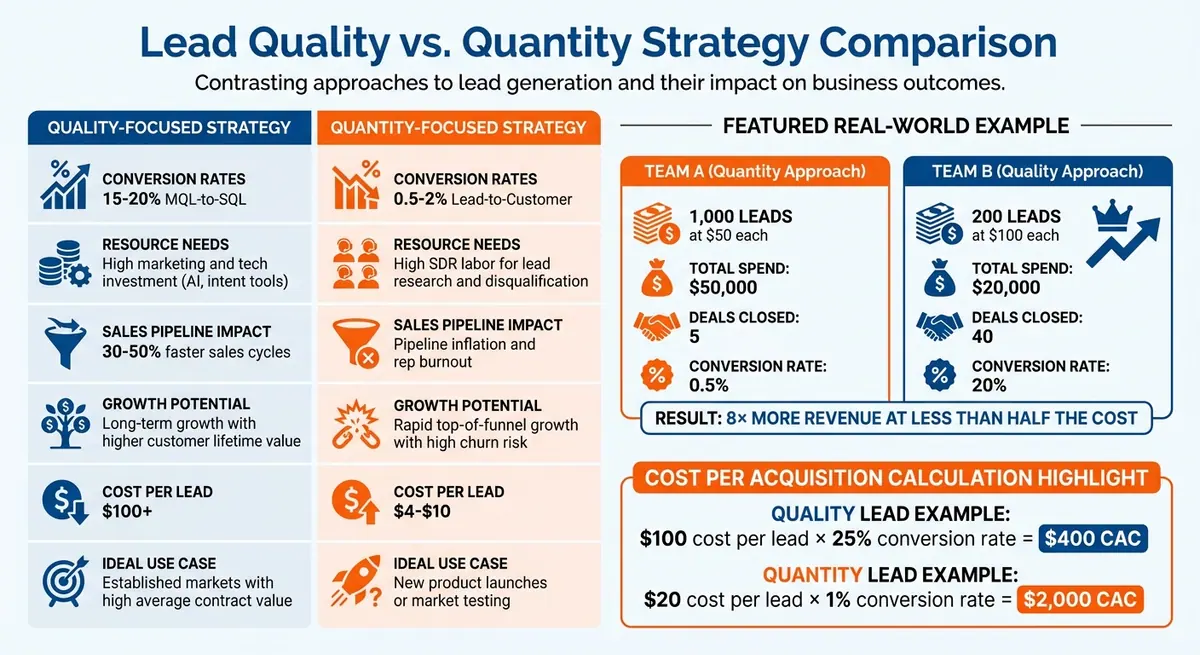
Lead Quality vs Quantity: Cost Per Acquisition Comparison
Choosing between a focus on quality or quantity in your strategy isn't just about preferences - it's about understanding the trade-offs in areas like conversion rates, resource allocation, and long-term growth. Here's a side-by-side comparison of how these two approaches stack up:
| Feature | Quality-Focused Strategy | Quantity-Focused Strategy |
|---|---|---|
| Conversion Rates | High (Target 15–20% MQL-to-SQL) | Low (Often 0.5–2% Lead-to-Customer) |
| Resource Needs | High marketing and tech investment (e.g., AI, intent tools) | High SDR labor for lead research and disqualification |
| Sales Pipeline Impact | Faster velocity (30–50% faster cycles) | Pipeline inflation and rep burnout |
| Growth Potential | Long-term growth with higher customer lifetime value | Rapid top-of-funnel growth with high churn risk |
| Cost per Lead | Higher initial CPL (around $100+) | Lower initial CPL (approximately $4–$10) |
| Ideal Use Case | Established markets with high average contract value | New product launches or market testing |
Real-World Example: Quality vs. Quantity in Action
Let’s break it down with an example:
- Team A opts for quantity, generating 1,000 low-quality leads at $50 each. They spend $50,000 and close just 5 deals, resulting in a 0.5% conversion rate.
- Team B takes a quality-driven approach, generating 200 high-quality leads at $100 each. They spend $20,000 but close 40 deals, achieving a 20% conversion rate.
The result? Team B generates 8× the revenue while spending less than half of what Team A did.
The Hidden Costs of Quantity
Labor costs often reveal the downside of a quantity-focused strategy. For instance, an SDR team processing 2,000 MQLs per quarter might waste between $8,500 and $17,000 in time on the 1,700 leads that never convert. As outreach efforts scale, these labor costs only grow.
"If your marketing team is measured on volume alone, you're incentivizing waste. If measured only on immediate conversions, you're leaving money on the table." - B2B Marketing Insights
Striking the Right Balance
Bad data alone can waste 25–40% of marketing budgets. On the flip side, being overly selective can leave your pipeline dry. Your strategy should fit your business stage - new products might benefit from a high-volume approach for market testing, while established offerings with higher contract values are better suited for a quality-first strategy. Finding the right balance is key to driving sustainable growth.
How to Balance Quality and Quantity
When it comes to lead generation, finding the right balance between quality and quantity can feel like walking a tightrope. But with the right strategies, you can build a system that works for both. Here’s how to create a framework that prioritizes sustainable growth by integrating both approaches.
Start with a data-driven Ideal Customer Profile (ICP). This should include details like firmographics, technographics, and the company’s growth stage. To refine your approach, create a tiered framework that categorizes leads into "ideal fit", "good fit", and "possible fit." This structure can guide automated lead scoring and routing, ensuring that leads are handled effectively based on their potential.
Dual-Dimension Lead Scoring
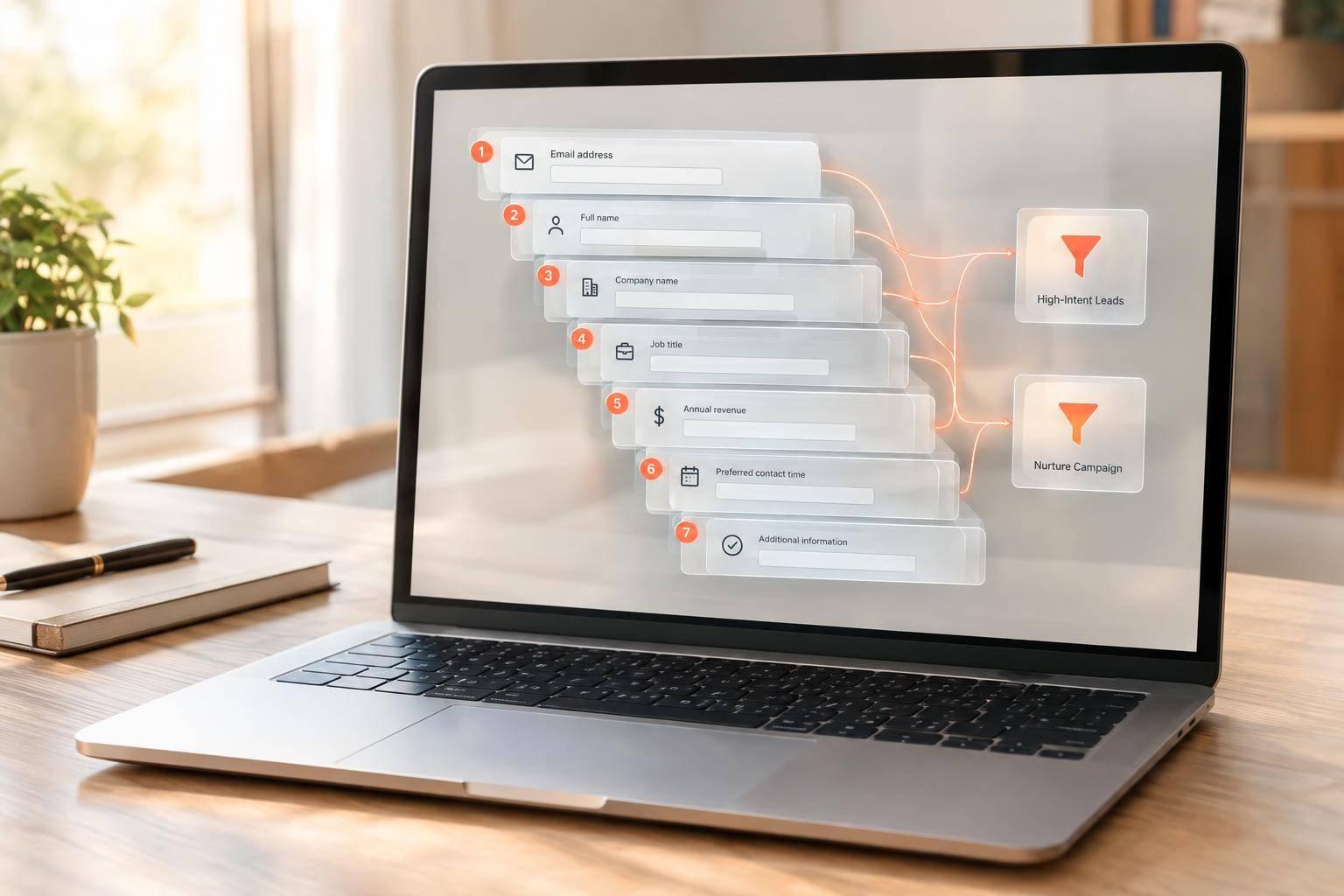
A dual-dimension scoring system evaluates leads on two fronts: fit (demographics and firmographics) and intent (behavioral signals like visits to pricing pages or demo requests). For example:
- A lead with a high fit but low intent might represent a future customer who isn’t ready to buy yet - perfect for nurturing.
- A lead with high intent but low fit could be eager but may need more qualification or longer-term engagement.
The sweet spot? Leads that score high in both areas should be prioritized for immediate sales outreach. This precise scoring system also shapes how you design forms and choose channels, helping you capture better data from the start.
Smarter Form Design and Data Capture
Multi-step forms beat static ones by making a big difference in lead quality. By spreading questions across multiple steps, you reduce cognitive load and increase the likelihood of completion. Add conditional routing to display only relevant fields based on the lead’s characteristics (e.g., enterprise-specific questions for larger companies). Combine this with lead enrichment tools to auto-fill firmographic and technographic data, keeping forms short while still providing your sales team with detailed insights.
Data-Driven Channel Allocation
Accurate scoring and well-designed forms fuel smarter decisions about where to allocate your marketing budget. Avoid being misled by vanity metrics like cost-per-lead alone. Instead, focus on quality-adjusted metrics. For instance:
- A channel with a $100 cost-per-lead and a 25% conversion rate results in a $400 acquisition cost.
- Compare that to a $20 cost-per-lead channel with only a 1% conversion rate, which ends up costing $2,000 per acquisition.
Tracking leads from their source all the way to a closed-won deal allows you to calculate the true cost per acquisition. With these insights, you can shift your budget to the most efficient channels.
Sales-Marketing Alignment
To keep everything running smoothly, establish structured feedback loops between sales and marketing. Weekly syncs can help identify why certain leads are being rejected and allow marketing to adjust its targeting in real-time. Introduce scoring decay rules to automatically lower the scores of dormant leads, ensuring your pipeline doesn’t get clogged with stale prospects. And don’t forget to revisit your ICP regularly - quarterly reviews are ideal to keep your strategy aligned with changes in your product or market.
"The teams that win aren't the ones generating the most leads or the most qualified leads. They're the ones who've built systems to consistently generate enough of the right leads to hit revenue targets".
As highlighted by Orbit Forms, success lies in building systems that consistently deliver the right mix of lead quality and volume to meet your revenue goals.
Conclusion
Striking the right balance between lead quality and quantity is essential. Chasing high volumes without proper qualification overwhelms sales teams, increases costs, and lowers conversion rates. On the flip side, being too selective about lead quality can slow down your pipeline, making it harder to meet growth goals.
For steady growth, you need systems that consistently bring in the right leads. Focus on quality-adjusted metrics like lead-to-opportunity conversion rates and average deal size, rather than just raw MQL counts. For example, a $100 lead with a 25% conversion rate costs $400 per deal, while a $20 lead with only a 1% conversion rate costs $2,000 per deal. These numbers highlight the importance of tools that streamline and optimize the lead capture process.
Tools like Reform make this balance easier to achieve. With features like multi-step forms, conditional logic, and lead enrichment, they help you gather valuable data without overwhelming prospects with long forms. Reform’s concept of "qualified friction" ensures you're not just increasing form completions - you’re improving conversions by filtering out unqualified leads before they drain your team’s resources.
FAQs
How do I set lead scoring for fit vs. intent?
When setting up lead scoring, it’s important to treat fit and intent as two distinct factors:
- Fit scoring focuses on characteristics like company size, industry, or job title. This helps determine whether a lead aligns with your ideal customer profile.
- Intent scoring evaluates actions that indicate interest, such as website visits, content downloads, or other engagement behaviors. This shows how ready a lead might be to make a purchase.
Using tools like Reform can help you enrich your data, making it easier to identify and prioritize leads that score high on both fit and intent.
Which metrics tell me if quality beats volume?
Metrics such as conversion rate and pipeline velocity play a key role in understanding whether lead quality is prioritized over sheer volume. A strong conversion rate signals that leads are well-qualified and more likely to generate revenue. Beyond that, assessing the effectiveness of qualification systems and the efficiency of sales follow-ups can reveal whether leads are genuinely valuable or simply high in quantity but lacking results. These evaluations help ensure that your efforts target the prospects most likely to drive meaningful growth.
How can forms collect more data without killing conversions?
To collect more data while keeping conversions intact, it's crucial to design forms that feel effortless and only request the most important details. Break up lengthy forms into multi-step processes, making them easier to tackle. Incorporate conditional logic to streamline the experience by showing users only the fields relevant to them.
Be thoughtful about how fields are arranged - group related ones together and avoid overwhelming users. Reduce mental effort by keeping the form simple and clear. Finally, use real-time validation (like email verification) to catch errors immediately, ensuring data accuracy without disrupting the flow.
Related Blog Posts
Get new content delivered straight to your inbox

The Response
Updates on the Reform platform, insights on optimizing conversion rates, and tips to craft forms that convert.


Drive real results with form optimizations
Tested across hundreds of experiments, our strategies deliver a 215% lift in qualified leads for B2B and SaaS companies.
