
.webp)
How Data Privacy Laws Impact Media Marketing



Data privacy laws like GDPR and CCPA/CPRA are reshaping media marketing. Here's what you need to know:
- GDPR (EU): Requires explicit opt-in consent for data use, limits data collection, and imposes fines up to 4% of global revenue. Example: Meta's €1.2 billion fine in 2023.
- CCPA/CPRA (California): Focuses on opt-out rights, includes penalties up to $7,988 per violation, and mandates honoring Global Privacy Control (GPC) signals.
- Non-compliance risks: Hefty fines, damaged reputation, and loss of consumer trust.
- Compliance benefits: Higher engagement, trust, and alignment with user expectations.
Marketers are shifting to first-party data, consent management platforms, and privacy-friendly strategies to meet these rules. Failure to comply is costly, but aligning with these laws builds trust and protects your business.
1. GDPR (General Data Protection Regulation)
Scope and Applicability
GDPR applies to any organization handling the personal data of EU residents, regardless of where that organization is based. This means U.S. media companies targeting EU audiences are also subject to GDPR rules - even something as seemingly simple as embedding a YouTube video that transmits an IP address falls under its jurisdiction. Under GDPR, "personal data" includes online identifiers like IP addresses, cookies, and device fingerprints. As a result, widely-used marketing tools like tracking pixels, retargeting scripts, and third-party analytics are directly impacted. These broad definitions have reshaped how media companies approach tracking and advertising.
Data Handling Requirements
GDPR requires all data processing to have a lawful basis, which can include explicit consent, legitimate interest, or contractual necessity. For marketers, consent is often the safest route, but it must meet strict criteria: it must be "freely given, specific, informed, and unambiguous", with users taking a clear affirmative action. Methods like pre-checked boxes or implied consent simply don’t cut it.
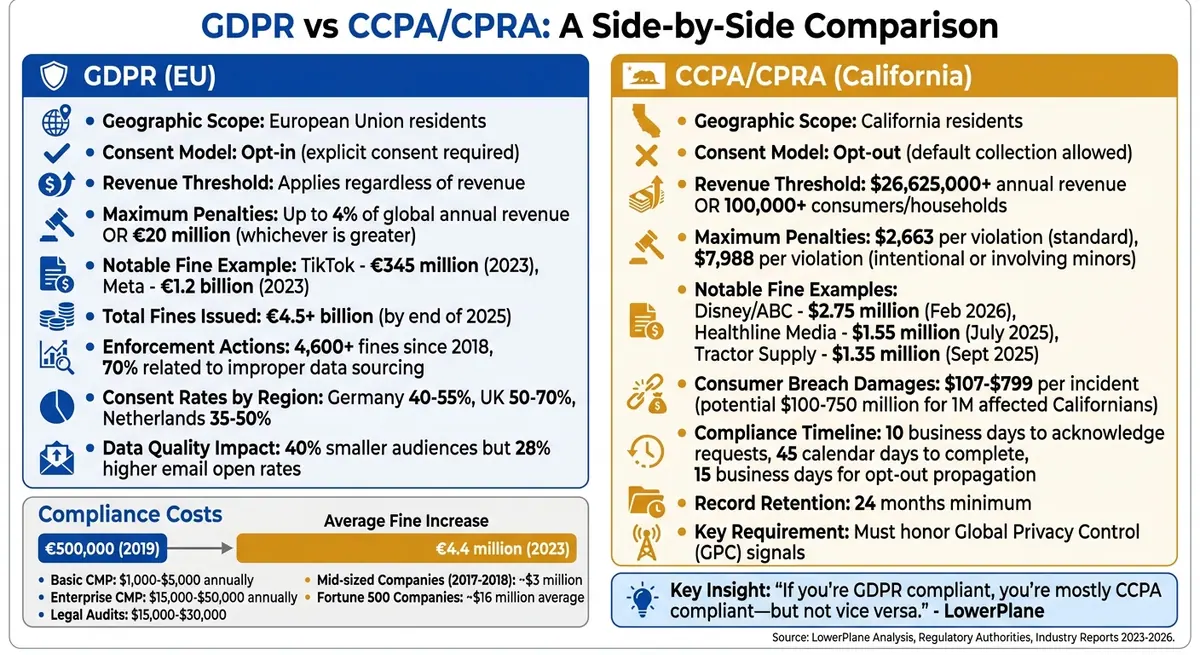
The regulation also enforces data minimization, meaning companies can only collect the information necessary for a specific purpose. Gathering extra, unnecessary data is prohibited. For example, companies using double opt-in email lists have reported smaller audiences - 40% smaller in some cases - but higher engagement rates, with open rates increasing by 28%. This shows that focusing on consented, high-quality data can actually yield better results. Failing to meet GDPR standards can lead to serious consequences.
Penalties for Non-Compliance
The penalties for violating GDPR are no joke. Fines can reach up to 4% of a company’s annual global revenue or €20 million, whichever is greater. A notable example is TikTok, which faced a €345 million fine in 2023 over issues with protecting children’s data.
Beyond financial penalties, regulators can impose restrictions on data processing or even require companies to delete data entirely. Since GDPR went into effect in 2018, over 4,600 fines have been issued across the EU, with 70% of enforcement actions tied to improper data sourcing.
Impact on Media Marketing Strategies
GDPR’s strict rules and hefty penalties have pushed media marketers to rethink their strategies. While compliance is essential to avoid fines, it also builds consumer trust, which is increasingly valuable in today’s market. Consent rates vary across Europe - Germany sees rates of 40–55%, the U.K. 50–70%, and the Netherlands 35–50%. These lower consent rates have led to smaller retargeting pools and made attribution more difficult. As a result, many marketers are turning to modeled conversions instead of relying on direct tracking.
To stay compliant, some video marketers have adopted a "two-click" approach: users first see a static thumbnail, and the third-party player (like YouTube or Vimeo) only loads after explicit consent is given. Adelina Peltea, CMO of Usercentrics, highlights this shift in mindset:
"The most forward-thinking brands are no longer treating privacy as a checkbox for the legal team. They're treating it as a core tenet of the customer experience".
With third-party cookies on their way out and tracking restrictions tightening, many companies are focusing on first-party data and contextual advertising as the way forward. These strategies not only ensure compliance but also align with evolving consumer expectations.
sbb-itb-5f36581
2. CCPA/CPRA (California Consumer Privacy Act/California Privacy Rights Act)
Scope and Applicability
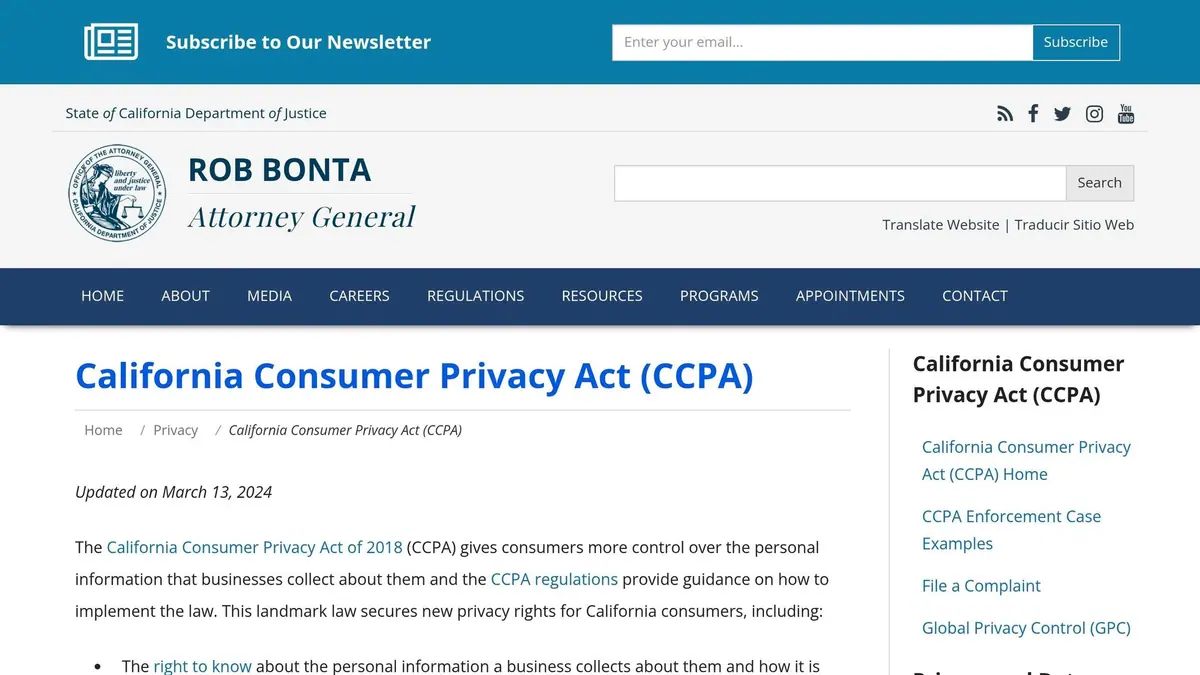
California's privacy laws set clear thresholds for businesses to comply. These rules apply to companies with annual gross revenues over $26,625,000 (starting January 1, 2025) or those that process data from 100,000 or more consumers or households. The CPRA expanded the definition of "sharing" to include cross-context behavioral advertising, even if no money changes hands. It also introduced categories of Sensitive Personal Information (SPI), such as precise geolocation (within 1,850 feet), race, and health data. Businesses must now offer a "Limit the Use of My Sensitive Personal Information" option.
Data Handling Requirements
Under these laws, businesses must follow strict rules for collecting and processing data. This means only gathering information necessary for specific purposes. For example, if an email address is collected for a newsletter, it cannot later be used for promotional ads without new consent. Starting in 2026, companies using AI or algorithms for profiling must provide "Pre-use Notices" and give consumers the ability to opt out of Automated Decision-Making Technology (ADMT) if it has significant effects on them.
Another critical requirement is honoring Global Privacy Control (GPC) signals - browser-based opt-out requests that businesses must treat as valid. Companies must act on consumer rights requests within 10 business days, complete them within 45 calendar days, and ensure opt-out requests are applied across all connected platforms (like ad networks or CRMs) within 15 business days. Additionally, businesses are required to maintain records of these actions for at least 24 months.
Penalties for Non-Compliance
The CPRA eliminated the 30-day "cure period", which previously allowed businesses to fix violations before facing penalties. Now, fines can be imposed immediately upon discovery of a breach. Penalties range up to $2,663 per violation for standard cases and $7,988 for intentional violations or those involving minors.
Recent high-profile cases illustrate the seriousness of compliance. In February 2026, Disney and ABC were fined $2.75 million for failing to implement opt-out requests across linked devices and ignoring GPC signals for logged-in users. Healthline Media LLC settled for $1.55 million in July 2025 after regulators found that, even after a "triple opt-out", 118 third-party advertising cookies remained active. Tractor Supply Company faced a $1.35 million fine in September 2025 for not recognizing GPC signals and maintaining an ineffective "Do Not Sell" link. Additionally, consumers can seek statutory damages for data breaches, ranging from $107 to $799 per incident. These penalties push businesses to overhaul their data practices to prioritize transparency and consumer trust.
Impact on Media Marketing Strategies
California regulators are actively conducting technical sweeps to ensure compliance. For instance, they use automated scripts to confirm that tracking pixels stop functioning after users opt out. In September 2025, California joined forces with Colorado and Connecticut to launch a coordinated enforcement sweep targeting businesses that failed to comply with GPC requirements. Regulators are also cracking down on "dark patterns" - design tactics that make it harder to opt out than opt in.
These enforcement efforts are forcing marketers to shift focus toward data explicitly shared by customers through lead capture forms, surveys, or preference centers. A 2023 survey revealed that 68% of consumers abandon websites with unclear data practices. This highlights how transparency is now both a legal requirement and a way to gain a competitive edge. Much like the GDPR, these rules are reshaping how media marketers operate, turning compliance into a key part of customer engagement strategies.
To adapt, many media companies are centralizing privacy controls into a single "Your Privacy Choices" link that handles both "Do Not Sell/Share" and "Limit SPI Use" requests. Additionally, they are investing in privacy automation tools to simplify data mapping and fulfill consumer requests efficiently. These tools typically cost between $15,000 and $50,000 annually for enterprise solutions.
TECH TALK: Understanding GDPR vs. CCPA: How It Affects Your Business | Part 1 of 3
Pros and Cons
GDPR vs CCPA/CPRA: Key Differences in Data Privacy Regulations
GDPR and CCPA/CPRA are reshaping how media marketers handle data collection and usage. Each regulation comes with its own set of benefits and challenges, making it essential to weigh these factors when planning compliance efforts and refining your marketing strategies.
| Regulation | Pros | Cons |
|---|---|---|
| GDPR | • Improved Data Quality: Focuses on high-quality, user-consented first-party data • Building Trust: Transparency fosters long-term loyalty and strengthens brand reputation • Global Standardization: Acts as a benchmark for privacy laws worldwide, simplifying compliance frameworks |
• Targeting Limitations: Reduces options for identity-based and precise targeting, pushing marketers toward contextual ads • Reduced Data Availability: Strict opt-in rules limit data for analytics and retargeting • Favoring Big Players: Large platforms gain an edge with internal data sharing, while smaller vendors face higher compliance hurdles • Operational Costs: Significant expenses for audits, updated policies, and appointing data protection officers |
| CCPA/CPRA | • Larger Data Pools: The "opt-out" system allows default data collection, creating broader marketing databases • Small Business Exemptions: Many smaller companies fall below compliance thresholds • Flexible Processing: Offers more leeway for data processing that doesn't involve "selling" or "sharing" |
• Design Challenges: The required "Do Not Sell or Share" link can disrupt website layouts Marketers can mitigate this by using multi-step form designs that maintain a clean user experience while ensuring compliance. • Legal Risks: Private right of action increases vulnerability to lawsuits; breaches affecting 1 million Californians could lead to damages between $100-750 million • Targeting Complexity: Extending data rights to households complicates individual-level targeting |
The financial stakes of non-compliance are high. Between 2017 and 2018, mid-sized companies spent around $3 million on GDPR compliance, while U.S. Fortune 500 firms averaged $16 million. Fines have also surged, with the average penalty rising from €500,000 in 2019 to €4.4 million in 2023.
"If you're GDPR compliant, you're mostly CCPA compliant - but not vice versa." - LowerPlane
Still, compliance is more than just a legal requirement. A striking 94% of marketers acknowledge that customers are likely to avoid brands that fail to protect their data. This underscores how aligning with these regulations not only avoids penalties but also builds trust and sets your brand apart in a competitive marketplace. These considerations pave the way for adapting your media marketing strategies to meet these evolving standards.
How to Adjust Media Marketing for Compliance
To ensure your media marketing efforts comply with regulations, start by implementing a Consent Management Platform (CMP). A CMP should respect user preferences, transmit consent signals accurately, and maintain detailed audit logs. As Prescient AI succinctly explains:
"A cookie banner is not the same thing as a consent management strategy".
Your CMP must integrate smoothly with your entire tech stack, ensuring that user opt-out decisions are consistently upheld across all platforms.
Once a strong consent system is in place, focus on data minimization. This means collecting only the data necessary to enhance customer experiences and avoiding the use of overly sensitive information. This principle should guide the design of your forms and lead capture tools. For instance, tools like Reform can help you create compliant forms that explicitly capture user consent, complete with timestamps and contextual details. Features like built-in email validation and spam prevention ensure high-quality, permission-based data collection. Additionally, Reform offers conditional routing and progressive consent options, giving users more nuanced control over their tracking preferences instead of an all-or-nothing choice.
Another crucial step is addressing legal opt-out requirements, particularly under regulations like CCPA/CPRA. For example, you need to honor Global Privacy Control (GPC) signals, which allow users to override existing settings without additional manual actions. Make sure privacy request options are easy to find and accessible. Offer at least two methods for submitting privacy requests, such as a toll-free number and a dedicated web form, and confirm receipt of these requests within 10 business days.
These adjustments go hand-in-hand with the broader trend of moving away from pixel-based tracking. Embracing aggregated measurement methods, such as Marketing Mix Modeling (MMM), helps maintain valuable campaign insights without relying on individual-level tracking through cookies or pixels. This shift not only reduces compliance risks but also aligns with evolving best practices. Don’t forget to review your email and SMS workflows - SMS, for instance, requires "explicit prior written consent" under TCPA, whereas email often operates on "implied consent".
Compliance isn’t just about avoiding penalties; it’s about staying competitive. With 73% of Fortune 500 companies now requiring vendors to provide privacy compliance documentation during procurement, it’s clear that adapting to these standards is essential. While costs can be significant - basic CMPs range from $1,000 to $5,000 annually (enterprise solutions can go up to $50,000), and legal audits cost between $15,000 and $30,000 - the alternative is far more expensive. Non-compliance fines have reached $345,178, with per-violation penalties as high as $7,988.
As Adam Bertram, IT Veteran and Consultant, aptly puts it:
"Privacy regulations like GDPR and CCPA aren't roadblocks - they're guardrails helping us build better, more trustworthy marketing practices".
Conclusion
The GDPR and CCPA/CPRA represent two distinct approaches to data privacy, each influencing how media marketers navigate their strategies. GDPR emphasizes explicit user consent, steering European campaigns toward permission-based marketing. In contrast, CCPA/CPRA adopts an opt-out model, with U.S. strategies focusing on transparency and respecting tools like Global Privacy Control (GPC).
Enforcement trends highlight these differences. GDPR fines have exceeded €4.5 billion by the end of 2025, with penalties reaching as high as 4% of a company's global revenue. Meanwhile, U.S. enforcement is exemplified by Healthline Media's $1.55 million settlement in July 2025 for failing to honor opt-out requests and improperly sharing sensitive browsing data. As Lauren Wetzel, CEO of InfoSum, aptly states:
"We have entered a new era of marketing where data privacy takes absolute priority".
These cases demonstrate how compliance is no longer just about avoiding penalties - it’s a competitive advantage. Privacy-focused organizations not only reduce risks but also thrive in the marketplace. Companies with strong privacy infrastructures close deals 80% faster and report fewer data breaches. Furthermore, with 94% of consumers unwilling to engage with brands that don’t safeguard their data, prioritizing privacy has become a cornerstone of building trust.
The regulatory environment is only growing more intricate. By early 2026, 20 U.S. states have enacted comprehensive privacy laws, and regulators are increasingly using automated audits to detect violations. This underscores the importance of adopting a privacy-first framework. This often starts with a lead capture blueprint that balances compliance with conversion. Media marketers who invest in solutions like server-side consent architectures, first-party data strategies, or tools such as Reform's features allow marketers to capture explicit consent with timestamps - are better positioned to succeed in this evolving landscape.
FAQs
Do I need GDPR compliance if my company is based in the U.S.?
U.S.-based companies are not obligated to comply with GDPR unless they handle the personal data of individuals located in the European Union. However, they must adhere to U.S. federal and state data privacy laws, such as the ADPPA (American Data Privacy Protection Act) and CPRA (California Privacy Rights Act). These laws govern the collection, storage, and use of personal data within the United States.
How do I honor Global Privacy Control (GPC) across my ad and analytics tools?
To respect Global Privacy Control (GPC), your tools must be able to detect the GPC signal - either through Sec-GPC: 1 in HTTP headers or navigator.globalPrivacyControl = true in JavaScript. Once detected, treat this signal as a valid opt-out request.
This means updating your systems to halt any data collection, sharing, or sales activities when GPC is active. Why is this so important? Several U.S. states now legally require businesses to honor GPC. Ignoring it could expose you to legal risks, so ensuring compliance isn't just good practice - it's necessary.
What can replace third-party cookies for measurement and targeting?
As third-party cookies are being phased out, there are several ways to adapt. One major approach is using first-party data, which is gathered directly from users with their consent. This data provides valuable insights while respecting privacy. Another option is server-side tracking, which works around browser restrictions to recapture lost conversion data.
Other strategies include contextual targeting, which focuses on the content of a webpage rather than tracking individual user behavior, and modeled attribution, where machine learning estimates conversions based on patterns and trends. By combining these methods, businesses can maintain effective measurement and targeting while prioritizing user privacy.
Related Blog Posts
Get new content delivered straight to your inbox

The Response
Updates on the Reform platform, insights on optimizing conversion rates, and tips to craft forms that convert.




Drive real results with form optimizations
Tested across hundreds of experiments, our strategies deliver a 215% lift in qualified leads for B2B and SaaS companies.
