
.webp)
State Privacy Compliance Tools for Public Sector



By 2026, at least 19 states enforce unique privacy regulations, including California's CPRA and Texas's TDPSA. Public sector organizations face mounting legal risks, with compliance-related lawsuits costing over $150,000 on average. To navigate this complex landscape, three tools stand out:
- Everlaw: A FedRAMP-certified platform for litigation, investigations, and public records requests.
- Smarsh: A communications governance tool that simplifies FOIA compliance and records management.
- Reform: A no-code form builder designed to securely collect citizen data while meeting privacy requirements.
Each tool addresses specific needs, from managing sensitive data to ensuring compliance with state mandates. Below, we break down their features and use cases.
The State of State Privacy Laws
sbb-itb-5f36581
1. Everlaw
Everlaw is an ediscovery platform tailored for government agencies handling litigation, investigations, and public records requests. It meets strict security standards, holding FedRAMP Moderate and GovRAMP (StateRAMP) Moderate certifications.
Data Encryption
To safeguard sensitive information, Everlaw employs FIPS 140-2 encryption, ensuring data is protected both at rest and in transit. For data at rest, including backups, the platform uses AES-256 encryption via AWS. Meanwhile, data in transit is secured with HTTPS and TLS 1.2 or higher protocols.
Audit Logs
Everlaw enhances transparency by logging all system activity. According to the company:
A record provides complete visibility into system activity, tracking who accessed data and when, to support transparency and accountability.
This detailed logging creates a reliable trail, enabling public sector organizations to demonstrate compliance during audits or respond to citizen inquiries about data handling.
Framework Support
Everlaw goes beyond FedRAMP and GovRAMP certifications by adhering to NIST 800-53 Revision 5 controls for secure cloud data management. The platform also holds ISO 27001 and SOC 2 certifications, follows NIST SP 800-61 guidelines for incident management, and complies with ITAR standards. To manage access securely, the platform uses Role-Based Access Control (RBAC) and Multi-Factor Authentication (MFA), ensuring only authorized personnel can view sensitive information. These measures help meet federal and state privacy requirements while maintaining data integrity.
State Law Coverage
Through its GovRAMP authorization, Everlaw supports state-level privacy mandates. The company emphasizes:
Everlaw's security and risk standards meet the critical needs of state government agencies, which can securely implement Everlaw's platform to manage litigation, investigations, public records requests, and collaboration.
The platform is equipped to handle Data Subject Access Requests (DSAR/SAR) and Public Records Requests (FOIA/FOI) - two essential components of state privacy laws. State Attorney General offices rely on Everlaw to streamline ediscovery processes and manage high volumes of public records requests, ensuring both efficiency and accountability. This comprehensive compliance framework positions Everlaw as a key tool for addressing privacy challenges in the public sector.
2. Smarsh
Smarsh is a communications governance platform trusted by over 6,500 customers, including 18 of the top 20 financial institutions. For public sector organizations, it offers tools specifically designed to handle FOIA requests and public records management, all while ensuring compliance with state privacy laws.
Data Encryption
Smarsh employs top-tier end-to-end encryption for data both in transit and at rest to comply with strict security standards. In addition, it features immutable storage, meaning data cannot be altered or deleted before its designated retention period ends. This ensures legal defensibility and protects sensitive information from unauthorized access, creating a secure, unchangeable record of all communications.
Audit Logs
The platform tracks every data activity, from collection to export, through comprehensive audit logs. For agencies leveraging AI tools, Smarsh enhances transparency with explainability and auditability features. These tools allow records managers to demonstrate compliance with retention schedules clearly.
"Smarsh has improved search efficiency and accountability in records management. The time it takes to search for records - especially emails and instant messages - has been significantly reduced. What once required two systems, multiple searches, refinements, and exports can now be done with a single sign-on and search".
This testimonial from Aaron Cosentino, CTO of the City of Elgin, Illinois, highlights the platform's practical benefits. Smarsh’s architecture can manage multi-petabyte cases and deliver search results across millions of records in less than five seconds, making it ideal for handling large-scale public records requests.
Framework Support
Smarsh goes beyond encryption and audit features by supporting major regulatory frameworks, including SEC 17a-4, FINRA, MiFID II, and FCA. Its data tiering system optimizes storage costs while maintaining compliance. Additionally, AI-driven surveillance tools reduce false positives by up to 95% and identify risks three times faster than older systems.
The platform also adapts to meet specific state privacy requirements, ensuring organizations remain compliant with evolving laws.
State Law Coverage
By 2026, Smarsh will support compliance with approximately 19 to 20 U.S. state privacy laws. It addresses key regulations like the California Consumer Privacy Act (CCPA), California Privacy Rights Act (CPRA), and newer laws such as the Indiana Consumer Data Protection Act, Kentucky Consumer Data Protection Act, and Rhode Island Data Transparency and Privacy Protection Act.
| State Law Effective in 2026 | Key Provisions |
|---|---|
| Indiana Consumer Data Protection Act | Rights to access, delete, and correct data; data portability; opt-out for targeted ads |
| Kentucky Consumer Data Protection Act | Access/delete rights; data portability; enforcement by the Office of Data Privacy |
| Rhode Island Data Transparency Act | Transparency obligations; rights to access and delete; opt-out for data sales |
| California (Delete Act) | Centralized deletion system for data brokers effective August 1, 2026 |
| Oregon Consumer Privacy Act | Recognition of universal opt-out signals; restrictions on selling precise geolocation data |
Bill Tolson, President of Tolson Communications LLC, puts it into perspective:
"Modern data privacy laws increasingly function as data governance mandates".
Smarsh helps organizations locate personal data across systems, enforce retention policies, and fulfill deletion requests as required by state laws. For public sector agencies, it balances FOIA transparency with privacy exemptions 6 and 7(C) to protect individual information. Violations of these privacy laws can result in civil penalties ranging from $7,500 to $10,000 per record, with Colorado imposing fines as high as $50,000 for violations involving consumers aged 60 or older.
Pricing
Smarsh does not disclose fixed pricing. The platform offers two levels of support: Standard Support, which includes access to compliance experts and detailed documentation, and Premium Support, which provides 24/7 expert assistance and proactive reviews. Custom pricing is available upon request.
3. Reform
Reform focuses on creating a secure and compliant way for state and local government agencies to collect sensitive citizen data. Built as a no-code form builder, it prioritizes compliance with privacy laws, addressing the specific challenges faced by public sector organizations.
Secure Storage & Data Minimization
Reform ensures that all data collected through its forms is securely stored, safeguarding it from unauthorized access. To further protect privacy, the platform supports data minimization, allowing agencies to gather only the information they truly need. This reduces the risk of holding unnecessary personal data.
Audit Logs
The platform includes tools for maintaining transparency and regulatory compliance. Features like audit logs allow agencies to regularly review their data practices. Additionally, Reform ensures users are fully informed by embedding privacy policy links directly into the forms and requiring explicit opt-ins before data submission.
State Law Coverage
By April 2026, more than 20 states will have implemented privacy regulations, each with different requirements, consumer rights, and penalties. Reform simplifies this complexity by offering specialized guidance, such as "State Healthcare Privacy Compliance", to help agencies navigate these state-specific rules effectively.
Pricing
Reform offers straightforward pricing plans aimed at making compliance manageable. The Basic Plan starts at $15/month (or $150/year) and includes unlimited responses. For $35/month (or $350/year), the Pro Plan adds features like team access, file uploads, and advanced tracking. Fully customized solutions are also available with tailored pricing options.
Advantages and Disadvantages
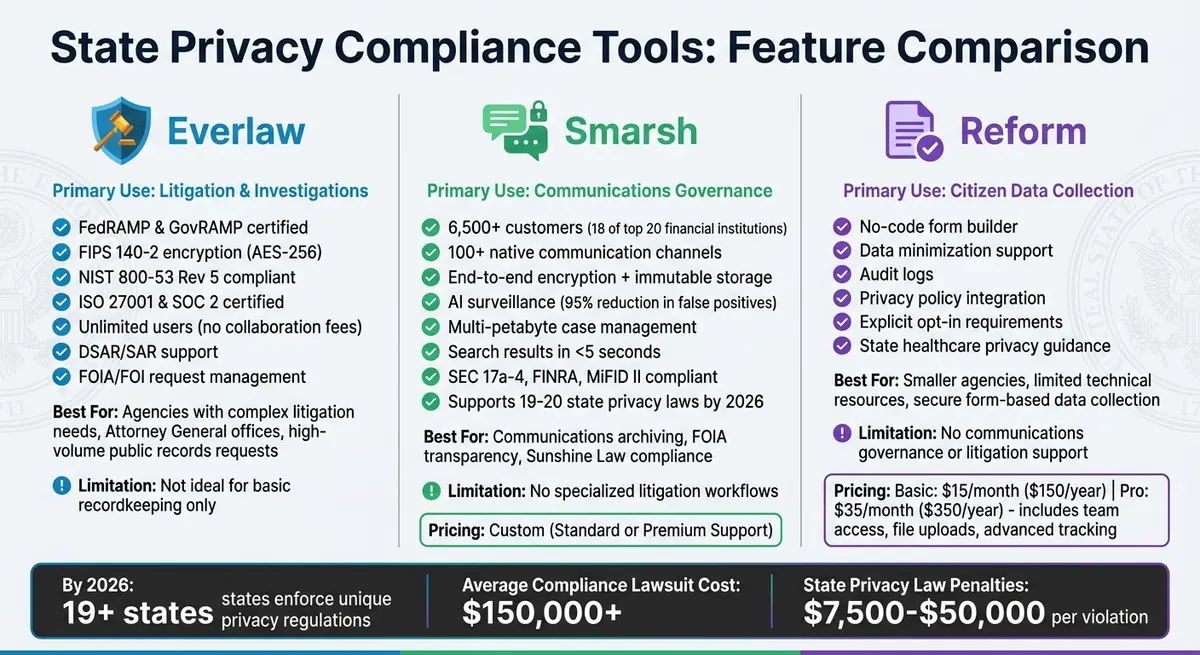
State Privacy Compliance Tools Comparison: Everlaw vs Smarsh vs Reform
This section highlights the key strengths and trade-offs of each platform, building on the earlier analysis.
Everlaw stands out for its strong security features and government authorizations. It is approved for state government use through GovRAMP and StateRAMP, and it allows unlimited users without additional collaboration fees. That said, Everlaw is tailored for litigation and complex investigations, which may not suit agencies needing only basic record-keeping. For agencies with advanced litigation needs, however, this focus is a major benefit.
Smarsh excels in communications governance. It supports over 100 native communication channels and uses AI to detect sentiment and non-financial misconduct. Trusted by more than 6,500 customers worldwide, as highlighted by Aaron Cosentino, Smarsh is a reliable choice for archiving and surveillance. Its drawback? It lacks specialized features for litigation workflows.
Reform offers a user-friendly, no-code platform for securely collecting citizen data. Its design emphasizes simplicity and accessibility for form-based data gathering. On the downside, Reform does not provide advanced communications governance or litigation support.
With varying state-level privacy regulations, it's essential to match the platform's strengths to your agency's priorities. Whether your focus is litigation, communication archiving, or citizen data collection, aligning the tool with your needs is key.
Conclusion
Navigating state-level privacy laws can be a complex task for public sector agencies, making it essential to choose tools that align with their specific compliance needs. Different tools cater to varied challenges - Everlaw simplifies litigation support, Smarsh focuses on automating communications governance, and Reform provides a cost-effective, no-code solution for citizen data collection.
Everlaw is ideal for agencies managing intricate investigations or handling large volumes of public records requests, such as those required by FOIA or DSAR. Its pre-approved authorizations help streamline compliance processes. However, its strong focus on litigation may not suit agencies that only require basic recordkeeping.
Smarsh stands out for agencies prioritizing communications governance and transparency. By automating the capture of communication channels, it ensures compliance with recordkeeping requirements under Sunshine Laws.
Reform offers a budget-friendly, no-code option tailored for smaller agencies or departments with limited technical resources. Its Basic plan starts at $15 per month, while the Pro plan, priced at $35 per month, includes team access and advanced integrations. This makes it an accessible solution for secure and efficient citizen data collection.
As state privacy regulations continue to evolve, selecting the right tool - whether for litigation, communications governance, or citizen data management - is key to reducing legal risks. Matching your agency’s compliance priorities with the appropriate platform ensures the best use of resources and supports long-term success.
FAQs
How do we choose the right privacy compliance tool for our agency?
When selecting a privacy compliance tool, there are a few critical factors to keep in mind:
- Regulatory Coverage: Make sure the tool aligns with both state and federal privacy laws. It should help you manage disclosures effectively and set up consent mechanisms seamlessly.
- Automation: Features like automated handling of data requests and consent management can save time and reduce manual effort.
- Ease of Use: Opt for a platform that’s intuitive and doesn’t require coding expertise. Bonus points if it integrates smoothly with your existing systems.
By focusing on these elements, you’ll be better equipped to choose a tool that fits your agency’s specific requirements.
What’s the difference between FOIA requests and DSARs?
FOIA requests and DSARs cater to distinct needs. FOIA requests, established under the Freedom of Information Act, allow individuals to access records from federal government agencies, promoting transparency and accountability. In contrast, DSARs (Data Subject Access Requests) are designed to give people access to their personal data held by organizations, often in line with privacy laws like GDPR or CCPA. The main distinction lies in their focus: FOIA is about government openness, while DSARs prioritize protecting individual privacy.
What security certifications should a public sector privacy tool have?
Public sector privacy tools need to meet strict security standards to safeguard sensitive data. Certifications like StateRAMP authorization and compliance with regulations such as CJIS, FERPA, and HIPAA are essential. These credentials confirm that the tool follows rigorous security protocols and aligns with the requirements for handling and protecting sensitive information in the public sector.
Related Blog Posts
Get new content delivered straight to your inbox

The Response
Updates on the Reform platform, insights on optimizing conversion rates, and tips to craft forms that convert.



Drive real results with form optimizations
Tested across hundreds of experiments, our strategies deliver a 215% lift in qualified leads for B2B and SaaS companies.
