
.webp)
Key GDPR Breach Notification Requirements


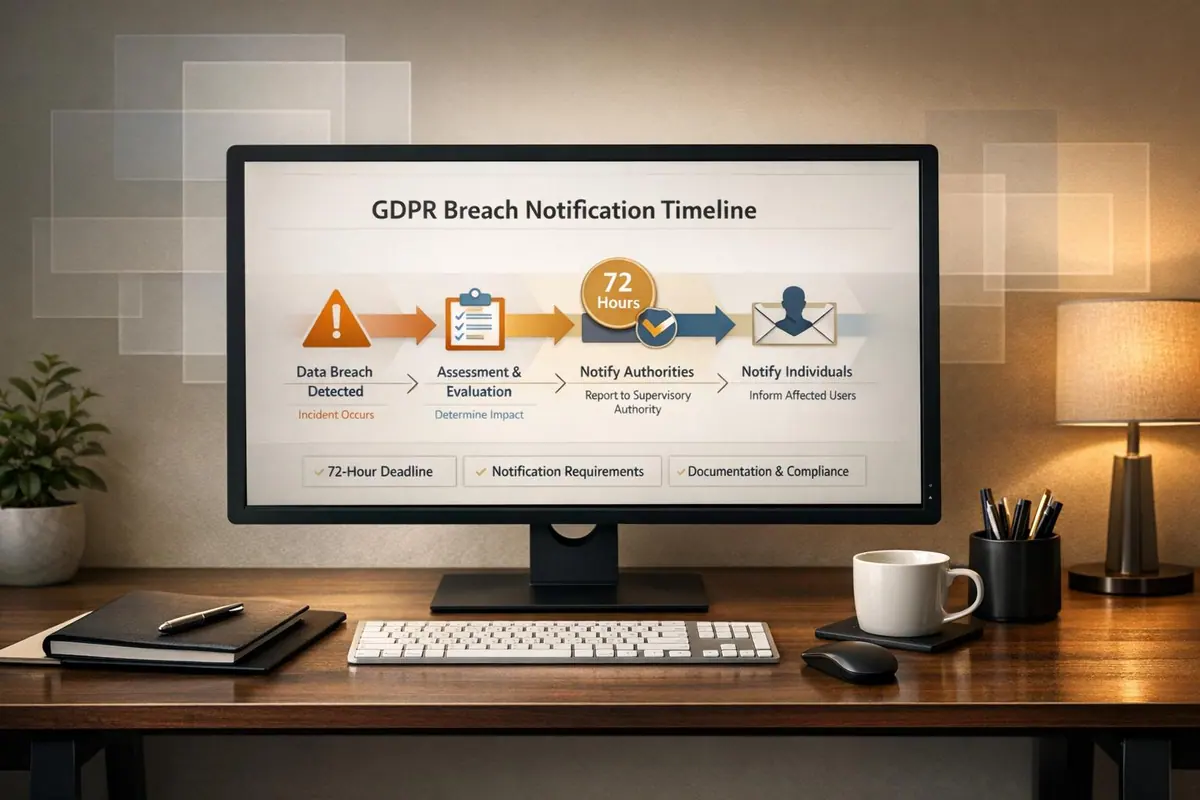
When personal data is exposed, quick action is critical to minimize harm and comply with regulations. Under GDPR, organizations must notify authorities of a breach within 72 hours if it risks individuals' rights. If the breach poses a high risk, affected individuals must also be informed. These rules apply to incidents like data theft, loss, or unauthorized access. Non-compliance can lead to fines up to €20 million or 4% of global turnover.
Other frameworks differ:
- CCPA/CPRA (California): 30-day notification for consumers; 15 days for Attorney General if 500+ residents are affected.
- PIPEDA (Canada): Notify "as soon as feasible" if there's a "real risk of significant harm."
- LGPD (Brazil): Flexible timeline for "relevant risk" incidents; fines capped at BRL 50 million.
- HIPAA (U.S.): 60-day notification for breaches of health data, with tiered penalties.
Each regulation has unique timelines, thresholds, and penalties, making global compliance complex. Encryption and strong security measures can often reduce liability. For multinational companies, aligning with GDPR's strict standards ensures readiness across jurisdictions.
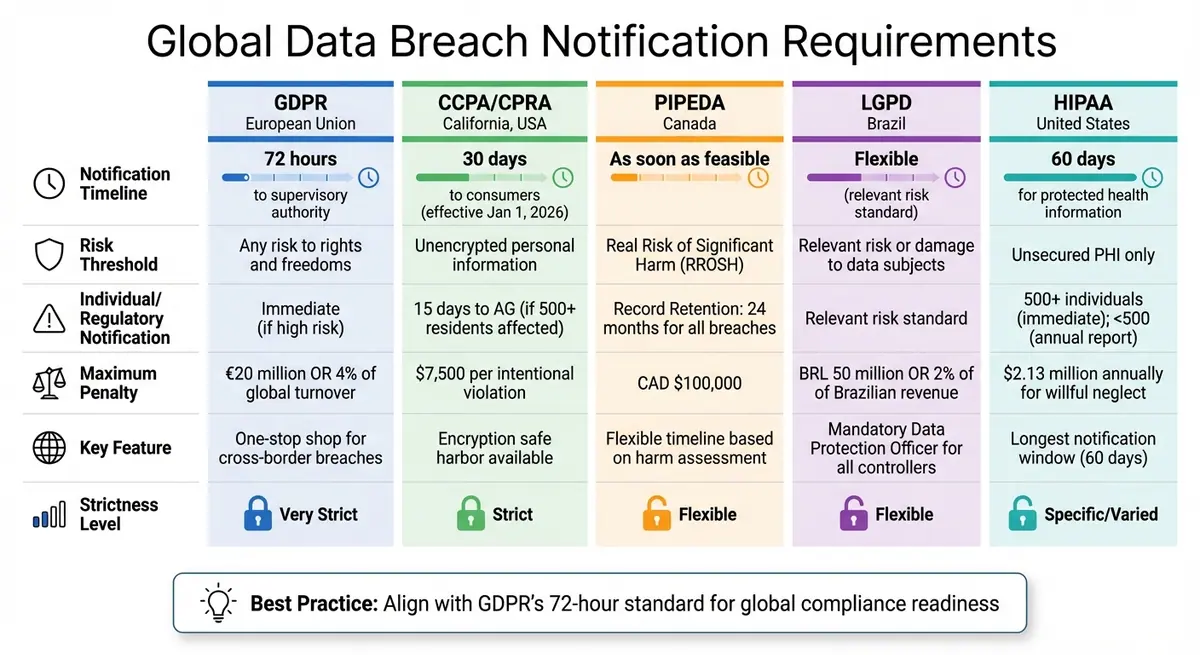
Global Data Breach Notification Requirements: Timeline and Penalty Comparison
When must a data breach be notified under GDPR?
1. GDPR
Under the GDPR, organizations are required to provide specific notifications depending on the level of risk associated with a data breach. If a breach is confirmed and poses a risk to individuals' rights and freedoms, the relevant supervisory authority must be notified within 72 hours. For breaches considered to carry a high risk, affected individuals must be informed immediately.
A personal data breach isn't limited to cyberattacks. It includes any accidental or unlawful destruction, loss, alteration, unauthorized disclosure, or access to personal data. For example, incidents like accidentally deleting a database or misconfiguring a server that exposes customer data also qualify as breaches.
Here’s a quick summary of the GDPR's notification requirements:
| Notification Target | Risk Threshold | Timeline |
|---|---|---|
| Supervisory Authority | Any risk to rights and freedoms | Within 72 hours of awareness |
| Affected Individuals | High risk to rights and freedoms | Immediately |
| Data Controller (from processor) | Any personal data breach | Immediately |
Each notification must include key details about the breach, such as:
- The nature of the breach (e.g., categories and estimated number of affected individuals).
- Contact information for the Data Protection Officer (DPO) or another designated contact.
- Possible consequences of the breach.
- Actions taken or planned to address the issue.
If all the necessary details aren't available within the 72-hour window, phased reporting is allowed. This means organizations can provide initial information and follow up with updates as more details become clear.
Failure to comply with these requirements can result in steep penalties - up to €10 million or 2% of global turnover (or up to £8.7 million in the UK). However, there are exceptions to notifying affected individuals. For example, if the breached data was encrypted and therefore unreadable, if subsequent measures have eliminated the high risk, or if notifying individuals would require disproportionate effort. In such cases, organizations may opt for alternative public communication instead.
2. CCPA/CPRA
California's data protection laws take a different approach compared to the GDPR's 72-hour breach notification rule. Starting January 1, 2026, California law (SB 446) requires businesses to notify affected residents within 30 calendar days of discovering a data breach. Highlighting the importance of this change, State Senator Melissa Hurtado stated:
By closing a critical loophole in California's data protection laws, SB 446 upholds transparency and accountability while ensuring that residents are not left in the dark about threats to their data.
This legal framework establishes a dual notification system, separating consumer notifications from regulatory reporting. For breaches impacting more than 500 California residents, businesses must notify the California Attorney General within 15 calendar days after informing consumers. The notification must follow a specific format, titled "Notice of Data Breach", and include clear headings such as: "What Happened", "What Information Was Involved", "What We Are Doing", "What You Can Do," and "For More Information".
The CPRA's enforcement rules differ significantly from the GDPR's penalty structure. Under California law, consumers can file lawsuits for statutory damages ranging from $100 to $750 per incident if their nonencrypted personal information is compromised. The CPRA also extends this right to breaches involving email addresses combined with passwords or security questions. Furthermore, the California Attorney General can issue civil penalties of $2,500 per unintentional violation and $7,500 per intentional violation.
One key change under the CPRA is the removal of the 30-day cure period. This means businesses are held strictly liable for data breaches if they fail to implement reasonable security measures beforehand. Violations involving minors under 16 years old carry penalties of up to $7,500 per incident. As Transcend points out:
The CPRA clarifies that implementing 'reasonable security' after a breach does not count towards a meaningful cure.
California has been refining its data breach notification laws since 2002, tightening requirements over time. Between 2020 and 2024, 90% of enforcement actions were multistate efforts, with the average U.S. breach cost reaching $10.22 million in 2025, a 9% increase from the previous year. These distinctions underline California's focus on consumer-driven enforcement, setting it apart from European regulatory models.
3. PIPEDA
Canada's Personal Information Protection and Electronic Documents Act (PIPEDA) requires organizations to notify both the Office of the Privacy Commissioner (OPC) and affected individuals if a breach poses a "real risk of significant harm" (RROSH). This standard focuses on measurable harm, such as bodily injury, financial loss, or damage to reputation. It's a practical approach that contrasts with the broader criteria often seen in European regulations.
To maintain seamless cross-border data flow, PIPEDA aligns with the European Union's General Data Protection Regulation (GDPR). As Fasken explains:
The government has sought to harmonize the Canadian rules with the breach notification rules in the forthcoming European Union General Data Protection Regulation (GDPR). Harmony with the GDPR is considered important for Canada-EU trade.
Unlike GDPR's strict 72-hour reporting window, PIPEDA requires breach notifications to be made "as soon as feasible" after determining the breach. Organizations must evaluate RROSH by considering both the sensitivity of the compromised data and the likelihood of misuse. Notifications to the OPC must include details such as the breach's cause, duration, affected data, number of individuals impacted, mitigation efforts, and contact information. Affected individuals must also be informed, with clear guidance on steps they can take to protect themselves.
PIPEDA mandates that all breach records, regardless of RROSH status, be retained for at least 24 months. If direct notification isn't possible - due to risks of additional harm, significant hardship, or lack of contact information - organizations may use indirect methods like public notices or website updates.
Non-compliance with PIPEDA's breach rules can result in fines of up to $100,000. While the OPC itself does not impose fines, it can refer cases to the Attorney General of Canada for prosecution. Organizations are also responsible for reporting breaches involving third-party providers, highlighting the need for strong contractual safeguards. These distinct measures underscore Canada's unique contribution to global data protection practices.
sbb-itb-5f36581
4. LGPD
Similar to the GDPR and other data protection laws, Brazil’s LGPD includes specific guidelines for breach notifications - but with some distinct differences.
Under the LGPD, controllers are required to inform the National Data Protection Authority (ANPD) and affected individuals when a security incident poses a "relevant risk or damage" to data subjects. This right has been enshrined in Brazil's Federal Constitution since February 2022.
The timeline for these notifications is flexible, as outlined in the Regulation on Notification of Security Incidents (effective April 26, 2024). Notifications must include detailed information, such as the type of data affected, the number of individuals impacted, security measures in place, identified risks, reasons for any delays, and actions taken to mitigate the issue.
Failure to comply can lead to hefty penalties. Financial fines may reach up to 2% of the company’s revenue from the previous year, with a cap of BRL 50,000,000 (approximately $8.3 million). Additional sanctions include warnings, public disclosure of the breach, data blocking or deletion, and even suspension of operations.
The ANPD has already begun enforcing these rules. In February 2024, public bodies faced penalties for failing to report security incidents. One organization received four warnings for multiple violations, including neglecting to report a 2022 breach and failing to appoint a Data Protection Officer. Another was sanctioned for not notifying individuals affected by a 2022 incident. Notably, unlike the GDPR, the LGPD mandates that all controllers must designate a Data Protection Officer.
Certain industries have extra reporting requirements. Financial institutions must report severe incidents to BACEN, while telecommunications providers are obligated to notify ANATEL of network security breaches. Importantly, the responsibility for breach notifications lies solely with the controllers, even if processors are involved in reporting.
5. HIPAA
In the United States, the Health Insurance Portability and Accountability Act (HIPAA) sets specific rules for breach notifications, focusing exclusively on protected health information (PHI). These rules apply only to "unsecured" PHI - data that has not been encrypted or properly destroyed, according to guidelines from the Department of Health and Human Services (HHS).
HIPAA requires covered entities to notify affected individuals and the HHS Secretary within 60 calendar days of discovering a breach. This timeframe is more lenient compared to the 72-hour window mandated by GDPR. Any unauthorized use or disclosure of PHI is treated as a breach unless a risk assessment determines there's a low probability of compromise. The specific notification requirements depend on the breach's scale.
For breaches impacting 500 or more individuals, entities must promptly notify the HHS Secretary and prominent media outlets. For smaller breaches - those involving fewer than 500 individuals - entities can delay reporting to the Secretary until submitting an annual report, which is due within 60 days of the end of the calendar year. Business associates are also obligated to inform the covered entity within 60 days of discovering a breach.
HIPAA enforces a tiered penalty system based on the severity of non-compliance. As of December 2024, civil penalties range from $141 per violation to a maximum of $2.13 million annually for uncorrected willful neglect. Unlike GDPR, which ties fines to global revenue, HIPAA's penalties are fixed dollar amounts. Additionally, criminal penalties can apply - violations involving malicious intent or personal gain may result in fines of up to $250,000 and prison sentences of up to 10 years.
Breach notifications must be straightforward and include key details: a description of the incident, the types of data involved, steps individuals can take for protection, information about the investigation and mitigation efforts, and contact details for further inquiries. Organizations are also required to keep thorough documentation of all risk assessments and notifications to prove compliance.
Strengths and Weaknesses of Each Framework
Looking at the framework requirements discussed earlier, it's clear that each regulation has its own strengths and challenges when it comes to data protection.
Take the GDPR, for instance. Its "one-stop shop" mechanism is a major advantage for multinational companies. It allows them to work with just one lead supervisory authority to handle cross-border breaches, simplifying the process. But the 72-hour breach notification deadline can be a real hurdle. As Thoropass explains:
The GDPR's 72-hour requirement poses many practical challenges. It would be difficult to gain certainty about a more complex breach in such a short time frame.
This tight timeline often pushes companies to err on the side of caution, reporting incidents that might not even turn out to be actual breaches.
On the other hand, the CCPA offers some breathing room by focusing on breaches involving unencrypted or unredacted data. If businesses use strong security measures like encryption, they can avoid liability altogether. Similarly, PIPEDA uses its "Real Risk of Significant Harm" (RROSH) threshold to filter out minor incidents, which helps reduce unnecessary notifications. HIPAA provides the most flexibility with a 60-day notification window, giving organizations more time to investigate breaches. However, its penalties are fixed, unlike GDPR's revenue-based fines, and can go up to $2.13 million annually for willful neglect.
The scope and definitions of personal data also vary widely across frameworks. GDPR takes a broad approach, covering a wide range of personal data. In contrast, U.S. laws like the CCPA require a combination of specific identifiers, such as a name paired with a Social Security number or driver’s license, to trigger breach notifications. This creates significant challenges for global companies trying to comply with multiple jurisdictions. Frameworks like the CCPA, PIPEDA, LGPD, and HIPAA each bring different approaches, showcasing the trade-offs businesses need to navigate.
Here’s a quick comparison of the strengths, weaknesses, and penalties across these frameworks:
| Framework | Key Strength | Key Weakness | Max Penalty |
|---|---|---|---|
| GDPR | One-stop shop for cross-border breaches | 72-hour deadline is tough for complex breaches | €20M or 4% of global turnover |
| CCPA | Encryption safe harbor can avoid liability | $7,500 per intentional violation adds up fast | $7,500 per intentional violation |
| PIPEDA | RROSH threshold minimizes unnecessary notifications | Penalty cap may not deter large companies | CAD 100,000 per violation |
| LGPD | Aligns with GDPR for international consistency | – | 2% of Brazilian revenue (up to R$50M) |
| HIPAA | 60-day window allows thorough investigation | Fixed penalties don’t scale with company size | Up to $2.13M annually for willful neglect |
One thing all these frameworks agree on? Encryption is a must-have. For global companies, planning ahead - like designating a lead supervisory authority and preparing notification templates - can make a big difference when it comes to meeting deadlines and avoiding hefty fines.
Conclusion
The comparisons above highlight how different frameworks handle breach notification timelines and data definitions, with the GDPR setting a notably strict standard for global operations.
As one analysis points out:
"The GDPR's 72-hour requirement poses many practical challenges... risk-averse companies may instead find themselves notifying appropriate parties of data incidents that at first sight do not appear to meet the GDPR's notification requirements." - Alston & Bird
To summarize the key differences: the GDPR mandates breach notifications within 72 hours, whereas HIPAA allows up to 60 days. Additionally, the GDPR's broad definition of personal data differs from U.S. regulations, which focus on specific combinations of sensitive identifiers.
For effective compliance, it’s wise to align with the strictest standard. Base your incident response plan on the GDPR's 72-hour rule, ensure thorough documentation of all breaches, and use encryption to qualify for safe harbor protections. If your organization operates across multiple EU member states, determine your lead supervisory authority under GDPR's "one-stop-shop" mechanism to simplify reporting. This strategy can help streamline compliance for multinational businesses.
U.S.-based organizations should also regularly simulate cross-border breach scenarios. These exercises are crucial for maintaining readiness and ensuring compliance with varying regulatory requirements.
FAQs
How do GDPR breach notification timelines compare to those in frameworks like CCPA and HIPAA?
Under the GDPR, organizations are required to notify the appropriate supervisory authority within 72 hours of discovering a data breach. On the other hand, the CCPA mandates businesses to provide "timely" notification to affected individuals but does not define a specific timeframe. Meanwhile, HIPAA sets a deadline of 60 days for notifying affected individuals. Additionally, it requires covered entities to inform the U.S. Department of Health and Human Services and, in certain cases, the media.
These variations underscore the need to thoroughly understand the notification timelines and specific obligations under each framework to remain compliant.
What qualifies as a high-risk data breach under GDPR, and when must affected individuals be notified?
Under the GDPR, a high-risk data breach refers to any incident that could seriously impact the rights and freedoms of individuals. This might include situations where the breach could result in physical harm, financial loss, emotional distress, identity theft, or even discrimination.
If a breach is classified as high-risk, the organization responsible - known as the controller - must notify the affected individuals without unnecessary delay. This prompt communication allows those impacted to take proactive steps to safeguard themselves from further harm.
What are the penalties for failing to comply with GDPR breach notification rules?
Failing to meet GDPR breach notification requirements can lead to hefty fines. Organizations risk penalties of up to $10 million or 2% of their global annual revenue, depending on which is greater.
This underscores the critical need to address data breaches swiftly and stay aligned with GDPR rules to protect both finances and reputation.
Related Blog Posts
Get new content delivered straight to your inbox

The Response
Updates on the Reform platform, insights on optimizing conversion rates, and tips to craft forms that convert.



Drive real results with form optimizations
Tested across hundreds of experiments, our strategies deliver a 215% lift in qualified leads for B2B and SaaS companies.
