
.webp)
How GPC Helps With ePrivacy



Managing online privacy is tough, especially with strict rules like the EU's ePrivacy Directive. This law demands user consent for cookies and protects personal data. Enter Global Privacy Control (GPC): a browser feature that automates privacy preferences, saving users time and helping businesses comply with privacy laws.
Key Takeaways:
- ePrivacy Directive: EU law requiring explicit consent for cookies and data tracking.
- GPC: Sends a "do not track or sell" signal automatically via browsers like Firefox and Brave.
- Global Use: Over 150 million users and 66,000+ websites support GPC.
- Challenges: GPC's opt-out system clashes with the EU's opt-in rules, complicating compliance.
- Legal Status: Binding in some U.S. states (e.g., California), less clear in the EU.
GPC simplifies compliance by automating privacy signals, but businesses must address regional differences to stay on the right side of the law.
Masters of Privacy LIVE NYC January 2026 (with Alan Chapell)
Challenges in Aligning GPC with ePrivacy
GPC simplifies privacy management but introduces hurdles when aligning with the ePrivacy Directive. The primary challenge lies in navigating the contrasting privacy frameworks across different jurisdictions, making global compliance a complex task. These issues highlight the pressing need for a more unified approach to harmonize consent models and regional requirements.
Opt-In vs Opt-Out Models
A key difference between the ePrivacy Directive and GPC lies in their consent frameworks. The ePrivacy Directive mandates explicit, affirmative consent before any tracking or non-essential cookies are used. In contrast, GPC was built around opt-out systems like the CCPA, where it acts as a universal signal to halt the sale or sharing of personal data that might otherwise occur by default.
This creates friction when GPC’s opt-out signal clashes with the ePrivacy Directive's opt-in requirements. For example, legal cases like Sephora’s settlement underscore the risks of failing to address such conflicts properly. Under the CCPA, businesses are required to honor GPC signals even if they contradict site-specific settings, though they can notify consumers of the conflict and request confirmation. However, the ePrivacy Directive offers no clear guidance on resolving such discrepancies, leaving businesses to interpret and navigate these situations on their own. Beyond consent model conflicts, regional legal variations further complicate GPC’s implementation.
Managing Privacy Across Multiple Jurisdictions
The legal recognition of GPC varies significantly across regions, adding another layer of complexity for businesses operating internationally. In the U.S., states like California, Colorado, Connecticut, and New Jersey explicitly require GPC to be treated as a legally binding opt-out signal. Colorado has even published the first official registry of universal opt-out mechanisms, with GPC currently the only mandatory signal on the list.
In Europe, however, regulators have yet to establish a clear, unified position on whether GPC qualifies as a valid "right to object" under GDPR Article 21. Other jurisdictions, like Virginia and Utah, have not addressed universal signals at all. Even the rules around default settings differ: Colorado specifies that general-purpose browsers cannot enable universal opt-out signals by default, though privacy-focused tools may do so if they explicitly market themselves as prioritizing user privacy.
To ensure compliance, businesses must map GPC’s binary signal onto more complex frameworks like the IAB USP API or the TCF. This technical translation adds another layer of difficulty, as companies must adapt to diverse and sometimes conflicting regional requirements. Despite these challenges, technical solutions can bridge the gap, enabling GPC to align more effectively with ePrivacy standards.
How GPC Supports ePrivacy Compliance
GPC (Global Privacy Control) offers practical tools for businesses aiming to meet ePrivacy compliance requirements, even amidst the challenges of reconciling opt-out and opt-in models. Its browser-based approach allows users to activate privacy controls before any tracking occurs, taking a proactive step toward data protection. This approach not only supports compliance strategies but also demonstrates a commitment to privacy, even in regions where GPC's legal status is still under review.
Browser-Based Privacy Controls
GPC works by automatically communicating users' privacy preferences with every browser request. Because it has a stateless design, businesses don't need to maintain databases of individual user preferences, making implementation straightforward. Over 40 million users already benefit from GPC through supported browsers and extensions, including Brave and DuckDuckGo. Firefox also offers GPC as a configurable option.
"GPC provides a clear and binary indication of an individual's choice... it appears likely to be a prominent, easily understandable, and accessible mechanism in the browser settings."
- Alexander McD White, Bermuda Privacy Commissioner
Many major publishers have embraced GPC, proving that respecting browser-based privacy controls can coexist with strong site performance and a seamless user experience. Beyond its technical capabilities, adopting GPC signals a company's proactive stance on compliance, which can build trust with both users and regulators.
Showing Good Faith Compliance Efforts
Even in areas where GPC isn't explicitly recognized under the ePrivacy Directive, its implementation reflects a privacy-first mindset. For instance, businesses can publish a JSON file at /.well-known/gpc.json to visibly declare their support for GPC. This public display of commitment helps regulators and privacy advocates assess a company's dedication to protecting user data.
Regulatory actions and enforcement cases have highlighted the importance of respecting GPC signals, setting noteworthy examples for how browser-based privacy controls should be treated. By automating privacy preferences at the browser level, GPC alleviates the burden of repetitive consent tasks for users. While it may not address every technical requirement of the ePrivacy Directive, it aligns with the principle that users should have control over their data before tracking begins.
Adopting GPC demonstrates good faith efforts in privacy compliance and positions businesses well as privacy laws and standards continue to evolve. These steps lay the groundwork for integrating more technical solutions that can further strengthen compliance strategies.
sbb-itb-5f36581
Implementing GPC for ePrivacy Compliance
Integrating Global Privacy Control (GPC) into your systems is a practical step toward automating privacy signaling and demonstrating your dedication to meeting ePrivacy standards. Here's how you can get started.
GPC works by detecting a visitor's privacy signal through two key methods: the Sec-GPC HTTP header, which is sent with every request, and the navigator.globalPrivacyControl JavaScript property. Since GPC operates as a stateless protocol, there's no need to store a user's opt-out status - each request automatically carries the signal. Below is a guide to help you set up this detection mechanism.
Technical Setup for GPC
Start by creating a JSON file at yoursite.com/.well-known/gpc.json with this structure:
{"gpc": true, "lastUpdate": "YYYY-MM-DD"}
This file serves as a clear indicator to regulators and users that your site supports the GPC protocol. Next, configure your server or CDN to recognize the Sec-GPC: 1 header. Additionally, add a client-side check, such as:
if (navigator.globalPrivacyControl) { … }
This ensures the GPC signal is processed as soon as the page begins loading.
Update your privacy policy to explain how GPC signals are handled. For example, The New York Times includes this statement:
"Finally, if your browser supports it, you can turn on the Global Privacy Control to opt-out of the 'sale' of your personal information under California's CCPA."
Your system should also translate the GPC signal into standard formats, such as those used in the IAB USP API, to ensure third-party vendors respect the user's preferences. If a user sends a GPC "opt-out" signal but has previously "opted in" on your site, prioritize the GPC signal and notify the user of the conflict to confirm their preference. Once the technical setup is complete, integrate GPC into your broader consent management processes.
Combining GPC with Consent Management Platforms
Many Consent Management Platforms (CMPs) - like OneTrust, SourcePoint, and Osano - offer built-in tools to automatically detect and honor GPC signals. Enabling these features allows you to seamlessly align the GPC signal with your existing consent frameworks. Make sure GPC detection scripts are placed early in the page load process to apply privacy preferences before any tracking or advertising scripts run.
For businesses operating under both opt-in (GDPR) and opt-out (CCPA) models, configure your CMP to treat the GPC signal as a "Do Not Sell" request in the U.S. and, where relevant, as an "Objection to Processing" under GDPR. Many publishers are already using GPC parsing to simplify user opt-outs and stay ahead of evolving privacy laws.
Limitations and Considerations for GPC
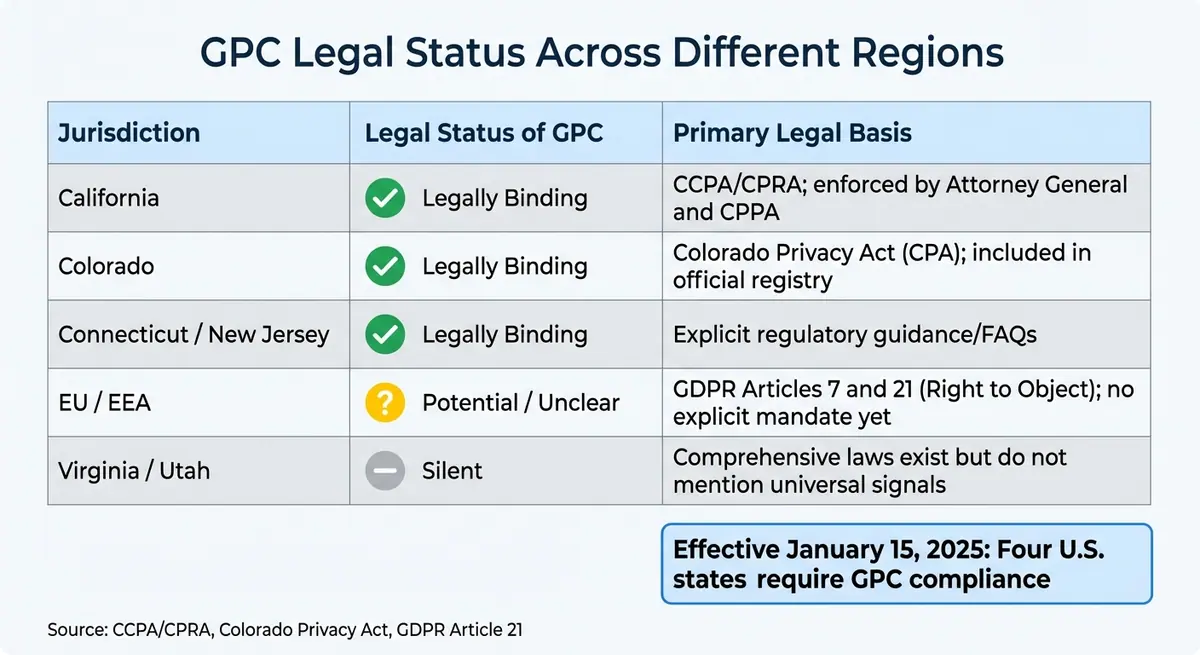
GPC Legal Status by Jurisdiction: Compliance Requirements Across US States and EU
GPC is focused on opting users out of data sales, sharing, and cross-context targeted ads, but it doesn't cover broader rights like data deletion. For instance, if someone visits your site with GPC enabled, you’re required to stop selling their data to third parties. However, you can still target ads based on their activity within your own site.
Another thing to keep in mind: if a user changes their GPC setting during a session, the previous preference remains active until they load a new top-level page. Additionally, segmenting users based on their GPC status could unintentionally contribute to browser fingerprinting, potentially making them more identifiable. While sending the GPC signal aims to provide a net privacy benefit, it doesn’t eliminate all tracking risks. This makes it important to pair GPC with other privacy measures for full compliance.
Legal Status Across Different Regions
The enforceability of GPC depends heavily on the user's location. Starting January 15, 2025, four U.S. states - California, Colorado, Connecticut, and New Jersey - require businesses to treat GPC as a legally binding opt-out request. In California, this is supported by the CCPA and CPRA, and the state has already enforced penalties for non-compliance. Recent U.S. settlements highlight the growing legal importance of honoring GPC signals.
In the European Union, GPC’s status is less defined. While it might align with the "Right to Object" under GDPR Article 21, European regulators haven’t officially recognized it as a binding mechanism. This creates tension with the ePrivacy Directive, which generally requires opt-in consent for tracking technologies. Meanwhile, U.S. states like Virginia and Utah have comprehensive privacy laws but don’t address universal opt-out signals.
| Jurisdiction | Legal Status of GPC | Primary Legal Basis |
|---|---|---|
| California | Legally Binding | CCPA/CPRA; enforced by Attorney General and CPPA |
| Colorado | Legally Binding | Colorado Privacy Act (CPA); included in official registry |
| Connecticut / New Jersey | Legally Binding | Explicit regulatory guidance/FAQs |
| EU / EEA | Potential / Unclear | GDPR Articles 7 and 21 (Right to Object); no explicit mandate yet |
| Virginia / Utah | Silent | Comprehensive laws exist but do not mention universal signals |
Using GPC with Other Privacy Tools
Since GPC has its limitations, combining it with other privacy tools is key to meeting compliance requirements. Consent Management Platforms (CMPs) can handle more detailed consent needs that GPC doesn’t address. For example, while GPC signals a "do not sell" request, a CMP can manage opt-ins for non-essential cookies or process data deletion requests.
It’s also important to clearly explain in your privacy policy how you handle conflicts between GPC and site-specific consent. If a user with GPC enabled clicks "Accept All" on a cookie banner, California guidelines suggest prioritizing the GPC signal to prevent "consent fatigue" from undermining user rights. Additionally, make sure to offer visible "Do Not Sell" links and manual data deletion request options to cover rights that GPC doesn’t address.
Finally, track how many users have GPC enabled (without identifying them) to measure its impact on your ad revenue and data processes. This data can help you adapt your compliance strategies. By early 2024, over 40 million consumers were actively using browsers or tools with GPC support, and at least 150 million users had access through compatible browsers and extensions.
Conclusion
Main Benefits of GPC for Businesses
GPC simplifies privacy compliance by using a stateless protocol that sends a privacy signal with every HTTP request. This eliminates the need for managing tracking databases, which can lower technical complexity and operational costs. Another plus? It speeds up ad execution, reducing the time it takes for the first ad to load compared to traditional consent frameworks.
The $1.2 million settlement against Sephora in August 2022 serves as a clear warning about the legal risks of ignoring GPC compliance under the CCPA. Attorney General Rob Bonta emphasized the importance of adhering to the law, stating: "Follow the law, do right by consumers, and process opt-out requests made via user-enabled global privacy controls". For users, GPC simplifies privacy management by removing repetitive tasks, fostering trust as businesses honor their opt-out preferences. With adoption growing steadily, GPC is becoming a cornerstone for trust and compliance. Embracing GPC isn't just about meeting legal requirements - it’s about earning trust from privacy-conscious users who expect their preferences to be automatically respected. As regulations shift, GPC’s importance in privacy strategies continues to grow.
Adapting to Changing Privacy Regulations
Beyond its technical advantages, GPC is becoming essential for navigating evolving privacy laws. California’s AB 566, signed in October 2025, mandates that major browsers integrate built-in opt-out preference signals by January 2027. Additionally, the W3C Privacy Working Group formally adopted GPC as an official work item in November 2024, pushing it closer to becoming a recognized standard.
While the EU hasn’t officially required GPC yet, experts see its potential. Alexander McD White, Bermuda’s Privacy Commissioner, noted, "GPC provides a clear and binary indication of an individual's choice... it appears likely to be a prominent, easily understandable, and accessible mechanism". Meanwhile, the "EU Digital Omnibus" proposal is considering universal preference systems to tackle consent fatigue. Early adoption of GPC offers businesses a solid foundation to prepare for future regulatory changes across different regions.
FAQs
What is the difference between GPC and the EU's ePrivacy Directive when it comes to consent?
Global Privacy Control (GPC) and the EU's ePrivacy Directive take different routes when it comes to handling user consent. GPC is a browser-based tool that lets users set their privacy preferences - like opting out of data sharing or sales - automatically across all websites. It’s designed to simplify the process by applying these preferences universally.
On the other hand, the ePrivacy Directive requires websites to obtain explicit consent from users through mechanisms like cookie banners. This means users have to actively approve data collection on a site-by-site basis, ensuring they are informed and in control every time.
While GPC aims for a streamlined, universal solution, the ePrivacy Directive prioritizes transparency and consent tailored to individual websites, staying aligned with the EU's legal framework.
What are the legal requirements for using Global Privacy Control (GPC) in different regions?
The legal obligations surrounding Global Privacy Control (GPC) depend heavily on the privacy laws of specific regions. In the United States, the California Consumer Privacy Act (CCPA) requires businesses to treat GPC signals as valid requests for opting out of the sale of personal data. Similarly, states like Colorado and Connecticut have enacted laws that also recognize global privacy signals, though some of these regulations are still in the process of being fully implemented.
On a global scale, whether GPC is recognized often hinges on how local laws interpret privacy preferences. For instance, while the European Union’s ePrivacy Directive may align with GPC’s objectives, its enforceability can vary across member countries. Adopting GPC not only reflects a business's commitment to user privacy but also helps ensure compliance with relevant laws. However, keeping track of regional legal updates is crucial to maintain adherence to these requirements.
How can businesses use GPC with their consent management platforms?
Businesses can make Global Privacy Control (GPC) work with their consent management platforms (CMPs) by ensuring their systems are equipped to detect and handle GPC signals. These signals, sent from users' browsers or devices, communicate privacy preferences - like opting out of data sales or sharing.
To achieve this, CMPs need updates that allow them to recognize GPC signals, whether they arrive via HTTP headers or DOM elements. This ensures user preferences are automatically respected. Additionally, businesses should configure their CMPs to treat GPC signals as valid privacy requests. This step is crucial for compliance with regulations like the California Consumer Privacy Act (CCPA), which mandates honoring such signals.
By integrating GPC, companies can simplify compliance processes, reduce the need for additional consent prompts, and demonstrate a commitment to respecting user privacy - building trust along the way.
Related Blog Posts
Get new content delivered straight to your inbox

The Response
Updates on the Reform platform, insights on optimizing conversion rates, and tips to craft forms that convert.




Drive real results with form optimizations
Tested across hundreds of experiments, our strategies deliver a 215% lift in qualified leads for B2B and SaaS companies.
