
.webp)
GDPR, CCPA, and APAC: Consent Rules Compared



Managing consent across regions is a challenge for businesses due to varying privacy laws. GDPR requires explicit opt-in, CCPA operates on an opt-out model, and APAC countries follow mixed rules that range from strict opt-in to deemed consent. Non-compliance can result in severe fines, such as GDPR’s 4% of global revenue or CCPA’s per-violation penalties.
Here’s what you need to know:
- GDPR: Explicit opt-in, purpose-specific consent, simple withdrawal process, and strict rules for sensitive data and minors under 16.
- CCPA/CPRA: Opt-out model, mandatory "Do Not Sell or Share" link, and opt-in required for sensitive data or minors under 16.
- APAC: Diverse rules - South Korea enforces explicit consent, Singapore allows deemed consent, and India requires unambiguous affirmative action.
Quick comparison:
| Feature | GDPR | CCPA/CPRA | APAC (Examples) |
|---|---|---|---|
| Primary Model | Explicit Opt-In | Opt-Out | Mixed (Opt-In to Deemed) |
| Granularity | High | Low | Varies (Very high in South Korea) |
| Withdrawal | Easy as granting | Opt-out rights | Explicit and accessible |
| Sensitive Data | Explicit consent | Limit use rights | Separate consent required |
| Children's Age | Under 16 (or 13) | Under 16 | 14 (China, South Korea) to 18 (India, Japan) |
To comply globally, businesses need geo-targeted consent systems, detailed consent logs, and tools to manage opt-in and opt-out requirements. Failing to meet these standards risks hefty fines, reputational damage, and legal challenges. By implementing a unified consent management strategy, you can simplify compliance while respecting user preferences.
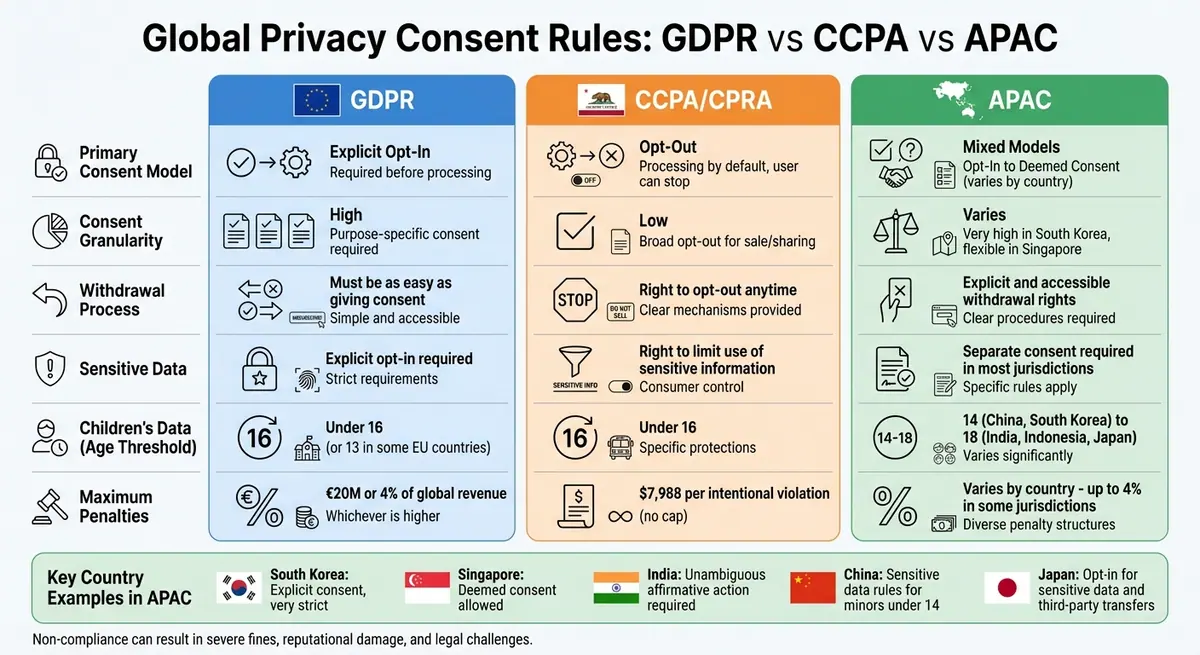
GDPR vs CCPA vs APAC Privacy Consent Requirements Comparison Chart
GDPR vs CCPA: Key Differences Businesses Need to Know
How Consent Models Differ by Region
The world's three major privacy frameworks - GDPR, CCPA, and APAC regulations - take distinct approaches to consent. GDPR mandates explicit consent before processing begins. CCPA operates on an opt-out basis, allowing data processing until a consumer objects. Meanwhile, APAC regulations vary, ranging from strict opt-in requirements to more flexible "deemed consent" models. These differences highlight the challenge of managing consent across regions. Let’s break down each framework’s unique rules.
GDPR: Opt-In Consent Requirements
GDPR sets the bar high with its opt-in model. Businesses must secure explicit, informed consent before processing personal data. Alternatively, they can rely on one of six legal bases: consent, contract fulfillment, legal obligation, vital interests, public interest, or legitimate interests. For sensitive data or information about minors (typically under 16, though some EU countries allow the age to drop to 13), explicit consent and parental approval are required. Importantly, withdrawing consent must be as simple as granting it.
CCPA: Opt-Out Model and CPRA Updates
California's CCPA adopts an opt-out approach. Companies can process data by default as long as they disclose their practices and provide a "Do Not Sell or Share My Personal Information" link on their website. However, with the 2023 CPRA updates, businesses now need opt-in consent for handling sensitive personal information and for data belonging to minors under 16. Additionally, companies must honor Global Privacy Control (GPC) signals, which let users automatically communicate their opt-out preferences through browser settings.
APAC: Region-Specific Consent Rules
APAC regulations are diverse. For example:
- Singapore (PDPA): Allows "deemed consent", meaning consent can be inferred if an individual voluntarily provides data for a reasonable purpose. Processing is also permitted for legitimate interests or business improvement, provided a balancing test is conducted.
- South Korea (PIPA): Requires explicit, informed consent for nearly all data collection. This includes detailed disclosures about purpose, data categories, and retention periods. Legitimate interest exceptions are narrowly defined.
- Japan (APPI): Demands opt-in consent for sensitive data, third-party transfers, or any use beyond the original purpose.
- India (2023 DPDP Act): Requires consent to be free, specific, informed, unconditional, and unambiguous. Consent must be given through clear affirmative action, and a "Consent Manager" must serve as a central contact for managing and withdrawing consent.
"Consent is the only legal basis that is shared by all [14 major APAC] regimes and that applies to processing all forms of personal data." - Josh Lee Kok Thong, Managing Director (APAC), Future of Privacy Forum
Side-by-Side Comparison of Consent Requirements
Now that we've broken down each framework, let's see how they stack up against each other. Comparing these frameworks helps highlight where they align and where they take different paths - critical knowledge for businesses juggling regulations in multiple regions.
Consent Models: Opt-In vs Opt-Out
The core difference lies in how consent is obtained. Under GDPR, consent must be explicitly granted before any data collection occurs. On the other hand, CCPA allows data processing by default unless the consumer actively opts out. Meanwhile, APAC countries mostly lean toward opt-in consent, though Singapore's "deemed consent" rule permits inferred consent when individuals voluntarily provide data for reasonable purposes.
The legal grounds for processing data also differ. GDPR lays out six specific bases for lawful processing, including consent, contracts, legal obligations, and legitimate interests. In contrast, CCPA doesn’t require companies to justify data processing with a specific rationale - processing is generally allowed unless the consumer opts out. Interestingly, 10 of the 14 leading APAC jurisdictions now incorporate a "Legitimate Interests" provision, signaling a gradual move away from relying solely on consent.
Let’s also take a closer look at how these frameworks approach consent granularity and withdrawal.
Granularity and Withdrawal Mechanisms
GDPR takes a detailed approach, requiring purpose-specific consent for different types of data processing. Users must approve or deny each category separately, ensuring transparency and control. CCPA, by contrast, focuses on broader issues like the sale or sharing of data. However, the 2023 CPRA update added a new right that allows users to limit the use of sensitive personal information.
South Korea’s PIPA is among the strictest, mandating explicit consent and full disclosure of data purposes and categories. Similarly, China’s PIPL requires separate consent for high-risk scenarios, such as processing sensitive data or transferring it across borders.
When it comes to withdrawal, GDPR insists that opting out should be as simple as opting in. APAC frameworks also emphasize accessible and straightforward withdrawal options, with clear rules in places like Singapore and South Korea.
Handling Children's and Sensitive Data
Stricter rules apply when managing children's data and sensitive information, but the specifics vary across regions. GDPR and CCPA both require parental consent or opt-in for minors under 16. GDPR, however, allows some flexibility, with member states lowering the age to 13. APAC countries set different thresholds, ranging from 14 in China and South Korea to 18 in India, Indonesia, and Japan.
Sensitive data is another area where consent is universally required across all 14 major APAC jurisdictions. China takes a particularly cautious approach, automatically classifying all personal information of minors under 14 as sensitive. Many APAC countries also go beyond standard notification requirements, demanding affirmative or separate consent for sensitive data. For example, Japan’s APPI requires prior consent for handling "special care-required" personal information, while South Korea mandates separate consent for data such as race, religion, and biometrics .
| Feature | GDPR | CCPA/CPRA | APAC (Examples) |
|---|---|---|---|
| Primary Model | Explicit Opt-In | Opt-Out (Sale/Share) | Mixed (Opt-In to Deemed) |
| Granularity | High (Purpose-specific) | Low (Broad opt-out) | Varies (Very high in South Korea) |
| Withdrawal | As easy as giving consent | Right to opt-out | Explicit right (e.g., Singapore, South Korea) |
| Sensitive Data | Explicit opt-in required | Right to limit use | Separate consent required |
| Children's Age | Under 16 (or 13) | Under 16 | 14 (China, South Korea) to 18 (India, Japan) |
sbb-itb-5f36581
How to Comply with Different Consent Rules
Managing compliance across various consent frameworks can feel overwhelming. However, with the right tools and strategies, you can create a system that meets regional requirements without complicating user experiences or overloading your team.
Unified Consent Management for Global Compliance
To achieve global compliance, start with a geo-targeted consent system. This system automatically adjusts to each user's location, ensuring the correct consent experience is displayed. For example:
- Opt-in banners are required under GDPR, as well as in India and South Korea.
- Opt-out notices with "Do Not Sell or Share" links are necessary for California residents.
Avoid relying on simple "Accept All" buttons. Instead, use granular consent models that allow users to select specific categories like analytics, marketing, or functional cookies. This approach not only aligns with GDPR's purpose-specific guidelines but also keeps the user interface clean and transparent. If you include an "Accept All" button, ensure there’s a "Reject All" button with equal prominence to avoid accusations of using dark patterns.
For regions requiring opt-in consent, block non-essential cookies and tracking pixels until users explicitly consent. In areas like California, comply with the Global Privacy Control (GPC) signal, which enables automatic opt-outs. This is now mandatory in California and Colorado, so make sure your website headers and scripts can process GPC as a valid opt-out request.
Tools like Reform simplify this process by using conditional logic and integrations. For example, you can embed consent preferences directly into forms, routing leads based on their privacy choices. Integration with CRM and marketing automation tools ensures that consent decisions are respected throughout your tech stack.
Finally, ensure you meticulously document your lawful bases for data processing to validate these technical measures.
Documenting Lawful Bases for Data Processing
Regulators require proof of compliance, so thorough documentation is essential. Maintain detailed consent logs that record:
- Who provided consent
- The exact timestamp
- The specific purpose
- The version of your privacy policy or banner
- The method of collection
Screenshots alone won’t suffice, especially under GDPR. Regulators expect functional audit trails with time-stamped records of every consent action and withdrawal.
Additionally, create Records of Processing Activities (ROPA) that detail data categories, purposes, third-party disclosures, cross-border transfers, and retention periods. If you rely on "Legitimate Interests" (recognized in regions like Singapore and the EU), document a balancing test to show how your interests outweigh individual rights. In Singapore, this also requires a Data Protection Impact Assessment (DPIA).
"Under GDPR, regulators want time-stamped logs of every consent action, withdrawal records, and the banner versions presented. A screenshot of a banner is not enough." - Cookie-Script
For high-risk activities, such as processing sensitive data or cross-border transfers under China's PIPL or Japan's APPI, separate or prior consent must be documented independently from general terms. Ensure you store the exact version of the notice users agreed to during the processing period.
Proper documentation not only supports compliance audits but also helps build trust with users.
Adapting to Opt-Out and Signal-Based Compliance
Once you’ve established a unified consent framework and robust documentation, adapt your technical measures to meet opt-out requirements for specific jurisdictions.
In the U.S., the opt-out model differs from GDPR's opt-in standard. For example:
- GDPR and Quebec's Law 25 mandate explicit opt-in for non-essential cookies.
- CCPA/CPRA allows tracking unless a user opts out.
Implement geo-targeting to ensure your Consent Management Platform (CMP) serves the correct legal framework based on the user’s location. For instance, visitors in the EU should see opt-in banners, while those in California should receive opt-out notices. Under CPRA, "sharing" includes cross-context behavioral advertising, so websites using advertising pixels must comply with opt-out requirements, even if they don't "sell" data for monetary gain.
Ensure the withdrawal process is as straightforward as the consent process. Maintain clear audit trails with time-stamped records of all opt-out actions. In the Asia-Pacific region, document when processing relies on "legitimate interests" or "deemed consent" instead of explicit opt-in, as many jurisdictions in this region now recognize these alternatives.
"DPOs should consider consent as one element among various legal bases, and not as the default or only option for processing personal data." - Josh Lee Kok Thong, Managing Director (APAC), Future of Privacy Forum
Regularly audit your tracking technologies. Conduct monthly scans of your website to identify first-party and third-party cookies, pixels, and local storage. Categorize them accurately to ensure your records of "essential" versus "non-essential" trackers remain up to date.
Penalties for Non-Compliance
Failing to adhere to consent regulations can lead to hefty financial penalties and severe reputational damage, with the exact consequences depending on the governing framework - whether GDPR, CCPA, or APAC-specific rules. These penalties often go beyond the initial fines, making it essential for organizations to understand the nuances of each system to effectively allocate resources and prioritize compliance.
GDPR: Fines Up to 4% of Global Revenue
GDPR enforces penalties through two tiers. Tier 1 violations, such as neglecting to maintain proper records of processing activities, can result in fines of up to €10 million or 2% of global annual turnover - whichever is higher. Tier 2 violations, which include consent-related issues like using pre-ticked boxes or restricting access to users who reject cookies, can escalate to €20 million or 4% of global revenue.
For instance, in May 2023, Meta faced a staggering €1.2 billion fine from the Irish Data Protection Commission for international data transfer violations. Similarly, Amazon was fined €746 million in July 2021 by Luxembourg's data protection authority over non-compliant data processing and consent practices. Between 2018 and March 2025, GDPR fines have totaled approximately €5.65 billion across 2,245 enforcement actions, with an average fine hovering around €2.36 million.
Regulators are increasingly targeting industries beyond tech giants, including media, telecom, and e-commerce, with a growing focus on "dark patterns" - user interfaces designed to confuse or discourage opting out or deleting data.
"Average fine figures hide dispersion. What matters is whether your controls stand up to inspection, and how quickly you can remediate. Documented good faith is an economic asset in enforcement." – Elena Martín, Data Protection Officer
Next, let’s dive into the CCPA’s unique per-violation penalty structure.
CCPA: Per-Violation Fines and Private Actions
The CCPA operates differently from GDPR by imposing penalties on a per-violation basis. As of late 2024, fines are set at $2,663 for unintentional violations and $7,988 for intentional violations or those involving minors' data. With no cap on total penalties, incidents involving large consumer bases can quickly balloon into multi-million-dollar liabilities.
Adding to the risk, private litigation under CCPA allows consumers to seek statutory damages ranging from $100 to $750 per person, per incident, in cases of security breaches. The CPRA has further heightened enforcement by eliminating the 30-day "cure period", which previously allowed businesses to resolve violations before fines were applied.
A notable example occurred in August 2022 when Sephora settled for $1.2 million with the California Attorney General for failing to disclose the sale of personal data and ignoring Global Privacy Control signals.
"California's move to proactive CPPA oversight means UX is a compliance surface. If your opt out flows are confusing, your risk spikes even without a breach." – David Ng, Privacy Engineering Lead
Now, let’s explore the diverse enforcement landscape in APAC.
APAC: Varying Penalty Structures
The APAC region presents a wide variety of enforcement models, from fixed penalty caps to revenue-based fines. For example, Quebec's Law 25, which aligns with GDPR, allows penalties of up to CAD 25 million or 4% of global revenue.
In APAC, non-compliance can erode consumer trust and cause rapid reputational harm. As jurisdictions like Singapore shift toward using legitimate interests to reduce consent fatigue, companies relying on intrusive or deceptive consent methods risk falling behind evolving regional standards. Additionally, violations of data localization mandates in countries like China and Vietnam can lead to significant reputational fallout tied to national security and sovereignty concerns.
Regulators across APAC are increasingly focusing on cross-border data transfers and localization requirements, creating enforcement priorities that differ from those seen under GDPR or CCPA.
Conclusion
Navigating global consent requirements is no easy feat, as each region brings its own unique set of rules. From GDPR's strict opt-in model to CCPA's opt-out framework and the varied approaches across APAC - such as South Korea's explicit consent and Singapore's deemed consent - businesses must adopt strategies tailored to each region. Sticking solely to GDPR compliance leaves gaps, especially in countries like China and India, where "legitimate interests" aren’t accepted as a valid legal basis.
The numbers highlight the challenge: while 81% of users expect their privacy preferences to follow them across borders, only 46% of decision-makers in Asia-Pacific report full GDPR compliance. Add to this strict requirements like India’s six-hour breach notification rule and potential fines reaching 4% of global revenue, and it becomes clear how high the stakes are.
This complexity calls for smarter consent solutions.
"The future belongs to consent systems as borderless as the data." – Secure Privacy
Unified consent management tools are key to simplifying this landscape. These systems can automate geo-targeting, maintain detailed audit logs, and deliver multilingual notices to meet requirements in places like Quebec and Indonesia. For businesses relying on web forms, platforms like Reform offer compliance-ready features, such as conditional routing, lead enrichment, and CRM integrations, ensuring consent documentation is accurate while also boosting conversions.
But tools alone aren’t enough. Organizations need to treat consent as a dynamic process. This means recording all lawful bases, enabling easy withdrawal of consent, and keeping up with new standards like Google Consent Mode v2 and the Global Privacy Control signal. By embedding Privacy by Design principles and conducting regular Data Protection Impact Assessments, businesses can stay ahead of shifting regulations. This approach transforms compliance from a burden into a strategic advantage.
FAQs
What are the main differences between GDPR, CCPA, and APAC consent rules?
The GDPR, CCPA, and consent regulations in the APAC region each take distinct approaches to data privacy, shaped by their regional priorities and legal frameworks.
GDPR (General Data Protection Regulation), enforced by the European Union, sets a high bar for data privacy standards. It mandates explicit and informed consent before any personal data is collected. Transparency is a cornerstone, requiring businesses to clearly state how data will be used. Additionally, GDPR grants individuals extensive rights over their data, such as the right to access, correct, or delete it. Its reach is global, applying to any organization handling the data of EU residents, regardless of where the business operates.
On the other hand, CCPA (California Consumer Privacy Act) focuses on empowering consumers in California. It emphasizes transparency and gives individuals the ability to opt out of having their data sold. While it doesn’t always require explicit consent like GDPR, it prioritizes consumer control, requiring businesses to disclose their data collection and sharing practices. The CCPA is more about offering choices rather than demanding prior consent.
In the APAC region, data privacy regulations vary significantly between countries. Many laws draw inspiration from GDPR but adapt to local contexts. For example, Japan’s APPI (Act on the Protection of Personal Information) requires businesses to clearly state the purposes for which data is collected. It also demands consent for processing sensitive data or transferring personal information across borders. While these frameworks incorporate principles from GDPR, they often reflect regional values and priorities.
In summary, GDPR is the strictest in terms of consent and individual rights, CCPA emphasizes consumer empowerment through opt-out mechanisms, and APAC regulations blend GDPR-inspired standards with local adaptations.
How can businesses comply with different global consent regulations like GDPR, CCPA, and APAC rules?
To meet global consent regulations, businesses need to tailor their strategies to the legal requirements of each region. For example, the GDPR in the EU mandates clear, informed, and explicit opt-in consent before processing personal data. In contrast, the CCPA in the U.S. prioritizes transparency and gives users the right to opt out of data sales. Meanwhile, in the Asia-Pacific region, many countries focus on explicit consent for sensitive data and enforce strict rules on cross-border data transfers.
Tools like no-code form builders can make compliance easier. They allow businesses to design consent flows specific to each region, include the necessary disclosures, and keep accurate records. This approach not only ensures compliance and reduces risks but also strengthens user trust while streamlining the consent collection process.
What are the consequences of not complying with GDPR, CCPA, or APAC privacy regulations?
Failing to follow privacy laws like GDPR, CCPA, or APAC regulations can lead to hefty fines and serious damage to your reputation. For instance, GDPR violations can result in penalties as high as €20 million or 4% of a company’s global annual revenue, whichever is greater. Meanwhile, under the CCPA (now expanded by the CPRA), fines can hit $7,500 per violation, particularly for intentional or negligent breaches.
But it’s not just about the money. Repeated or severe violations can erode customer trust and open the door to further legal issues. These consequences underscore the need for businesses to focus on compliance and create strong data protection measures that align with regional laws.
Related Blog Posts
Get new content delivered straight to your inbox

The Response
Updates on the Reform platform, insights on optimizing conversion rates, and tips to craft forms that convert.




Drive real results with form optimizations
Tested across hundreds of experiments, our strategies deliver a 215% lift in qualified leads for B2B and SaaS companies.
