
.webp)
How Lead Nurturing Goals Change by Stage



Lead nurturing is about moving leads through their buying journey by delivering the right content at the right time. The process evolves across three key stages:
- Awareness: Focus on educating leads about their problem.
- Consideration: Show how your product solves their challenges.
- Decision: Help leads confidently choose your solution.
Here’s why this matters: 80% of unqualified leads buy within 24 months, but only if you stay on their radar. Companies that nurture leads see a 20% boost in sales opportunities and 50% more sales-ready leads while reducing costs by 33%. Tailoring your strategy to each stage builds trust and drives conversions.
Key tactics include:
- Awareness: Share educational content like blog posts and guides.
- Consideration: Provide case studies, demos, and ROI calculators.
- Decision: Offer free trials, pricing clarity, and social proof to build credibility.
The goal is simple: Progress leads step-by-step while addressing their needs at every stage. Done right, nurturing leads can shorten sales cycles and increase deal sizes by 47%.
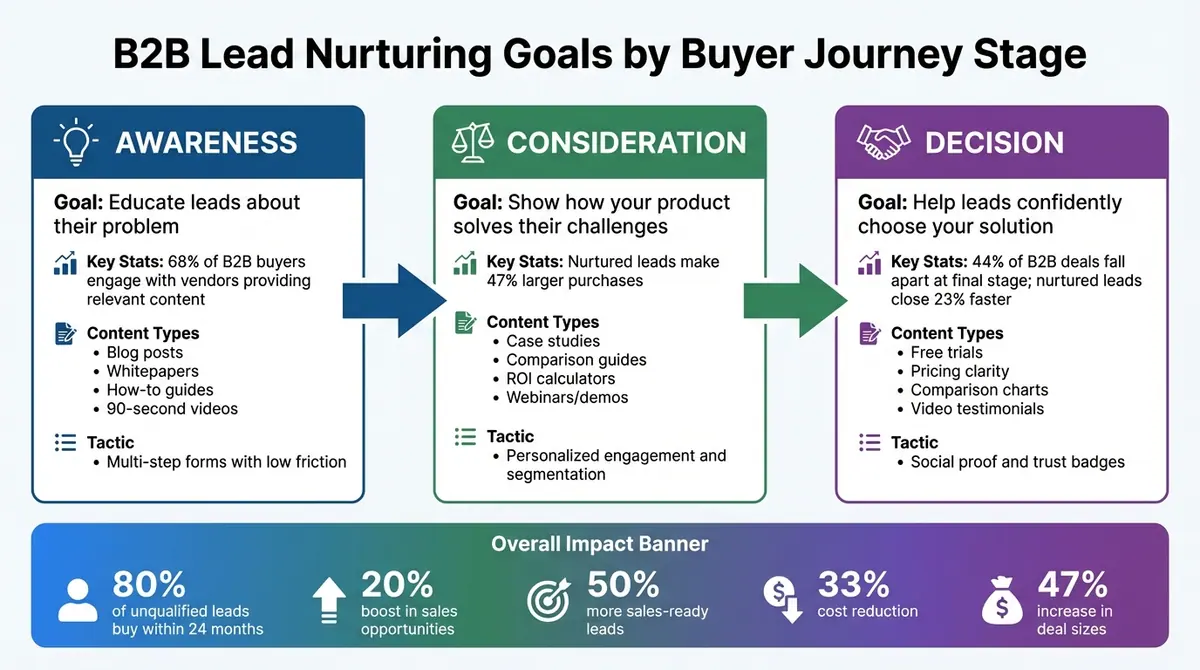
Lead Nurturing Goals and Tactics by Buyer Journey Stage
How Lead Nurturing Works (Automate!)
sbb-itb-5f36581
Awareness Stage: Building Initial Interest
At this stage, leads are just starting to notice that something's off. They’re not actively hunting for solutions yet - they’re simply trying to figure out what’s wrong and whether it’s worth their attention. Your job here is to educate them and position your brand as a reliable source of information.
"Content at the awareness stage always should center around making the buyer more aware of their need or problem. This is never the time to educate on your solution -- the buyer just isn't there quite yet." - Ironpaper
Rather than jumping into a sales pitch, focus on addressing their pain points. This builds trust. In fact, 68% of B2B buyers are more likely to engage with a vendor that consistently provides relevant content over time. The idea is to stay on their radar without being pushy. Let’s look at the kind of content that can help you do this.
Educating Leads Through Content
Content at the top of the funnel should help your audience identify and understand their problems. Think blog posts that highlight industry trends, whitepapers exploring common challenges, or how-to guides packed with actionable tips. Short videos (around 90 seconds) are another great way to explain concepts quickly and effectively.
The trick is to focus on the issue, not the solution. For instance, if your audience includes marketing teams, a blog post titled "Why Your Lead Conversion Rate Dropped in 2025" is likely to grab more attention than one that immediately promotes a product. The first helps diagnose the problem, while the second assumes they’re already shopping for answers.
Once they’ve recognized their challenge, you can gently guide them toward taking the next step.
Capturing Lead Information with Forms
After delivering value, it’s time to gather contact details - but keep it simple. Forms that ask for too much information upfront can scare prospects away. Instead, aim for a low-friction approach.
Multi-step forms with progress bars are a smart choice. They break the process into smaller steps, which reduces drop-off rates. Tools like Reform make it easy to create branded, multi-step forms without needing any coding. Features like email validation, spam prevention, and real-time analytics help ensure you’re collecting quality data while identifying where prospects might lose interest.
The goal? Make it easy and worthwhile for leads to share their contact details by focusing on multi-step form design. Whether you’re offering an ebook, a guide, or webinar access, the process should feel seamless - encouraging them to take that first step into your nurturing funnel.
Consideration Stage: Showing Value
At this stage, leads have identified their problem and are actively searching for solutions. Your approach needs to shift from general education to showing how your product directly addresses their challenges. Here’s why this matters: nurtured leads tend to make purchases that are 47% larger than those of non-nurtured leads. Getting this part right can have a big impact on your revenue.
The focus here is on providing resources that help prospects compare their options and see the potential results of choosing your solution. They’re no longer casually browsing - they’re seriously weighing their choices and looking for proof that your product delivers. Your content should answer one critical question: "Why is this the best solution for my specific needs?"
"In the consideration stage, leads are more aware of the solutions available to them and your content can begin to delve more deeply into your products and services."
- Chantel Hall, Marketing Content Specialist, Ironpaper
Using Product-Specific Resources
This is where case studies shine. They showcase real-world successes and build trust by demonstrating how businesses similar to your prospect’s achieved measurable results. For example, one case study revealed that personalized content suggestions boosted lead generation by 10% in 2019.
Comparison guides also play a major role. They help prospects understand the trade-offs between different solutions, positioning your product as the clear choice. ROI calculators are another powerful tool, especially for decision-makers focused on financial outcomes - they quantify the value your solution brings.
Webinars and product demos give leads an up-close look at how your solution works. These sessions should zero in on specific features that solve their pain points. For technical decision-makers, detailed data sheets can provide the comprehensive specs they need to move forward.
| Content Type | Purpose | Best For |
|---|---|---|
| Case Studies | Showcasing real-world results and building credibility | Leads seeking proof of success in their industry |
| Comparison Guides | Highlighting your product’s advantages | Prospects actively comparing their options |
| ROI Calculators | Demonstrating financial benefits | Budget-conscious decision-makers |
| Webinars/Demos | Offering a hands-on look at your product | Leads wanting a deeper understanding of features and functionality |
The goal is to shift their mindset from "this could work" to "this will work for us." Once you’ve established this confidence, the next step is to make your engagement even more tailored to their specific needs.
Personalizing Engagement
After showcasing how your product solves their challenges, it’s time to personalize your follow-ups. Personalization isn’t just about adding someone’s name to an email - it’s about crafting content that reflects their role, industry, and specific interests.
"Personalization isn't sprinkling someone's first name into a subject line. It's sending industry-specific reports to a CFO, integration details to an IT director, or ROI benchmarks to a COO."
Segmentation is key. Group your leads based on firmographic details (like company size or industry) and behavioral cues (such as pages visited or resources downloaded). For instance, a startup founder and an enterprise CFO should receive completely different messaging. Companies that excel at lead nurturing see 50% more sales-ready leads while reducing the cost per lead by 33%. Segmentation is a big part of that success.
You can take it further with conditional routing, which adjusts email sequences based on a lead’s actions. For example, if someone downloads a case study, your next email could offer related ROI data or an invitation to a demo instead of sending a generic follow-up. Tools like Reform make this easier by dynamically tailoring content paths based on user responses.
Behavioral triggers are another smart tactic. If a lead repeatedly visits your pricing page or downloads a comparison guide, that’s a strong signal of intent. Configure your CRM to notify your sales team so they can follow up with timely, personalized outreach. Amazon, for instance, used predictive modeling for lead scoring, which led to a 32% increase in qualified lead conversions and cut the time to close a deal by 125%.
The more personalized and relevant your engagement, the more likely prospects are to see your solution as the perfect fit - and take the next step toward becoming customers.
Decision Stage: Driving Conversions
At this point, your leads are ready to make a choice. They’ve identified their needs and are evaluating solutions. Now, your job is to make saying "yes" to your product as easy as possible. Did you know that 44% of B2B deals fall apart at the final stage due to delays or lingering doubts? That’s why it’s critical to remove obstacles and guide them toward a confident decision.
This stage is all about shifting gears from educating leads to promoting your product while addressing any lingering concerns. Your content should answer the questions prospects are likely asking: “What does it cost?”, “Can I see how it works?”, and “Why is this the better option?”
Providing Clear Offers
Content at this stage needs to be highly specific and focused on your product. High-intent keywords like “pricing,” “demo,” “reviews,” or “[your product] vs [competitor]” should guide your approach. Your landing pages and emails should be tailored to deliver exactly what these prospects are seeking.
Free trials and demos are powerful tools here. They let potential customers experience your product firsthand with minimal commitment. For SaaS companies, it’s especially important to lead users to an “aha moment” during the trial - a point where the value of your product becomes crystal clear. If a trial doesn’t convert immediately, offering an extension can help ease hesitation.
Comparison charts can also play a big role in helping prospects choose you over competitors. Instead of relying on third-party review sites, create your own vendor comparison pages using data and examples to back up your claims. For instance, Asana’s comparison page highlights specific features and benefits that set it apart from Trello.
Urgency can help nudge hesitant leads into action. Tactics like limited-time offers, coupon codes, or gamified pop-ups can encourage quicker decisions. If a lead revisits your pricing page multiple times within a week, that’s a strong buying signal - trigger a personalized follow-up or alert your sales team to act quickly.
Your calls to action (CTAs) should focus on benefits. Instead of generic phrases like “Submit” or “Sign Up,” opt for something more engaging, like “See it in action” or “Start your free trial”. Additionally, having product-specific FAQs that address common concerns - like return policies or technical details - can make the buying process smoother.
Building Trust with Social Proof
Even when a lead is ready to buy, doubts can creep in. That’s where social proof becomes crucial. In fact, 92% of customers trust peer recommendations over branded content, and the same percentage trust user-generated content more than traditional marketing messages.
To build trust, display star ratings, customer logos, and trust badges near your high-intent CTAs like “Book a Demo” or “Sign Up.” These visual cues reassure leads precisely when they’re making their decision. Trust badges (e.g., ISO 27001 compliance, GDPR certification, or “Hosted on AWS”) can also help ease security concerns near pricing tables and forms.
Case studies are another effective tool. Use detailed stories that highlight measurable outcomes and ROI. For example, Webflow’s comparison page features testimonials from well-known brands like Rakuten to showcase better results than WordPress. Tailor your social proof to your audience - show startup founders testimonials from other startups, and enterprise leads examples from large organizations.
Video testimonials add an emotional, human element that text can’t fully capture. Keep them concise (45–90 seconds) and focus on customers explaining the tangible results they’ve achieved. Including customer testimonials in email campaigns can even boost click-through rates by 20–30%.
For more technical buyers, provide materials like security briefs, architecture overviews, or data migration plans. These resources can address final concerns and help your champion secure internal buy-in. To stay relevant, update your case studies and testimonials every 6–12 months.
"Social proof isn't optional - it's essential."
This is the stage where all your nurturing efforts pay off. Nurtured leads tend to close deals 23% faster and generate 47% higher average order values compared to non-nurtured leads. By offering clear, compelling options and reinforcing trust with social proof, you can turn hesitant prospects into confident customers.
Next, we’ll explore how to automate these strategies for consistent, multi-touch engagement across all stages.
Automating Lead Nurturing Across Stages
Relying on manual follow-ups often leads to inconsistency. Automated workflows step in to ensure timely engagement, capturing early interest, tracking behavior, and pacing interactions based on where a lead is in their journey. The trick? Making sure automation doesn’t feel robotic - it should genuinely respond to what the lead is doing.
"Nurture isn't a 'nice to have.' It's a funnel control mechanism."
Here’s a stat to consider: 80% of sales require at least five follow-up touches, yet 44% of sales reps stop after just one attempt. Automation bridges this gap, ensuring consistent touchpoints without relying on memory or bandwidth. And the results speak for themselves - lead nurturing campaigns produce 50% more sales-ready leads at 33% lower costs.
Mapping Goals to Automated Workflows
To align automation with the lead's journey, set clear triggers for each workflow. These might include actions like filling out a form through Reform, reaching a lead score of 30–59 points, or attending a webinar.
For awareness-stage leads, the focus is on trust-building and education. A newsletter signup or initial form submission could kick off a sequence delivering blog posts, industry insights, or tools over the next few weeks. The goal isn’t selling - it’s staying relevant and building credibility.
At the consideration stage, automation shifts to addressing "how" questions. Triggers might include downloading a whitepaper, attending a webinar, or viewing a comparison guide. These leads receive content like product use cases, customer success stories, or live demo invitations. It’s about helping them evaluate their options without pushing too hard.
Once leads reach the decision stage, automation zeroes in on conversion. Triggers such as visiting the pricing page, viewing a product tour, or surpassing 60 points on the lead score initiate workflows offering trial opportunities, ROI calculators, or direct scheduling links for sales meetings. Speed matters here - if a lead visits your pricing page multiple times in a week, your automation should immediately alert your sales team via Slack or your CRM.
Incorporate lead scoring into your workflows. Assign points for actions like clicking a CTA (+10), viewing a product tour (+20), or replying to an email (+25). When a lead hits a threshold, such as 60 points, they should automatically move to a high-priority sequence or trigger an alert for your sales team. Set up exit rules to remove leads from nurture workflows once they convert, unsubscribe, or engage in active sales discussions. Sending irrelevant emails - like pitching a product to someone already negotiating a contract - can erode trust quickly.
Next, synchronize these automated touchpoints across multiple channels.
Creating Multi-Touch Sequences
A multi-touch approach works because today’s buyers interact with suppliers through 10 or more channels on average. Your automation should reflect this by coordinating touchpoints across email, SMS, LinkedIn, and even direct mail.
Start with a thoughtful cadence. Send the first email 2–3 days after a lead enters a workflow, then space subsequent touchpoints every 5–7 days. Keep sequences concise, limiting them to 5–8 total touches to avoid overwhelming the lead.
Make your content relevant to the lead’s industry, role, and actions. For example, if someone downloaded a guide on email validation, follow up with, "Since you downloaded our guide on email validation, you might find this case study on spam prevention helpful". Reform’s integrations allow you to capture behavioral data and trigger tailored follow-ups automatically.
Use jump logic to adapt workflows dynamically. For instance, if a lead in an awareness-stage sequence suddenly visits your pricing page, don’t let them sit through irrelevant emails. Move them directly to a decision-stage workflow or alert your sales team immediately. This level of responsiveness makes your nurturing feel personal and timely.
"Done poorly, it's spam. Done right, it's how you win business before your competitor even sees the lead."
- LeadOps
For leads that go cold, implement decay logic. If someone hasn’t engaged in over 30 days, deduct points from their score (e.g., -15 points) or move them into a re-engagement sequence featuring lighter content, such as infographics or a simple "Are you still interested?" email. This keeps your active lists clean and ensures your sales team focuses on leads showing fresh activity.
Measuring and Improving Lead Nurturing Performance
Tracking the right metrics at every stage of the lead nurturing process is essential. Carly Miller from Madison Logic encapsulates this perfectly:
"If you're not tracking the right key performance indicators (KPIs) at the right stages, you're not nurturing - you're just sending content into the void".
As leads progress through their journey, the metrics you focus on should evolve. This understanding is what separates a well-executed lead nurturing strategy from one that misses the mark.
Key Metrics to Track
Each stage of the buyer's journey has its own set of metrics to prioritize. Early on, during the awareness stage, focus on visibility by tracking impressions, website visits, email open rates, and content views. As leads transition to the consideration stage, shift your attention to engagement metrics like email click-through rates (CTR), webinar registrations, time spent on product pages, and account engagement scores. Finally, in the decision stage, pipeline-focused metrics become critical. Track opportunities created, time-to-conversion, meetings booked, and the conversion rate from Marketing Qualified Leads (MQLs) to Sales Qualified Leads (SQLs). If MQLs aren’t converting, it’s a sign your lead scoring may need adjustment in collaboration with your sales team.
| Buying Stage | Key Metrics to Track | Purpose |
|---|---|---|
| Awareness | Impressions; Website visits; Email open rates | Measure visibility and initial reach |
| Consideration | CTRs; Webinar registrations; Time on page | Gauge intent and depth of engagement |
| Decision | Opportunities created; MQL-to-SQL rate; Meetings booked | Measure pipeline influence and sales readiness |
To stay on top of performance, review metrics frequently: check open rates and CTR weekly, evaluate mid-funnel performance monthly, assess pipeline impact quarterly, and analyze long-term retention annually. Additionally, monitor your unsubscribe rates - if they creep above 1%, your content might not be resonating with your audience. These insights allow for quick tweaks to your strategy.
Using Reform's Real-Time Analytics
Accurate measurement strengthens every stage of your lead nurturing strategy. Reform’s real-time analytics provide actionable insights by identifying points where leads drop off and sending alerts when a lead reaches a specific score. For example, if a lead hits an 80-point threshold, your sales team is notified immediately to ensure timely follow-up.
Reform also integrates seamlessly with CRM and marketing tools, enabling closed-loop analytics that connect form submissions directly to pipeline outcomes. This means you can track not only who submitted a form but also whether they converted into paying customers and at what cost. If email CTRs are stagnant while webinar sign-ups are climbing, Reform’s data can guide you to shift your budget toward what’s performing better. By comparing funnel metrics, you can identify areas for improvement - such as testing new calls-to-action or refining lead scoring thresholds.
"Successful inbound marketers don't make decisions based on feelings -- their decisions are based on data".
Conclusion
Lead nurturing requires specific goals, tailored content, and thoughtful tactics for each stage of the sales process. Rushing into product demos too soon or relying on shallow content can harm relationships. Instead, aligning your strategy with where leads are in the journey is key to fostering genuine connections and guiding them toward a purchase.
The data backs this up. Companies that excel in nurturing see 50% more sales-ready leads at 33% lower costs, and nurtured leads tend to make purchases that are 47% larger than those who aren't nurtured. Here's another eye-opener: 80% of prospects who aren't qualified today will buy from someone within 24 months. The real question is: will they buy from you - or from a competitor who nurtured them more effectively? These stats highlight the importance of ensuring that every stage of nurturing moves leads closer to conversion.
Reform applies this approach by refining stage-specific forms - whether capturing initial interest or identifying high-intent signals - to collect accurate and timely data. As LeadOps puts it:
"Nurture isn't a 'nice to have.' It's a funnel control mechanism".
FAQs
How does lead nurturing influence sales opportunities and reduce costs?
Lead nurturing is key to turning potential customers into actual buyers. By delivering timely and relevant communication, businesses can build trust with their leads, guiding them smoothly through the buyer's journey and making them more likely to convert into paying customers.
On top of that, lead nurturing helps businesses save money. By streamlining marketing efforts and focusing on efficiency, companies can reduce wasted time and resources. This approach lowers the cost per lead while boosting the return on investment. When done right, lead nurturing not only drives revenue growth but also cuts operational costs, creating a win-win for businesses.
What kind of content works best at each stage of lead nurturing?
The type of content you use to nurture leads depends a lot on where they are in their journey. For those in the awareness stage, it’s all about education. Think blogs, e-books, and webinars - resources that help them understand their challenges and explore potential solutions without feeling pressured.
When leads move into the consideration stage, your focus should shift to building trust and showcasing your expertise. This is where case studies, product guides, and comparison charts shine. They provide the deeper insights that help leads evaluate their options.
Finally, for the decision stage, it’s time to get personal. Tools like tailored demos, free trials, or exclusive offers can give that final nudge toward conversion. These options make it easier for leads to see the real value your solution offers.
The key is to match your content to what the lead needs at each stage. Early-stage leads are looking for broad, helpful information, while those further along want specific answers and clear next steps. By staying relevant, you’ll guide them smoothly through the sales funnel.
How does personalization improve lead nurturing?
Personalization makes lead nurturing more effective by tailoring interactions to each prospect's unique needs and interests. When you address someone directly - like using their name in an email - or provide content that aligns with their specific preferences, it grabs attention, builds trust, and strengthens the relationship. These small, thoughtful touches can lead to higher engagement and better response rates.
Taking it a step further, data-driven personalization uses details like a lead's job title, industry, or even browsing behavior to craft messages that feel highly relevant. This approach ensures that your communication reaches prospects at the right time with the right message, making it more impactful. By focusing on what matters most to your audience, personalization turns lead nurturing into a more targeted and successful strategy that connects with prospects on a deeper level.
Related Blog Posts
Get new content delivered straight to your inbox

The Response
Updates on the Reform platform, insights on optimizing conversion rates, and tips to craft forms that convert.


Drive real results with form optimizations
Tested across hundreds of experiments, our strategies deliver a 215% lift in qualified leads for B2B and SaaS companies.
