
.webp)
Lead Nurturing Workflow Examples by Stage


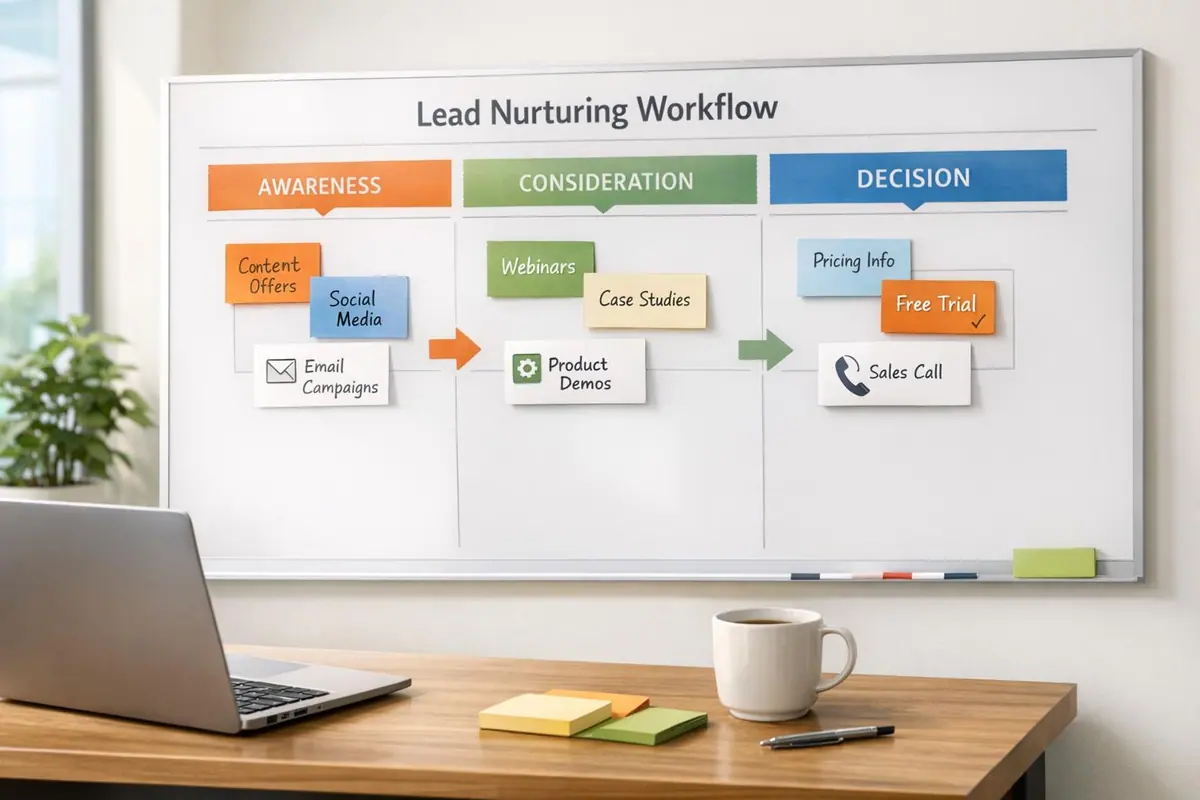
96% of website visitors aren’t ready to buy immediately. They’re researching, comparing, or just starting to define their problem. Ignoring these leads means missed revenue opportunities. That’s where lead nurturing workflows come in. These automated email sequences build relationships over time, guiding potential customers through their journey with the right content at the right moment.
Here’s the breakdown:
- Awareness Stage: Educate leads with welcome emails and topic-based content.
- Consideration Stage: Help leads compare options using case studies and product insights.
- Decision Stage: Encourage action with free trials, demos, and urgency-driven offers.
Companies that excel at nurturing see 50% more sales-ready leads while reducing costs by 33%. Start small: map your content to buyer stages, set triggers, and automate workflows. Tailored nurturing ensures your leads stay engaged and convert faster.
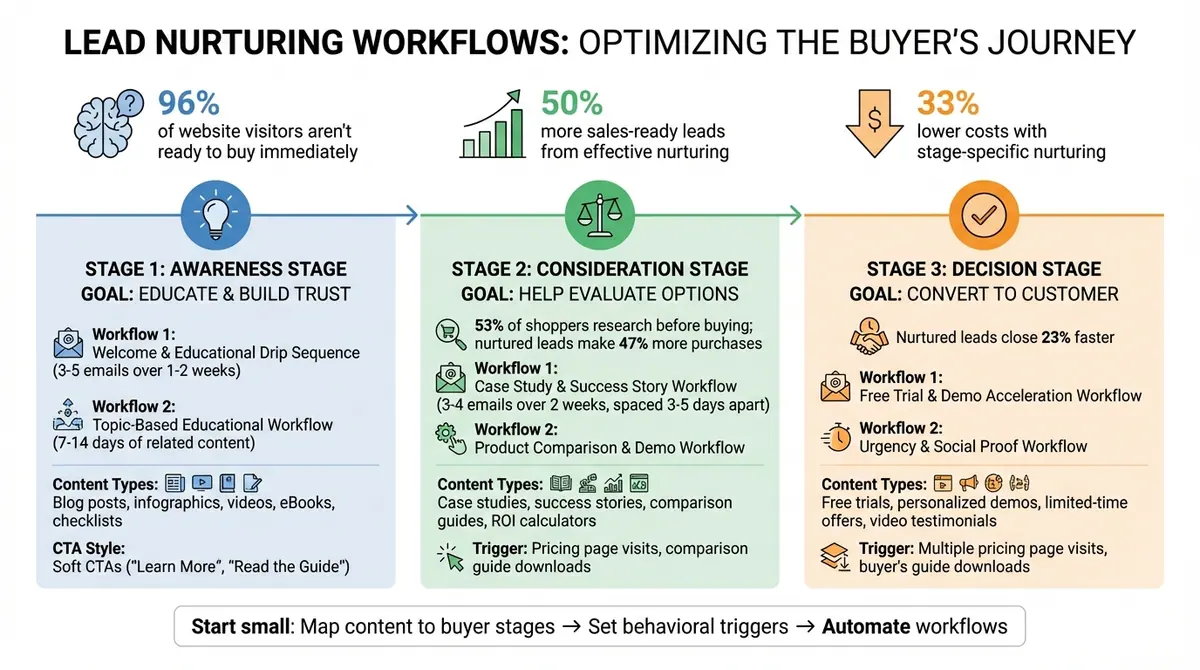
Lead Nurturing Workflow by Buyer Journey Stage
How Lead Nurturing Works (Automate!)
1. Awareness Stage
At this stage, potential leads acknowledge they have a problem and begin searching for solutions. As Tammy Duggan-Herd from HubSpot explains:
"The awareness stage is when people first recognize - or are prompted to recognize - their problem".
Your primary objective here isn't to sell anything. Instead, focus on educating your audience and building trust by positioning your brand as a reliable and helpful resource.
Welcome & Educational Drip Sequence
This workflow kicks off when someone subscribes to your content or completes a form on your website. It's crucial to engage these new subscribers right away. Tools like Reform's branded forms make integration with your marketing systems seamless. Amanda Meade from LeadG2 highlights the importance of this step:
"A personalized welcome email series is a great way to make a strong first impression".
Typically, this sequence includes 3–5 emails sent over a week or two. Start with a friendly welcome email that introduces your brand's mission and sets expectations for what your subscribers will receive. Follow up with educational materials like blog posts, infographics, or videos. Use soft calls-to-action (CTAs) such as "learn more" or "read the guide". This strategy allows leads to better understand their challenges while becoming familiar with your brand.
From here, you can expand into workflows triggered by specific content downloads to deepen the educational experience.
Topic-Based Educational Workflow
This workflow is activated when a lead downloads awareness-stage content, like a checklist, eBook, or whitepaper. As Molly Rigatti from SmartBug Media explains:
"The first download is an invitation to a conversation about how you can be the solution to the lead's challenge".
After the initial download, follow up with a series of related educational materials over the next 7–14 days. For instance, if someone downloads a guide on identifying productivity bottlenecks, you could send blog posts on time management, a video tutorial on optimizing workflows, or an interactive quiz to help them evaluate their current processes. The key here is segmentation - tailoring your follow-up content to align with the specific topic that initially caught their interest. This keeps the conversation relevant and gradually guides leads toward understanding potential solutions, all without rushing to sell your product.
2. Consideration Stage
After laying the groundwork in the awareness phase, the focus shifts to helping leads evaluate their options. At this stage, potential customers have identified their problem and are actively comparing solutions. Jeff Previte, Content Manager at Bluleadz, puts it this way:
"The consideration stage takes place when your leads start actively searching for solutions. You've likely gained a bit more information on leads in this stage, which can help inform how you tailor content to them".
This is the time to provide detailed evaluations and social proof to build trust. Research shows that 53% of shoppers always research a product or service before making a purchase. Additionally, nurtured leads make 47% more purchases than those who were not nurtured. Let’s dive into how case studies and product insights can guide these informed leads toward a decision.
Case Study & Success Story Workflow
When a lead shows clear intent - like visiting pricing pages multiple times or downloading a comparison guide - it’s time to focus on social proof. A great way to do this is by sending a series of 3–4 emails over two weeks, each featuring relevant success stories. For instance, if the lead works in healthcare, share case studies from similar healthcare organizations that have tackled comparable challenges.
Space these emails out every 3–5 business days to keep prospects engaged without overwhelming them. Each email should emphasize measurable results, such as time saved, revenue growth, or cost reductions. This approach taps into a key insight: over 90% of consumers say they would buy from a company they trust.
Product Comparison & Demo Workflow
This workflow is designed for leads actively comparing vendors. It’s triggered by behaviors like repeated visits to feature pages or downloads of ROI calculators. The goal is to provide comparison content that highlights what sets your solution apart from competitors.
Next, offer an invitation to a personalized demo or an interactive product tour. Tools like Reform’s multi-step forms with conditional routing can help qualify leads more effectively by tailoring questions to their specific needs. This ensures your sales team has the right context before engaging with the lead. Relevance is everything - generic outreach gets ignored. Every interaction should directly address the lead’s specific challenges and priorities.
sbb-itb-5f36581
3. Decision Stage
At this point, potential customers are ready to make a purchase. They’ve done their homework, weighed their options, and are now narrowing down their final choice. As Tammy Duggan-Herd from HubSpot puts it:
"The decision stage of the buyer's journey is when a person is just about ready to make a purchase... target sales qualified leads and past customers".
The goal here is to give them that final push to overcome any lingering hesitation and turn them into paying customers. This is where targeted workflows can make a big difference.
Free Trial & Demo Acceleration Workflow
This approach is perfect for leads who have shown strong interest by visiting your pricing page multiple times or downloading buyer’s guides. The idea is to let them experience your product firsthand through a free trial or a live demo. Start with an email offering immediate access to a trial or a demo tailored to their needs.
For example, PlanetTogether used automated workflows to shorten their sales cycle significantly - from 6–9 months down to just 3 months. To make the process seamless, use forms with conditional routing to collect essential details upfront. This allows your sales team to customize the demo experience for each lead. Tools like Reform can help streamline this step with no-code, customizable forms that make it easier to capture leads and boost conversions.
If some leads are still undecided, you can combine urgency with social proof to nudge them toward a decision.
Urgency & Social Proof Workflow
For leads who are still comparing options, a mix of limited-time offers and customer success stories can be highly persuasive. This workflow is triggered when a prospect engages with your content but hasn’t taken the final step. Pairing a time-sensitive discount with compelling video testimonials can encourage them to act.
True Classic, a menswear brand, uses this strategy effectively. When a lead views a product or adds it to their cart but doesn’t complete the purchase, an automated workflow sends a limited-time offer to motivate conversion. It’s worth noting that nurtured leads tend to close 23% faster than those who aren’t nurtured.
Conclusion
Lead nurturing plays a key role in staying competitive. Businesses that master stage-specific lead nurturing see impressive results - 50% more sales-ready leads at 33% lower costs. These numbers make it clear: tailoring your workflows to each stage of the buyer's journey isn't just helpful - it’s financially impactful.
The takeaway? Match your messaging to where your leads are in their journey. For awareness-stage leads, focus on education. Consideration-stage leads need solid evidence to evaluate their options. And for decision-stage leads, a well-timed demo or a limited-time offer can seal the deal. As Syed Ali Nemath from Pipedrive aptly puts it:
"If you are not nurturing your leads, you're leaving a lot of money on the table".
Begin by reviewing your current content and mapping it to the stages of the buyer's journey. Set up behavioral triggers - like when someone downloads a pricing guide or revisits your product page - and use lead scoring to prioritize high-intent prospects. Automation tools can simplify this process and help you focus on the leads that matter most.
Start small by implementing one workflow at a time. Whether it’s a welcome series or a free trial follow-up, test and refine your approach to improve conversions. From educational drip campaigns to accelerating demos, every stage can benefit from thoughtful automation. Tools like Reform can also make lead capture easier with customizable, integrated forms.
FAQs
How do I align my content with each stage of the buyer's journey?
To ensure your content aligns with the buyer's journey, focus on providing the right information at the right time as potential customers move through the awareness, consideration, and decision stages. Start by pinpointing the common questions and challenges your audience faces at each stage. For the awareness phase, create educational content such as blog posts, infographics, or videos to inform and attract. In the consideration phase, offer resources like case studies, webinars, or detailed guides to help prospects evaluate their options. When they reach the decision stage, prioritize actionable materials like product demos, free trials, or pricing sheets to encourage them to take the next step.
Once you’ve mapped out your content, use segmentation and automation to deliver it effectively. For instance, if a lead downloads a whitepaper during the awareness stage, follow up with an invitation to a related webinar that fits the consideration phase. Similarly, leads requesting a demo in the decision stage could receive personalized outreach with detailed pricing information to guide their decision-making process.
Keep a close eye on performance metrics like open rates, click-through rates, and conversions to fine-tune your strategy. If a piece of content isn’t resonating, experiment with adjusting its format, timing, or messaging to better address your audience's needs and help them move smoothly through their journey.
What are the best triggers to include in lead nurturing workflows?
Some of the best ways to kick off lead nurturing workflows are tied to specific actions or milestones, such as:
- Hitting an engagement score milestone - for example, when a lead opens or clicks on emails a certain number of times.
- Downloading gated resources, like eBooks, whitepapers, or case studies.
- Signing up for or attending events, whether it's a webinar or an in-person conference.
- Filling out forms, such as demo requests, pricing inquiries, or surveys.
- Updating their profile or showing new behaviors, like a change in job title, industry, or browsing habits.
These triggers let you send content that matches what your leads care about at the right time, keeping them interested and moving closer to making a purchase.
How do personalized demos and free trials improve lead conversion rates?
When it comes to turning leads into customers, personalized demos and free trials can make a huge difference. They give potential buyers the chance to try before they buy, letting them see the product in action and how it fits their unique needs. This hands-on experience not only shows the value of the product but also builds trust along the way.
By providing customized demos or risk-free trials, businesses can guide prospects through the decision-making process more smoothly. The result? Better-quality conversions and stronger, long-lasting customer connections.
Related Blog Posts
Get new content delivered straight to your inbox

The Response
Updates on the Reform platform, insights on optimizing conversion rates, and tips to craft forms that convert.

Drive real results with form optimizations
Tested across hundreds of experiments, our strategies deliver a 215% lift in qualified leads for B2B and SaaS companies.
