
.webp)
How to Match Content to Lead Nurturing Stages



Not all leads are ready to buy right away - 50% are qualified but need time. This is why aligning your content with each stage of the lead nurturing funnel is key to driving conversions. By delivering the right content at the right time, you can guide prospects from awareness to decision and increase sales opportunities by 20%.
Here’s the breakdown of content for each stage:
- Awareness Stage: Focus on education. Use blog posts, infographics, and whitepapers to help leads define their challenges without pushing a sales agenda.
- Consideration Stage: Build trust with case studies, webinars, and comparison guides to show how your solution stands out.
- Decision Stage: Address final doubts with free trials, live demos, and ROI-focused content to encourage action.
Key stats to note:
- Lead nurturing campaigns can achieve 4–10x higher response rates than standard email blasts.
- 80% of new leads fail to convert without proper nurturing.
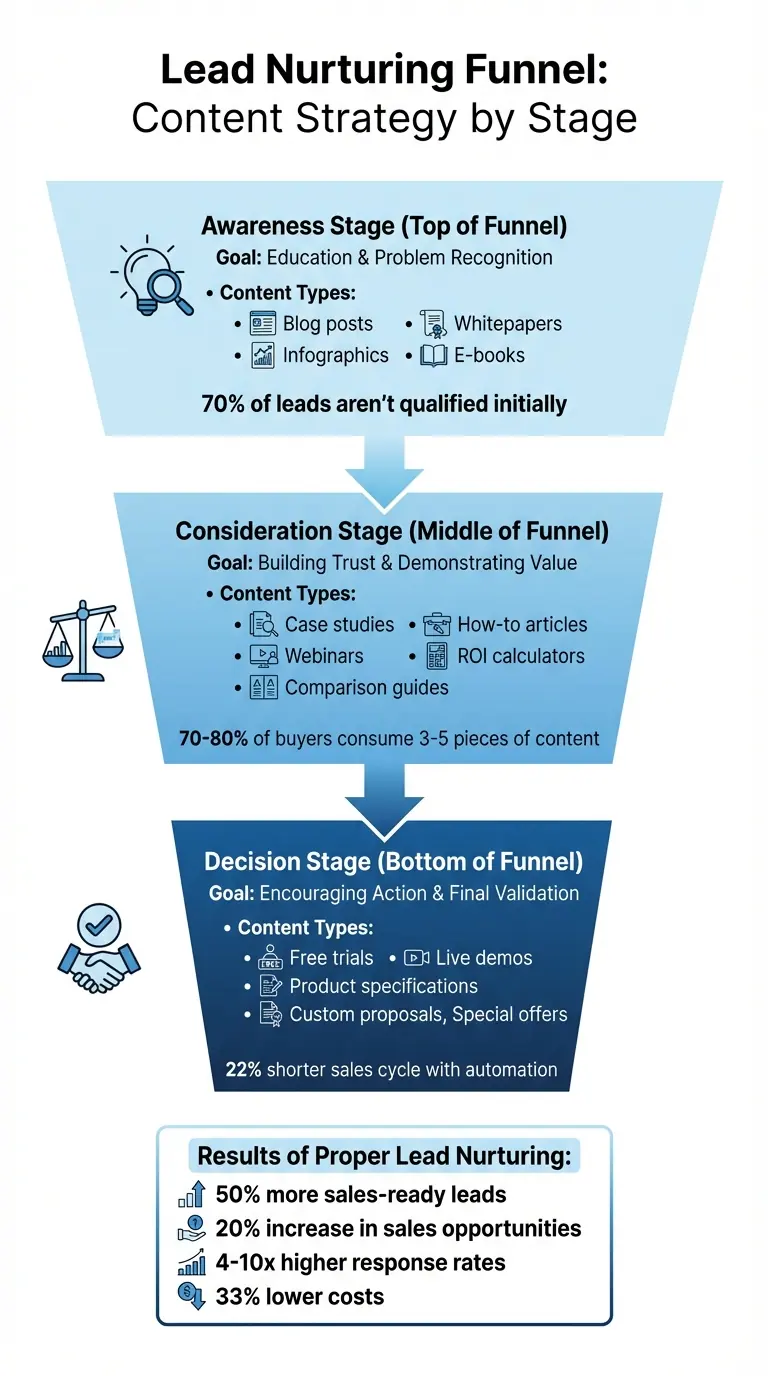
Lead Nurturing Funnel: Content Strategy by Stage
Convert more leads with email nurture campaigns
sbb-itb-5f36581
The Lead Nurturing Funnel Explained
The lead nurturing funnel is divided into three main stages: Awareness, Consideration, and Decision. Each stage reflects a different part of the buyer's journey, with specific informational needs and behaviors. Since 62.2% of B2B sales cycles span over two quarters, it’s clear that buyers take their time to evaluate options carefully.
During the Awareness stage (top of funnel), potential buyers start recognizing a problem or need. They’re focused on understanding their challenges and exploring potential solutions. At this point, they’re not ready for sales pitches - they’re looking for educational content to help them define their situation.
As leads move into the Consideration stage (middle of funnel), their focus shifts. They now have a clearer understanding of their problem and are actively researching solutions. This is when they start comparing products, reading case studies, and seeking evidence to build trust. As INFUSE puts it:
"Trust is a key goal of lead nurturing. By providing value and client centricity... you are more likely to build trust and yield greater performance".
Finally, in the Decision stage (bottom of funnel), buyers are ready to choose a vendor but may still have lingering doubts. They need content that reassures them - proof of ROI, detailed implementation plans, and answers to any final objections.
Creating content tailored to each stage is crucial. Corey Wainwright from HubSpot emphasizes:
"Mapping the most appropriate content to each stage in the buying cycle will help you speak to the individual needs of each lead so you're having the right conversation with the right people at the right time".
If content isn’t aligned, you risk overwhelming early-stage leads with pushy sales tactics or leaving decision-stage prospects without the specifics they need to move forward. This structured approach ensures you’re meeting leads where they are in their journey.
Awareness Stage: Building Initial Interest
At the Awareness stage, the focus is on education, not promotion. Leads are just starting to understand their challenges and aren’t ready to consider specific solutions yet. Your content should guide them toward identifying and articulating their problems without pushing a sales agenda.
Educational resources work best here. Think blog posts discussing industry trends, infographics highlighting common pain points, whitepapers offering in-depth research, or e-books providing comprehensive guides. As Ironpaper explains:
"Content at the awareness stage always should center around making the buyer more aware of their need or problem. This is never the time to educate on your solution - the buyer just isn't there quite yet".
Keep the barriers to engagement low. For example, using multi-step forms to ask only for an email address makes it easy for leads to access your content. This is important because 70% of leads that sales teams follow up on aren’t actually qualified. By focusing on education and patience, you lay the groundwork for stronger conversions later. Once leads have a solid understanding of their challenges, the next step is earning their trust with more solution-focused content.
Consideration Stage: Demonstrating Value
In the Consideration stage, leads are actively comparing solutions and evaluating vendors. They’ve identified their problem and are now looking for proof that your offering can deliver results. This is where trust-building becomes essential.
Content that works well at this stage includes case studies showcasing real customer success, webinars demonstrating expertise, comparison guides to evaluate options, and how-to articles featuring your product or service in action. For instance, Magic Software effectively used webinars to highlight software integration solutions after first providing educational content. By offering this type of content, you help leads feel more confident as they move closer to a decision.
Decision Stage: Encouraging Action
When leads reach the Decision stage, they’re almost ready to commit but may need a final push. They want specific product details, clear evidence of ROI, and reassurance that they’re making the right choice. Your content here should be direct and focused on driving action.
Examples of effective Decision-stage content include free trials, live demos, detailed product specifications, and custom proposals. Offering discounts or special deals can also help hesitant prospects take the final step.
A great example comes from EssayTigers, which implemented marketing automation to deliver targeted content at this stage. This strategy reduced their sales cycle by 22%, cutting the time from registration to first order from 4.35 weeks to 3.39 weeks. It also reduced support team costs by 29.5% through automated delivery of final educational materials. By addressing objections and validating choices, decision-stage leads convert faster and require less manual effort from your team.
Content Strategies for Each Lead Stage
Content for the Awareness Stage
At the top of the funnel, your content should aim to educate and engage without overwhelming potential leads. The goal here is to help them identify their challenges and explore solutions - without pushing a hard sell. Infographics are a great way to visually present industry trends, while whitepapers can showcase in-depth research and establish credibility. As Natallia Slimani from Traqq aptly notes:
"People may need your product but don't always realize it."
To maximize engagement, keep access easy. Start with ungated content like blog posts or social media updates to build trust and visibility. Once interest is piqued, gated content - like comprehensive reports or ebooks - can be used to gather contact details. You can also repurpose larger assets, such as whitepapers, into smaller formats like LinkedIn carousels or email snippets to reach a broader audience. Checklists and templates work well, too, as they provide immediate value and foster trust. Considering that 50% of leads are qualified but not yet ready to buy, patience and a helpful approach are key. Avoid overly promotional content, as it can turn potential leads away during this early stage of nurturing.
Content for the Consideration Stage
After capturing awareness, it’s time to focus on building trust and demonstrating value. At this stage, leads are evaluating solutions, so your content should provide clear, tangible proof of why your product or service stands out. Research shows that B2B buyers often consume 3–5 pieces of content during this phase, with webinars and case studies influencing up to 70–80% of purchasing decisions.
Case studies and webinars are especially effective tools here. They provide real-world examples and expert insights that help prospects see the potential benefits of your solution. Comparison guides are another valuable resource, offering a clear breakdown of how your offering stacks up against competitors. Tools like ROI calculators can also be a game-changer, as they allow leads to see measurable value upfront. Since nearly 59.5% of buyers consult with experts when evaluating options, featuring industry professionals in your webinars or content can significantly boost credibility and trust during this phase.
Content for the Decision Stage
At the decision stage, leads are close to making their final choice, and your content should help them feel confident about committing. Free trials, live demos, product sheets, and personalized consultations are all effective ways to address last-minute concerns and validate their decision. Behavioral triggers - like tracking visits to pricing pages or downloads of product data sheets - can help you deliver highly targeted content at just the right moment. This strategy pays off: nurtured leads are shown to generate a 20% increase in sales opportunities compared to those who aren’t nurtured.
To streamline the process, tools like Reform can help you create forms designed to capture detailed lead information, such as conditional routing and lead enrichment features. These details can be critical for equipping your sales team with the insights they need to close the deal. Pairing this targeted approach with automation tools ensures a smooth and efficient path to conversion.
Segmenting and Personalizing Content
To make your lead nurturing efforts more effective, segmenting and personalizing your content is crucial. By doing so, you ensure that every lead gets the right message at the right time. For instance, personalized emails can boost click-through rates by 14% and improve conversion rates by 10%. Additionally, companies that excel in lead nurturing see 50% more sales-ready leads while cutting costs by 33%.
Segmentation Techniques
Begin by dividing your leads into three main categories: demographics, behavior, and engagement levels.
- Demographics: This includes details like job title, seniority, industry, company size, and location.
- Behavior: Tracks actions such as the website pages they visit, links they click, and the content they download.
- Engagement levels: Uses lead scoring to identify where each prospect is in your sales funnel.
Instead of overwhelming potential leads with long forms upfront, try progressive profiling. Start by collecting basic details and gradually ask for more specific information over time. Including self-identification fields in forms - like asking prospects to select their role - can also enhance segmentation in your CRM system.
To make things easier, group leads by their stage in the funnel:
- New: Just entering the awareness stage.
- Cold: Contacted but showing no progress.
- Warm: Interested and actively considering options.
- Hot: Ready to make a purchase.
This kind of grouping helps you deliver the right content sequence to each lead, setting the stage for highly personalized messaging.
Personalization Strategies
Once your audience is segmented, personalization becomes the driving force for engagement. Tailor your content by adjusting its format, depth, tone, and language to suit different buyer personas. For example, advanced users may appreciate technical details and in-depth analysis, while beginners often prefer simplified summaries. As Pamela Vaughan from HubSpot explains:
"The most successful lead nurturing campaigns deploy content specifically tailored to the needs of different marketing personas, too."
Behavioral triggers are another powerful tool for personalization. For instance, if a lead visits your pricing page multiple times without taking action, you could send a personalized email offering a demo or consultation. Similarly, if they download a top-of-funnel resource like an ebook, enroll them in a related nurturing sequence automatically.
A real-world example of this comes from Tom Hag, email marketing manager at EssayTigers. In 2017, he used marketing automation to personalize the lead journey based on registration data. This approach shortened the sales cycle by 22% (from 4.35 to 3.39 weeks) and cut support costs by nearly 30%.
Tools like Reform can streamline this process by collecting detailed lead information through features like conditional routing and lead enrichment. When integrated with your CRM, these insights allow for hyper-personalized workflows at scale. And remember, personalization goes beyond just using someone’s name. Leverage CRM data to customize subject lines, content depth, and more. For example, a personalized subject line alone can increase email open rates by 50%. Combining these methods with automation tools ensures that your lead engagement remains optimized and effective.
Using Automation for Content Delivery
Automation relies on triggers to deliver content that's both timely and relevant. For example, if a lead downloads an ebook, visits your pricing page, or opens an email, automation tools can instantly follow up with content that matches their actions. This drip-style approach ensures leads receive messages when they’re most likely to engage.
Taking this a step further, dynamic tracking helps refine the lead journey. By adapting to a prospect’s behavior, automation can shift them into more relevant content paths. For instance, someone starting in an educational sequence might be moved to a product-focused track if they repeatedly visit your product pages. Crafting strong subject lines can significantly enhance the performance of these sequences.
At the core of effective automation is lead scoring, which works hand-in-hand with segmentation. By evaluating factors like demographics, engagement, and behavior, lead scoring ensures each prospect gets content suited to their stage in the funnel. For example, when a lead hits a specific score, automation can move them out of general nurturing and notify your sales team instead. This approach has proven results: companies using it generate 50% more sales-ready leads while cutting costs by 33%.
While email remains the backbone of automated nurturing, combining it with other channels can amplify impact. For example, you can structure retargeting ads in stages: start with a broad video ad, follow up with educational content for those who engage (like watching 50% of the video), and then deliver product-specific offers. Tools like Reform can seamlessly integrate enriched lead data into your CRM, ensuring smooth coordination across channels. The key is to maintain consistent messaging while tailoring each channel to its strengths.
To stay top-of-mind, schedule automated emails every 6–30 days. Early-stage emails can include "micro-CTAs", such as encouraging recipients to download a resource or watch a video, while later emails should feature stronger CTAs for leads ready to take the next step. Don’t forget to automate suppression for leads who have converted or those dealing with support issues. With these strategies, you can ensure every lead gets content that aligns with their journey through the funnel.
Measuring and Optimizing Your Content Strategy
To fine-tune your content strategy, it's crucial to track the right metrics at each stage of the funnel. During the awareness stage, focus on metrics like website traffic, social media engagement, and how many anonymous visitors convert into marketing qualified leads (MQLs). As prospects move into the consideration stage, pay attention to MQL-to-subscriber conversion rates, content downloads, webinar attendance, and lead acceleration. At the decision stage, key metrics include subscriber-to-customer conversion rates, demo requests, free trial sign-ups, and time-to-customer conversion.
While these numbers provide a solid foundation, understanding why users behave the way they do requires deeper analysis. Funnel analysis can help identify where users drop off in their journey. For instance, high unsubscribe rates or declining engagement might signal overly aggressive sales messaging or redundant content. Combining these metrics with tools like heatmaps (to see how far users scroll on landing pages), session replays (to identify friction points like "rage clicking"), and on-site surveys can offer valuable insights into user behavior.
Another effective tool for optimization is lead scoring. By evaluating factors like fit (demographics), interest (pain points), behavior (content interactions), and buying stage, you can pinpoint which content drives real progress. Companies using lead scoring systems experience a 30% increase in deal close rates, along with an 18% revenue boost and a 17% rise in revenue per deal. Once a lead's score indicates they're ready for sales, automation can move them out of nurturing and notify your sales team.
Looking beyond individual metrics, mapping user behavior across conversion paths can uncover opportunities for improvement. By analyzing the paths taken by converted leads, you can identify the most effective content and fill gaps in your library. For example, PathFactory took this approach to new heights by creating 27 distinct nurture streams. They built three product-specific modules, each with its own funnel-based stream, further divided into three "speed lanes" based on engagement data. While this level of complexity isn't necessary for everyone, understanding successful conversion paths can help you prioritize content promotion and identify areas needing attention.
Nurturing leads pays off, delivering 20% more sales opportunities, a 45% higher ROI, and 50% more sales-ready leads - all at 33% lower costs. Regularly tracking CPA and auditing content against buyer personas ensures you're spending wisely and addressing any content gaps.
Key Takeaways
Aligning your content with lead nurturing stages isn't just a smart move - it’s a proven way to boost revenue. Companies that excel in lead generation strategies see 50% more sales-ready leads at 33% lower costs, and nurtured leads generate a 20% increase in sales opportunities compared to those left unattended. When you deliver the right content at the right time, leads progress through your funnel faster and are more likely to buy.
Start by auditing your content library. Break it down into three categories: awareness (educational content), consideration (solutions-focused resources), and decision (validation materials) stages. This process helps you pinpoint gaps and prioritize where to create or improve content. Then, introduce lead scoring to track how prospects engage with your materials. Companies using lead scoring systems report a 30% increase in deal close rates and a 17% revenue boost.
Use automation to deliver personalized content at scale. Set up workflows triggered by specific actions, such as downloading a whitepaper or attending a webinar. Automated email campaigns can generate up to 30 times more revenue per recipient than one-off emails. For example, Tom Hag from EssayTigers implemented automation tailored to the customer journey, resulting in a 22% shorter sales cycle and a 29.5% drop in support costs.
Keep in mind that 70% of prospects aren’t ready to buy when they first provide their contact details. However, 80% of those who delay will convert within 24 months. Staying relevant during this waiting period is crucial. Go beyond basic personalization - recommend content based on the prospect’s industry, job role, or past interactions. This approach can boost click-through rates by 14% and conversion rates by 10%.
Finally, continuously track your performance to spot areas for improvement. Focus on key metrics at each stage: visitor-to-lead conversion rates during the awareness stage, content engagement (like downloads or webinar attendance) during the consideration stage, and actions like demo requests or trial sign-ups in the decision stage. Regular audits ensure your efforts remain effective and prevent missed opportunities caused by content gaps.
FAQs
How do I segment leads to deliver personalized content effectively?
To effectively organize your leads, start by gathering essential data such as demographics (like job titles or industries) and behavioral insights (like pages visited or forms completed). Tools such as Reform can be incredibly helpful, allowing you to design multi-step forms with conditional logic to effortlessly collect this information. Once you have the data, group leads into segments based on shared traits - think categories like "decision-makers" or "early-stage researchers."
After segmenting, align these groups with their position in the buyer's journey. For instance, leads in the awareness phase might find educational blog posts useful, while those nearing a decision could benefit more from product demos or ROI calculators. By customizing content to match each segment's specific needs, you create experiences that are both relevant and engaging.
Don't forget to regularly update your segments. Monitor real-time actions like email opens or resource downloads to track shifting interests. Adjust segments as leads display new behaviors, ensuring they consistently receive messages that resonate with their current intent.
What are the best ways to use automation effectively in lead nurturing?
Automation plays a key role in keeping leads engaged and guiding them efficiently through the nurturing process. Start by setting up automatic routing of new submissions directly to your CRM or marketing platform as soon as they’re captured. This not only ensures accurate data but also prevents leads from going stale. Use segmentation to group leads based on factors like industry, role, or behavior, and trigger personalized email sequences tailored to where they are in their journey.
Leverage lead scoring to identify signals that indicate high intent, then automatically move those prospects into the next workflow. Multi-step, conditional paths can help deliver the right content at the right moment, boosting response rates while keeping costs in check. For example, tools like Reform’s no-code, multi-step forms allow you to capture high-quality leads with built-in validation before they’re funneled into your automation.
Keep refining your workflows by experimenting with email frequency, tweaking subject lines, and optimizing calls-to-action. Regularly validate email addresses and clean up duplicates to maintain a clean database. Lastly, make sure all automations align with U.S. privacy regulations, integrate smoothly with your CRM, and include monitoring tools to spot and fix bottlenecks - helping you achieve stronger conversion rates.
How can I track the success of my content strategy at each lead nurturing stage?
To gauge how effective your content strategy is, tie specific metrics to each phase of the lead nurturing process. At the awareness stage, pay attention to indicators like page views, time spent on the page, social shares, and click-through rates. These metrics show whether your content is catching the attention of the right audience and keeping them engaged. Moving into the consideration stage, focus on lead-quality markers such as form submissions, content downloads, and email open rates. These signals reveal if your audience finds your material useful and relevant. Finally, at the decision stage, track conversion-focused metrics like demo requests, trial sign-ups, and closed deals to see how well your content is driving purchasing decisions.
For a broader perspective, consider using a dashboard to monitor key performance indicators (KPIs) across all stages and compare these to your benchmarks. If you're leveraging Reform forms, its real-time analytics can be especially helpful for tracking conversions and spotting where leads might drop off in the funnel. Make it a habit to review your metrics regularly, calculate conversion rates between stages, and tweak your content strategy based on the patterns you observe.
In addition to the numbers, incorporate qualitative feedback, such as survey responses or insights from your sales team. This blend of data and human input helps uncover why some content resonates more than others. By taking this well-rounded approach, you can fine-tune your strategy to drive better engagement and higher revenue.
Related Blog Posts
Get new content delivered straight to your inbox

The Response
Updates on the Reform platform, insights on optimizing conversion rates, and tips to craft forms that convert.



Drive real results with form optimizations
Tested across hundreds of experiments, our strategies deliver a 215% lift in qualified leads for B2B and SaaS companies.
