
.webp)
How to Map Buyer Journeys to Lead Stages


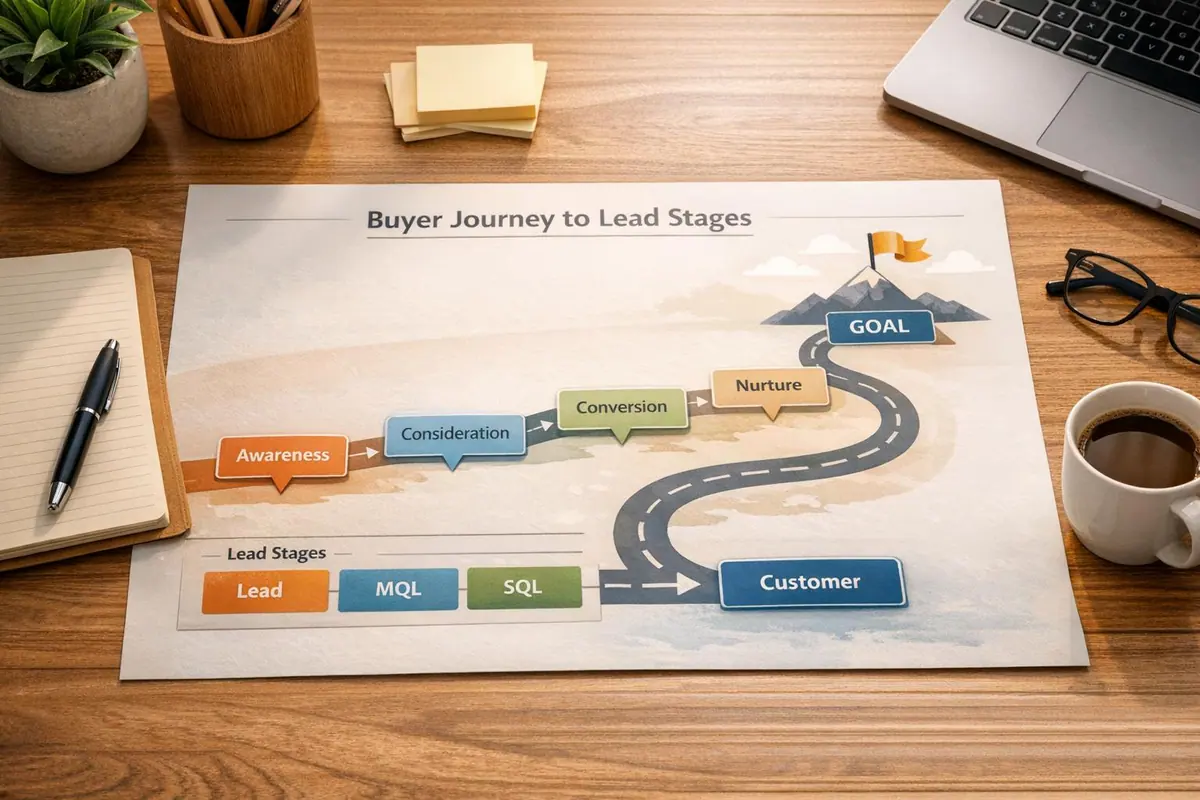
Want better results from your lead nurturing efforts? The key is aligning buyer journeys with lead stages. Most marketers lose opportunities by sending the wrong message at the wrong time. But when you match your outreach to where a lead is in their journey, you can:
- Increase email response rates by 4–10x.
- Prevent 40–70% of potential sales from slipping away.
- Boost ROI by 45% and sales opportunities by 20%.
Here’s the bottom line: Buyers need different types of content at each stage of their journey. For example:
- Awareness Stage: Leads want educational resources like blogs or ebooks.
- Consideration Stage: They’re comparing options and need webinars or case studies.
- Decision Stage: They’re ready to buy and look for demos or pricing details.
This guide explains how to map buyer actions to lead stages, create tailored content, and automate the process to build trust and close more deals.
Understanding Buyer Journeys and Lead Stages
What Are Buyer Journeys?
The buyer journey represents the steps a customer takes from identifying a problem to finding the best solution. As Justina Thompson from HubSpot explains:
"The buyer's journey describes a buyer's path to purchase... buyers don't wake up and decide to buy on a whim".
This process unfolds in three key stages: Awareness, Consideration, and Decision. Each stage reflects what the customer is thinking, feeling, and doing at that moment. Unlike your internal sales process, the buyer journey is entirely customer-focused, ensuring their needs and perspectives take center stage.
What Are Lead Stages?
Lead stages, on the other hand, are more about your business. They serve as a framework for tracking prospects as they move closer to making a purchase.
These stages are business-focused, marking internal milestones like when a lead becomes a marketing-qualified lead (MQL) or a sales-qualified lead (SQL). The goal is to determine when a lead is ready to transition to your sales team. As defined by Brian Carroll:
"I define lead nurturing as consistent and meaningful communication with viable potential customers regardless of their timing to buy".
| Stage | Customer Journey | Business Perspective | Content Examples |
|---|---|---|---|
| Awareness | Recognizing a problem or need and starting research | TOFU: Attracting and converting anonymous visitors | Blogs, Infographics, E-books, Social Media |
| Consideration | Defining the problem and exploring solutions | MOFU: Qualifying leads and building purchase intent | Webinars, Case Studies, Comparison Guides |
| Decision | Evaluating vendors and making a purchase decision | BOFU: Passing qualified leads to sales for closing | Demos, Free Trials, Consultations |
Next, we’ll dive into why aligning these customer-focused and business-focused models is so important.
Why Aligning Buyer Journeys with Lead Stages Matters
Once you understand both buyer journeys and lead stages, the next step is bringing them together. Aligning these frameworks ensures your prospects get exactly what they need, when they need it. This prevents common missteps, like sending educational content to someone ready to buy or pushing a demo on someone still exploring their options.
The benefits are clear. 67% of B2B marketers reported at least a 10% increase in sales opportunities through lead nurturing, with 15% seeing increases of 30% or more. Moreover, marketing teams that use lead nurturing campaigns achieve a 45% higher ROI compared to those that don’t.
But it’s not just about numbers - it’s about trust. Michael Brenner puts it best:
"Most economic buyers evaluate you based on: 'How you sell me indicates how you will serve me'".
Why Is The Buyer's Journey Important For Lead Nurturing?
Step 1: Gather and Analyze Customer Data
To map buyer journeys to lead stages, you first need a clear understanding of your buyers - who they are, what they want, and what influences their decisions. This begins with gathering data from various sources and analyzing it to uncover meaningful insights.
Where to Find Customer Data
Customer data comes from a variety of places. Your CRM is a great starting point for core details like job titles, company size, and purchase history. Email tools provide engagement metrics, while GA4 offers insights into visitor behavior and the channels they use.
Direct feedback from interviews, surveys, and focus groups can reveal the motivations behind customer actions. Don’t overlook your sales and support teams - they hear recurring objections, questions, and pain points firsthand. Competitive research, such as analyzing competitor audiences or testing their lead forms, can also shed light on buyer expectations.
Another often-missed goldmine is lost opportunities. As LeanLabs notes:
"The negatives in their experience with your brand are the most valuable pieces of information you can glean from these interviews".
Speaking with prospects who chose not to buy can highlight friction points you might not have noticed otherwise. By combining all these insights, you can create a detailed picture of your buyer's journey.
Building Buyer Personas
Once you’ve collected diverse data, the next step is to refine it into actionable buyer personas. These aren’t just demographic snapshots - they’re detailed profiles that include responsibilities, challenges, decision-making criteria, and common objections. In B2B contexts, it’s helpful to define roles like decision-makers, technical evaluators, users, and financial gatekeepers.
Adele Revella, CEO of the Buyer Persona Institute, underscores the importance of staying focused:
"The purpose of buyer personas is to help marketers understand the buyer's attitudes, questions, and concerns at each of the defining moments in their journey. Without this focus, marketers build too many personas that deliver almost no value".
To make personas relatable, assign each one a name and photo. Revisit and update these profiles yearly to keep pace with changing buyer needs. Well-crafted personas are essential for mapping buyer actions to lead stages with precision.
Step 2: Map Buyer Actions to Lead Stages
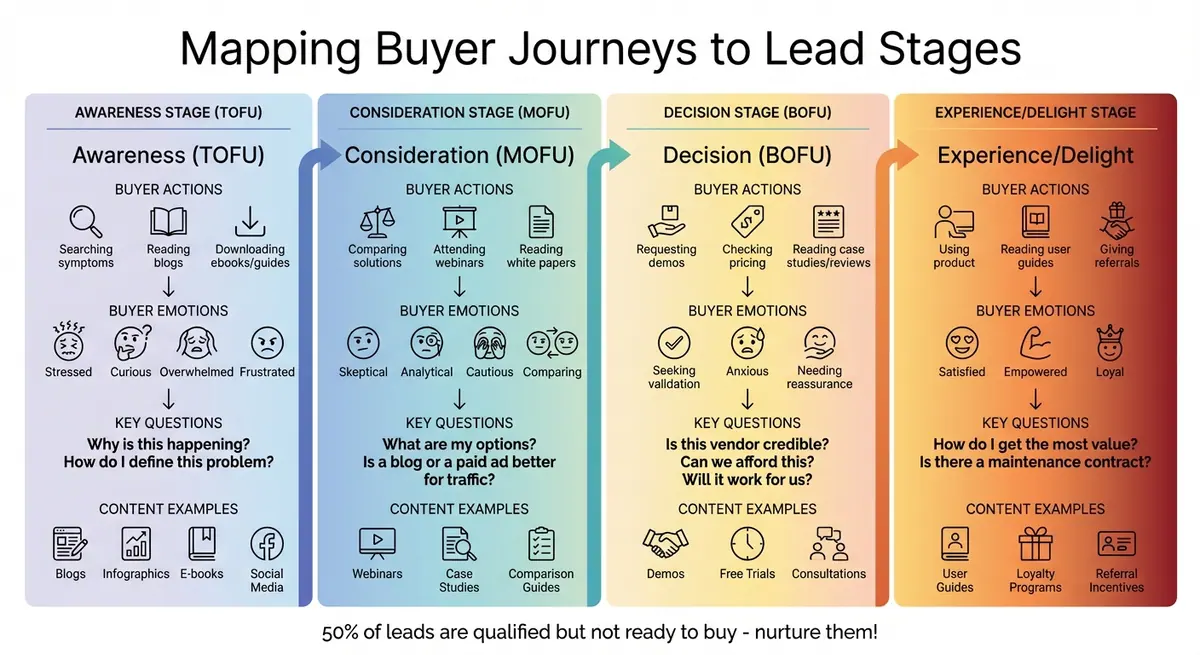
Buyer Journey Stages: Actions, Emotions, and Content Mapping Guide
Once you've built your buyer personas, the next step is to connect buyers' actions with their position in the purchasing journey. By mapping these actions, you can uncover their motivations, emotions, and key questions at each stage.
Identifying Buyer Actions and Motivations
Different actions reflect varying levels of interest or intent. For example, someone casually reading a blog post is in a much earlier stage than someone requesting a product demo. The trick lies in recognizing these signals and interpreting what they mean.
Start by analyzing closed deals to identify common patterns. Dive into your CRM to trace the activity history of your current customers: Which pages did they visit? In what order? What offers or calls-to-action did they engage with before making a purchase? This backward analysis highlights the real journey your successful buyers took.
Pay close attention to "micro-yeses" - small, incremental actions like subscribing to your newsletter, downloading a checklist, or registering for a webinar. These seemingly minor commitments indicate growing interest and intent. On the other hand, high-commitment actions - such as requesting a demo, signing up for a free trial, or visiting your pricing page - signal serious buying intent. These actions often require more time or personal information, making them strong indicators of readiness.
Tailor your content to match the buyer's stage. Educational content works well for the Awareness stage, while solution-focused resources are better suited for the Consideration stage.
To refine this process, consult your sales team. Ask them about common friction points and triggers they encounter. Which content pieces help move prospects forward? What are the most frequently asked questions at each stage? These insights will help you fine-tune your approach.
Using a Mapping Framework
Once you've gathered insights on buyer actions, organize them into a structured framework. A clear framework ensures everyone on your team understands what buyers need at each step of their journey.
Here’s a breakdown of how buyer actions align with lead stages, along with the emotions and questions driving those actions:
| Lead Stage | Buyer Actions | Buyer Emotions | Key Questions |
|---|---|---|---|
| Awareness | Searching symptoms, reading blogs, downloading ebooks/guides | Stressed, curious, overwhelmed, frustrated | "Why is this happening?" "How do I define this problem?" |
| Consideration | Comparing solutions, attending webinars, reading white papers | Skeptical, analytical, cautious, comparing | "What are my options?" "Is a blog or a paid ad better for traffic?" |
| Decision | Requesting demos, checking pricing, reading case studies/reviews | Seeking validation, anxious, needing reassurance | "Is this vendor credible?" "Can we afford this?" "Will it work for us?" |
| Experience/Delight | Using product, reading user guides, giving referrals | Satisfied, empowered, loyal | "How do I get the most value?" "Is there a maintenance contract?" |
Understanding the emotions tied to each stage is just as important as identifying the actions. For instance, someone in the Awareness stage might feel overwhelmed and confused, while a buyer in the Decision stage is likely anxious and looking for reassurance. Use this emotional insight to shape your messaging. Awareness-stage content should be calming and educational, while decision-stage materials should focus on proof points, such as case studies or testimonials.
To streamline data collection, use progressive profiling. Begin with simple, low-commitment questions like name and email during the Awareness stage. Save more detailed questions - such as budget or project timeline - for later stages, once trust has been established. This gradual approach reduces the risk of form abandonment.
Keep in mind that about 50% of leads are qualified but not immediately ready to buy. Your framework should include nurture tracks to engage these "not yet ready" leads. By staying on their radar, you'll ensure they think of your brand when they’re ready to move forward. This approach prevents qualified prospects from slipping through the cracks just because their timeline doesn’t match your sales cycle.
sbb-itb-5f36581
Step 3: Create Content and Touchpoints for Each Stage
Once you've mapped buyer actions to lead stages, the next step is to craft targeted content that directly addresses their stage-specific questions. This approach helps bridge the gap between understanding buyer behavior and selecting the right communication channels.
Content Types for Each Lead Stage
Your content should align with the mindset and needs of buyers at each stage. Research indicates that the average consumer reads 11.4 pieces of content before making a purchase decision, and 95% of B2B buyers trust content as a reliable source when evaluating companies.
Awareness stage content is all about education. At this point, buyers are identifying their problem and looking for answers. Around 86% of customers conduct non-branded searches during this phase, meaning they’re searching for solutions, not specific companies. Create content like blog posts, how-to videos, infographics, and educational ebooks that address their pain points and questions. Titles with phrases like "how to" or "troubleshoot" can help match their search intent.
Consideration stage content takes a solution-oriented approach. Buyers now understand their problem and are exploring potential ways to solve it. This is where you can introduce expert webinars, comparison whitepapers, checklists, quizzes, and product demos. Use titles with terms like "best tools" or "solutions" to resonate with their intent. Many companies excel at creating awareness and decision-stage content but often overlook the need for middle-of-funnel resources.
Decision stage content focuses on building trust and providing reassurance. Case studies, testimonials, ROI calculators, product spec sheets, and FAQ pages can help address objections and prove your solution’s value. Titles with words like "compare" or "reviews" can be particularly effective. In B2B scenarios, where decisions are often made by committees, ensure your content is easy for your primary contact to share with stakeholders.
Here’s a practical tip: Work backward to ensure your content flows logically. Start by creating decision-stage materials, then move on to consideration and awareness-stage assets.
"Content mapping is the process of delivering the right content, to the right people, at the right time." - HubSpot
Don’t forget the post-purchase "delight" stage. Offer guides, loyalty perks, or other resources to keep customers engaged. Happy customers often become advocates, leading to referrals and repeat business.
Choosing the Right Engagement Channels
Once your content is tailored to each stage, it’s time to deliver it through the channels your buyers use most.
For the awareness stage, focus on platforms that align with early research habits. With 94% of internet searches happening on Google or Google-owned properties, SEO-optimized blog posts are a must. Social media platforms like LinkedIn, Instagram, and Twitter are also great for sharing educational content in a low-pressure environment.
The consideration stage calls for more direct engagement. Email nurturing campaigns can achieve response rates 4 to 10 times higher than standard email blasts. Webinars are another effective way to showcase expertise in real time. Additionally, industry publications, trade shows, and retargeting ads can keep your solution top-of-mind as buyers evaluate their options.
At the decision stage, shift to high-commitment channels like direct sales consultations, personalized demos, and one-on-one calls. Your website’s pricing and demo pages become critical touchpoints. Exit-intent popups can also capture leads on the verge of leaving. For example, Medstar Media used exit-intent popups and targeted onsite retargeting to boost client conversions by 500%, generating millions in additional revenue.
To find the most effective channels for your audience, analyze the activity history of your current customers. Identify where they first engaged and the sequence of touchpoints that led to a sale. Conversations with your sales and support teams can also uncover common engagement patterns and frequently asked questions.
One example: Magic Software successfully guided leads from awareness to purchase using a five-step email nurturing sequence. It started with a whitepaper download (awareness), followed by an invitation to an educational Resource Center, then offered software integration webinars (evaluation), provided product documentation, and finally invited leads to product training (purchase). Each step had a clear purpose and encouraged the next action.
Keep in mind that buyer journeys aren’t always linear. Prospects may skip stages, move backward, or start over entirely. Your multichannel strategy should ensure that relevant information is always accessible. For instance, if someone lands directly on your pricing page without reading your blog, they should still find the answers they need.
"There's the journey that someone takes through your product. And then there's the journey that someone takes in their own real life outside of your product." - Aurelia Heitz, User Research and Strategy Expert, Centigrade
Finally, adjust your timing and frequency based on your sales cycle. A three-week decision process requires faster content delivery than a six-month cycle. Also, remember that about 50% of leads are qualified but not immediately ready to purchase. This makes nurturing campaigns essential for staying top-of-mind until they’re ready to move forward. By aligning your channels with the buyer journey, you can guide leads through each stage with precision.
Step 4: Implement and Automate the Process
Once you've mapped out your buyer journeys and crafted targeted content, automation can take your efforts to the next level. It ensures that every lead gets the right message at the right time, while freeing your team to focus on more strategic tasks.
Using Reform for Lead Capture and Routing
Reform’s multi-step forms make it easier to gather information while keeping the process smooth for your leads. Start with basic details like name and email, then use conditional logic to guide follow-up questions based on their responses.
For instance, if a prospect selects “just researching options,” Reform can tag them as being in the awareness stage. This triggers an automated workflow that delivers educational content over the following weeks. On the other hand, if they indicate they’re “ready to buy,” the system can notify your sales team immediately and fast-track them to a demo booking. By integrating Reform with your CRM and marketing automation tools, you can ensure that data flows seamlessly and no lead slips through the cracks.
Reform’s lead enrichment feature adds an extra layer of context by automatically appending company data and contact details to each submission. This helps you identify high-priority prospects and tailor follow-ups based on firmographic insights. Plus, features like spam prevention and email validation ensure you’re working with clean, actionable data.
With automation handling lead qualification and routing, your team gains actionable insights and more time to focus on closing deals. Once your lead capture process is running smoothly, the next step is keeping an eye on performance and fine-tuning your workflows.
Tracking and Optimizing Performance
Real-time analytics help you understand how leads interact with your funnel and where they drop off. Keep an eye on metrics like conversion rates, time-to-convert, and drop-off points to spot problem areas. For example, if many prospects abandon a form at a specific question, it might be worth simplifying or rephrasing it. Similarly, if leads aren’t moving from consideration to decision, it could signal the need to strengthen your middle-of-funnel content.
Set clear, measurable goals for each stage of your funnel, such as booking consultations or visiting pricing pages. Use form submissions or behavioral triggers to enroll leads in workflows, and set unenrollment rules to ensure they exit once they convert or meet your criteria. Adding short delays - like 3–5 business days - between touches can help maintain engagement without overwhelming your audience. For leads who complete a bottom-of-funnel workflow without converting, consider sending a final “break-up” email. This could acknowledge that the timing isn’t right and offer a low-pressure alternative, like subscribing to your blog.
Regularly auditing your workflows is essential for spotting bottlenecks and refining your approach. Remember, the goal isn’t perfection right away - it’s about learning from your data and continuously improving based on how your buyers actually behave.
Key Takeaways for Buyer Journey Mapping
Mapping buyer journeys to lead stages is a continuous process. Begin by creating detailed, data-backed buyer personas that reflect your prospects' main challenges and where they turn for information. From there, pinpoint every interaction prospects have with your brand - whether it’s a blog post or a social media ad during the awareness phase, or a product demo as they approach a decision.
Content is key at every stage. Early on, educational resources like blogs and infographics help prospects better understand their problems. As they compare solutions, tools like webinars and comparison guides step in to provide clarity. When they’re ready to decide, case studies and live demos often make the difference. This structured approach seamlessly integrates with the initial persona creation and data collection process. For example, a case study from OptinMonster shows how using targeted touchpoints and journey-specific triggers can lead to significant conversion rate improvements.
Once your mapping and content strategy are in place, automation can help you scale. Tools like Reform simplify lead management by automating tasks like lead capture and routing. Features such as conditional logic and lead enrichment allow you to tag leads based on their responses and instantly trigger the right nurturing sequence. This ensures prospects get the right message at the right time without overloading your team.
Keep in mind that buyer journey maps are not static. Update them quarterly to account for shifts in buyer behavior, evolving market conditions, and product updates. Metrics like conversion rates and drop-off points can reveal areas of friction in your funnel, emphasizing the need for consistent refinement.
Don’t aim for perfection from the start. Begin with one persona and one journey, then expand as you gather insights. As Tristen Taylor from HubSpot aptly puts it:
"The actual value of a buyer journey map comes from how you use it to drive action".
FAQs
What’s the best way to collect and analyze customer data for mapping buyer journeys?
To map buyer journeys effectively, start by gathering detailed customer data from every interaction with your brand. Use tools like website analytics to monitor page views, time spent on site, and exit rates. Your CRM can provide valuable insights, such as job titles, company sizes, and deal stages. Multi-step forms are another great way to capture richer lead details in real time, while surveys and polls can help fill in any demographic gaps. By centralizing all this data, you can uncover patterns, segment your audience, and pinpoint where leads tend to drop off in the funnel.
Once you've collected the data, analyze it by aligning customer actions and emotions with the stages of their journey - awareness, consideration, and decision. Pay close attention to metrics like conversion rates, deal sizes, and time-to-close. Tools like Reform can make this process easier with features like conditional routing and lead enrichment, which help tag leads by stage and improve data accuracy. Integrating these insights into your CRM or analytics dashboards enables you to refine your buyer journey map over time, making lead nurturing strategies more effective.
What types of content work best for each stage of the buyer journey?
At the Awareness stage, buyers are just beginning to realize that they have a problem or need. This is the time to offer educational and easy-to-understand content that introduces the issue while positioning your brand as a reliable resource. Think blog posts, short and engaging videos, infographics, social media tips, or downloadable guides that provide value without overwhelming them.
When buyers reach the Consideration stage, they’re actively exploring potential solutions. Here, you’ll want to deliver more in-depth content that helps them weigh their options. Examples include eBooks, webinars, step-by-step how-to guides, comparison charts, and case studies that highlight real-world success stories.
By the Decision stage, buyers are ready to make their choice. This is where you showcase your product’s value and reliability. Content like product demos, free trials, pricing sheets, customer testimonials, and detailed case studies with measurable outcomes can help seal the deal.
Tailoring your content to these stages ensures you’re meeting buyers where they are and guiding them toward becoming loyal customers.
How does automation help align buyer journeys with lead stages?
Automation keeps a buyer’s journey aligned with their lead stage by dynamically updating their status based on real-time actions. Imagine this: a prospect visits your pricing page, downloads a resource, or completes a multi-step form. Instead of relying on manual updates, automation steps in to instantly adjust their lead stage. This ensures marketers can deliver the right content at the right time, minimizing the chances of sending outdated or irrelevant messages.
Here’s how automation tools make this happen:
- Triggering workflows: Automation moves leads through stages - like shifting someone from "Subscriber" to "Marketing Qualified Lead" - based on actions such as form submissions or email clicks.
- Instant data syncing: Leads captured through tools like Reform are immediately enriched and routed to CRMs or marketing platforms, ensuring up-to-date information flows across systems.
- Conditional logic: Forms can qualify leads on the spot, assigning them to the right nurture streams based on their responses.
By responding to buyer behaviors in real time, automation creates smooth, personalized experiences that not only engage prospects but also boost conversion rates.
Related Blog Posts
Get new content delivered straight to your inbox

The Response
Updates on the Reform platform, insights on optimizing conversion rates, and tips to craft forms that convert.


Drive real results with form optimizations
Tested across hundreds of experiments, our strategies deliver a 215% lift in qualified leads for B2B and SaaS companies.
