
.webp)
8 Legal Risks of Ignoring Cookie Regulations



Ignoring cookie regulations can cost your business - big time. From massive fines to reputational damage, non-compliance with cookie laws like GDPR, CCPA, and others can have severe consequences. Here’s what you need to know:
- Fines are steep: GDPR fines can reach €20 million or 4% of global revenue. In the U.S., CCPA violations cost up to $7,988 per user.
- Class action lawsuits: Non-compliance opens the door to lawsuits under privacy and wiretapping laws, with damages up to $10,000 per violation.
- Executive accountability: Business leaders can face personal liability for deliberate misconduct.
- Reputation loss: Privacy breaches erode customer trust, pushing users toward competitors.
- Operational disruptions: Regulators can force businesses to halt non-compliant operations, including disabling tracking tools.
- Statutory damages: Fixed penalties apply even without proof of harm, adding to financial risks.
- State enforcement: U.S. attorneys general are ramping up investigations, even in states without privacy laws.
- Cross-border data issues: Transferring user data outside the EU without safeguards can trigger hefty penalties.
Key takeaway: Compliance costs are far lower than the risks. Regular audits, clear consent mechanisms, and proper data handling are essential to avoid legal and financial fallout.
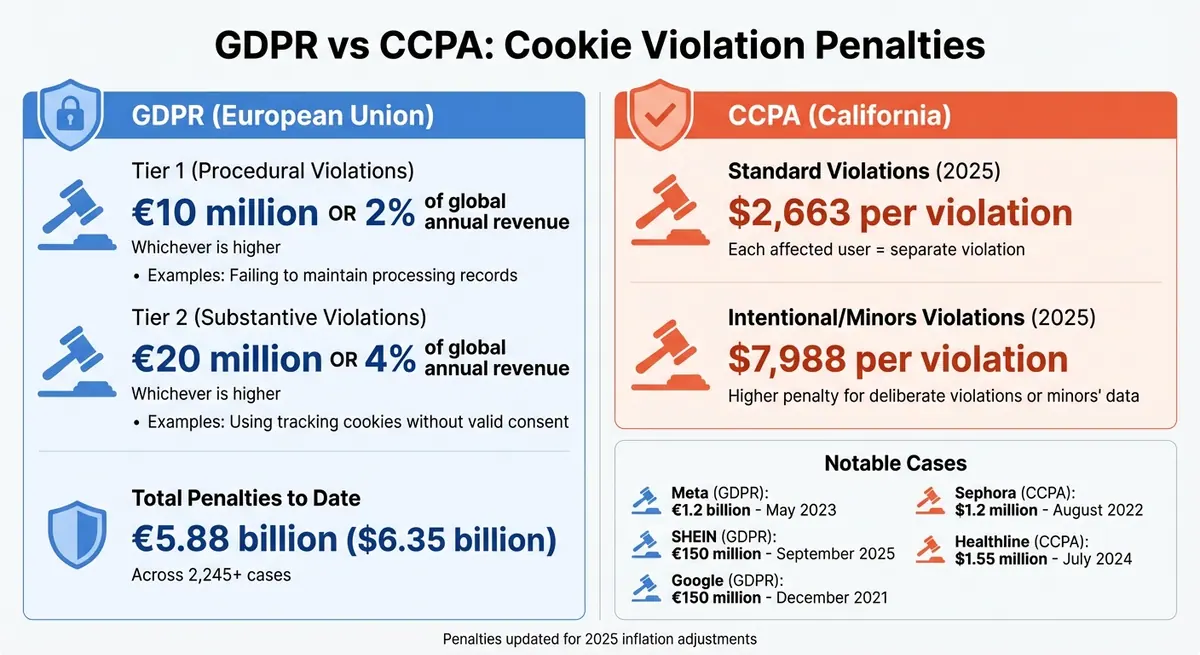
GDPR vs CCPA Cookie Violation Penalties Comparison 2025
Cookie Law in 2025 What enforcement means for your organisation
sbb-itb-5f36581
1. Heavy Regulatory Fines
Regulators in both the U.S. and Europe are ramping up penalties for cookie-related violations, and the numbers are staggering.
Under GDPR, fines are divided into two tiers. Tier 1 violations, like failing to maintain proper processing records, can result in penalties of up to €10 million ($10.8 million) or 2% of global annual revenue, whichever is higher. Tier 2 violations, such as using tracking cookies without valid consent, are even steeper - up to €20 million ($21.6 million) or 4% of global annual revenue, whichever is greater. As of early 2025, GDPR penalties have already exceeded €5.88 billion ($6.35 billion) across more than 2,245 cases.
Some high-profile cases illustrate the seriousness of these fines. In May 2023, Meta Platforms was fined €1.2 billion ($1.3 billion) by the Irish Data Protection Commission for transferring Facebook user data to the U.S. without sufficient safeguards. Similarly, France's CNIL fined SHEIN €150 million ($162 million) in September 2025 for installing cookies without user consent and providing a faulty "Reject all" button. Even earlier, in December 2021, Google faced a €150 million fine for making it unnecessarily complicated for users to refuse cookies.
In the U.S., the California Consumer Privacy Act (CCPA) takes a different approach, enforcing fines on a per-violation basis. Each affected user counts as a separate violation, with 2025 inflation-adjusted penalties set at $2,663 per standard violation and $7,988 for intentional violations or those involving minors' data. For example, Sephora settled for $1.2 million in August 2022 after failing to honor Global Privacy Control (GPC) opt-out signals and not disclosing its sale of personal data through third-party trackers. In July 2024, Healthline paid $1.55 million for allowing trackers to collect sensitive health-related search data without proper disclosure.
Here’s a quick breakdown of these penalties:
| Law | Violation Type | Maximum Penalty |
|---|---|---|
| GDPR | Tier 1 (Procedural) | €10M or 2% of global annual turnover |
| GDPR | Tier 2 (Substantive) | €20M or 4% of global annual turnover |
| CCPA | Standard (2025 Adjusted) | $2,663 per violation |
| CCPA | Intentional/Minors (2025 Adjusted) | $7,988 per violation |
2. Class Action Lawsuits
Non-compliance with cookie regulations doesn't just result in fines - it also opens the door to class action lawsuits that can be just as costly, if not more so.
These lawsuits are often brought by groups of users who claim their data was collected without proper consent. Plaintiffs rely on claims like unlawful wiretapping, fraud, or breach of contract to demand statutory damages for unauthorized data collection.
For example, recent cases in the Northern District of California have highlighted how ineffective consent mechanisms can lead to legal trouble. In these cases, plaintiffs argued that clicking "Reject All" did not actually stop third-party tracking by companies like Adobe, Google, and Microsoft. As a result, lawsuits were filed under laws like the California Invasion of Privacy Act (CIPA) and the federal Wiretap Act. These lawsuits sought not only statutory damages but also restitution and the return of profits gained through the alleged unauthorized tracking.
The financial stakes are high. Violating CIPA can result in $5,000 per violation, while the federal Wiretap Act allows for damages of $10,000 or $100 per day for unauthorized interception.
Judges have also raised concerns about the use of tracking pixels, which can extract user data without consent. If a "Reject All" button doesn't completely stop tracking, businesses risk more than just regulatory penalties. The accumulation of statutory damages for every affected user can lead to massive legal exposure, making class action lawsuits a serious and growing threat.
3. Criminal Liability for Executives
When cookie violations escalate from negligence to deliberate misconduct, executives can face criminal charges. Federal law makes corporate officers personally accountable for crimes they commit, conspire to commit, or assist in committing, regardless of whether the corporation itself is penalized. These penalties often come in addition to corporate fines.
The Wiretap Act, for example, criminalizes the intentional interception of communications. Similarly, the VPPA (Video Privacy Protection Act) prohibits the knowing disclosure of personally identifiable information. Executives who allow tracking tools, like the Meta Pixel, to transmit user data without proper consent could find themselves personally liable.
The Responsible Corporate Official doctrine adds another layer of accountability. This principle holds executives criminally liable for failing to prevent or correct violations - even if they were unaware of the misconduct. A Congressional Research Service report explains:
"The 'responsible corporate official' doctrine... puts the burden of acting at hazard upon a person otherwise innocent but standing in responsible relation to a public danger."
Federal agencies are increasingly emphasizing executive accountability. They now consider an executive's specialized knowledge, awareness of any unlawful actions, and potential personal benefit from those offenses when determining liability. Starting in June 2025, the CFPB (Consumer Financial Protection Bureau) will issue guidance on handling "criminally liable regulatory offenses", highlighting a shift toward greater individual responsibility.
In today’s regulatory landscape, ignorance won’t shield executives from liability. To protect themselves, executives need to ensure that data collection practices are thoroughly documented, any intentional data sharing is backed by explicit user consent, and tracking technologies are not intercepting or disclosing data in unauthorized ways. Regular compliance training and technical audits are crucial steps for avoiding personal legal risks.
4. Damage to Brand Reputation
Non-compliance doesn't just hit a company’s wallet - it can also take a serious toll on its public image.
When privacy violations occur, they don’t just lead to fines; they damage the trust that customers place in a business. Today’s consumers are more aware of their data rights than ever before, and a company seen as careless with personal information risks losing both loyalty and long-term customer relationships. Once a business is publicly called out for non-compliance, it often appears as though it values data collection more than respecting user choice.
As Vanessa Thomas, Head of Development at WebSight Design, puts it:
"Trust rarely collapses overnight. It erodes gradually through accumulated opacity".
For example, using dark patterns - like pre-ticked consent boxes or making opt-out options difficult to find - signals a lack of respect for user autonomy. When such practices are exposed by regulators or the media, they further chip away at consumer trust.
The financial fallout from reputational damage doesn’t stop at regulatory fines. Privacy breaches often push customers toward competitors who are perceived as more transparent, leading to ongoing revenue losses. Additionally, when there’s a gap between a company’s stated privacy policies and its actual behavior - such as tracking users before they’ve given consent - it signals dishonesty. This kind of deception can severely tarnish a brand’s reputation.
Thomas emphasizes the importance of transparency:
"If your cookie strategy is engineered to collect as much data as possible without depressing conversion rates, you are optimizing for short-term performance. If it is engineered around clarity, restraint, and meaningful consent, you are investing in durable trust".
5. Forced Operational Shutdowns
Regulators don’t just stop at imposing fines when cookie regulations are breached - they can go a step further and enforce operational shutdowns. In cases of serious violations, authorities issue compliance orders that require companies to immediately halt specific data processing activities. This highlights how regulatory actions can impact not just finances but also the core operations of a business.
For example, regulators may demand the disabling of third-party tracking tools. A failure to implement tools like Google Consent Mode v2 could result in businesses losing access to critical digital marketing platforms. This could mean pausing digital campaigns or being entirely locked out of key advertising platforms.
A notable case occurred in July 2022, when the Danish Data Protection Authority banned the use of Google Workspace in Helsingør municipality. The authority determined that its data transfer practices conflicted with GDPR rules, forcing the municipality to stop using the software altogether. Similarly, in mid-2025, Finland’s Data Protection Ombudsman fined Yliopiston Apteekki, a pharmacy chain, €1.1 million. The chain was also required to remove Google Analytics and Meta Pixels after it was found tracking sensitive prescription-related data without proper consent.
These shutdowns don’t just disrupt operations - they ripple across the entire business. Resources that could fuel growth initiatives are instead allocated to compliance reviews and legal defenses. Marketing campaigns are delayed, product launches are postponed, and the loss of high-quality, consented first-party data weakens a company’s ability to compete effectively. This operational fallout only adds to the legal and reputational risks already at play.
Even technical missteps can lead to enforcement actions. For instance, simply displaying a cookie banner while allowing tracking scripts to run in the background is considered a violation. Regulators now use browser developer tools to ensure that scripts are genuinely blocked until consent is obtained - they no longer rely solely on the appearance of compliance.
6. Statutory Damages Without Proving Harm
Statutory damages bring a unique challenge to businesses by enforcing fixed penalties without requiring evidence of harm. This creates a significant financial risk for companies that fail to comply with cookie regulations or data privacy laws.
Under the California Consumer Privacy Act (CCPA), consumers can sue companies directly if their personal data is exposed in a breach caused by poor security practices. Here’s the kicker: consumers don’t need to prove they suffered identity theft, financial losses, or any other tangible harm to claim damages.
Starting in January 2025, statutory damages for CCPA breaches will range from $107 to $799 per consumer, per incident. For example, a breach affecting 50,000 California residents could result in damages nearing $40 million. If the breach involves 1,000,000 residents, the liability could soar to somewhere between $107 million and $799 million.
"Statutory damages for these breaches now range from $107 to $799 per consumer, per incident. You do not need to prove actual financial harm to claim these damages." – Kukie.io
The financial risk grows even more with cookie violations. If a single non-compliant tracking script impacts 1,000 California visitors, that’s considered 1,000 separate violations. This per-visitor calculation makes even small oversights a tempting target for class-action lawsuits, as plaintiffs don’t need to show actual harm to pursue claims.
One real-world example highlights the stakes: In February 2024, DoorDash agreed to a $375,000 settlement with the California Attorney General. The company was accused of sharing customer names, addresses, and transaction histories with a marketing cooperative without offering proper notice or an opt-out option. The Attorney General emphasized that DoorDash couldn’t "cure" the violation because the data had already been sold to third-party brokers.
This shows how even minor compliance failures can lead to massive financial and legal consequences.
7. State Attorney General Enforcement Actions
State attorneys general have taken an active role in enforcing cookie regulations, going beyond corporate fines and operational shutdowns to pursue targeted legal actions. This enforcement often relies on Unfair and Deceptive Acts and Practices (UDAP) statutes, even in states without comprehensive privacy laws. Companies with inaccurate cookie banners or flawed privacy controls are increasingly under scrutiny.
In July 2024, the New York Office of the Attorney General investigated 13 major e-commerce websites that collectively served 75 million visitors in March 2024. The investigation revealed that marketing tags continued to operate even after users opted out, and seven of these cases involved uncategorized tags. As a result, all 13 companies were required to update their privacy controls to align with New York's consumer protection laws.
"Statements about when and how website visitors are tracked should be accurate, and privacy controls should work as described." – Office of the New York State Attorney General
This investigation marked the beginning of a broader wave of enforcement actions. For example, in April 2025, Michigan's Attorney General filed a lawsuit against Roku, alleging that the company hid advertising opt-out options within a "Your privacy choices" section without providing clear instructions. This case highlighted that enforcement of cookie practices is not limited to states with specific privacy laws. Around the same time, California's Privacy Protection Agency reached a $632,500 settlement with Honda after finding that the company made it harder for users to reject cookies than to accept them, violating the principle of symmetry in cookie preferences.
Adding to the complexity, a bipartisan group known as the Consortium of Privacy Regulators, representing seven states (California, Colorado, Connecticut, Delaware, Indiana, New Jersey, and Oregon), has formed to address violations across state lines. This collaboration increases the likelihood of coordinated legal actions, making compliance even more challenging. These state-led efforts emphasize the growing risks companies face if they fail to meet cookie regulation standards.
8. Cross-Border Data Transfer Penalties
When cookies are triggered from servers outside the European Economic Area (EEA), it qualifies as a cross-border data transfer. According to GDPR Chapter V, transferring personal data - such as IP addresses, device IDs, and browser details collected by cookies - to countries lacking adequate data protection measures requires specific safeguards. Failing to meet these requirements can lead to fines of up to 4% of global annual revenue.
Recent high-profile cases illustrate how seriously these rules are enforced. In May 2023, Meta was fined €1.2 billion by the Irish Data Protection Commission for transferring EU Facebook user data to the United States. The company relied on Standard Contractual Clauses that were deemed insufficient to safeguard against U.S. surveillance. Meta was given five months to suspend these data transfers. Similarly, in May 2025, TikTok faced a €530 million fine for transferring EEA user data to China without conducting necessary Transfer Impact Assessments. Initially, TikTok claimed it did not store EEA data on Chinese servers, but this was later contradicted by its own disclosures.
Even common website tools aren’t exempt from scrutiny. In January 2022, the European Data Protection Supervisor found that the European Parliament violated data protection rules by using Google Analytics and Stripe cookies on a COVID-19 testing website. These cookies transferred personal identifiers to the U.S. without proper safeguards. The ruling clarified:
"tracking cookies are considered personal data, even if the traditional identity parameters of the tracked users are unknown".
The issue also affects U.S.-based companies, which face additional restrictions under Executive Order 14117. The U.S. Department of Justice limits the transfer of bulk sensitive data to countries like China, Russia, and Iran. Civil penalties can reach $368,136 per violation or double the transaction's value, while willful violations carry criminal fines of up to $1 million and prison sentences of up to 20 years. Ignorance of your vendor's data practices won’t shield your organization from these penalties.
To reduce these risks, take proactive steps:
- Map all cookies and scripts that transmit data outside the EEA.
- Confirm that U.S.-based services are certified under the EU-U.S. Data Privacy Framework.
- Conduct Transfer Impact Assessments for data transfers relying on Standard Contractual Clauses.
- Where feasible, encrypt data or store EU personal data within the EU.
Conclusion
Navigating cookie compliance isn’t just a box to check - it’s a legal necessity that can profoundly impact your business. The risks of non-compliance are steep. For instance, SHEIN faced a €150 million fine in September 2025, and small businesses can incur legal defense costs between $20,000 and $25,000 when targeted by lawsuits.
Regulations are becoming tougher. Over 20 U.S. states now enforce privacy laws, while European regulators are using automated tools to monitor websites for violations. These authorities stress that cookie consent must be a real, active choice - not just a superficial checkbox.
A cookie banner isn’t just a visual element - it’s a compliance safeguard. It must block all non-essential scripts until users explicitly consent. Ensure that both "Accept All" and "Reject All" buttons are equally visible, and your privacy policy should accurately mirror your data practices. On the technical side, tools like Google Consent Mode v2 and regular runtime audits are essential to prevent scripts from bypassing consent requirements.
Setting up a compliance system can cost between $500 and $2,000. To test your setup, open your site in incognito mode and use Chrome DevTools to verify that no tracking scripts run before consent is given.
Beyond cookie banners, rethink your overall data collection practices. Tools like Reform can help you create forms that not only meet privacy standards but also generate high-quality, first-party data with built-in consent options. As third-party cookies phase out and regulations grow stricter, adopting transparent data practices isn’t just about avoiding fines - it’s about safeguarding your brand and maintaining customer trust.
FAQs
Do I need cookie consent for analytics?
Yes, businesses are required to obtain cookie consent for analytics. Under GDPR, opt-in consent is mandatory before using any non-essential cookies, which includes those used for analytics purposes. This means users must actively agree to the use of these cookies before they are implemented.
Failing to properly implement this consent process can lead to serious legal risks, such as fines or other compliance issues. Taking the time to ensure your website's cookie practices align with GDPR is not just a legal necessity - it’s also a way to build trust with your users.
What counts as a valid 'Reject all' button?
A valid 'Reject all' button is a straightforward, user-friendly option on a cookie banner that lets people decline all non-essential cookies. It plays a key role in meeting privacy regulations like GDPR and CCPA by offering users a clear way to opt out of unnecessary data collection.
How can I check if scripts run before consent?
To see if scripts are running before consent is given, start by monitoring network traffic and script execution in a clean browser session. Pay close attention to any data transfers happening before the user engages with the consent banner. Identifying these activities can help pinpoint potential issues with cookie regulation compliance.
Related Blog Posts
Get new content delivered straight to your inbox

The Response
Updates on the Reform platform, insights on optimizing conversion rates, and tips to craft forms that convert.




Drive real results with form optimizations
Tested across hundreds of experiments, our strategies deliver a 215% lift in qualified leads for B2B and SaaS companies.
