
.webp)
How Machine Learning Improves Lead Scoring Accuracy


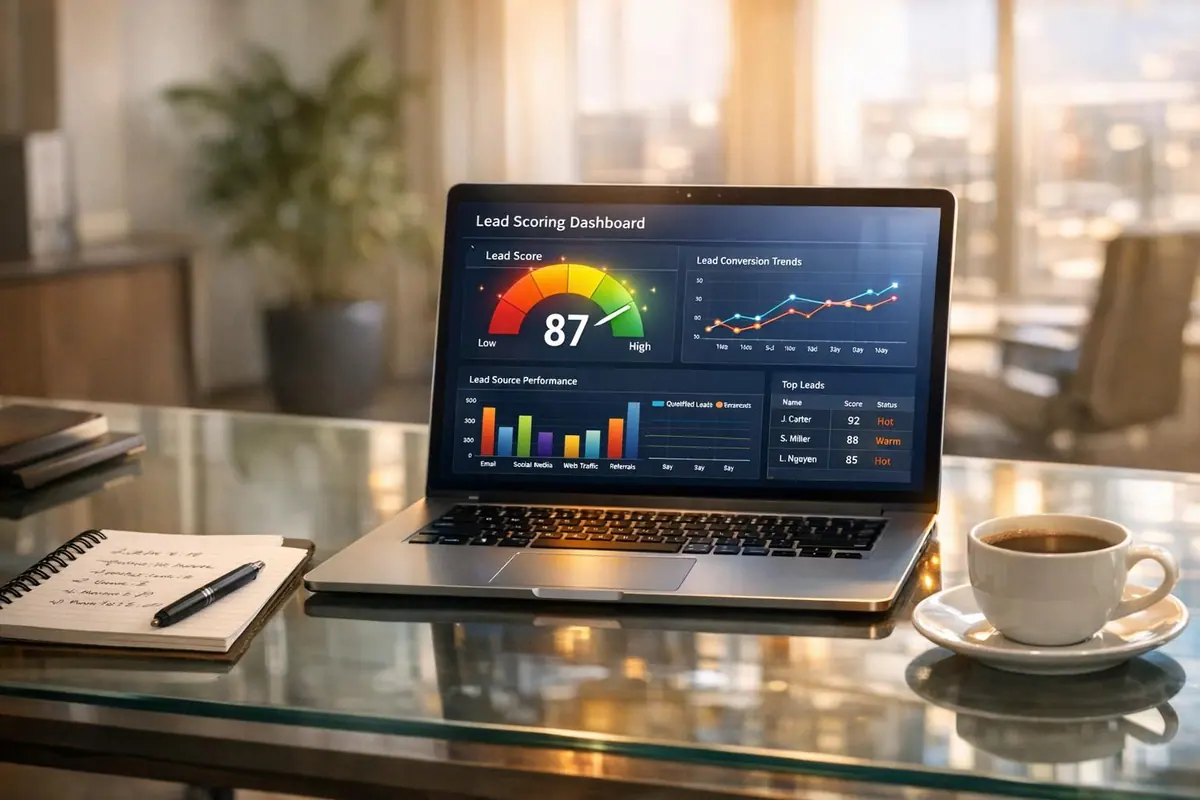
Machine learning (ML) is transforming lead scoring by replacing outdated, rule-based methods with data-driven insights. Unlike rigid systems prone to bias and inefficiency, ML analyzes vast amounts of data, finds patterns humans miss, and continuously updates to reflect real-time behaviors.
Key Benefits of ML in Lead Scoring:
- Higher Conversion Rates: Companies report a 75% increase in conversions with ML-powered scoring.
- Improved ROI: Businesses see a 300–400% return on investment within the first year.
- Real-Time Updates: ML recalculates lead scores based on new interactions, ensuring accuracy.
- Scalability: ML handles large datasets and adapts to evolving customer behaviors without manual intervention.
How It Works:
- ML uses data from multiple sources like CRM systems, website activity, and email engagement.
- It identifies subtle patterns, such as engagement timing or behavioral sequences, that predict purchase intent.
- Continuous learning ensures the model stays relevant as markets and customer behaviors evolve.
Real-World Impact:
- Companies like Progressive Insurance and Grammarly have achieved over 90% accuracy in predictions and boosted lead conversions by up to 80%.
- Sales teams save time by focusing on high-value leads, reducing wasted effort by 60–80%.
Machine learning is not just for large enterprises; small businesses are adopting these systems, with tools starting at $750–$2,500 per month. By building a strong dataset, selecting the right algorithm, and integrating the system into existing workflows, businesses can improve lead scoring accuracy and drive better results.
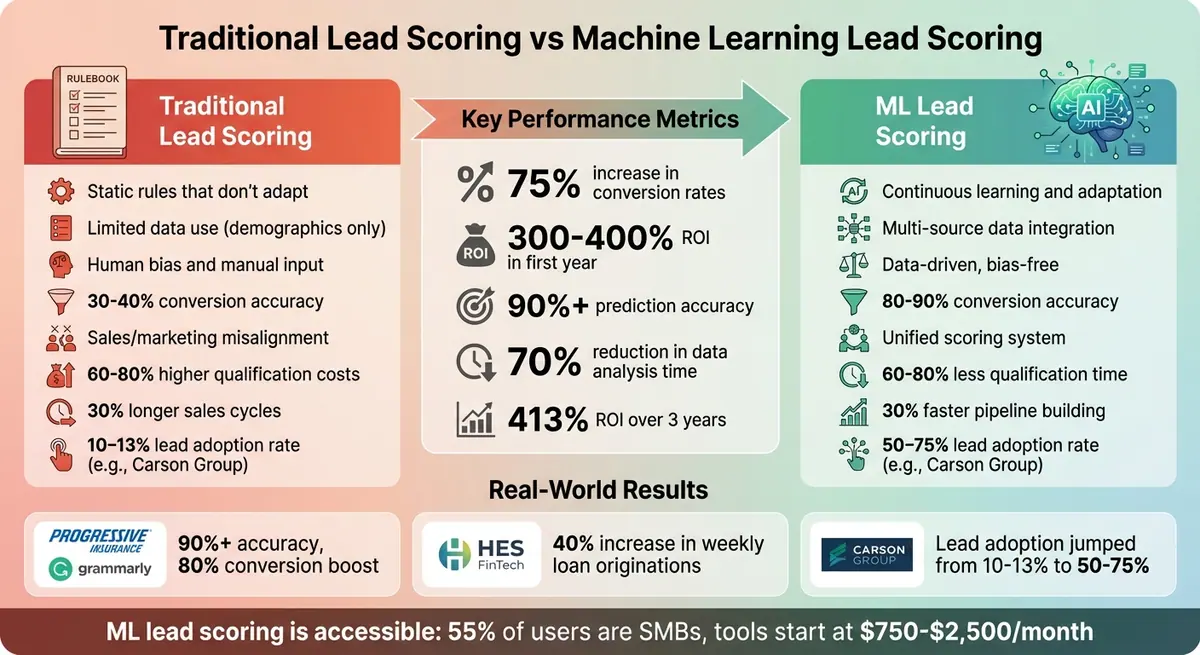
Traditional vs Machine Learning Lead Scoring: Performance Comparison
Why Traditional Lead Scoring Falls Short
Static Rules That Don't Adapt
Traditional lead scoring operates on fixed rules set up long ago. For example, a lead might earn +10 points for being a CEO, +5 for downloading a whitepaper, and +3 for visiting the pricing page. These scores are based on assumptions about what should matter, not on what actually drives conversions. As a result, they fail to account for the nuanced relationships between various data points.
The issue? Markets change, buyer behaviors shift, and your ideal customer profile (ICP) evolves - but these scoring rules remain static. Marc Perramond, VP Product at Demandbase, highlights the challenge:
"Traditional systems rely heavily on manual input, which limits their adaptability and can lead to oversights or inaccuracies in scoring".
Let’s say your ICP shifts from mid-market companies to enterprise accounts. To reflect this change, you'd need to manually update dozens of rules across your system. This process is not only tedious but also prone to errors, often getting delayed until the quality of your leads has already declined. Moreover, traditional models lack the ability to distinguish between a lead who downloads a technical document at 2:00 AM after visiting your pricing page multiple times in one week and someone who casually browses your blog once.
And this rigidity is only part of the problem. Limited data usage further undermines the accuracy of traditional scoring methods.
Limited Data Use and Human Bias
Most traditional scoring models rely on basic demographic and firmographic data - things like job titles, company size, and industry. They largely ignore more meaningful behavioral signals, such as how users engage with content, the sequence of their website interactions, or the timing of their activities. This narrow focus often causes high-potential leads from unconventional backgrounds to slip through the cracks simply because they don't fit the predefined mold.
Adding to the problem is the human bias baked into these scoring rules. Asia Rapai from ProPair explains:
"Traditional lead scoring tools will rank leads by giving them a number, but these rankings are based on attributes that may be arbitrary and are often flawed".
For example, sales and marketing teams might debate whether a Director deserves a higher score than a VP or whether company size is more important than industry - all based on gut feelings rather than hard data. This subjective approach creates cognitive bottlenecks at scale. Humans simply can’t process thousands of data points across hundreds of leads every day. Stan Rymkiewicz, Head of Growth at Default, notes:
"Manual scoring is subject to human error and bias, especially if you hand it off to a junior sales rep with limited experience".
The outcome? Teams spend time chasing leads based on arbitrary criteria instead of focusing on those most likely to convert. This wastes valuable sales resources and creates inefficiencies that could have been avoided with a more data-driven approach.
Misalignment Between Sales and Marketing Teams
Inaccurate lead scoring also fuels tensions between sales and marketing teams. Marketing often prioritizes generating a high volume of Marketing Qualified Leads (MQLs), while sales teams prefer fewer, high-quality leads that are easier to close. Without a unified, data-driven system, both teams lack a shared understanding of what truly qualifies a lead.
This misalignment isn’t just frustrating - it’s expensive. Traditional lead qualification costs are 60–80% higher than automated methods. Sales reps spend unnecessary time manually qualifying low-quality leads, which can extend sales cycles by as much as 30% compared to systems with optimized prioritization.
For example, when Carson Group, a financial advisory firm managing $33 billion in assets, relied on traditional rule-based scoring in 2024, their sales team adopted only 10–13% of marketing leads. The system simply couldn’t predict conversions accurately. After transitioning to a machine learning model, adoption rates soared to 50–75%, with prediction accuracy hitting 96%.
This disconnect also takes a toll on team morale. Sales reps become frustrated by the flood of unqualified leads, while marketing teams feel their efforts are undervalued. Instead of working together toward revenue goals, both teams often end up defending their processes. Machine learning offers a solution by dynamically adjusting scoring to match evolving market conditions, bridging the gap between departments and fostering collaboration.
How Machine Learning Improves Lead Scoring Accuracy
Using Data From Multiple Sources
Traditional lead scoring models often rely on limited, static data, but machine learning (ML) changes the game by pulling in information from a wide range of sources. It taps into everything - CRM data, website activity, email engagement, social media interactions, and even firmographics. On top of that, it can incorporate external economic indicators like employment rates and consumer price index data to adjust scores based on broader market conditions.
This approach paints a much fuller picture of each lead. For example, ML assigns dynamic weights to different actions. A lead who downloads a technical whitepaper in the middle of the night and visits your pricing page multiple times in a week is ranked far higher than someone who just opens an email once. It also uses negative scoring to subtract points for behaviors or attributes that fall outside your Ideal Customer Profile (ICP), helping your sales team focus on prospects that truly matter.
The results speak for themselves. Companies using ML for lead scoring report a 70% reduction in time spent on data analysis and preparation and a 413% return on investment over three years. By blending explicit data (like information leads share directly) with implicit data (such as behavioral patterns and inferred traits), ML uncovers "hidden buying signals" that traditional models would never detect. This ability to integrate multiple data sources allows ML to reveal nuanced patterns in lead behavior.
Finding Patterns Humans Miss
Machine learning doesn’t just gather data - it uncovers patterns that static models and even seasoned analysts might overlook. By analyzing thousands of data points at once, ML identifies nonlinear relationships and subtle combinations of behaviors. It can detect engagement sequences, timing patterns, and the velocity at which leads move through the sales funnel. These insights go far beyond obvious correlations, diving into the fine details of lead behavior.
Take Grammarly as an example. By integrating Salesforce Einstein AI, the company was able to track product usage and collaboration patterns. The result? A 30% boost in marketing qualified lead conversions and an 80% increase in account upgrades between 2023 and 2024.
ML also employs unsupervised learning to identify new customer segments by clustering leads with similar behaviors - no pre-set labels required. This advanced capability helps companies achieve conversion rates that are 75% higher than those using traditional methods, with some organizations reaching up to 96% prediction accuracy.
Continuous Learning and Model Updates
One of ML's standout features is its ability to evolve. These models continuously improve by retraining on fresh data. They can be set to update automatically on a regular schedule, such as every 15 days, ensuring accuracy without the need for manual intervention. This adaptability allows the system to recognize when certain behaviors become stronger or weaker indicators of intent and adjust scoring weights accordingly. For instance, if downloading a specific whitepaper starts showing a stronger link to conversions, the model automatically increases its importance in the scoring process.
Teams leveraging predictive ML models build their sales pipelines about 30% faster than those sticking with traditional methods. Feedback loops from sales teams also play a key role, as the model learns from the qualitative outcomes of previously scored leads. This creates a system that gets smarter with every interaction, keeping lead scoring accurate even as your business and market conditions evolve. Ultimately, this self-improving capability allows sales teams to scale their lead nurturing efforts more effectively.
How to Implement Machine Learning Lead Scoring
Building a Strong Data Foundation
To make machine learning (ML) lead scoring work, you need a clean and well-organized dataset. Start by pulling together lead data from all available sources - such as internal databases, cloud storage, CRMs, and spreadsheets - and merge them into one master dataset. Be sure to include a final column that indicates whether a lead converted (e.g., Qualified/Disqualified). Your dataset should cover critical categories like:
- Demographics: age, location, job title
- Firmographics: company size, industry, revenue
- Online behavior: website visits, content downloads
- Email engagement: opens, clicks
- Social interactions: likes, shares
For instance, between January 2020 and April 2024, a B2B software company developed a lead scoring model using CRM data. Researchers Laura González-Flores and Guillermo Sosa-Gómez identified "source" and "lead status" as key features, enabling their Gradient Boosting Classifier to outperform traditional methods significantly.
When preparing your dataset, aim for balance - such as 40 qualified and 40 disqualified leads from a recent timeframe - to train your model effectively. Don’t forget to assign negative scores for spam indicators and enable Change Tracking in your CRM to ensure your data stays up to date.
Once your dataset is ready, you can move on to selecting the right ML model for your needs.
Choosing and Testing Machine Learning Models
With your dataset in place, the next step is selecting an algorithm that fits your goals. For straightforward and transparent predictions, Logistic Regression or Decision Trees work well. For larger datasets with more complex patterns, consider Gradient Boosting or Neural Networks.
Evaluate your chosen model using metrics such as Accuracy and Area Under the Curve (AUC). Also, analyze feature importance to uncover which attributes - like lead source, website activity, or email engagement - have the most influence on conversions.
Companies leveraging predictive lead scoring have seen impressive results, such as a 77% boost in ROI and a 15–20% increase in converting prospects into qualified leads.
"The success vastly depends on a variety of non-model related factors such as change management and new process implementation."
- Amir A. Darbani, Predictive Lead Scoring Expert
Integrating Scores Into Your Systems
After validating your model, the final step is integrating it into your workflow. Feed the lead scores directly into your CRM through your data pipeline. To make the scores actionable, display the key factors influencing each score for better clarity.
Keep your system dynamic by updating scores in real time based on new behaviors - like visiting pricing pages or clicking on emails - to capture high-intent signals. Sales and marketing teams should align on what qualifies as a "qualified" lead and agree on a numerical threshold for passing leads from marketing to sales. Use historical data to pinpoint the ideal score range - one that’s not too broad or too narrow.
Finally, set your system to retrain the model regularly, such as every 15 days, to adapt to changing market conditions. Businesses that have embraced AI-driven lead scoring report a 32% increase in converting prospects to buyers, with accuracy rates of 80–90%, compared to just 30–40% for traditional methods.
sbb-itb-5f36581
Build a Lead Scoring Model using Machine Learning in Python
Scaling Lead Nurturing With Machine Learning Scores
Integrating machine learning (ML) lead scoring into your systems makes scaling lead nurturing more structured and efficient.
Better Lead Segmentation
Machine learning takes lead scoring to the next level by enabling more precise segmentation. By analyzing vast amounts of data - like behavior patterns, demographics, and engagement history - ML helps identify leads that align with your Ideal Customer Profile and display clear buying intent.
For example, the system can automatically assign leads to different nurturing paths based on their stage in the buyer's journey. A prospect downloading a white paper might be placed in an educational sequence. If that same lead later visits your pricing page multiple times in a week, ML shifts them into a high-intent track with sales-focused messaging. This kind of behavior-based personalization ensures that leads receive content tailored to their specific buying stage. And it works - 71% of consumers prefer personalized interactions, and 96% of marketers say personalization drives better sales results.
Real-Time Score Updates
ML-powered lead scoring isn't static - it updates in real time. Each time a lead interacts with your business, whether through an email click, a website visit, or social media engagement, their score is recalculated to reflect their current interest level.
This real-time adaptability can transform your lead nurturing efforts. A lead marked as "cold" yesterday might become "hot" today after viewing case studies or integration guides. The system identifies these changes immediately, triggering alerts for your sales team or moving the lead into a priority email sequence - all automatically.
In late 2025, a startup using the Smartlead.ai platform demonstrated the power of real-time scoring. A single sales rep closed 11 deals in just 60 days, generating an estimated $200,000–$300,000 in revenue. Predictive scoring flagged high-intent leads and suggested personalized follow-ups, allowing the rep to focus on the most promising prospects - something that would have been much harder with manual processes. Quick follow-ups matter too: contact success rates drop sharply if the response time exceeds one hour. With real-time updates, sales teams can engage leads at the right moment.
Focusing Sales Resources on High-Value Leads
ML scoring helps sales teams prioritize their efforts by identifying leads that are most likely to convert. Instead of wasting time on low-opportunity prospects, teams can focus on high-value leads flagged by the system. What’s more, the system provides context for each lead’s score - such as a recent visit to the pricing page or active email engagement - making personalized outreach more effective.
The results speak for themselves. Companies using ML lead scoring report conversion rates 75% higher than those relying on traditional methods. High-scored leads convert at a rate of 73%, compared to 30–40% for traditionally identified "hot leads". Sales teams also save time, spending 60–80% less effort qualifying unfit prospects, which allows them to work more strategically.
Take HES FinTech as an example. In 2024, they implemented a three-month ML project that boosted weekly loan originations by 40%. Additionally, AI-empowered sales reps often achieve the productivity of 1.5 to 2 traditional reps. And nurtured leads tend to make larger purchases - 47% bigger, in fact, than leads that aren’t properly nurtured. By zeroing in on leads with real conversion potential, teams can close more deals faster and with higher value per deal.
Conclusion
Machine learning has transformed lead scoring into a precise, data-driven process. Unlike traditional rule-based methods, which rely on static rules and are prone to human bias, machine learning analyzes vast amounts of data, adapts dynamically, and uncovers patterns that manual systems often overlook.
The impact of ML lead scoring on business performance is undeniable. Companies report a 75% increase in conversion rates, achieve 300–400% ROI within the first year, and accelerate pipeline building by 30%. Some organizations have even reached over 90% accuracy in identifying high-value leads.
This shift directly addresses the limitations of older approaches, offering measurable improvements across key performance metrics.
Key Takeaways
- Start with a strong data foundation: Use 12–24 months of historical lead and conversion data to train your models.
- Choose the right algorithm: For example, ensemble methods like the Gradient Boosting Classifier have achieved up to 98.39% accuracy in B2B settings.
- Integrate seamlessly: Feed ML-generated scores into your CRM and marketing tools so teams can act on insights immediately.
Keep in mind that machine learning models require regular updates. Retrain your system quarterly to account for changes in buyer behavior and market conditions. Define clear thresholds for when a lead transitions from marketing to sales, and provide context for each score to help your team prioritize effectively.
This technology is no longer reserved for large enterprises. Small and medium businesses now make up 55% of the ML lead scoring market, with tools available at prices starting from $750–$2,500 per month. For instance, HES FinTech used ML to cut bad loan rates from 18.9% to 4.4%, showcasing the tangible benefits of adopting this approach.
FAQs
How does machine learning make lead scoring more accurate than traditional methods?
Machine learning (ML) has transformed lead scoring by introducing smarter, data-driven models that constantly evolve and improve. Traditional approaches, which often rely on fixed, rule-based systems, can fall short due to human bias and outdated criteria. ML, on the other hand, processes massive datasets - like website interactions, email responses, and CRM histories - to uncover patterns that better predict which leads are most likely to convert.
Because ML learns from past outcomes, it eliminates the hassle of manual updates and minimizes errors caused by incomplete or messy data. This means sales teams can zero in on the most promising leads, close deals faster, and make better use of their time and resources. With ML-powered lead scoring, businesses can refine their strategies, boost conversion rates, and see a real impact on revenue growth.
What types of data are used in machine learning for lead scoring?
Machine learning models for lead scoring draw from multiple data sources to refine their accuracy. These sources typically include demographic and firmographic information, company-specific details, and behavioral data like website visits, click behavior, and form submissions. Metrics such as email opens, clicks, and social media interactions also contribute significantly to the analysis.
To create a fuller picture, these models often integrate CRM records with data from external enrichment platforms. By analyzing this mix of information, machine learning enables businesses to identify and focus on high-quality leads with improved precision.
How does machine learning improve lead scoring for small businesses?
Machine learning (ML) gives small businesses a smarter way to prioritize leads by analyzing data like website behavior, email interactions, and CRM records. It identifies patterns that signal a higher chance of conversion, taking the guesswork out of lead scoring. Unlike manual methods, ML is not only faster and more accurate but also improves over time as it processes new interactions.
With tools like Reform’s no-code form builder, businesses can gather detailed lead information right at the entry point and feed it directly into ML systems. This enables real-time scoring updates, ensuring sales teams concentrate on the leads most likely to convert. The payoff? Faster sales cycles, lower customer acquisition costs, and a better return on investment - all without needing a large sales team.
For small businesses, the advantages are undeniable: less time chasing dead-end leads, smarter allocation of marketing dollars, and a system that scales effortlessly as the business grows.
Related Blog Posts
Get new content delivered straight to your inbox

The Response
Updates on the Reform platform, insights on optimizing conversion rates, and tips to craft forms that convert.




Drive real results with form optimizations
Tested across hundreds of experiments, our strategies deliver a 215% lift in qualified leads for B2B and SaaS companies.
