
.webp)
Predictive Lead Scoring in CRM Platforms Explained



Predictive lead scoring uses AI to rank leads based on their likelihood to convert, helping sales teams focus on high-potential prospects. It analyzes data like past interactions, firmographics, and behaviors to assign real-time scores, often between 0 and 100. Compared to manual methods, predictive scoring is faster, more accurate, and eliminates human bias. Businesses using this approach report faster pipeline growth, higher lead conversion rates, and better alignment between sales and marketing.
Key points:
- What it does: Predicts which leads are most likely to convert.
- How it works: Uses machine learning to analyze historical and behavioral data.
- Why it matters: Saves time, improves lead quality, and drives revenue growth.
- Implementation: Requires clean data, the right CRM tools, and regular model updates.
Predictive scoring transforms CRM platforms into powerful tools for prioritizing leads and streamlining sales efforts.
Predictive Lead Scoring - What it is & How to Use it
Key Benefits of Predictive Lead Scoring
Predictive lead scoring reshapes sales and marketing by refining lead prioritization, removing biases, and improving forecasting. These enhancements lead to measurable gains in efficiency and revenue. Let’s break down how each benefit directly impacts sales performance.
Better Lead Prioritization
With predictive scoring, every lead gets a numerical score (usually 0–100) and a grade (A–D) based on their likelihood to convert. This gives sales teams a clear view of which prospects are most promising. By eliminating guesswork, reps can focus their efforts more effectively. For instance, sales reps typically spend about 8% of their time just figuring out which leads to prioritize. Predictive systems update scores instantly as prospects engage, ensuring reps always have the most current information. High-priority leads are automatically assigned to available reps, cutting response times dramatically. This approach can increase the time reps spend with qualified leads from 30% (using manual methods) to as much as 80%.
Removing Bias from Lead Scoring
Traditional lead scoring often depends on subjective judgments. For example, a sales rep might favor CEOs from Fortune 500 companies based on past successes, while overlooking equally strong leads from smaller firms. Predictive scoring eliminates this subjectivity by using machine learning to analyze historical data and determine what truly defines a high-quality lead.
"Predictive lead scoring has the ability to create an 'ideal customer' profile based on past buying behavior, and then identify which current prospects best fit that profile. It removes the possibility for human error or bias." – HubSpot
This consistent, data-driven approach ensures every lead is evaluated using the same criteria, avoiding the inconsistencies caused by human bias or fatigue.
Better Forecasting and Customer Behavior Insights
Predictive models replace gut-based pipeline predictions with data-backed probability scores. This gives sales leaders a clearer picture of pipeline health. By analyzing thousands of data points - like the order of content downloads or website visits - AI can identify "digital body language" that signals intent to buy. It can even reveal unexpected trends, such as prospects being twice as likely to convert after viewing pricing pages on mobile devices during specific times.
These insights go beyond individual leads, helping teams distinguish between behaviors that indicate buying readiness and those that require further nurturing. This not only sharpens forecasting accuracy but also allows for better resource allocation. Teams using predictive scoring can build their sales pipelines about 30% faster by avoiding wasted time on poor-fit leads.
How Predictive Lead Scoring Works
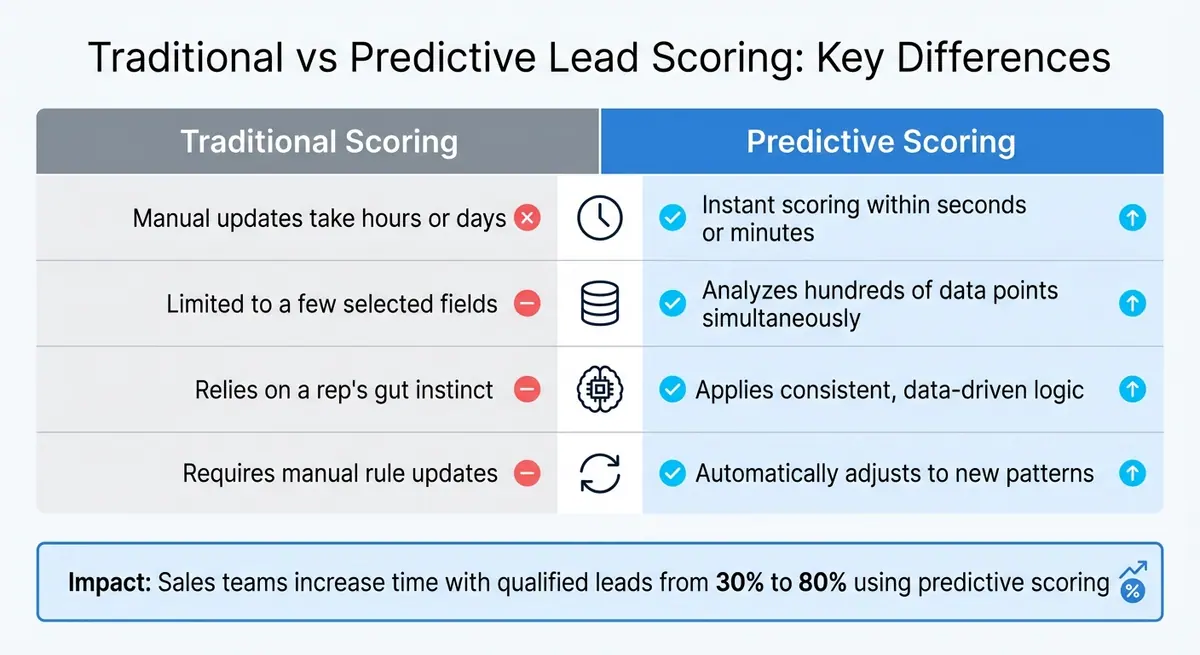
Traditional vs Predictive Lead Scoring Comparison
Predictive lead scoring unfolds in three key stages: collecting and analyzing data, leveraging machine learning to identify patterns, and scoring leads automatically in real time. This process helps sales and marketing teams make the most of their CRM platforms.
Data Collection and Analysis
Predictive models pull together a mix of demographic, firmographic, behavioral, and CRM metadata to create a detailed profile for each lead. This includes information like job title, industry, company size, website interactions, email engagement metrics, and call records. Behavioral data - such as website visits, white paper downloads, webinar participation, and social media activity - offers insights into a lead's level of interest. On the flip side, negative signals like generic email addresses (e.g., Gmail or Yahoo), spam entries, or leads from unsupported regions reduce a lead's score. CRM metadata, such as lead source, partnerships, and product preferences, adds another layer of refinement.
To train these models effectively, a solid foundation of historical closed leads is essential. Once the data is in place, machine learning models step in to uncover the patterns that indicate lead quality.
Machine Learning Models and Pattern Recognition
Machine learning algorithms dive into past successes and failures to pinpoint the factors that separate high-quality leads from less promising ones. For example, they compare how attributes like job title, industry, or webinar attendance influence conversion rates relative to a baseline, assigning higher scores to attributes with strong correlations.
"AI lead scoring changes this equation entirely. Instead of static point systems, machine learning algorithms analyze hundreds of data points simultaneously to predict conversion probability in real time."
– Sean O'Connor, Content Specialist, monday.com
These models continuously improve through feedback loops. Each closed deal or lost lead helps fine-tune the algorithm, improving its accuracy over time. Advanced systems also use techniques like score decay, where a lead's score gradually decreases every 30 days without new engagement, ensuring scores reflect current interest levels. To stay sharp, many platforms retrain their models on historical data every 15 days.
Automated Lead Scoring and Routing
Once the system has refined its insights, it automates the scoring and routing process. Trained models calculate scores almost instantly - often within minutes of a lead being added to the CRM. Many CRM platforms also include a Score Trend indicator (e.g., improving, declining, or steady) to track changes in a lead's activity and momentum.
When a lead crosses the threshold for being sales-ready, the CRM can trigger automated workflows. This might involve moving the lead to a sales-acceptance stage or notifying a sales rep. High-scoring leads are automatically assigned to available representatives, ensuring no promising opportunity slips through the cracks. Some advanced systems even deploy AI-powered digital assistants to call new leads within seconds, qualify them through conversation, and schedule meetings on the spot.
| Aspect | Traditional Scoring | Predictive Scoring |
|---|---|---|
| Speed | Manual updates take hours or days | Instant scoring within seconds or minutes |
| Data Volume | Limited to a few selected fields | Analyzes hundreds of data points simultaneously |
| Objectivity | Relies on a rep's gut instinct | Applies consistent, data-driven logic |
| Adaptability | Requires manual rule updates | Automatically adjusts to new patterns |
sbb-itb-5f36581
Steps to Implement Predictive Lead Scoring in Your CRM
To implement predictive lead scoring effectively, you need the right CRM tools, clean data, and a commitment to regular updates. Here's a step-by-step guide to help you navigate the process - from selecting a platform to refining your scoring model.
Step 1: Choose a CRM Platform with Predictive Scoring Features
Start by selecting a CRM that supports AI-driven lead scoring and integrates smoothly with your existing tools. Look for features like explainable AI, compatibility with marketing automation platforms, and a user-friendly, no-code interface. Some CRMs require a minimum data threshold - such as 40 qualified and 40 disqualified leads from the past two years - to build an effective scoring model.
Once you've settled on a platform, make sure your lead data is well-prepared for analysis.
Step 2: Clean and Organize Lead Data
Predictive scoring models thrive on clean, organized data. Go through your CRM and eliminate duplicate, incomplete, or spam entries. Since these models rely on identifying patterns, messy data can lead to inaccurate scores. Standardize key fields like job titles, industry names, and company details to help the AI detect meaningful trends.
Ensure every lead is linked to a parent account or contact record, as orphaned leads may not be scored by many platforms. To fill in missing details - like company revenue or technology use - consider enriching profiles with third-party data. You can also set up negative scoring to flag leads with generic email domains (e.g., Gmail, Yahoo) or from regions outside your operational scope. For inactive leads, apply score decay rules to keep your database relevant.
Once your data is in shape, focus on keeping your scoring models accurate and relevant over time.
Step 3: Monitor and Adjust Scoring Models
Predictive models aren't "set it and forget it" tools - they need regular attention. Review your scoring models every three to six months to ensure they align with current market conditions. Keep an eye on metrics like conversion rates by score, sales cycle duration, and the Area Under Curve (AUC) score, which measures predictive accuracy. If you notice that high-scoring leads aren't converting, consider placing more emphasis on behavioral signals rather than static demographics.
Collaboration with your sales team is essential. If they find that leads scoring above 80 are often unqualified, you may need to adjust thresholds or retrain the model with updated data. Regularly review top influencing factors - like industries or web page visits driving conversions - to identify shifts in buyer behavior. Experiment with scoring thresholds through A/B testing to balance lead quality and quantity.
Improving Lead Data with No-Code Form Builders
To get predictive scoring right, you need reliable data - and no-code form builders can help you achieve this. Issues like incomplete profiles, duplicate entries, or spam submissions can seriously throw off AI predictions. No-code form builders streamline the process, letting you collect clean, structured lead data from the start. This gives your CRM the quality input it needs to generate accurate predictions.
Using Reform for High-Quality Lead Data Collection
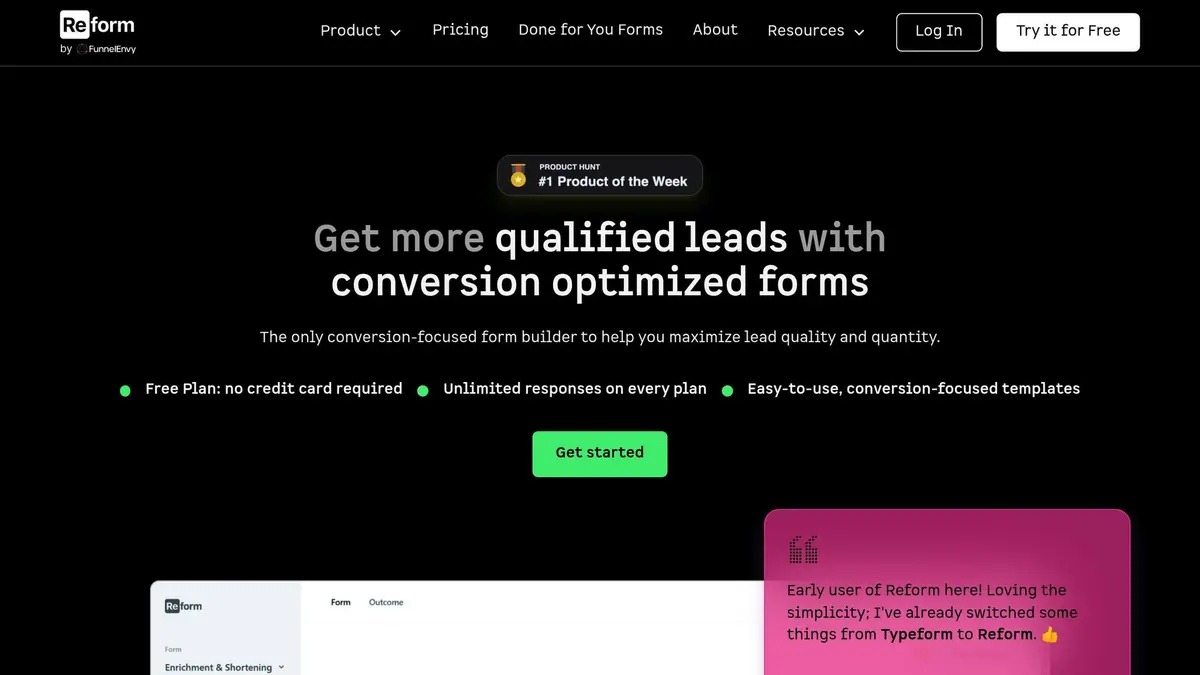
Reform is a no-code form builder designed to prioritize lead quality while improving conversions. Its lead enrichment feature automatically fills in missing details, such as company size or industry, ensuring your CRM has complete records for scoring. Features like spam prevention and email validation filter out junk data, so your predictive model works with real prospects instead of fake entries. Starting with clean data saves you the headache of cleaning up your database later.
Reform doesn’t stop at capturing data - it also offers advanced options to refine lead quality further.
Benefits of Multi-Step and Conditional Routing Forms
Once you’ve ensured high-quality data capture, tools like multi-step forms and conditional routing can help qualify leads even more effectively. Multi-step forms split long questionnaires into smaller, manageable sections, reducing fatigue and abandonment. This approach allows you to collect more information without overwhelming prospects.
Conditional routing takes things up a notch by customizing follow-up questions based on earlier answers. For instance, enterprise buyers might see different fields compared to small business owners. This tailored interaction not only improves lead qualification but also provides richer behavioral insights for your CRM.
Tracking metrics like "Count of Form Submissions" can be particularly revealing. A prospect who completes multiple forms demonstrates stronger intent than someone who submits just one. To make the most of this data, configure your forms to update both lead and contact records simultaneously. Many CRM scoring models struggle to process leads that aren’t linked to a parent contact.
Integration with CRM Platforms
Reform integrates seamlessly with CRM tools, ensuring that every form submission, page view, and interaction flows directly into your predictive scoring model. This real-time synchronization captures behavioral signals instantly, allowing your AI to adjust scores as prospects engage with your brand. With scores updated within minutes, your sales team can act on high-priority leads without delay.
You can embed Reform forms on landing pages, in emails, or as standalone pages, ensuring all submission data populates the correct CRM fields. To optimize results, map your form fields to CRM attributes that heavily influence predictive models - like first and last page views, email interactions, and total form submissions. This way, your scoring engine has the behavioral data it needs to identify patterns and prioritize leads effectively.
Conclusion
Predictive lead scoring reshapes the way sales and marketing teams collaborate by replacing guesswork with actionable, data-based insights. Companies using lead scoring in their lead generation efforts report a 77% boost in ROI compared to those that don’t. This approach eliminates human bias, automatically prioritizes top-quality leads, and provides instant insights.
The success of predictive lead scoring hinges on one critical factor: clean, reliable data. Accurate predictions require structured, high-quality data from the start. Tools like Reform help ensure this by capturing complete lead profiles through features like lead enrichment, spam prevention, email validation, multi-step forms, and conditional routing. These tools feed your CRM with the data it needs to deliver results from day one.
Getting started with lead scoring doesn’t have to be a heavy lift. Even small, initial datasets are enough to kick things off. Over time, these systems refine themselves, becoming smarter and more precise as they process additional customer data.
The benefits are hard to ignore. Predictive lead scoring can improve the conversion rate of prospects into qualified leads by 15–20%. At the same time, sales teams can avoid wasting up to 40% of their time chasing unqualified leads. With around 68% of marketers already leveraging lead scoring models, businesses that delay adopting this strategy risk being outpaced by competitors who make faster, more informed decisions about their sales priorities.
FAQs
What are the benefits of using predictive lead scoring in a CRM?
Predictive lead scoring empowers sales teams to work more efficiently by pinpointing and prioritizing leads with the highest likelihood of converting. Instead of wasting time chasing low-potential prospects, sales reps can focus their energy on opportunities that truly matter.
This approach doesn’t just save time - it transforms the sales process. By narrowing in on the right leads, teams can speed up pipeline growth, close deals faster, and increase revenue per representative. It’s a game-changer for boosting productivity and delivering stronger results.
What types of data are crucial for predictive lead scoring?
Predictive lead scoring involves analyzing a combination of behavioral, demographic, and firmographic data to assess how likely a lead is to convert into a customer. Here's a closer look at the key data points that feed into this process:
- Website activity: Tracks the pages a lead visits, how much time they spend on your site, and any actions they take, such as filling out forms or downloading resources.
- Email engagement: Measures how leads interact with your emails, including open rates, link clicks, and replies.
- CRM records: Includes past interactions, the history of deals, and the current status of the lead in your sales pipeline.
- Demographics: Covers personal details like age, location, job title, and the industry they work in.
- Firmographics: Focuses on company-level information, such as the size of the business, its revenue, and the sector it operates in.
By blending these data points, businesses can generate accurate lead scores, helping sales and marketing teams zero in on the opportunities most likely to convert. This targeted approach saves time and resources while improving overall efficiency.
What steps can businesses take to keep their predictive lead scoring models accurate?
To keep predictive lead scoring models working effectively, businesses need to update and retrain these models regularly using fresh, reliable data. This practice ensures the models stay aligned with current trends and evolving customer behaviors.
It's equally important to track the model's performance over time. Monitoring helps catch issues like data drift or inaccuracies early on. By taking a proactive approach, companies can maintain accurate insights that support smarter decision-making.
Related Blog Posts
Get new content delivered straight to your inbox

The Response
Updates on the Reform platform, insights on optimizing conversion rates, and tips to craft forms that convert.



Drive real results with form optimizations
Tested across hundreds of experiments, our strategies deliver a 215% lift in qualified leads for B2B and SaaS companies.
