
.webp)
Predictive Scoring Validation: Best Practices



Predictive lead scoring helps sales and marketing teams focus on the best prospects to increase lead conversions by using machine learning to rank leads based on their likelihood to convert. But without proper validation, even advanced models can fail, leading to wasted efforts and lost trust. Here's how you can ensure your scoring model delivers reliable results:
- Start with clean data: Remove duplicates, fill missing fields, and standardize formats to avoid skewed results. Regularly update records to counteract data decay (22.5% annually).
- Enrich your data: Add firmographic, technographic, and behavioral details to improve prediction accuracy. Teams using enriched data report up to 30% higher conversions.
- Test predictions rigorously: Compare lead scores against actual outcomes using metrics like discrimination (AUC/ROC), calibration, and stability.
- Calibrate outputs: Adjust raw scores into dependable probabilities using methods like Platt Scaling or Isotonic Regression.
- Monitor and retrain: Regularly review performance to detect issues like model drift. Retrain models quarterly or after major changes.
Preparing Data for Validation
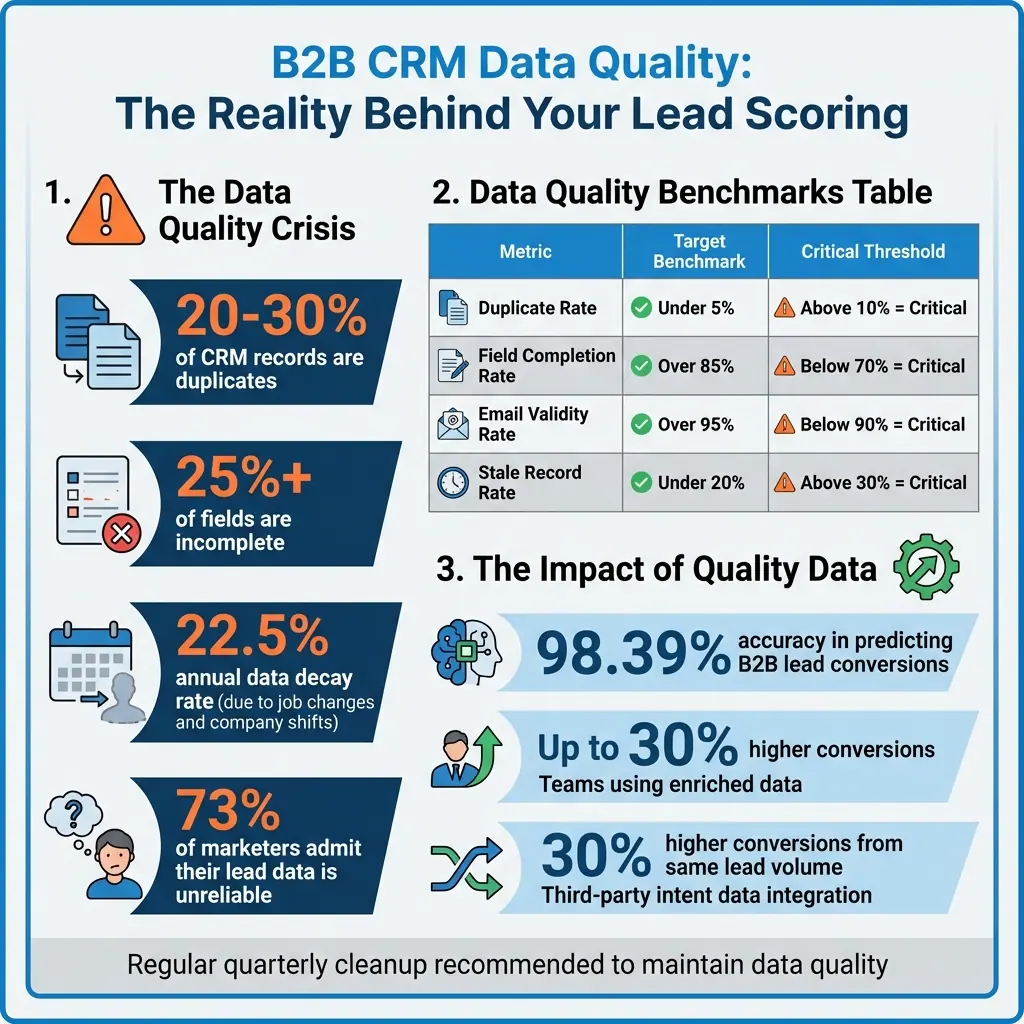
B2B CRM Data Quality Statistics and Benchmarks
If you want accurate predictive scoring validation, you need clean, complete data. Messy CRM records - like duplicates, inconsistent formats, or missing fields - can skew results and lead to poor decisions. Reliable data doesn’t just validate your model; it ensures your lead scoring efforts actually drive better decision-making.
Here’s the reality: most B2B CRMs are riddled with issues. About 20–30% of records are duplicates, and over 25% of fields are incomplete. On top of that, B2B data deteriorates at a rate of 22.5% annually due to job changes and company shifts. If you're testing your model's ability to separate high-converting leads from low-converting ones, dependable data is non-negotiable.
Cleaning and Auditing Your Data
Start by conducting a data quality audit. This helps you set benchmarks and measure the effectiveness of your cleanup efforts.
| Metric | Calculation Method | Target Benchmark |
|---|---|---|
| Duplicate Rate | Duplicates / Total records | Under 5% |
| Field Completion Rate | Filled fields / Total required fields | Over 85% |
| Email Validity Rate | Valid emails / Total emails | Over 95% |
| Stale Record Rate | Records not updated in 12+ months | Under 20% |
Eliminate duplicates by starting with exact email matches, then use fuzzy matching for names and company combinations. Duplicates can fragment activity histories, making it harder for models to understand engagement patterns. When merging, apply rules to decide which record to keep - for example, prioritize the most recent email or the record with the latest activity.
Standardize your data fields. Normalize job titles (e.g., "VP" vs. "Vice President"), use ISO codes for locations, and format phone numbers according to E.164 standards. This ensures your model correctly interprets data like geographic regions and organizational roles.
Validate contact details using automated tools to check email deliverability, phone number formats, and address authenticity. Remove records with invalid emails, outdated contact info, or inactive social profiles that don’t meet your target criteria.
Since data decays quickly - remember that 22.5% annual rate - schedule regular data cleanup and re-enrichment, ideally every quarter. This helps keep your validation datasets relevant and usable.
Once your data is clean and consistent, you can enhance it with additional details for better insights.
Enriching Lead Data
Basic records, like a name and email, don’t give machine learning much to work with. Adding firmographic, technographic, and behavioral details lets algorithms uncover meaningful patterns.
For example, machine learning models trained on enriched CRM data have achieved 98.39% accuracy in predicting B2B lead conversions.
"The difference between these high performers and everyone else? Not the algorithm. The data feeding it."
- Jan, Databar.ai
Enrichment adds depth to your data, distinguishing Fit (attributes like company size and industry) from Engagement (actions like downloads or email interactions). This allows your sales team to focus on leads that are both suitable and actively engaged. For instance, a model might reveal that a specific company size paired with a particular content interaction sequence leads to a 3× higher conversion rate.
Before training your model, backfill historical records with enrichment data. Incomplete training data can lead to inaccurate predictions. For ongoing use, automate enrichment after form submissions for real-time scoring and routing using direct CRM and marketing integrations. Refresh existing records monthly to counteract data decay.
To maximize enrichment, use a waterfall approach - querying multiple data providers in sequence. This helps ensure your lead records are as complete as possible. Teams that incorporate third-party intent data into their models have reported 30% higher conversions from the same lead volume.
Even with enriched historical data, capturing high-quality leads from the start remains critical.
Using Forms to Collect Quality Data
Forms are your first defense against bad data entering your system. Yet, 73% of marketers admit that their lead data is unreliable, often because their forms lack proper validation.
"The form is the first checkpoint in your revenue engine, and it's failing to filter bad data before it enters your systems."
- Priyanshi Sharma, Content Strategist, Clearout
Tools like Reform can help by offering features like email validation to block fake addresses, spam prevention to filter bot submissions, and real-time analytics to optimize form fields for better lead scoring and sales qualification.
For high-value assets like demos, require business email domains instead of personal ones. This improves lead quality and makes account matching more accurate. To avoid overwhelming users, balance your need for detailed data with their experience. For instance, instead of asking for firmographic details directly on the form, use waterfall enrichment to fill in missing information like company size or industry.
sbb-itb-5f36581
Testing Model Predictions Against Actual Results
Once your data is cleaned and prepared, it’s time to evaluate how well your predictive model performs. This involves comparing the model’s predictions to the actual outcomes of leads.
Start by defining a clear target outcome - like a "Sales Accepted Lead" or "Closed-Won" deal - and set a specific time frame for evaluation, such as 30, 60, or 90 days from the lead score date. For instance, if your model scores a lead on March 1, 2026, check whether it converts within the next 60 days.
Before diving into performance metrics, make sure your data is consistent. For example, verify that lifecycle stages and timestamps are uniformly defined in your CRM. Issues like inconsistent data entry - where leads are marked as "converted" at different stages - can create what appear to be model errors, but are actually process inconsistencies.
Creating Validation Test Sets
To properly evaluate your model, split your historical data into three distinct groups: training, validation, and testing. Each group serves a unique purpose:
- Training Set: Used to build the model.
- Validation Set: Helps fine-tune and compare different model versions.
- Testing Set: Provides an unbiased assessment of the model’s final performance.
Typically, allocate 60–70% of your data for training, with 10–20% each for validation and testing. Ensure these sets represent a variety of score ranges, industries, and time periods. One effective method is backtesting: use historical data from a specific date (e.g., January 15, 2025) to score leads from that period and compare those scores to the actual outcomes observed weeks later.
Metrics That Measure Model Performance
To understand how well your model is performing, focus on a few key metrics:
| Validation Metric | Definition | Purpose |
|---|---|---|
| Discrimination | Measures how well the model separates high and low score cohorts | Ensures high scores convert more often than low scores |
| Calibration | Aligns predicted scores with actual outcomes | Confirms that a score of "70" reflects a 70% likelihood |
| Stability | Consistency of model performance across time and segments | Ensures reliable results over weeks or months |
| Business Lift | Improvement over baseline methods (e.g., random routing) | Highlights the revenue impact, like faster lead follow-up |
Discrimination evaluates whether the model effectively distinguishes between leads likely to convert and those that are not. Metrics like AUC/ROC (Area Under the Curve/Receiver Operating Characteristic) or KS (Kolmogorov-Smirnov) statistics can quantify this.
Calibration ensures that the probabilities your model assigns are accurate. For instance, if a lead is given a 70% likelihood of conversion, approximately 70% of similar leads should convert within the defined window. To test this, conduct a monotonic lift analysis by grouping leads into score brackets (e.g., top 10%, next 10%) and checking if conversion rates rise consistently with higher scores.
Precision and recall are also worth considering. Precision measures how many leads predicted as high quality actually convert, while recall measures how many of the total converters your model successfully identifies. High precision minimizes wasted sales efforts, and high recall ensures you don’t miss valuable leads.
Running A/B Tests with Lead Scores
A/B testing can reveal your model’s real-world impact on business outcomes. For example, direct a portion of your leads (10–20%) using the predictive model while assigning the rest through traditional methods, like FIFO (First In, First Out) or round-robin. Compare results such as win rates and pipeline growth for each group over at least one full sales cycle (typically 60–90 days) to account for natural fluctuations.
Beyond conversion rates, track metrics like speed-to-lead, average deal size, and sales team productivity. Regularly check for patterns in false positives and negatives, and monitor changes in tier conversion rates. If performance declines, it may be time to retrain your model to maintain its effectiveness.
Once your test sets and metrics are in place, you’re ready to refine and interpret your model’s outputs for even better results.
Calibrating and Interpreting Model Outputs
Once your model's performance is validated, the next step is ensuring the scores it generates are both accurate and easy to interpret. Raw outputs often need calibration to become reliable probabilities. For example, a score of "0.8" from an uncalibrated model doesn’t necessarily mean an 80% chance of conversion. Calibration bridges this gap, transforming raw outputs into dependable probabilities that sales and marketing teams can confidently act on.
Adjusting Score Probabilities
Calibration adjusts raw model outputs into probability scores between 0 and 1 (or 0–100 for easier understanding). A properly calibrated model adheres to the "balance property": if a group of leads is assigned an 80% probability, approximately 80% of them should convert.
Platt Scaling is one method for calibration. It applies a logistic regression model to the raw scores, creating a sigmoid curve that maps them to probabilities. This approach works particularly well with smaller datasets or when the model's outputs lack confidence. For instance, calibrating a Random Forest model using Platt scaling has been shown to significantly lower log loss from 0.63 to 0.36 while preserving the AUC.
Isotonic Regression takes a different route, fitting a non-decreasing function to the scores. This method is better suited for correcting complex, non-linear distortions and generally performs well with larger datasets - typically over 1,000 samples. However, it may overfit if applied to smaller datasets.
Calibration should always be done on a separate validation dataset, not the training data. Using the same dataset for both can result in overly optimistic and biased probability estimates.
To confirm calibration quality, use reliability diagrams (also known as calibration curves). These diagrams plot the mean predicted probability against actual conversion rates across score bins. A well-calibrated model will have points close to the diagonal line, showing that predicted probabilities align with real-world outcomes.
Once your probabilities are calibrated, the next step is turning these numbers into actionable insights for your team.
Explaining How Models Make Predictions
Even with calibrated outputs, a model’s success depends on whether your sales team trusts and understands its predictions.
Start by rescaling probabilities to a 0–100 range. While models output scores between 0 and 1, multiplying by 100 makes them easier to interpret. For example, a score of 70 is more intuitive as a 70% likelihood of conversion.
Next, map score ranges to operational actions. Create a calibration table that links specific score bands to observed conversion rates, and tie these ranges to concrete actions like service level agreements. For example, leads in the 80–100 range might receive immediate follow-ups, while those in the 50–70 range could be nurtured with automated campaigns. This ensures that the model’s predictions directly inform practical strategies.
Highlight the key drivers behind each score. When sales representatives see a lead’s score, showing the factors that influenced it - like job title, company size, or recent online behavior - builds trust and helps them tailor their outreach. Transparency in how scores are generated makes the model’s outputs more actionable.
If your lead data comes from forms, tools like Reform can help ensure high-quality inputs. Features like email validation, lead enrichment, and conditional routing keep the data clean and complete, minimizing the risk of "garbage in, garbage out."
Lastly, establish a routine for reviewing the model. Regular scoring meetings with sales and marketing leaders allow you to discuss issues like model drift, review false positives, and adjust score thresholds as market conditions change. These ongoing conversations keep your model relevant and ensure team alignment.
Monitoring and Updating Models Over Time
Once you've calibrated and interpreted your model outputs, the work doesn’t stop there. Continuous monitoring is essential to maintain performance. Predictive scoring models can lose accuracy over time as market dynamics shift, product lines change, and customer behaviors evolve. Without regular oversight, these changes can significantly impact results.
Tracking Model Performance
Keeping an eye on model performance helps catch issues early - before they affect revenue. One common problem is model drift, which shows up when conversion rates in specific score tiers drop, lead volumes shift unexpectedly, or false positive rates spike. To stay ahead of these issues, conduct monthly reviews. These should include both statistical accuracy checks and business-focused metrics, like SLA adherence by tier and lead volume distribution across score bands.
Automated dashboards and real-time alerts can make this process more efficient. For example, if conversion rates in your "high likelihood" band fall below expectations over a 30-, 60-, or 90-day period, it's a clear sign that recalibration is needed. This kind of real-time monitoring ensures the model stays aligned with its original validation benchmarks.
Creating a scoring council that includes RevOps, sales, and marketing leaders can help manage updates and prioritize changes effectively. Aetna, for instance, saved eight hours of daily work by automating lead distribution through scoring logic, while also improving SLA compliance in December 2025.
Retraining Models with New Data
Retraining your model is another critical step. Depending on how fast your business environment changes, this should happen quarterly or semi-annually. Major shifts, like launching a new product or adopting new marketing channels, call for immediate retraining rather than waiting for the next scheduled update.
Take Salesforce Einstein as an example. It refreshes every 10 days, allowing it to incorporate new data and configuration changes regularly. However, it’s important to distinguish between a refresh, which updates scores with recent data, and a full retrain, which rebuilds the model’s logic to address fundamental changes in patterns. Monitoring your Model Stability Index can help identify when a retrain is necessary. A noticeable drop in stability across segments or channels is a strong indicator that your model needs an overhaul with updated training data.
Incorporating Sales Team Feedback
Sales teams often notice patterns and details that metrics alone might overlook. For instance, they might flag high-scoring leads that underperform or low-scoring leads that unexpectedly convert.
"Feedback from sales teams regarding the lead-to-conversion process can unveil subtleties not immediately apparent through metrics alone." - Guillaume Heintz, Dolead
Hold quarterly meetings with sales and marketing teams to ensure the scoring logic aligns with actual revenue outcomes. In these sessions, review the top positive and negative factors influencing scores. This helps confirm that the model reflects real-world conditions.
"Trust evaporates if reps can't validate the scores they see." - Colin Price, Head of Growth at Distribution Engine
Use this feedback to fine-tune your model. For example, if sales teams report that leads with free email domains or specific job titles rarely convert, adjust the model to penalize those attributes. In December 2025, 360 Learning linked engagement scoring with automated lead assignments, achieving 97% routing accuracy and reducing lead response times to under 10 minutes. Similarly, Tebra implemented a hybrid scoring model after a merger, routing leads based on rep skills and territory alignment. The result? A 40% faster response time and a 30% boost in conversion rates.
Conclusion
Validating predictive lead scoring models isn’t a one-and-done task - it’s a continuous process that separates successful revenue teams from those struggling with misaligned pipelines. The basics are non-negotiable: start with clean, enriched data collected through well-designed forms, rigorously test predictions against actual conversion outcomes, and monitor performance regularly to catch any drift before it affects revenue. Even the most advanced models can fail quickly without these essential practices in place.
The real value of lead scoring comes from turning raw scores into actionable insights for sales teams. To achieve this, marketing and sales must treat lead scoring as a shared operational framework. This means agreeing on clear MQL (Marketing Qualified Lead) and SQL (Sales Qualified Lead) definitions, setting strict follow-up SLAs (Service Level Agreements), and using nuanced scoring tiers - typically 4 to 6 levels, such as A1 to D4 - rather than oversimplified "hot" or "cold" labels.
Regular audits are critical to maintaining trust in the scoring system. Monthly reviews of false negatives, quarterly checks for bias, and evaluations of sales overrides can highlight areas for improvement. Sales team feedback is also invaluable, as it can uncover patterns that metrics alone might miss, such as high-scoring leads that consistently fail to convert or unexpected wins from lower-score groups.
From a technical perspective, use metrics like ROC AUC to evaluate model performance, periodically reduce scores (by 10–20% every 7–14 days) to focus on recent intent, and version updates to your scoring system just like you would with software releases.
For predictive scoring to work effectively, you need a sufficient volume of data - at least 1,000 leads and 100 conversions - to identify meaningful patterns. If your team is just starting out, rules-based scoring offers a simple, explainable approach that can be fine-tuned quickly. As your lead volume grows and patterns become clearer, predictive models can take over, provided they’re backed by consistent validation. This disciplined approach ensures predictive scoring remains a reliable tool for driving impactful sales strategies.
FAQs
How do I pick the right conversion window (30/60/90 days) to validate lead scores?
To get the most accurate lead qualification, it's important to align your conversion window with your sales cycle and the typical time it takes for leads to convert. Start by analyzing your data to identify patterns and set thresholds that match actual buyer behavior. Regularly review and adjust your model to ensure it stays in sync with how your customers make purchasing decisions. This approach helps refine your process and keeps your lead qualification efforts on point.
What AUC/ROC and calibration targets should I aim for before using scores in sales routing?
To use scores effectively in sales routing, aim for an AUC-ROC of 0.80 or higher and a precision above 70%. These benchmarks ensure the model can reliably differentiate between high- and low-value leads while maintaining accurate predictions. Strong metrics like these play a key role in streamlining sales processes and making informed decisions.
When should I retrain versus just recalibrate my scoring model?
Regularly monitor your scoring model for accuracy. If you notice a significant drop in performance or major shifts in market conditions, it's time for a retraining session. For smaller, routine tweaks, recalibrate the model using performance metrics. Consistent evaluation is key to keeping your model performing at its best.
Related Blog Posts
Get new content delivered straight to your inbox

The Response
Updates on the Reform platform, insights on optimizing conversion rates, and tips to craft forms that convert.



Drive real results with form optimizations
Tested across hundreds of experiments, our strategies deliver a 215% lift in qualified leads for B2B and SaaS companies.
