
.webp)
How Predictive Scoring Boosts Conversions



Predictive lead scoring uses machine learning and historical data to rank leads based on their likelihood to convert. This approach outperforms manual scoring by analyzing patterns in demographics, behaviors, and firmographics to prioritize high-quality leads. Companies using predictive scoring report:
- 28% higher conversion rates (Forrester).
- 25% shorter sales cycles.
- Up to 70% ROI growth and 15% higher win rates.
The secret? Clean, structured data from forms. Tools like Reform improve data quality by enriching leads, validating emails, and blocking spam. Effective scoring requires at least 80 historical leads (40 won, 40 lost), and models achieve up to 89% accuracy compared to 31% with manual methods.
Key Benefits of Predictive Scoring:
- Focus on high-intent leads, saving time and resources.
- Reduce acquisition costs by up to 30%.
- Boost sales efficiency with better lead prioritization.
To get started, ensure you have reliable historical data, optimize your forms for quality input, and test predictive scoring in a specific segment. This data-driven method can transform your lead qualification process, helping you close more deals faster.
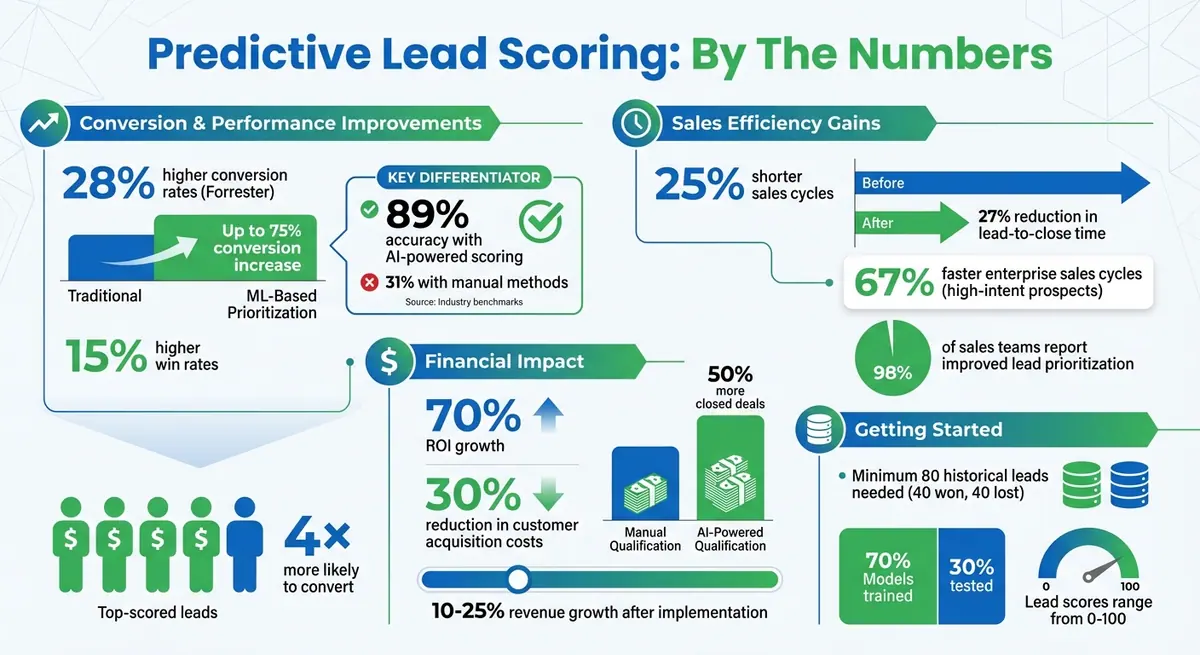
Predictive Lead Scoring Performance Metrics and ROI Statistics
Research Findings on Predictive Scoring Performance
Conversion Rate Increases
Research continues to confirm how predictive scoring can significantly boost conversion rates. For instance, Forrester reported a 28% increase in conversions when predictive scoring was applied. Another study found that machine learning–based lead prioritization could lead to conversion increases of up to 75%. Real-world examples back these numbers: Intercom, using internal data enriched with Clearbit, saw leads become four times more likely to convert. Similarly, DocuSign achieved a 38% jump in MQL-to-SQL conversions within just six months. A national real estate brand also discovered that leads in the top 10% of their predictive scoring system converted at four times the baseline rate. These conversion improvements naturally translate into higher revenue and better ROI.
Revenue Growth and ROI Gains
The financial benefits of predictive scoring are just as compelling. Studies indicate that ROI can increase by as much as 70%, while conversion rates can double from 10% to 20%. Salesforce data highlights that companies using AI-driven predictive scoring enjoy 15% higher win rates, and Harvard Business Review found that AI-powered lead qualification can result in 50% more closed deals. Case studies further illustrate these gains, with businesses reporting revenue growth ranging between 10% and 25% after implementing predictive scoring. By focusing on high-quality leads, companies not only increase revenue but also improve efficiency, which reduces overall costs - a topic explored further in the next section.
Lower Costs and Faster Sales Cycles
Predictive scoring doesn’t just drive conversions - it also slashes costs and shortens sales cycles. Forrester research shows that businesses using predictive scoring reduce their sales cycle length by 25% compared to traditional methods. Other examples echo this trend: companies focusing on high-intent leads have reported similar 25% reductions in sales cycles, while a cybersecurity SaaS provider used behavioral data to cut enterprise sales cycles by an impressive 67% for high-intent prospects. On top of that, businesses have seen a 30% drop in customer acquisition costs alongside conversion improvements. DocuSign, for instance, achieved a 27% reduction in lead-to-close time. By eliminating wasted effort on the 94% of leads that typically don’t convert, predictive scoring ensures that every outreach effort delivers maximum impact .
How Predictive Models Prioritize Leads
Data Types Used in Predictive Scoring
Predictive models zero in on three main types of data to figure out which leads are most likely to convert. First, there's behavioral data, which tracks actions that signal buyer intent - things like filling out forms, visiting pricing pages, engaging with emails, browsing websites, or viewing content. For instance, leads who check out compliance documents and attend webinars have a 94% conversion rate. Then there's firmographic data, which includes details about a company, such as its size, industry, and revenue. This helps pinpoint high-value accounts. Lastly, demographic data focuses on individual details like job titles and locations, giving a fuller picture of each lead.
Interestingly, you don’t need a massive dataset to get started. With just 80 leads - half qualified and half not - you can provide enough historical data for the model to start making accurate predictions. These distinct data categories form the backbone of effective predictive scoring.
How Algorithms Calculate Lead Scores
Algorithms like logistic regression and gradient boosting analyze historical data to assign each lead a score between 0 and 100. Here’s how it works: data is split, with 70% used to train the model and 30% reserved for testing. The algorithms then identify patterns by comparing attributes of past converters and non-converters, applying these insights to score current leads.
To ensure accuracy, models are evaluated using metrics like AUC, F1-score, precision (how many “hot” leads actually convert), and recall (how many actual converters the model catches). The results speak for themselves - AI-powered scoring achieves an impressive 89% accuracy in identifying high-value leads, compared to just 31% with manual methods. Unsurprisingly, 98% of sales teams report improved lead prioritization when they use AI.
How Reform Improves Data Quality for Scoring
The accuracy of predictive models depends heavily on the quality of the data they process. Reform steps in to boost this quality with several standout features. Lead enrichment automatically adds firmographic and demographic details to form submissions, creating complete profiles that help models spot patterns more effectively. Email validation and spam prevention ensure that invalid emails and bot submissions don’t clutter the data, keeping it clean and reliable.
Additionally, real-time analytics capture behavioral data as prospects interact with forms, while conditional routing ensures data collection stays accurate and relevant. By delivering cleaner and more detailed inputs, Reform enables predictive models to generate more dependable lead scores. This means sales teams can focus on the leads that truly matter.
Case Study Results: Predictive Scoring in Action
Before and After: Lead Generation Outcomes
Before adopting predictive scoring, B2B conversion rates left much to be desired. Many organizations struggled with prospect-to-qualified-lead conversion rates hovering around 10%, and only 1–6% of leads ultimately becoming customers.
The picture changed dramatically once predictive models were introduced. Companies reported 2–4× higher conversion rates for leads prioritized by these models compared to their baseline performance. Predictive scoring implementations drove 15–20% prospect-to-qualified-lead conversion rates (up from 10%), tripled sales conversion rates, and boosted lead-generation ROI by as much as 70%. Additionally, sales cycles became 25–27% shorter as reps focused on leads with genuine buying intent, while win rates improved by an average of 15%.
Take Intercom, for example. Their machine-learning-driven scoring made leads 4× more likely to convert, accelerating revenue growth. Similarly, DocuSign, leveraging predictive scoring through 6sense and Salesforce data, targeted behaviors like form fills and trial usage. Within just six months, they saw a 38% increase in MQL-to-SQL conversions and a 27% reduction in lead-to-close time.
These results underscore the transformative potential of predictive scoring when implemented effectively.
What Works: Implementation Best Practices
The success stories above reveal several key practices that fuel these impressive outcomes. First, companies achieving strong results ensure they have sufficient historical data - at least 40 won and 40 lost deals - to train accurate models. They also integrate behavioral signals such as website activity, content downloads, and pricing-page visits with form submissions, rather than relying solely on static demographic data. High-performing teams craft conversion-optimized forms that collect critical qualification details (e.g., company size, role, use case) and intent indicators (e.g., timeline, budget range), then enhance this data with firmographic insights.
Another best practice is to validate models through A/B testing or holdout experiments to measure incremental lift. For example, one national brand discovered that the top 10% of scored leads converted at 4× the baseline rate before scaling their model for full deployment.
Alignment across teams is also crucial. Companies that synchronize their marketing, sales, and RevOps teams around scoring thresholds and follow-up SLAs see faster responses and better close rates. These teams prioritize CRM outreach queues based on predictive scores, assign high-value leads to senior account executives, and set up real-time alerts for high-intent actions like pricing form completions.
sbb-itb-5f36581
Using Form Data Effectively in Predictive Scoring
Maintaining Data Quality and Enrichment
For predictive scoring to work well, the data you collect needs to be clean, organized, and reliable. The most useful information falls into four main categories: contact details (like name, role, and work email), firmographic data (such as company name, industry, employee count, and revenue in USD), behavioral signals (like visits to pricing pages, downloads, or trial sign-ups), and qualification indicators (like use case, budget range, or buying timeframe).
To keep forms simple and increase completion rates, many successful teams stick to three to five essential fields on their initial forms. They then use multi-step forms or enrichment tools to fill in the blanks automatically. For example, just collecting a work email and domain can trigger enrichment services to add details like company size, estimated revenue (in USD), U.S. headquarters location, and even the technology stack. Reform’s lead enrichment feature helps by gathering extra information online and only asking prospects for what can’t be filled in automatically - keeping forms short while ensuring profiles stay complete and standardized.
Standardization is equally important. Job titles should be grouped into consistent categories (e.g., "VP Sales" and "Head of Revenue" might both fall under "Decision Maker – Sales"). Similarly, industries should use controlled picklists, and company size should follow U.S. ranges like 1–10, 11–50, 51–200, 201–1,000, and 1,001+ employees. Revenue data works best when presented as annual ranges in USD, such as "$1M–$10M" or "$10M–$50M", to avoid unnecessary complexity. Reform enforces these standards with picklists, format validation for U.S. phone numbers and ZIP codes, and hidden fields that sync clean data directly to CRMs - eliminating the need for manual cleanup.
Keeping data quality high also involves real-time validation and deduplication. For instance, you can validate emails to block disposable domains and use CAPTCHA or behavioral checks to filter out spam submissions. CRM systems can apply deduplication rules - matching entries by email and domain - to ensure multiple form submissions from the same person update a single contact record. Reform’s advanced spam prevention, email validation, and CRM integrations handle these processes automatically, ensuring predictive scoring models always have accurate, up-to-date profiles.
With clean, enriched, and standardized data, predictive scores become a powerful tool for driving targeted marketing and sales strategies.
Applying Predictive Scores to Marketing and Sales
Once predictive scores are calculated, they can guide specific actions based on score ranges. Many teams use letter grades (A: 80–100, B: 60–79, C: 40–59, D: under 40) to set routing rules and service-level agreements (SLAs). For example, an A-grade lead from a U.S. company with 200+ employees might be routed directly to a senior account executive, with a 15-minute call SLA and a personalized email referencing the form asset they downloaded. B-grade leads are often sent to SDR queues with longer SLAs and a mix of outbound and nurturing campaigns, while C- and D-grade leads remain in automated nurture programs until they show new high-intent behaviors, such as filling out a pricing form.
Form responses can further refine lead routing. For instance, a prospect who selects "Enterprise security evaluation" as their use case and indicates a three- to six-month buying window might be routed to a vertical specialist. On the other hand, someone requesting a quick product overview might stay in a general queue. Reform’s conditional routing makes this process seamless: high-scored leads can be sent down a VIP path with a direct scheduling link, while lower-scored leads might receive a prerecorded demo or educational content - all based on rules that combine predictive scores with form inputs.
Predictive scores also support tiered engagement strategies. A-leads might receive personalized demos, ROI assessments, and pricing discussions tailored to their industry and use case. B-leads often get a mix of automated and human outreach, such as case studies or webinar invites, while C- and D-leads are placed into longer-term educational campaigns. Behavioral tags from forms - like "Downloaded enterprise security whitepaper" - can make emails and sales conversations more relevant by referencing the specific asset or page that sparked the lead's interest.
Finally, feedback loops are essential for keeping predictive models accurate. Teams should monitor conversion rates, pipeline progression, and revenue by score band, comparing predictions to actual closed-won deals. Models should be retrained if performance metrics, like precision or AUC, begin to decline. On the form side, A/B testing different field combinations - such as single-step versus multi-step forms or including versus excluding budget questions - can help identify designs that maximize both completion rates and lead quality. Sales feedback should also be incorporated into model training to refine features and correct labels. Reform’s real-time analytics can show which forms and fields are linked to higher scores and revenue, allowing teams to fine-tune both their data collection and predictive models over time.
Setting Up Predictive Lead Scoring Using Machine Learning
Conclusion
Research highlights that predictive lead scoring can lead to noticeable gains in conversion rates, sales efficiency, and ROI. For example, Forrester reports that companies leveraging predictive scoring achieve 28% higher conversion rates, 25% shorter sales cycles, and improved ROI compared to traditional methods. For U.S. B2B teams, where only 10% of leads are qualified and closing rates hover between 1–6%, even small improvements can mean tens - or even hundreds - of thousands of dollars in additional annual revenue.
The key to these results lies in high-quality form data. Predictive models thrive on complete and accurate demographic, firmographic, and behavioral signals to identify high-intent leads. Tools like Reform can make a big difference here by enabling businesses to collect structured data - such as company size, role, and use case - while applying real-time validation, blocking spam, and enriching records automatically. This kind of approach not only boosts scoring precision but also helps teams close deals faster, reduce sales cycles, and lower customer acquisition costs.
To get started, evaluate your existing data to ensure you have enough historical conversions - typically, a minimum of 80 leads (40 qualified and 40 disqualified) is recommended. Once that’s in place, refine your form capture and enrichment processes, establish key metrics like lead-to-opportunity rates and sales cycle lengths, and test predictive scoring with a specific segment to measure its impact. With modern tools, implementation is simpler than ever, making it easier for teams to unlock these benefits quickly.
FAQs
How does predictive lead scoring help increase sales conversions?
Predictive lead scoring empowers sales teams to zero in on leads most likely to convert by leveraging data-driven insights. This means less time wasted on unqualified prospects and more time spent closing deals, boosting overall efficiency.
By highlighting top-tier leads and delivering practical insights, predictive scoring not only enhances conversion rates but also optimizes ROI. It ensures resources are used wisely, enabling businesses to achieve stronger outcomes with less effort.
What data is most important for successful predictive scoring?
To make predictive scoring work effectively, it's important to zero in on the right data points. These include lead behavior (like browsing activity or email interactions), demographic details (such as age or location), firmographic data (like industry type or company size), and historical interactions (including past communications or purchase history). By digging into these areas, businesses can evaluate lead quality more accurately and estimate conversion potential, helping boost overall ROI.
What steps can businesses take to improve data quality for predictive scoring?
To enhance the quality of data used for predictive scoring, businesses need to prioritize accurate data validation and proactive data management. This means leveraging tools that tackle spam prevention, perform real-time email validation, and enrich leads to maintain clean, trustworthy data inputs.
On top of that, incorporating real-time analytics and A/B testing can pinpoint inconsistencies in the data and fine-tune processes. By routinely reviewing and updating data, businesses can ensure it stays relevant and usable, leading to improved predictive scoring results.
Related Blog Posts
Get new content delivered straight to your inbox

The Response
Updates on the Reform platform, insights on optimizing conversion rates, and tips to craft forms that convert.



Drive real results with form optimizations
Tested across hundreds of experiments, our strategies deliver a 215% lift in qualified leads for B2B and SaaS companies.
