
.webp)
Real-Time Bot Detection for Lead Generation



Bots are a growing problem for lead generation, with automated submissions making up as much as 30–60% of captured leads. These fake leads waste time, pollute your CRM, and skew critical performance metrics. Traditional methods like CAPTCHAs and IP blacklists are no longer effective against advanced bots that mimic human behavior. Real-time detection offers a better solution by analyzing user interactions during form submissions to identify bots instantly.
Key Takeaways:
- Why it Matters: Bots inflate costs, corrupt data, and can even lead to legal risks if stolen data is used.
- How It Works: Tracks user behavior (e.g., typing speed, mouse movements) and device details to spot anomalies.
- Benefits: Filters out bots without disrupting genuine users, ensuring clean, actionable leads.
Reform's no-code platform simplifies bot protection with tools like honeypots, email validation, and behavioral checks, helping businesses maintain data quality and improve marketing ROI.
Lead fraud: The hidden costs of bots in lead generation
How Bots Affect Lead Generation Forms
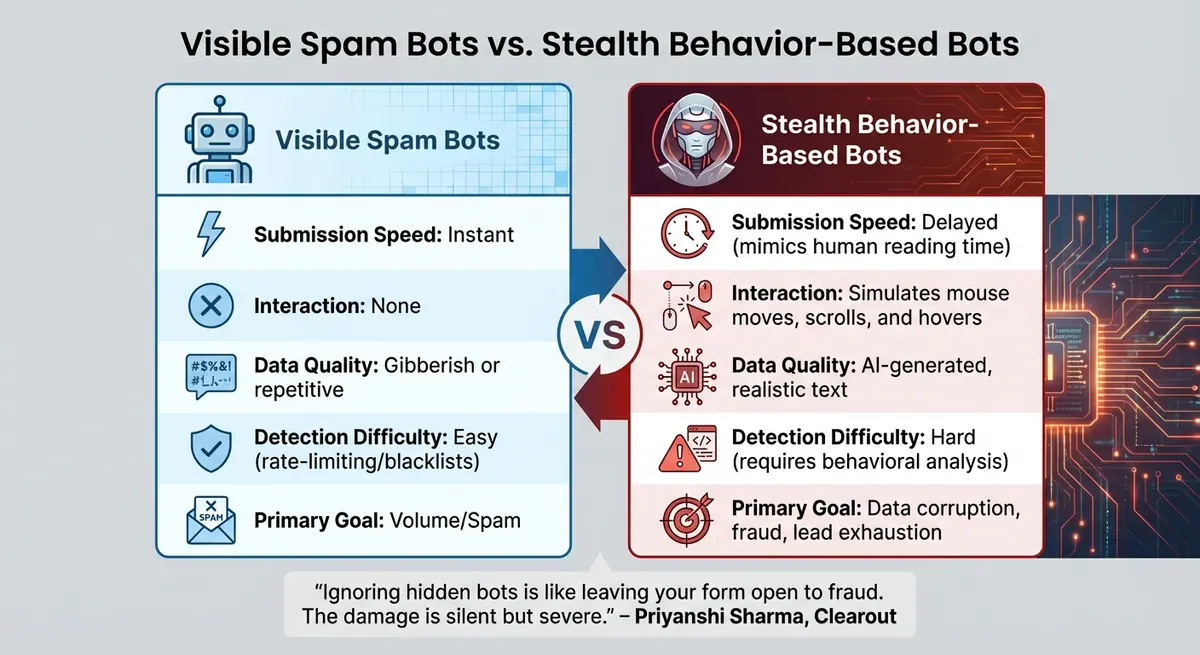
Visible Spam Bots vs Stealth Behavior-Based Bots Comparison
To combat bots effectively, it's crucial to first understand their behavior and the risks they pose. These automated threats have become more advanced, going far beyond the basic spam scripts of the past. Their impact extends well beyond clogging up your inbox.
Common Bot Types That Target Lead Forms
Modern bots are much smarter than their predecessors. They mimic human actions to slip past detection systems.
- Human-like typing simulation bots: These bots imitate natural typing patterns, including delays, typos, and cursor movements. They even wait 5 to 60 seconds before submitting a form to avoid detection by filters that flag instant submissions.
- IP rotation and geo-spoofing bots: By rotating residential IPs and proxies, these bots can appear to come from legitimate locations, bypassing rate limits and geographic restrictions.
- Browser fingerprint mimicry bots: Using tools like Playwright, Puppeteer, or Selenium, these bots can spoof device fingerprints, making them harder to identify.
- AI-generated text submission bots: These bots use advanced language models to produce realistic, contextually appropriate responses, allowing them to evade keyword-based spam filters.
- Low-and-slow bots: These bots operate sporadically, sometimes hijacking user sessions to appear as authenticated users.
"Ignoring hidden bots is like leaving your form open to fraud. The damage is silent but severe."
– Priyanshi Sharma, Clearout
| Feature | Visible Spam Bots | Stealth Behavior-Based Bots |
|---|---|---|
| Submission Speed | Instant | Delayed (mimics human reading time) |
| Interaction | None | Simulates mouse moves, scrolls, and hovers |
| Data Quality | Gibberish or repetitive | AI-generated, realistic text |
| Detection Difficulty | Easy (rate-limiting/blacklists) | Hard (requires behavioral analysis) |
| Primary Goal | Volume/Spam | Data corruption, fraud, lead exhaustion |
These advanced tactics create significant challenges, as bots increasingly behave like real users.
Problems Caused by Bot Activity
The consequences of bot activity on lead generation forms are far-reaching, affecting both data integrity and operational efficiency.
- Data corruption: Fake submissions pollute your CRM, skewing conversion metrics and making it difficult to identify genuine leads. This forces sales teams to waste time chasing "ghost" leads - contacts who never actually expressed interest or even know their data was submitted.
- Budget drain: Bots can target pay-per-click ads, driving up costs without generating real value. This not only inflates your cost-per-lead but also reduces ROI, making even successful campaigns appear unprofitable. On average, 10–30% of inbound leads are bot-generated or invalid, and if this figure exceeds 30%, it reflects major issues with campaign targeting or form security.
- Legal risks: Many bots use stolen or scraped data, such as real names and phone numbers from data breaches, to fill out forms. These fake "opt-ins" can lead to compliance violations. Under TCPA regulations, fines for contacting leads submitted by bots using stolen data can reach $1,500 per violation.
"In short, bot-driven lead fraud isn't just a quality issue, it's a compliance issue that can threaten your brand's reputation and financial stability."
– ActiveProspect
- Email deliverability issues: High volumes of fake sign-ups increase bounce rates, damaging your sender reputation. This makes it harder for your legitimate emails to reach actual prospects.
When bots infiltrate your lead generation forms, they undermine your ability to personalize marketing campaigns, score leads accurately, and trust performance metrics. The fallout goes beyond wasted time and money - it can erode your brand’s reputation and put your compliance at risk.
Signals Used to Detect Bots in Real-Time
Real-time bot detection relies on analyzing user behavior, device details, and network patterns to identify automation instantly. A submission might appear legitimate, but if its interaction style, device characteristics, or network source diverge from typical human patterns, it’s likely a bot. Advanced bots now use synthetic identities, leveraging real consumer data to bypass basic checks. This makes it crucial to conduct deeper behavioral analyses to detect anomalies effectively. These signals - behavioral, device-based, and network-related - form the foundation of modern detection methods.
"Detection systems monitor user interactions, device signals, and network behaviors to separate real people from bots." – ActiveProspect
Behavioral Analysis and User Interaction Patterns
Humans naturally take time to think, type, and interact, while bots perform tasks - like filling out forms - in the blink of an eye. Metrics such as keystroke dynamics and dwell time are key indicators of automated behavior. Additionally, movement patterns provide valuable insights: humans tend to exhibit erratic mouse movements and nonlinear scrolling, whereas bots often display uniform scrolling or straight-line cursor paths.
"Bots operate unnaturally fast - clicking, scrolling, and submitting forms in milliseconds." – ActiveProspect
This behavioral data is further complemented by device fingerprinting to refine detection accuracy.
Device Fingerprinting and Browser Environment Checks
Device fingerprinting works by creating a unique identifier based on details like installed fonts, screen resolution, hardware specs, and device capabilities. Detection systems also examine automation indicators. For example, browsers controlled by tools like Selenium or Puppeteer often have the navigator.webdriver property set to true . Comparing claimed User Agent data with actual browser behavior can expose inconsistencies. For instance, a bot might claim to be a high-end consumer device but reveal mismatched details, such as reporting an Nvidia GPU while posing as a MacBook .
"The good old days where bots used PhantomJS and could be detected because they didn't support basic JavaScript features are over. It's 2025, and the bots have never been as sophisticated as today." – Antoine Vastel, Research Lead, Castle
Advanced detection techniques may also trigger serialization events that occur only when a browser is controlled via CDP (Chrome DevTools Protocol). With over half of automated web traffic classified as "bad bots" designed for malicious purposes, these methods are more important than ever.
Network Traffic and IP Reputation Analysis
Network analysis plays a crucial role by examining IP geolocation, submission speeds, and cross-referencing traffic against known bot networks, proxy servers, and data center IP ranges. While IP reputation serves as a foundational signal, combining it with behavioral data adds depth to the analysis. This approach helps address issues like outdated or spoofed IP information, enabling systems to detect synthetic identities that use legitimate consumer data but originate from suspicious sources.
"Bot detection software cross-references traffic against known bot networks, proxy lists, and data center IPs." – ActiveProspect
sbb-itb-5f36581
Bot Detection Techniques for Lead Forms
Protecting lead forms from automated submissions requires practical, real-time defenses. A layered strategy - combining different techniques to address diverse bot behaviors - is key to maintaining security. Modern defenses integrate invisible traps, behavioral analysis, and pattern recognition, building on earlier-discussed signals to create a unified system.
Honeypot Fields and CAPTCHAs
Honeypots are hidden fields designed to trick bots. These fields, invisible to human users (using CSS properties like display: none or visibility: hidden), are often filled out by bots, signaling automated activity. Another example is time-based honeypots, which measure the time between form load and submission. If a form is submitted in under five seconds, it’s likely a bot. More advanced setups might include multiple hidden fields with varied names or fake links that only bots would interact with.
"Honeypots are a powerful yet subtle method to stop bots and malicious actors by tricking them into interacting with fake or decoy elements on your website or application." – Maria Paktiti, WorkOS
reCAPTCHA v3 offers another layer of defense by assigning a behavioral score (ranging from 0.0 to 1.0) to submissions. Scores below 0.5 are generally flagged as suspicious. Google provides reCAPTCHA v3 free for up to 1 million requests per month, with enterprise pricing starting at about $1 per 1,000 requests beyond that limit.
"Unlike reCAPTCHA v2, which offers a challenge to the user before submitting the form... reCAPTCHA v3 does not offer any challenge but passes a score... that can be used for triaging after the form has been submitted." – TyronPr, Adobe Champion
To avoid frustrating genuine users, honeypots should be well-hidden and paired with other detection methods for a more comprehensive approach. Scoring systems further refine this process.
Scoring Systems and Validation Rules
Real-time risk scoring evaluates how users interact with forms. Factors like typing speed, rhythm, and additional interactions help determine whether the user is human. Humans tend to type with irregular pauses, while bots often input data uniformly or instantaneously. Some bots attempt to mimic human behavior by delaying submissions for 5–60 seconds, but they often lack other natural interactions like mouse movements.
Behavioral scoring works best when combined with data integrity checks, such as filtering out disposable email domains, validating names, and using JavaScript fingerprinting. Tools like Playwright or Selenium can reveal mismatched device signatures through entropy scoring. Monitoring submission patterns also adds another layer of verification.
Form Submission Pattern Monitoring
Tracking submission patterns over time can expose subtle bot activities, such as "low-and-slow" attacks. In these cases, bots submit only a few forms per hour, avoiding detection by volume-based thresholds. Anomalies like impossible geographic travel patterns or unusual network activity can also signal bot behavior.
As CAPTCHA methods become increasingly bypassed by AI-driven solvers and human CAPTCHA farms, continuous behavioral monitoring is vital. By 2026, bots could account for 30–60% of captured leads, with modern bots representing over 25% of traffic on high-traffic sites. This activity not only clogs CRM systems with fake leads but also risks violations of laws like TCPA and CAN-SPAM.
Using Reform for Real-Time Bot Detection

Reform's no-code platform simplifies the integration of layered bot protection directly into your lead forms. By combining invisible traps, behavioral validation, and real-time monitoring, the system effectively filters out automated submissions while ensuring a smooth experience for genuine users. This streamlined approach brings the real-time detection methods mentioned earlier right into your form workflow.
Reform's Spam Prevention Features
Reform uses honeypot fields to automatically block bot submissions. These hidden fields, added through the no-code interface, are invisible to legitimate users, meaning they don't interfere with user experience or conversion rates. However, bots and browser extensions scanning for input fields are caught and rejected immediately .
Another powerful feature is real-time email validation, which identifies disposable email domains and malformed addresses as users type. This ensures invalid entries are stopped before they reach your CRM. To counter more advanced bots, Reform layers behavioral checks on top of basic challenges, enhancing its ability to detect suspicious activity .
Using Reform's Analytics to Monitor Bot Activity
Reform's custom dashboards provide detailed insights into behavioral signals, helping you monitor key metrics to detect bot activity. For instance, unusual spikes in form submissions or patterns like repeated entries from specific IP ranges can quickly indicate bot interference. Additionally, field-level abandonment analytics highlight the top five fields where users most frequently drop off. This helps differentiate between fields that frustrate human users and those targeted or bypassed by bots.
The platform’s real-time analytics allow you to act swiftly. If you observe a sudden influx of submissions without mouse movement or clusters from specific IP addresses, you can immediately tweak your validation rules to address the issue.
Setting Up Custom Validation Rules in Reform
To strengthen your bot defenses even further, Reform lets you create custom validation rules. Using Event Handlers in the "Code" section under Form Events, you can implement rules like requiring a minimum mouse movement of 3 pixels to catch headless browsers, validating zip code-state combinations to flag bot-generated mismatches, and capping submissions to 3 per hour per IP address for velocity control. These strategies are particularly effective against AI-driven bots that mimic human behavior and have been shown to reduce bot activity by 40% in high-volume lead generation campaigns .
Two key events for bot detection are:
onInput: Triggers after a field value changes, ideal for real-time validation of fields like email format.onPageSubmitted: Runs after submission but before backend processing, perfect for cross-field validation and final spam checks.
| Event Name | When It Runs | Best Use Case for Bot Detection |
|---|---|---|
onInput |
After an input value changes | Real-time validation of specific fields (e.g., email) |
onPageSubmitted |
After page submission, before backend | Cross-field validation and final spam checks |
onFormLoaded |
Once after the first page loads | Initializing third-party detection scripts |
Custom Event Handlers are available with Reform's Pro Plan, which is priced at $35/month or $350/year.
Conclusion
Protecting lead quality and ensuring a strong return on investment hinges on real-time bot detection.
Why Real-Time Bot Detection Matters
Bots don’t just waste your marketing dollars - they pollute your CRM with fake data and drag down conversion rates. Without real-time safeguards, sales teams end up chasing phony leads, and performance metrics become unreliable. Real-time detection acts as a frontline defense, ensuring only legitimate leads make it into your CRM.
Traditional methods like basic CAPTCHAs are no longer enough. Advanced bots can now outsmart these tools using AI-based image recognition. Real-time detection employs smarter techniques like behavioral analysis, device fingerprinting, and monitoring submission speeds to weed out automated traffic. The result? Your team gets clean, actionable data they can trust.
How Reform Protects Your Lead Data
Reform takes these principles a step further with layered detection strategies. Features like honeypot fields, real-time email validation, and behavioral checks block bots without creating extra hurdles for genuine users. Plus, Reform’s analytics dashboards let you track key performance indicators, making it easier to spot unusual patterns that could signal bot activity.
Custom no-code validation rules - such as requiring minimum mouse movement, matching zip codes to states, or limiting submissions by IP - add another layer of protection against bots. And because Reform integrates seamlessly with your CRM and marketing tools, only verified, human-generated leads make it into your sales pipeline. This not only preserves your budget but also keeps your data clean and reliable.
FAQs
How does real-time bot detection help improve the quality of leads?
Real-time bot detection works to ensure that only legitimate submissions make it through your lead generation forms. By spotting and blocking bots on the spot, it keeps your data clean and free from spam, protecting your database from unnecessary clutter.
With fake entries filtered out, your team can concentrate on connecting with real leads, which not only saves time and resources but also improves conversion rates. It’s an easy and efficient way to enhance the quality of the leads you capture.
What’s the difference between visible spam bots and stealth behavior-based bots?
When it comes to spam bots, the obvious ones are easier to catch. They tend to fill out forms with glaring issues - think random strings of gibberish, fake email addresses, or repetitive patterns. Tools like CAPTCHAs or basic spam filters are usually enough to block these.
The real challenge comes with stealthy, behavior-based bots. These are far more sophisticated and mimic human actions to fly under the radar. They can replicate things like typing speed, mouse movements, or even browsing habits to seem authentic. Spotting these bots takes more advanced strategies, such as analyzing behavioral patterns and employing layered security measures.
How does Reform help ensure accurate and reliable lead data?
Reform keeps your lead data clean and reliable by using real-time verification tools directly within its forms. These tools work instantly to confirm essential details like email addresses and phone numbers, so you only collect accurate and dependable information.
On top of that, Reform includes built-in anti-spam features to protect your database. With tools like email validation, spam filters, and behavioral analysis, it actively prevents fake or bot-generated submissions. This means better-quality leads and more effective marketing and sales efforts.
Related Blog Posts
Get new content delivered straight to your inbox

The Response
Updates on the Reform platform, insights on optimizing conversion rates, and tips to craft forms that convert.




Drive real results with form optimizations
Tested across hundreds of experiments, our strategies deliver a 215% lift in qualified leads for B2B and SaaS companies.
