
.webp)
PCI DSS Payment Forms: Encryption vs Tokenization


When it comes to securing payment forms under PCI DSS, two key methods stand out: encryption and tokenization. Both aim to protect sensitive cardholder data, but they work differently and suit different needs.
- Encryption: Converts readable data into unreadable ciphertext using algorithms and keys. Ideal for securing data in transit (e.g., during online transactions) and when the original data needs to be retrieved, such as for refunds or reports.
- Tokenization: Replaces sensitive data with random, non-reversible tokens. Best for long-term storage, recurring payments, and reducing PCI DSS compliance scope since sensitive data never resides in your systems.
Key Takeaways:
- Use encryption to secure data during transmission (e.g., from customer to server).
- Use tokenization to protect stored data and simplify compliance.
- Combining both offers the strongest protection: encrypt the journey, tokenize the destination.
Quick Comparison:
| Feature | Encryption | Tokenization |
|---|---|---|
| Purpose | Secure data in transit or at rest | Protect stored data |
| Reversibility | Reversible with a decryption key | Non-reversible (vault required) |
| PCI DSS Scope | Systems remain in scope | Reduces compliance scope |
| Performance | Higher processing overhead | Lower processing overhead |
| Use Case | One-time transactions, refunds | Recurring payments, data storage |
For the best results, use encryption to safeguard data as it moves and tokenization to secure it at rest.
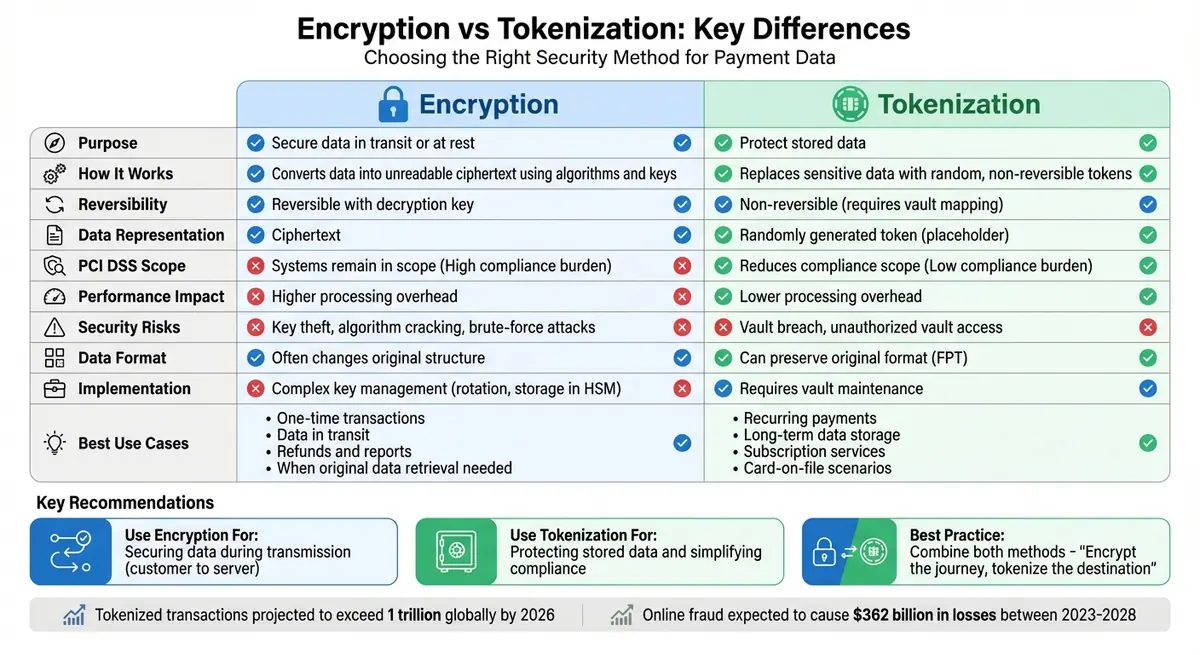
Encryption vs Tokenization for PCI DSS Payment Security Comparison Chart
How Encryption Works for PCI DSS Payment Forms
What is Encryption?
Encryption, as required by PCI DSS, secures sensitive data by converting it into an unreadable format called ciphertext. Stripe explains:
"Encryption transforms plaintext, the readable form of data, into ciphertext, an unreadable format."
This process uses a cryptographic algorithm along with a secret key, much like encoding a message with a private code. Commonly used algorithms include AES (128/256-bit) and RSA.
Since encryption can be reversed using the correct decryption key, it is ideal for situations where access to the original card data is necessary, such as processing refunds, generating reports, or authorizing transactions.
How Encryption Protects Payment Data
Encryption plays a critical role in securing payment data in two main scenarios: data in transit and data at rest.
- Data in transit refers to information being transmitted, such as when a customer enters their card details on a payment form. This data travels from their browser to your server. PCI DSS mandates the use of strong cryptography, often through protocols like Transport Layer Security (TLS), to protect this data as it moves across public networks. This prevents attackers from intercepting and reading the information.
- Data at rest includes stored information, such as data kept in databases, file systems, or backups. Encrypting stored data ensures that even if someone accesses the storage, the cardholder information remains unreadable.
However, encryption is only as strong as the protection of its decryption keys. If attackers gain access to the key, they can unlock the encrypted data. PCI Booking highlights this risk:
"The Achilles heel is key management."
To address this, PCI DSS requires encryption keys to be stored separately from the encrypted data. Ideally, keys should be kept in a Hardware Security Module (HSM) with strict access controls, regular rotation, and detailed logging. It's also important to note that encrypted cardholder data is still considered sensitive under PCI DSS, so systems handling it must undergo compliance audits.
Up next, we’ll look at tokenization and how it provides an alternative approach to securing payment data.
sbb-itb-5f36581
How Tokenization Works for PCI DSS Payment Forms
What is Tokenization?
Tokenization is a method that swaps sensitive cardholder data, like the Primary Account Number (PAN), with a randomly generated token. Unlike encryption, tokens have no mathematical connection to the original data, making it impossible to reverse-engineer the original information from the token itself.
Alex Pezold, CEO of TokenEx, explains it this way:
"Irreversible tokens have no mathematical relationship to the original data point. In other words, you cannot mathematically reverse-engineer the token value to get back to the original data point."
Here’s how it works: the original sensitive data is securely stored in an isolated vault protected by an HSM (Hardware Security Module). Meanwhile, the tokens - completely independent of the original data - are used by business systems. This method eliminates the need for decryption keys, significantly reducing the risk of key-related security breaches.
A special feature of tokenization is format-preserving tokens. These tokens are designed to match the length and format of the original data, such as a 16-digit credit card number. This makes it easier to integrate tokenization into older systems without requiring major changes to database structures.
Up next, let’s look at how this process helps protect payment data by separating sensitive information from your internal systems.
How Tokenization Protects Payment Data
Tokenization safeguards payment data through a streamlined five-step process. Here’s how it works:
- A customer inputs their card details via a secure API or hosted payment page.
- The data is encrypted during transmission using TLS (Transport Layer Security) and sent to a Token Service Provider (TSP).
- The TSP securely stores the original card data in a vault.
- A unique token is generated and sent back to your system. This token replaces the raw card data in your internal databases - whether it’s a CRM, analytics tool, or billing platform.
- When payment processing is required, authorized systems use the token to access the vault. The token is mapped to the original PAN, which is then sent directly to the payment processor through a controlled and auditable detokenization process.
This approach ensures that sensitive data never resides in your internal systems, reducing risk and simplifying PCI DSS compliance. By isolating the raw card data, tokenization creates a safer environment for handling payment information.
Encryption vs Tokenization: Key Differences
Key Factor Comparison
Both encryption and tokenization aim to protect payment data, but they function differently - and these differences influence which approach works best for your business.
The main distinction lies in reversibility. Encryption transforms data into ciphertext, which can be reverted to its original form using a decryption key. Tokenization, on the other hand, replaces sensitive data with a random placeholder that has no direct connection to the original information. As Checkout.com puts it:
"Tokenization is safer than encryption because there is no key or algorithm that a hacker could use to reveal its original value, and because the original data never has to leave the token provider's database."
This fundamental difference affects compliance and security. Encrypted data is still classified as sensitive, which means your systems stay within the scope of audits. Tokenization, however, removes sensitive data from your environment, reducing compliance burdens.
Here’s a closer look at how these two methods compare:
| Category | Encryption | Tokenization |
|---|---|---|
| Data Representation | Ciphertext | Randomly generated token (placeholder) |
| Security Risks | Key theft, algorithm cracking, brute-force attacks | Vault breach, unauthorized vault access |
| PCI DSS Scope Reduction | High; systems remain in scope | Low; effectively removes systems from scope |
| Performance Impact | Higher overhead due to processing demands | Lower overhead; minor lookup latency |
| Reversibility | Reversible with a decryption key | Non-reversible (requires vault mapping) |
| Implementation Complexity | Complex key management (rotation, storage) | Requires vault maintenance |
| Data Format | Often changes the original structure | Can preserve the original format (FPT) |
The performance and maintenance demands of each method also vary. Encryption requires careful management of keys - covering everything from generation and rotation to secure storage, often in Hardware Security Modules. Tokenization shifts the focus to maintaining the token vault. While a vault outage can disrupt processing, it eliminates the need for distributed key management.
For many businesses, the best strategy isn't choosing one method over the other. Instead, combining both can provide robust protection. As PCI Booking explains:
"The strongest payment architectures encrypt the journey and tokenize the destination".
In practice, this means using encryption to secure data in transit and tokenization to safeguard data at rest. This combination is especially useful for recurring billing and card-on-file use cases, offering comprehensive security tailored to different stages of the payment process. These distinctions help clarify when to choose encryption, tokenization, or both.
Is Payment Tokenization Safer Than Encryption?
When to Use Encryption vs Tokenization
Both encryption and tokenization are effective methods for securing payment data under PCI DSS, but they shine in different scenarios depending on your needs.
When Encryption is the Better Choice
Encryption works best for data in transit and situations where the original data needs to be retrieved. The PCI Security Standards Council describes it as:
"Cryptography is a method to protect data through a reversible encryption process, and is a foundational primitive used in many security protocols and services."
For example, encryption is ideal when card details are being transmitted over public networks, such as from a customer's browser to your payment gateway. With modern TLS protocols, this process is highly secure and introduces minimal delays.
It’s also a smart choice for one-time purchases where card details don’t need to be stored. Encrypting data in such cases eliminates the need for managing a token vault, simplifying operations. Additionally, if you’re working with older systems designed around encrypted storage, sticking with encryption might save you the hassle of a major infrastructure overhaul.
There are also scenarios where the original card number is necessary. For instance, international payment networks or advanced fraud detection systems may require temporary decryption for routing or analysis.
When Tokenization is the Better Choice
Tokenization, on the other hand, is particularly effective for long-term data storage and reducing compliance scope. When done properly, tokens are not classified as cardholder data, which can significantly shrink the systems included in your PCI DSS audit.
"Tokenization provides a greater degree of protection than encryption since the payment data itself is not used or transmitted and is only revealed once the token reaches its endpoint."
This makes tokenization perfect for recurring billing and subscription services, as it allows you to process payments without storing actual card numbers.
Tokenization is also advantageous for addressing data residency requirements. For instance, privacy laws like GDPR may require sensitive customer data to remain within a specific region. Using tokenization, you can store sensitive data in a local vault while relying on non-sensitive tokens for global transactions. Even in the event of a database breach, stolen tokens are useless to attackers without access to the secure vault.
Using Encryption and Tokenization Together
The most secure payment systems rely on a mix of encryption and tokenization to protect data both in transit and at rest. This approach addresses vulnerabilities at every stage of the payment process, offering end-to-end protection.
How the Two Methods Work Together
When encryption and tokenization are combined, they create a robust defense that covers the entire payment process. As Payop explains:
Encryption secures the journey, while tokenization secures the destination.
Here’s how this works in practice: when a customer enters their card details on a payment form, encryption (typically using TLS 1.2 or higher) safeguards the data as it travels across the internet to the payment gateway. Once the gateway processes the transaction, it replaces the sensitive card number with a token, which can be used for tasks like refunds or recurring payments.
This layered approach minimizes risk. If hackers intercept encrypted data during transmission, they can’t decode it without the encryption keys. Similarly, if they breach a database, the tokens are useless without access to the secure vault where the original data is stored. As James Ballard from Cryptek highlights:
In many cases, businesses combine tokenization and encryption to achieve the highest level of payment security.
By addressing vulnerabilities from multiple angles, this strategy ensures a more comprehensive defense.
Another advantage of using both methods is a reduced PCI DSS compliance scope. Encryption secures payment processing systems, while tokenization eliminates the need to store sensitive card data in your environment. With tokenized transactions projected to exceed one trillion globally by 2026, this combined approach is quickly becoming the go-to standard for businesses prioritizing security.
For optimal protection, encrypt data at the point of entry - whether through hosted payment pages or embedded iFrames - and tokenize it before it reaches internal servers. Additionally, encrypt tokens during transmission to safeguard against unauthorized mapping or metadata exposure.
Conclusion and Key Takeaways
Summary of Key Differences
After diving into the details, let's break down the critical distinctions and practical steps to improve payment form security.
Encryption and tokenization serve different purposes in protecting payment data. Encryption scrambles information so it’s unreadable without a decryption key, securing data during transmission. Tokenization, on the other hand, replaces sensitive card details with random tokens, ensuring stored data is safe. Think of it this way: encryption shields data in transit, while tokenization locks down stored information.
The main difference lies in reversibility and compliance implications. Encrypted data can be decrypted if someone gains access to the key, and systems storing encrypted data remain under PCI DSS audit requirements. Tokens, however, are useless to attackers since they can’t be reversed, and they reduce PCI audit scope by eliminating sensitive data from your systems. With tokenized transactions expected to exceed one trillion globally by 2026, this method is fast becoming a standard in the industry.
Next Steps for Your Business
Here’s how you can apply these insights to strengthen your payment form security:
- Map your card data flow: Identify every point where card data is captured, transmitted, or stored. This will help you determine where encryption or tokenization fits best within your systems.
- For recurring payments, adopt tokenization. This lets you securely reference payment details without storing sensitive card data.
- For one-time transactions, especially high-volume ones, use strong encryption protocols like TLS 1.2+ to protect data in transit. Once the transaction is authorized, delete the data immediately to minimize risk.
- Manage encryption keys carefully: Use secure storage, rotate keys regularly, and stick to trusted algorithms like AES-256. Shane Curran, the Founder & CEO of Evervault, puts it best:
The most secure data is data that doesn't exist
. Decrypt data only for the brief moment it’s needed for processing, and then erase it immediately.
- Combine encryption and tokenization: A layered approach offers the best defense. Use encryption to secure data in motion and tokenization to protect stored data. With online fraud expected to cause $362 billion in losses between 2023 and 2028, this dual strategy ensures robust protection for your payment forms.
FAQs
Does tokenization eliminate PCI scope completely?
Tokenization helps reduce PCI scope considerably by safeguarding sensitive payment data. However, it doesn't eliminate PCI scope entirely. Systems like the token vault and any related infrastructure still require compliance efforts. Ensuring proper implementation and ongoing management is crucial to meeting PCI DSS standards.
What happens if the token vault goes down or is breached?
If the token vault experiences downtime or a breach, the actual card data remains protected because tokens are non-sensitive and cannot be converted back into the original data. That said, risks can still emerge if access controls are weak. This makes it essential to implement strong security measures to reduce potential vulnerabilities.
Can I support refunds without storing card numbers?
Tokenization makes it possible. It works by replacing sensitive card information with a secure, randomly generated token that holds no actual value. The original card number is securely stored in a PCI DSS-certified environment. This means businesses can handle tasks like refunds, recurring payments, or even data analysis without directly managing card details. As a result, it minimizes PCI compliance requirements and boosts security.
Related Blog Posts
Get new content delivered straight to your inbox

The Response
Updates on the Reform platform, insights on optimizing conversion rates, and tips to craft forms that convert.



Drive real results with form optimizations
Tested across hundreds of experiments, our strategies deliver a 215% lift in qualified leads for B2B and SaaS companies.
