
.webp)
SCC Basics for SMEs



If EU personal data leaves Europe and your vendor is not covered by adequacy or the EU-U.S. Data Privacy Framework, I need SCCs plus a written TIA. That is the short answer.
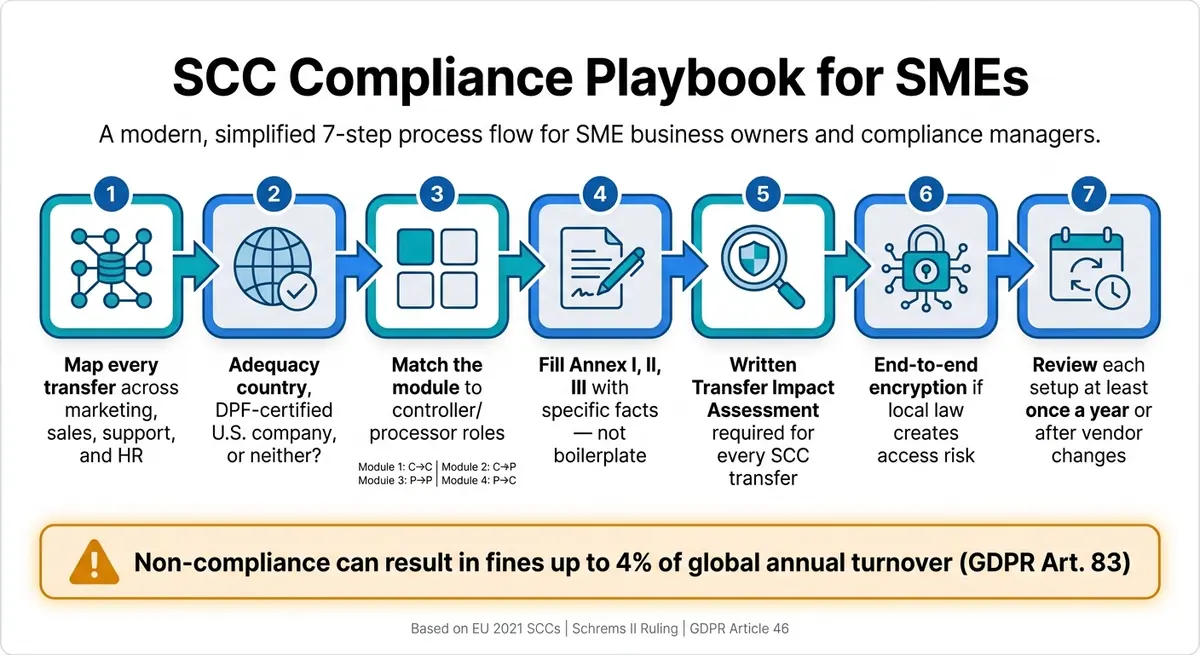
Here’s the playbook in plain English:
- Map every transfer across marketing, sales, support, and HR
- Check the destination: adequacy country, DPF-certified U.S. company, or neither
- Pick the right SCC module based on controller/processor roles
- Fill in the annexes with exact facts, not boilerplate
- Run a TIA for each transfer
- Add extra safeguards if local law creates access risk
- Review each setup at least once a year or after vendor changes
A few points stand out:
- The 2021 SCC text cannot be changed
- For many SMEs, Module 2 is the one used most
- Article 49 derogations are not for normal SaaS use
- GDPR transfer failures can lead to fines of up to 4% of global annual turnover
- A U.S. vendor may still need SCCs as backup even if it uses the DPF
This means SCCs are not just contract paper. I need the contract, the annexes, the TIA, and the day-to-day records to match the actual data flow.
That’s the core of the article: find the transfer, match the tool, document the risk, and keep one owner in charge.
SCC Compliance Playbook for SMEs: 7-Step Process
Core SCC Concepts and the Legal Rules Behind Them
Before you sign anything, pin down three basics: who the parties are, which module fits, and whether the SCCs need extra safeguards.
One rule sits at the center of all of this: the core legal text cannot be changed. You can complete the Annexes with your business details, but you can't rewrite the main clauses.
Exporter, Importer, Controller, and Processor Roles Explained
The exporter is the EU/EEA party sending the data. The importer is the non-EU party receiving it. Controller and processor, though, are about role, not geography.
A controller decides why and how personal data gets processed. A processor handles data only for a controller and follows that controller's instructions. This is where many SMEs slip up. They assume every vendor is a processor.
That isn't always true.
If a vendor makes its own decisions about how the data is used, it may be a controller under the law. And that can change the module you need.
Once you've sorted out who exports the data and who imports it, the next move is choosing the right module.
The Four SCC Modules and What Each One Covers
The 2021 SCCs come in four modules. Each one matches a different relationship between the parties.
| Module | Transfer Type | Typical SME Example |
|---|---|---|
| Module 1 | Controller → Controller | Sending EU leads to a U.S. partner for joint marketing |
| Module 2 | Controller → Processor | Using a U.S. cloud service to store EU customer records |
| Module 3 | Processor → Processor | An EU processor hiring a third-country sub-processor |
| Module 4 | Processor → Controller | An EU processor returning data to its third-country client |
For most SMEs, Module 2 is the one that comes up most often.
There’s another detail that matters under Modules 2 and 3. You need to keep an up-to-date list of sub-processors, and you need to make sure the SCC protections flow down to each party that handles the data.
Picking the right module is step one. But it still doesn't solve everything if the destination country's laws weaken those protections.
Schrems II and Why SCCs Alone May Not Be Enough
The Schrems II ruling in July 2020 made one thing very clear: signing SCCs by itself is not enough. If the destination country's laws, such as U.S. surveillance rules under FISA Section 702, weaken the SCC protections in practice, then the SCCs may not work as intended.
That is why you need a written Transfer Impact Assessment (TIA). The TIA looks at whether the legal setting in the destination country undercuts the SCC protections in practice. Regulators treat the lack of a TIA as its own compliance failure.
If the TIA shows risk, you need supplementary measures. In many cases, that means end-to-end encryption with the keys kept in the EU.
The 2023 Meta enforcement action drove the point home: SCCs need supplementary measures when foreign law creates access risk.
For SMEs, SCCs are often the practical Article 46 route, paired with a TIA. So the work doesn't stop once the paperwork is signed.
Next, map each transfer and match it to the right mechanism.
sbb-itb-5f36581
How SMEs Assess Whether They Need SCCs
Start with a data map. Then sort each transfer by destination and legal basis.
Map Data Flows Across Marketing, Sales, Support, and HR
Build a transfer inventory that shows what data you collect, where it goes, and which tools handle it.
Go function by function: marketing, sales, support, HR, and any outside vendors. Marketing often works with names, email addresses, IP addresses, and other customer data. Support teams may see customer messages and case history. HR handles payroll, benefits, performance records, and other employee data. That means employee data needs the same cross-border check as customer data.
Also check onward transfers. A main vendor may pass your data to its own sub-processors in countries that do not have adequacy. For each tool, ask two basic things:
- Where is the data stored?
- Are any sub-processors outside the EEA, UK, or Switzerland?
An EU vendor can still trigger SCCs if its support, hosting, or sub-processing happens outside the EEA.
If the data stays inside the EEA, SCCs are not needed.
Once your inventory is done, you can line up each transfer with adequacy, DPF, or SCCs.
Match Each Transfer to the Right Legal Mechanism
After you list your transfers, check the destination country. As of 2026, adequacy coverage includes the UK, Japan, South Korea, Switzerland, and Canada for commercial transfers. For U.S. vendors, check whether they are certified under the DPF. Many teams still use SCCs alongside DPF certification as a fallback.
If a U.S. vendor is not DPF-certified, or the vendor is in a country like India or China that has no adequacy decision, SCCs are usually the practical path. From there, match the SCC module to the exporter and importer roles.
Run a Basic TIA for Common SME Transfers
After you pick the legal mechanism, check whether local law cuts into the protection in practice.
Every SCC transfer needs a written TIA. For many SMEs, standard CRM and support data tends to be lower risk than sensitive data.
The table below shows common SME cases, the right module, the risk level, and measures you may want to use.
| Scenario | Role | SCC Module | TIA Risk Level | Suggested Measures |
|---|---|---|---|---|
| US CRM (DPF certified) | Controller → Processor | Module 2 | Low | Verify DPF status; pair DPF certification with SCCs |
| US analytics tool (non-DPF) | Controller → Processor | Module 2 | Medium/High | Encryption at rest; IP anonymization |
| EU SaaS with US sub-processor | Processor → Processor | Module 3 | Medium | Contractual audit rights; transparency reports |
| UK-based support team | Controller → Processor | N/A (Adequacy) | Adequacy | Document UK adequacy in ROPA |
| Indian development agency | Controller → Processor | Module 2 | High | End-to-end encryption; strict access controls |
Treat the TIA as a living document. Review it every year, or sooner if a vendor changes its sub-processor list or the destination country’s laws change in a material way.
Step-by-Step SCC Implementation for Contracts and Operations
After you map transfers and finish the TIA, the next job is to update contracts and records. Use what the TIA showed you to pick the right module, then turn that into contract language, annex details, and review dates.
Review Old Contracts and Add the Correct SCC Module
Start by pulling your current vendor agreements and DPAs. Flag each vendor that handles personal data outside the EEA. For each one, confirm which module fits based on the exporter and importer roles you identified during data mapping. Then check whether the contract already points to the current SCCs.
Attach the SCCs to the DPA or service agreement. If any contract term clashes with the SCCs on data protection, the SCCs win. Also take a close look at liability clauses. SCCs give broader third-party beneficiary rights than most standard commercial contracts.
If you work with DPF-certified U.S. vendors, keep SCCs ready as a backup.
Complete the Annexes with Specific Technical and Business Details
Once the contract is signed, the annexes need to match the actual data flow. This is where many teams slip up. Boilerplate annexes might look fine at a glance, but regulators often focus on them because they can expose a gap between paperwork and reality.
| Annex | What to Include | What to Avoid |
|---|---|---|
| Annex I | Specific data categories, data subjects, transfer purpose, frequency, and retention criteria | Vague phrases like "all personal data" or "as needed" |
| Annex II | Concrete security controls such as encryption at rest and in transit, pseudonymization, access control policies, data logging, and business continuity plans | Non-specific security language |
| Annex III | Named sub-processors, their addresses, and a description of the processing they perform | Blank fields or generic sub-processor language |
Make sure the annex details line up with your Record of Processing Activities (ROPA). If the SCCs say one thing and the ROPA says another, that can stand out during an audit.
Set Up Reviews, Records, and Owner Accountability
After signature, SCCs are not just paperwork sitting in a folder. They become part of day-to-day control. Keep everything in one SCC file: the signed SCCs with all annexes, the TIA for each destination country, and proof of any technical safeguards, such as encryption key management logs.
It also helps to name one person who owns the process. That might be your DPO, legal counsel, or a compliance lead. That person should review each transfer every year, or sooner if a vendor updates its sub-processor list, changes its hosting region, or if the destination country's laws shift in a material way. For high-risk transfers, the owner should document sign-off.
The table below sums up the main ongoing duties for EU exporters and non-EU importers after SCCs are signed.
| Obligation | EU Exporter | Non-EU / US Importer |
|---|---|---|
| TIA review | Review annually or after material legal or transfer changes | Share updated hosting or transfer details when material changes occur |
| Sub-processor updates | Verify downstream Module 3 SCCs are in place | Keep the sub-processor list current |
| ROPA maintenance | Link each transfer to the SCC module and TIA | N/A |
| DPF status check | Verify certification on the official DPF list | Maintain active certification if relying on the DPF |
| Due diligence readiness | Keep a vendor review pack with TIA methodology and an Annex II summary | Be ready to share the same support materials |
Non-compliance with GDPR transfer rules can lead to fines of up to 4% of global annual turnover. A clean, organized file makes it much easier to respond when a customer or regulator asks for proof.
Using SCCs in Marketing Forms and SaaS Workflows
Once the contract work is done, apply the same rules to the forms and SaaS tools that collect EU data. Marketing forms are often the first place EU personal data enters U.S.-connected workflows.
Apply SCC Principles to Lead Capture, Routing, and Downstream Tools
Map the full chain - form, automation, CRM, email - and assign Module 2 SCCs to each U.S.-based processor. Route EU submissions to EU-hosted workflows, collect only the fields you need, and check sub-processor pages for any new onward transfers.
How Reform Can Support SCC-Compliant Data Handling
Reform's multi-step form structure helps with data minimization right at collection. Conditional routing makes it easier to send EU visitors into region-specific workflows with tighter handling rules. Email validation and spam prevention cut down on records that don't need to enter downstream systems.
Because Reform connects with tools like Google Sheets, Zapier, and HubSpot, you can document exactly which systems receive EU lead data. That matters in practice. If your data flow changes and your paperwork doesn't, things drift fast. Use those controls to keep Annex I and the ROPA in line with the actual flow.
Conclusion: The Minimum SCC Playbook for SMEs
The examples below show where SCC duties show up in a typical lead-flow stack.
| Form Audience | Data Captured | Destination System | Destination | SCC Requirement | Safeguard |
|---|---|---|---|---|---|
| EU Visitor | Email, IP, Name | Reform (Form Builder) | EU/US | Module 2 (C2P) | Data minimization; encryption |
| EU Visitor | Lead Score | Salesforce (CRM) | US | Module 2 + TIA | DPF certification + SCC backup |
| Global | Newsletter Opt-in | Mailchimp (Marketing) | US | Module 2; add a TIA if DPF does not cover the transfer | Retention controls |
Treat SCCs as an operating control, not a one-time signature. For SMEs, the baseline is simple:
- Map transfers
- Match roles to modules
- Complete annexes
- Run a TIA
- Keep one owner accountable
FAQs
When do SMEs need SCCs?
SMEs need Standard Contractual Clauses (SCCs) when they transfer personal data from the EEA to a country that does not have a European Commission adequacy decision. The goal is simple: help keep that data protected at GDPR-level standards.
This often comes up when working with non-EU vendors, service providers, or business partners. And it’s not limited to regular data flows. Even a one-off transfer can trigger this requirement.
SMEs also need to complete a Transfer Impact Assessment. If local laws in the destination country could weaken privacy protections, they must add supplementary technical or organizational measures as well.
How do I choose the right SCC module?
First, identify who is exporting the data and who is importing it in the transfer. The SCCs include four modules:
- Controller to Controller
- Controller to Processor
- Processor to Processor
- Processor to Controller
Next, work out whether each party is a controller or processor. The key test is simple: who decides the purposes and means of the processing?
If the roles change from one transfer to another, you can use more than one module within the same set of SCCs. Just make sure the selected module for each transfer is clearly listed in the annexes.
What should a TIA include?
A Transfer Impact Assessment (TIA) should spell out your data transfers in plain terms. That includes the type of data being sent and any onward transfers to sub-processors.
It should also look at whether the destination country’s laws and day-to-day practices could weaken the protections in the SCCs. In practice, that means checking things like government access, redress options, and bulk collection.
If you spot risks, document the extra safeguards needed to deal with them. These can include technical, contractual, or organizational measures.
Related Blog Posts
Get new content delivered straight to your inbox

The Response
Updates on the Reform platform, insights on optimizing conversion rates, and tips to craft forms that convert.



Drive real results with form optimizations
Tested across hundreds of experiments, our strategies deliver a 215% lift in qualified leads for B2B and SaaS companies.
