
.webp)
How Standard Contractual Clauses Work for Data Transfers


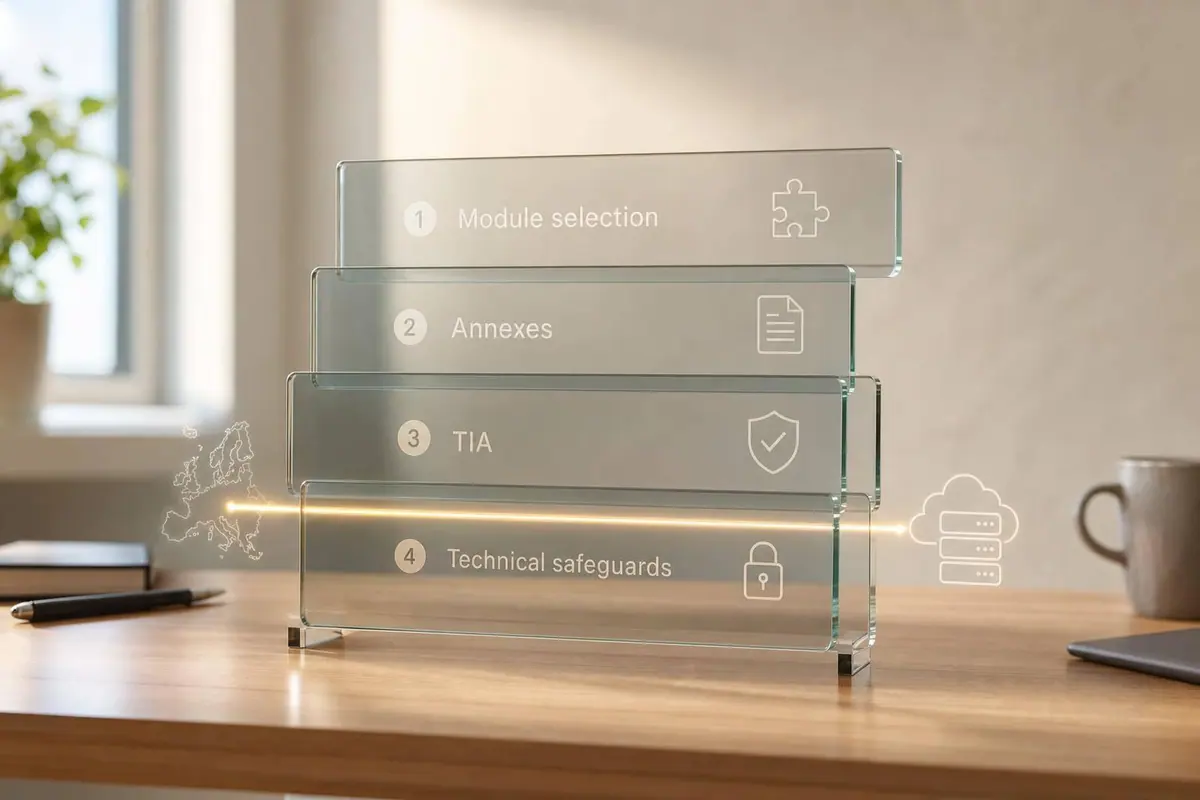
If you send EU personal data to the U.S. and you do not use the EU-U.S. Data Privacy Framework, you will usually need SCCs. But signing SCCs alone is not enough.
Here’s the short version: I use SCCs to make the transfer contract lawful, pick the right module based on party roles, fill in the annexes, run a Transfer Impact Assessment, add extra safeguards, and review the setup at least once a year. That matters because the GDPR treats cross-border transfers as a separate step from normal data processing rules.
Before I approve any transfer, I check these points:
- Is there an adequacy decision or DPF coverage? If yes, SCCs may not be needed.
- Which SCC module fits? There are 4 modules, based on controller/processor roles.
- What data is leaving the EEA? Think form data, CRM records, analytics data, and support data.
- Do the annexes match the data flow? If not, the paperwork is weak.
- Has a TIA been done? After Schrems II, this is a must.
- Are extra safeguards in place? For example, encryption, MFA, and limits on sub-processors.
- Is there a review plan? A vendor change, new data field, or new use case should trigger an update.
A few facts stand out: the current SCCs come from EU Decision 2021/914, they use Modules 1 through 4, and U.S. transfer reviews often look at FISA 702 and EO 12333.
So if I had to boil the whole process down, it would be this: check if SCCs are needed, choose the right module, complete the annexes, document the TIA, apply the stated safeguards, and keep everything up to date. The rest of the article explains how to do that without missing a step.
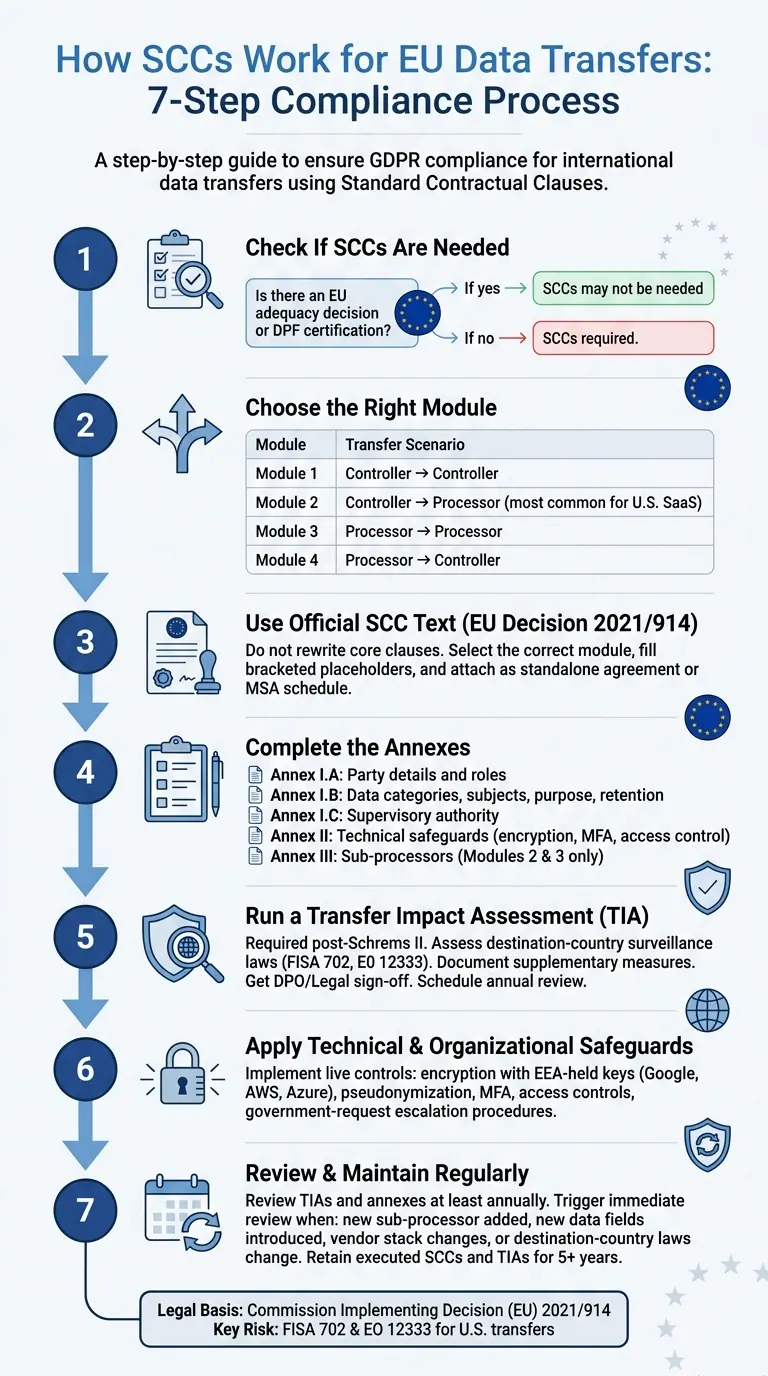
EU Standard Contractual Clauses (SCCs): Step-by-Step Compliance Process
When You Need SCCs and How to Choose the Right Module
Check the Destination Country and Map the Data Flow
First, check whether the recipient country is covered by an adequacy decision or whether the recipient is certified under the DPF. If neither applies, use SCCs. You can check DPF certification at dataprivacyframework.gov.
After that, map every system that touches EU personal data. That includes your CRM, email platform, analytics setup, and support tools. For each system, note:
- the recipient country
- the data categories involved
- whether the vendor uses sub-processors in other third countries
You should also record any onward transfers in Annex III.
Once you've confirmed SCCs apply, match each transfer to the right module.
Match the Transfer to Modules 1 Through 4
Use the roles of the parties, not the vendor's location, when choosing the module.
| Module | Relationship | Common Example |
|---|---|---|
| Module 1 | Controller → Controller | Two companies sharing a prospect list for a joint webinar |
| Module 2 | Controller → Processor | An EU company syncing leads to a U.S.-hosted CRM like Salesforce |
| Module 3 | Processor → Processor | An EU SaaS provider using a U.S.-based sub-processor for data analysis |
| Module 4 | Processor → Controller | A processor returning processed data to its controller client |
For many U.S. SaaS and marketing teams, Module 2 is the one that comes up most often. It covers cases where an EU controller sends data to a non-EU service provider acting as a processor.
Module 3 matters when you act as a processor and pass work to another non-EU vendor. That's common with sub-processors.
Identify Form and Lead Capture Workflows That Require SCCs
Headless forms are often where SCC duties show up first. If an EU visitor fills out a form and that data syncs to a U.S.-hosted CRM or email platform, Module 2 SCCs apply.
A simple way to limit risk: collect only the fields you need before sending data to U.S.-hosted systems.
sbb-itb-5f36581
How to Implement SCCs Step by Step
Use the Official SCC Text and Attach It Correctly
Once you’ve matched the transfer to the right module, finish the SCC package in three steps.
Start with the European Commission’s modular SCCs under Commission Implementing Decision (EU) 2021/914. Don’t rewrite the core clauses. Pick the right module and any optional fields in the text, fill in the bracketed placeholders and annexes, and add supplementary safeguards that don’t conflict with the SCCs.
You can execute the SCCs as a standalone agreement or attach them as a schedule to the MSA.
Complete the Annexes with Accurate Transfer Details
Use the same data-map details here so the SCCs line up with the actual transfer.
| Annex | What to Include |
|---|---|
| Annex I.A | Names, addresses, contact persons, and roles (exporter/importer) for each party |
| Annex I.B | Categories of data subjects, data categories, sensitive data, transfer frequency, purpose, and retention periods |
| Annex I.C | The specific EEA supervisory authority responsible for the exporter |
| Annex II | Specific controls such as encryption, MFA, access control, pseudonymization, and incident response |
| Annex III | Full list of sub-processors with their full legal names, locations, and specific processing tasks (Modules 2 & 3 only) |
For Annex I.B, include only the data your forms actually collect. If you use Reform, its conditional logic and form fields can help you document the data categories captured.
Sign, Store, and Link SCCs to Your Data Map
Authorized representatives of each exporter and importer must sign the executed SCCs. You can use electronic signatures if they’re valid under the governing law.
Store the executed SCCs in a central contract register alongside any related Transfer Impact Assessments (TIAs). Link each signed SCC to the related vendor, integration, and ROPA entry. Keep the signed SCCs tied to the vendor record so updates show up during review.
How to Handle TIAs, Safeguards, and Day-to-Day Controls
Run a Transfer Impact Assessment for Each Transfer
Signing SCCs is only the start. You also need to show that the transfer is protected in practice.
Use the signed SCCs and your data map as the basis for the TIA. At a minimum, the TIA should map the transfer, review third-country law, list any extra measures, and include a review date.
For U.S. transfers, look closely at government-access risk under FISA Section 702 and Executive Order 12333. Your notes should also cover any redress and challenge procedures that may be available. EDPB country-specific recommendations can help with this review.
Use this table as a minimum checklist for TIA records:
| TIA Component | What to Document |
|---|---|
| Transfer Map Extract | Data categories, subjects, purpose, and recipient identity |
| Transfer Mechanism | Applicable SCC module |
| Third-Country Analysis | Assessment of surveillance laws (FISA 702, EO 12333) and redress |
| Supplementary Measures | Technical (encryption), contractual (notices), and organizational steps |
| Conclusion | Formal determination if the transfer provides adequate protection in practice |
| Sign-off & Review | DPO/Legal approval and a scheduled annual review date |
Review each TIA at least once a year, or earlier if the vendor’s stack changes or the destination country’s laws change.
Apply Technical and Organizational Safeguards
Annex II safeguards need to be live in your setup, not sitting in a file somewhere.
For higher-risk transfers, encrypt data with EEA-held keys. Providers like Google, AWS, and Azure offer setups where decryption keys stay in the EU and aren’t available to a U.S. processor. Pseudonymization before transfer can also cut exposure, especially for form-submission data that does not need to stay identifiable on the importer’s side.
On the organizational side, set a clear process for disclosure and escalation. Put formal procedures in place for challenging government-access requests. Also use strict internal rules that limit onward transfers to extra sub-processors. Safeguards should match the facts on the ground:
- Data volume
- Data sensitivity
- Likelihood of government access under destination-country law
Keep these controls lined up with the TIA so any shift in risk leads to a review.
Build SCC Obligations into Day-to-Day Controls
SCC duties shouldn’t live only in the contract. They need to show up in daily work.
Keep processing instructions documented. Make sure the importer has a clear process for government requests, internal escalation, and onward-transfer limits. If the importer decides it can’t comply with the SCCs - for instance, because a government order clashes with those duties - it should tell you fast so you can suspend the transfer.
"The processor shall process personal data only on documented instructions from the controller." - European Commission, SCC Clause 7.1
If your forms send data into U.S. systems, link each form field to the transfer map before you approve the TIA. Then revisit the TIA any time vendors, sub-processors, or transfer conditions change.
How to Review, Update, and Maintain SCCs Over Time
Update SCCs When Vendors, Data Fields, or Purposes Change
Once SCCs are in place, the job shifts from setup to change control. In plain English: treat SCCs like documents that need regular care, not something you file away and forget.
A few changes should set off a review right away. If you add a new sub-processor, update Annex III and notify the controller. If the transfer starts to include sensitive data, revise Annex I.B. And if the purpose of processing changes - for example, from storage to AI training - the SCCs need to reflect that shift and the different level of risk.
The same goes for new data fields or a new routing path to a third-country system. Review the transfer documents before that change goes live, not after the fact.
Document Decisions and Show Compliance
When a review is triggered, your records should be updated too.
Regulators expect SCCs to be current, and they expect the paperwork behind them to match. That includes signed SCCs with completed annexes, written TIAs, a current Record of Processing Activities (ROPA), and updated privacy notices when transfer destinations or transfer tools change. Keep executed SCCs and TIAs for at least five years after a transfer ends. It also helps to keep dated approvals in version control, so you can show what changed and when.
Key Takeaways
Use this checklist to keep SCCs current.
| Step | What to Do |
|---|---|
| Confirm the need | Check whether the destination country has an EU adequacy decision; if not, SCCs are required |
| Choose the module | Match the transfer to Module 1, 2, 3, or 4 based on the controller/processor relationship |
| Use official text | Use the 2021 European Commission modular SCCs; legacy 2001/2010 templates are no longer valid |
| Complete the annexes | Fill in Annex I (transfer details), Annex II (technical and organizational measures), and Annex III (sub-processors) accurately |
| Perform a TIA | Assess destination-country law, document supplementary measures, and get formal sign-off |
| Apply safeguards | Implement technical controls, such as encryption with EU-held keys, that match your Annex II commitments |
| Review regularly | Reassess TIAs and annexes at least annually, and immediately when vendors, data fields, or laws change |
What Are Standard Contractual Clauses (SCCs)?
FAQs
Do SCCs cover every U.S. data transfer?
No. Standard Contractual Clauses do not cover every U.S. data transfer.
They apply to cross-border transfers from the EEA to countries that do not have a European Commission adequacy decision in place. So this isn't a one-size-fits-all rule.
If a transfer falls under an adequacy decision, such as the EU-U.S. Data Privacy Framework, SCCs are not needed. Organizations can also rely on other transfer tools, including Binding Corporate Rules or certain regulatory derogations.
What if my vendor changes sub-processors?
If your vendor swaps or adds sub-processors, update your records and keep Annex III under the Standard Contractual Clauses up to date.
Your agreement may call for either general written authorization or prior specific authorization. When general authorization applies, you can usually object to a new sub-processor. The exact steps matter here, so check your data processing agreement for the notice process and any deadlines tied to it.
Can I use one TIA for multiple transfers?
Usually, no. A Transfer Impact Assessment (TIA) is tied to a specific transfer, so one TIA generally shouldn’t cover every transfer.
Each transfer case should be reviewed and documented on its own. That review should look at the destination country’s laws, the data being transferred, and the safeguards in place, so you can confirm that those laws don’t weaken the Standard Contractual Clauses.
Related Blog Posts
Get new content delivered straight to your inbox

The Response
Updates on the Reform platform, insights on optimizing conversion rates, and tips to craft forms that convert.


Drive real results with form optimizations
Tested across hundreds of experiments, our strategies deliver a 215% lift in qualified leads for B2B and SaaS companies.
