
.webp)
Global Cookie Laws: Key Trends 2026



Cookie rules got stricter in 2026, and a weak consent setup now hits both compliance and marketing data. I’d boil it down like this: if your site drops non-essential trackers before consent, hides “Reject All,” ignores Global Privacy Control, or logs consent poorly, you have a problem.
Right now, 144 countries have national privacy laws, covering about 82% of the world’s population. At the same time, consent rates are falling: average acceptance is around 39%, about 40% of users say no when given a clear choice, and bad consent setups can wipe out 40%–60% of ad measurement data. For teams that run ads or depend on lead forms, this is not just a legal issue. It changes attribution, remarketing, and reporting.
Here’s the short version:
- EU and UK: opt-in first; non-essential tracking must wait for consent
- U.S.: mostly opt-out, but state laws and GPC checks are growing
- Brazil, Quebec, India, and China: stricter consent rules, plus local language or separate consent rules
- Banner design matters: “Reject All” should be as easy to use as “Accept All”
- Enforcement is more direct: regulators now review script timing, consent flows, logs, and vendor disclosures
- Third-party tracking is losing ground: first-party data, server-side tagging, and consent-aware analytics are getting more attention
- lead forms are part of the issue too: form tracking has to match the user’s consent choice , requiring optimized conversion paths that respect privacy.
This is why your site might need a cookie banner in 2026
sbb-itb-5f36581
Quick Comparison
| Region | Main Model | What to watch |
|---|---|---|
| EU / EEA | Prior opt-in | No non-essential tracking before consent; equal reject option |
| UK | Prior opt-in with narrow exceptions | Low-risk analytics carve-outs, but consent-first still leads |
| U.S. | Opt-out | GPC signals, “Do Not Sell/Share,” state-by-state rules |
| Brazil | Prior opt-in | Portuguese interface, no pre-ticked boxes |
| Quebec | Prior opt-in | Explicit action and French/English support |
| India | Prior opt-in | Multi-language consent and one-click withdrawal |
| China | Explicit opt-in | Separate consent for profiling and tracking uses |
If I were summarizing the whole article in one line, it would be this: cookie compliance in 2026 depends on what your site actually does, not just what your banner says.
2026 Global Cookie Regulation: A Quick Overview
In 2026, regulators are lining up around one idea: valid consent. That means consent must be freely given, specific, informed, and unambiguous. And the gap between the rule and what many sites are doing is still huge. A 2025 study found that 78% of cookie banners across 10,000 EU websites were non-compliant.
The catch is that the same core rule doesn’t look exactly the same everywhere.
Consent standards are getting stricter
Pre-ticked boxes, bundled consent, and implied acceptance are facing tougher legal scrutiny across the EU, UK, Brazil, and India. Regulators want a user to take a clear yes-action before non-essential cookies start firing. Just landing on a page while tracking begins in the background doesn’t cut it anymore.
Bundling analytics, advertising, and functional cookies into one big “Accept” button is also running into trouble. Why? Because users aren’t being given a real choice for each purpose. If everything is lumped together, control is more fiction than fact.
One-click rejection is becoming a bigger issue too, especially in the EU and India. The rule is simple: refusing or withdrawing consent must be just as easy as giving it. So if someone can accept all cookies in one tap, but has to click through multiple settings screens to say no, regulators are starting to treat that as a compliance issue, not just bad UX.
The pattern is broad, but it plays out differently across the EU, the U.S., and APAC.
Banner design now carries more legal risk
Regulators aren’t stopping at “Does a banner exist?” They’re looking at how that banner is built.
The European Data Protection Board (EDPB) has flagged deceptive design patterns, including tactics like "Stirring" and "Obstructing". If the design pushes, nudges, or traps users into saying yes, the consent collected through that banner can be legally invalid. No gray area there.
Recent CNIL fines against Google and SHEIN show what that can cost when dark patterns or pre-consent tracking are involved.
First-party data is replacing third-party cookies
Legal pressure, plus tighter browser limits, is pushing companies toward first-party data strategies. That includes consent-aware analytics, server-side tagging, and direct lead capture. In plain English: businesses are moving toward setups that don’t rely on tracking signals users are blocking or refusing more often.
The numbers make the shift hard to ignore:
- Average cookie consent acceptance rates have fallen to 39%, down about 15% in one year.
- 40% of users now refuse cookies when they’re given a real choice.
- In markets like Germany and France, fewer than 25% of users accept cookies at all.
- A weak consent setup can reduce advertising measurement data by 40% to 60%.
That last point matters a lot. It’s not just a legal problem. It hits attribution, reporting, and campaign readouts almost immediately.
These trends are global, but enforcement still varies a lot by region. The regional models behind those differences come next.
How Cookie Laws Differ by Region
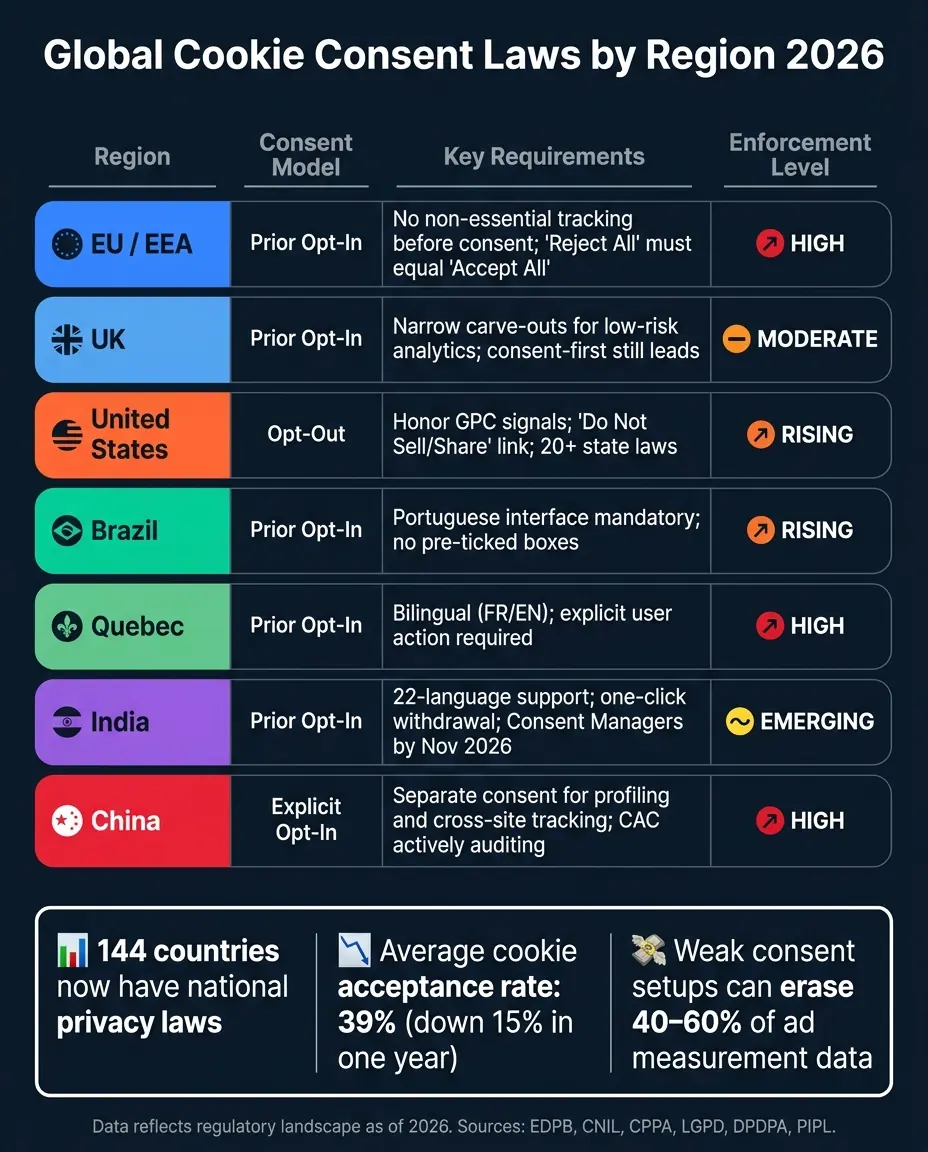
Global Cookie Consent Laws by Region 2026
Cookie law tends to split into two operating models: opt-in outside the U.S. and opt-out across most U.S. states. That gap matters a lot. The exact same tracking setup might be allowed in one place and blocked in another.
| Jurisdiction | Default Consent Model | Third-Party Cookie Treatment | Consent UI / Key Requirements | Enforcement Severity |
|---|---|---|---|---|
| EU / EEA | Prior opt-in | Blocked until consent | "Reject All" must equal "Accept All" | High |
| UK | Prior opt-in | Blocked until consent | Opt-out allowed for "low-risk" analytics only | Moderate |
| U.S. | Opt-out | Generally allowed until opt-out | "Do Not Sell/Share" link; must honor GPC signals | Rising |
| Brazil | Prior opt-in | Blocked until consent | Mandatory Portuguese; no pre-ticked boxes | Rising |
| Quebec | Prior opt-in | Blocked until consent | Bilingual (FR/EN); explicit action required | High |
| India | Prior opt-in | Blocked until consent | Multi-language support; one-click withdrawal | Emerging |
| China | Explicit opt-in | Separate consent for tracking/profiling | Separate consent for sensitive/profiling data | High |
EU and UK: consent-first enforcement remains the baseline
The EU and UK are still the toughest consent-first markets. If a cookie or tracker is non-essential, it can't fire until the user actively agrees. That includes more than standard HTTP cookies. The rule also covers tracking pixels, URL parameters, local storage, and device fingerprinting. In the UK, the Data Use and Access Act 2025 adds narrow carve-outs for low-risk cookies, such as basic analytics and load balancing.
Both regions also expect "Reject All" to be just as visible and just as easy to use as "Accept All" on the first banner layer. It can't be hidden in a settings menu or tucked behind extra clicks. The September 2025 CNIL fines against Google (€325 million) and SHEIN (€150 million) show what happens when rejecting is harder than accepting.
United States: state privacy laws create an opt-out patchwork
In the U.S., the big issue is fragmentation. As of early 2026, more than 20 states had active privacy laws, and most follow an opt-out model. For many teams, the rule with the biggest day-to-day impact is Global Privacy Control (GPC). Twelve states, including California, Colorado, and Texas, require sites to treat those browser signals as a valid opt-out.
Enforcement is picking up. In September 2025, California, Connecticut, and Colorado ran a joint sweep against businesses that failed to honor GPC. Later, the California Privacy Protection Agency reached a $1.35 million settlement with Tractor Supply over opt-out failures. Then more states came online. Indiana, Kentucky, and Rhode Island activated their laws in January 2026, adding opt-out duties tied to targeted advertising.
Canada, Brazil, and APAC: mixed models with rising compliance pressure
Canada, Brazil, and parts of APAC sit in a more mixed landscape. The rule set often combines opt-in consent with language and consent-manager demands.
Canada is a good example. Federal PIPEDA allows implied consent for low-risk cookies, but Quebec's Law 25 takes a stricter line and requires explicit opt-in for tracking. Brazil's LGPD also uses an opt-in model, and it adds Portuguese-language interfaces plus a ban on pre-ticked boxes.
Across APAC, the rules vary but the direction is clear. India's DPDPA is rolling out through 2027 and will require consent interfaces in 22 languages, along with registered Consent Managers by November 2026. China's PIPL goes further for cross-site tracking and profiling, requiring separate, explicit consent. The CAC is also actively auditing compliance.
Those regional differences shape enforcement risk, measurement loss, and how you design lead capture.
Enforcement, Litigation, and Compliance Risk in 2026
Once regional rules are in place, enforcement comes down to execution: what loads, what gets logged, and what the user can actually control.
Cookie compliance in 2026 isn't just about putting a banner on your site. Regulators are now digging into consent flows, and private lawsuits are adding another layer of risk.
What regulators are actively reviewing
Enforcement is centering on the same trouble spots again and again. Here's where regulators are looking in 2026, and what they keep finding:
| Review Area | Regulator Focus in 2026 | Common Violation |
|---|---|---|
| Banner Design | "Reject All" must be as prominent and easy to use as "Accept All" on the first layer | "Reject All" hidden in a second layer or smaller than "Accept All" |
| Script Timing | Prior consent enforcement | Analytics or ad pixels firing before consent |
| Technical Integrity | Signal persistence and withdrawal | "Reject All" button failing to actually block scripts |
| Data Mapping | Vendor-level disclosure | Bundling 40+ vendors under a single "Marketing" toggle |
| Automated Signals | Global Privacy Control (GPC) | Ignoring GPC signals |
Regulators have confirmed that tracking pixels, URL parameters, IP-only tracking, and device fingerprinting all fall within scope for enforcement. And the cost isn't theoretical. Recent CNIL actions show how expensive these failures can get: pre-consent cookie placement and non-working reject buttons have each led to fines in the hundreds of millions of euros.
Private lawsuits are also adding pressure. In the U.S., plaintiffs are using statutes like the California Invasion of Privacy Act to go after deceptive consent design, even when no regulator has acted yet.
Why compliance breaks down over time
The hard part usually starts after launch.
A marketing team adds a new retargeting pixel through a tag manager. A CMS plugin updates and drops in a new analytics script. No one sends either change through legal review, and the consent management platform never gets updated. So now you have a compliant-looking banner in front of a non-compliant tracking setup.
Under the UK's Data (Use and Access) Act 2025, organizations are liable if they cause a third-party vendor to set a cookie. That makes vendor oversight a legal duty, not just a smart internal habit. Then there's the proof problem. Under GDPR Article 7, you must be able to show that valid consent was obtained, including the timestamp, the version of the notice shown, and the per-purpose consent state, for a statutory limitation period that can run three to six years. If your logs don't hold that detail, defending yourself in an audit gets much harder.
Controls that reduce legal and technical exposure
Because enforcement now targets implementation, compliance can't stop at launch.
Recurring technical audits are the starting point. Open developer tools in incognito mode and watch what loads before and after consent. If non-essential scripts fire on page load, that's a pre-consent violation no matter what the banner says.
Consent logging also needs to go beyond a simple yes/no record. At a minimum, log:
- a pseudonymous ID
- timestamp
- notice version
- purpose-level consent state
In other words, don't just log "accepted." Log the full consent state.
You also need legal review before any new pixel or script goes live. Without that gate, drift is almost guaranteed. In 2025, the French CNIL imposed approximately $537 million in cookie and tracking fines, a ninefold increase from 2024.
These failures don't just create legal exposure. They also skew analytics and lead capture strategies, which is the next issue.
How Cookie Rules Affect Tracking, Attribution, and Lead Generation
What changes for analytics and ad attribution
Consent rules don't just shape compliance anymore. They directly affect how much you can measure.
When users decline consent, the data pool gets smaller. Attribution gets weaker, retargeting lists shrink, and it becomes harder to see what happened across the funnel. In high-enforcement markets, low opt-in rates can leave attribution models with big holes. And the hit shows up fast: poorly configured consent setups can erase 40–60% of advertising measurement data.
That creates a simple problem. If measurement starts at zero for a large share of visitors, multi-touch attribution stops being reliable. You're no longer looking at the full path to conversion. You're looking at a partial version of it.
Remarketing audiences and conversion tracking also stop working without a compliant consent signal for EEA and UK traffic.
Why compliant lead capture matters more now
This doesn't stop at analytics. It reaches lead capture too.
Tracking controls now apply at the point where a user submits their information. Under GDPR and the ePrivacy Directive, storing or accessing information on a user's device - including through lead tracking pixels - requires prior, explicit consent. So the form has to follow the same consent rules as the banner.
In plain English: if the banner says consent comes first, the form can't quietly bypass that rule.
Lead forms should avoid non-essential tracking and sync only consent-aligned data to CRMs. Progressive profiling helps here. It lowers friction for users while limiting how much data gets collected upfront.
Conclusion: Key trends businesses should act on now
The direction is hard to miss. Consent standards are getting stricter across major regions. Banner design and script timing are now under direct regulator review. At the same time, third-party tracking is losing legal support and becoming less dependable in practice.
The 2025 enforcement spike shows that regulators are moving past warnings and into penalties. Teams that handle this well tend to focus on four things:
- Audit tag firing on a regular basis
- Keep detailed consent logs
- Shift toward first-party data strategies
- Treat compliance as an operating function, not a one-time legal task
Compliance now depends on both the way consent flows are designed and how data is handled after that point.
FAQs
How do I know if a cookie is non-essential?
A cookie is non-essential when the site doesn’t need it to work or to deliver a service the user directly asked for.
That means these cookies can’t be set by default. The user has to give clear, informed opt-in consent first.
This group often includes:
- Analytics cookies
- Marketing cookies
- Tracking cookies
What should I audit first on my site?
Start with a full cookie and tech audit. Map your cookies, third-party scripts, pixels, and tags so you can see what data gets collected, how it’s used, and whether it lines up with laws like the GDPR and CCPA/CPRA.
Then review your cookie banner, consent flows, and consent logs. Check that they meet local rules, avoid dark patterns, and leave a clear, timestamped audit trail.
It helps to look at this in two parts:
- Data collection: cookies, tags, scripts, SDKs, pixels, and any tool that sends user data to another system
- Consent records: what users saw, what they chose, when they chose it, and how that record was stored
This step often surfaces stuff teams forgot was even there. A marketing pixel added two years ago. A chat widget that drops cookies before consent. An analytics tag firing on page load when it shouldn’t. That’s why the audit matters so much: you can’t fix what you can’t see.
How should lead forms handle consent?
Lead forms need to handle consent in a way that is freely given, specific, informed, and unambiguous.
That means people should know exactly what they’re agreeing to, without vague wording, pre-checked boxes, or any pressure baked into the form. The choice needs to be clear and separate.
It also needs to be easy for someone to change their mind later. A visible preferences link or simple toggle can help people withdraw consent without jumping through hoops, which helps with rules in regions like GDPR and U.S. state laws.
Related Blog Posts
Get new content delivered straight to your inbox

The Response
Updates on the Reform platform, insights on optimizing conversion rates, and tips to craft forms that convert.




Drive real results with form optimizations
Tested across hundreds of experiments, our strategies deliver a 215% lift in qualified leads for B2B and SaaS companies.
