
.webp)
Key Compliance Requirements for Vendor Data Transfers



When transferring customer data to vendors outside the European Economic Area (EEA), compliance with GDPR Chapter V (Articles 44–50) is mandatory. These rules ensure data protection standards remain consistent, even across borders. Non-compliance can lead to severe penalties, such as Uber's €290 million fine in 2023 for mishandling EU data transfers to the U.S.
Here’s what you need to know:
-
Two main compliance mechanisms:
- Adequacy Decisions: Simplify transfers to countries with EU-approved data protection laws.
- Example: The EU recently recognized Brazil and South Korea as adequate (Feb 2026).
- Standard Contractual Clauses (SCCs): Flexible, modular templates for transfers to non-approved countries.
- Requires Transfer Impact Assessments (TIAs) to evaluate local laws and risks.
- Adequacy Decisions: Simplify transfers to countries with EU-approved data protection laws.
-
Key updates:
- Updated SCCs with modular structures and stricter rules have been mandatory since Dec 2022.
- Real-time monitoring and continuous risk assessment are now essential as enforcement tightens in 2026.
-
Compliance steps:
- Map international data flows.
- Verify vendor certification or adequacy status.
- Use SCCs with completed annexes and conduct TIAs where needed.
- Update privacy policies and implement technical safeguards like encryption.
Quick Tip: Adequacy Decisions are simpler but limited to specific countries. SCCs offer broader applicability but require more effort to implement correctly. Both options demand active governance to avoid penalties.
Stay ahead by ensuring proper documentation, monitoring regulatory changes, and maintaining secure data transfer practices.
1. Adequacy Decisions
Applicability
Adequacy decisions simplify the regulatory process for transferring personal data securely. They apply to data transfers from the EEA (EU, Iceland, Liechtenstein, and Norway) to certain approved third countries or organizations, allowing data flows without requiring additional safeguards.
For the United States, adequacy is limited to companies that have self-certified under the EU-U.S. Data Privacy Framework (DPF). This means only U.S. vendors with active certification qualify. Before transferring data, it’s essential to confirm a vendor’s certification status on the official Data Privacy Framework website.
Legal Framework
Adequacy decisions are rooted in Article 45 of the GDPR, which empowers the European Commission to assess whether a country’s data protection laws meet EU standards. This evaluation ensures compatibility with EU principles on rule of law, human rights, and independent oversight.
In the U.S., the framework is supported by Executive Order 14086, which introduced binding safeguards for how U.S. intelligence agencies handle data. It also established the Data Protection Review Court (DPRC), giving Europeans a channel to file complaints about national security-related data collection.
President Joe Biden noted that the agreement "will provide greater data privacy protections and economic opportunities".
Implementation Requirements
To comply, U.S. companies must follow strict self-certification procedures. They need to certify with the Department of Commerce and adhere to the DPF Principles, such as data minimization and purpose limitation. Annual recertification is required, as failing to renew certification can create compliance issues.
Additionally, companies must update their privacy policies within three months of adopting the framework to reflect their commitment to the DPF. Before sharing data with a U.S. vendor, always verify their certification status, as adequacy does not cover non-certified companies.
Examples
Recent adequacy decisions highlight how international agreements facilitate secure data flows. For instance, on February 10, 2026, the EU and Brazil established mutual adequacy decisions, forming one of the largest areas for free and secure data exchange. This agreement, finalized by Commissioner Michael McGrath and Waldemar Gonçalves Ortunho Júnior (Director-President of the ANPD), was based on the alignment of Brazil’s LGPD (Lei Geral de Proteção de Dados) with EU standards.
On the same day, the Republic of Korea’s adequacy decision came into effect. Commissioner McGrath and Chairperson Haksoo Ko issued a joint statement confirming the compatibility of Korea’s Personal Information Protection Act (PIPA) with EU regulations. Earlier, on December 19, 2025, the European Commission renewed adequacy decisions for the United Kingdom, ensuring continued data transfers under both the GDPR and the Law Enforcement Directive after temporary extensions expired.
As of February 2026, the European Commission has recognized 16 countries/territories and one international organization (European Patent Organisation) as meeting adequacy standards. Countries like Argentina, Japan, Switzerland, and Israel enjoy full adequacy, while Canada is recognized only for its commercial organizations.
sbb-itb-5f36581
2. Standard Contractual Clauses (SCCs)
Applicability
Standard Contractual Clauses (SCCs) are the go-to compliance tool for transferring personal data to countries without an adequacy decision from the European Commission. In fact, 88% of organizations rely on SCCs as their main method for international data transfers. These pre-approved terms are essential when sending data from the European Economic Area (EEA) to vendors in countries that don’t meet EU data protection standards.
The 2021 SCCs, introduced on June 4, 2021, under Implementing Decision 2021/914, offer a modular structure tailored to different data transfer scenarios:
- Controller-to-Controller (Module 1)
- Controller-to-Processor (Module 2)
- Processor-to-Processor (Module 3)
- Processor-to-Controller (Module 4)
This setup allows businesses to choose the module that fits their specific vendor relationship. For example, if a U.S.-based cloud provider processes customer data on your behalf, Module 2 is typically the right choice.
However, SCCs don’t apply if the data importer is already subject to the GDPR under Article 3, such as a non-EU company actively targeting EU consumers. For these situations, the European Commission is working on separate clauses. This modular approach ensures that SCCs align with the nature of each vendor relationship, filling the gap where adequacy decisions are unavailable.
Legal Framework
SCCs are grounded in Article 46 of the GDPR, which allows data transfers given appropriate safeguards. After the Schrems II ruling invalidated the Privacy Shield agreement, SCCs became critical for EU–US data transfers until the Data Privacy Framework was introduced in July 2023. The 2021 updates brought a modular design and stricter transparency requirements.
Organizations must strictly follow the pre-approved SCC language - only the applicable modules can be selected, and annexes must be completed. Any alteration to the standardized terms voids their approval as safeguards. A key feature of the updated clauses is the "docking clause" (Clause 7), which allows new parties to join an existing agreement without renegotiating the entire contract.
"The standard contractual clauses... provide appropriate safeguards... for the transfer by a controller or processor of personal data processed subject to [GDPR] to a controller or (sub-)processor whose processing of the data is not subject to that Regulation." - Article 1, Commission Implementing Decision 2021/914
Implementation Requirements
To comply with SCCs, organizations need to take concrete steps to secure data transfers. One critical step is conducting a Transfer Impact Assessment (TIA). This evaluates whether the destination country’s laws, especially those related to government surveillance, could interfere with the vendor’s ability to honor the SCCs. This requirement stems from the Schrems II decision.
Next, businesses must map all data flows leaving the EEA, select the appropriate SCC module, and outline technical safeguards in the annexes. For instance, Annex I should detail the data categories involved and specify security measures like AES 256-bit encryption or multi-factor authentication. Companies were required to transition to the updated SCC templates by December 27, 2022.
Privacy policies should also be updated to disclose the use of SCCs for international transfers. Additionally, data importers are obligated to notify exporters of any government access requests and challenge them when legally possible. Failure to implement SCCs properly can result in hefty fines, as enforcement actions have shown.
Examples
In August 2024, Uber faced a €290 million fine from the Dutch Data Protection Authority for transferring European taxi driver data to the U.S. without using valid safeguards after the older SCCs were invalidated. This case highlighted the importance of proper SCC implementation - geographic distance doesn’t exempt companies from accountability.
"Distance from Europe doesn't reduce accountability – we actively pursue cases involving inadequate safeguards." - Dutch Data Protection Authority
On the other hand, a global logistics firm successfully streamlined its data transfer process using the SCC docking clause. In 2023, the company integrated 12 regional carriers into its framework in just 18 days - a task that previously took months with bilateral contracts. This example shows how the docking clause can simplify vendor management across jurisdictions.
Cross-Border Data Transfers in 2025: Regulatory Changes, AI Risks, and Operationalization
Advantages and Disadvantages
Adequacy Decisions vs Standard Contractual Clauses for GDPR Data Transfers
When deciding between Adequacy Decisions and Standard Contractual Clauses (SCCs), it's all about weighing their strengths and challenges while considering your vendor's location and your organization's capacity to manage compliance.
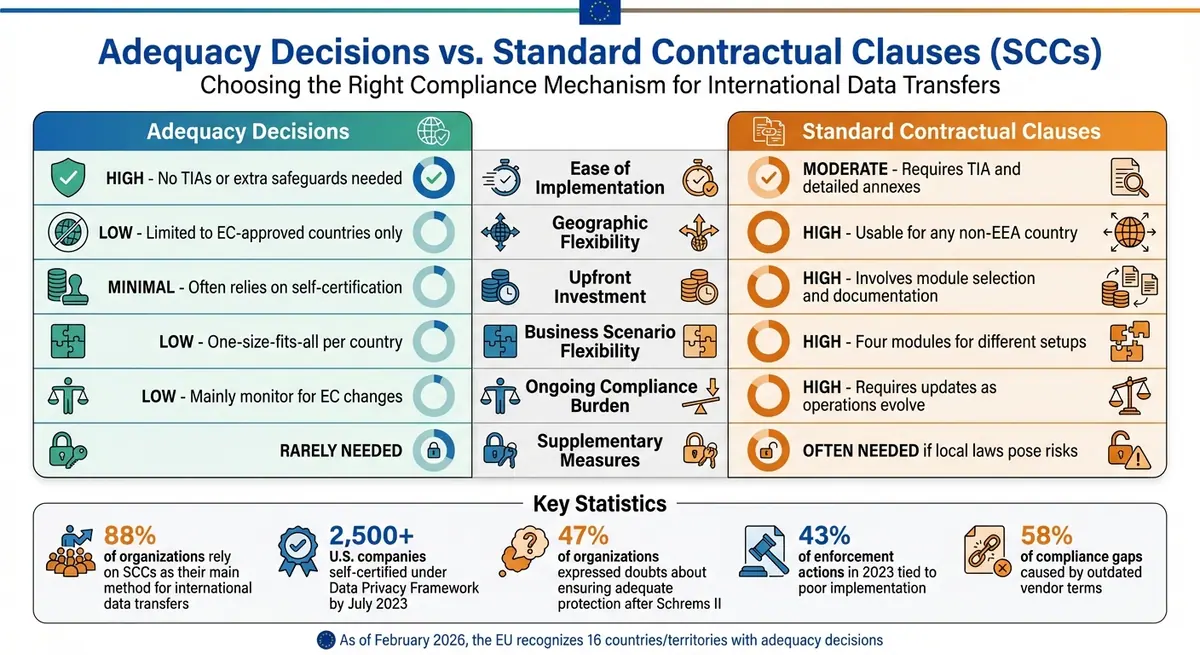
Adequacy Decisions are the easiest route. Once the European Commission approves a country, data can flow freely without extra paperwork or Transfer Impact Assessments (TIAs). For example, by July 2023, around 2,500 U.S. companies had self-certified under the Data Privacy Framework to benefit from this streamlined process. However, this option is limited to specific countries like Japan, Canada, and the UK, and sometimes only applies to certain industries.
On the other hand, SCCs shine with their global applicability. They can be used for transfers to any non-EEA country, and their modular structure supports various business setups - whether it's a controller-to-processor or processor-to-processor arrangement. This flexibility makes SCCs a popular choice among businesses. Plus, the docking clause allows new vendors to join existing agreements without the hassle of renegotiating everything.
But SCCs come with their own set of challenges. They require more effort upfront and ongoing. For each destination country, you'll need to conduct a TIA to assess whether local surveillance laws might compromise data protections. If risks are identified, you'll have to add measures like encryption with EEA-retained keys. After the Schrems II ruling, nearly 47% of organizations expressed doubts about ensuring adequate protection, and 43% of enforcement actions in 2023 were tied to poor implementation of legal templates.
To help clarify the differences, here's a side-by-side comparison:
| Feature | Adequacy Decisions | Standard Contractual Clauses (SCCs) |
|---|---|---|
| Ease of Implementation | High; no TIAs or extra safeguards needed | Moderate; requires TIA and detailed annexes |
| Geographic Flexibility | Low; limited to EC-approved countries | High; usable for any non-EEA country |
| Upfront Investment | Minimal; often relies on self-certification | High; involves module selection and documentation |
| Business Scenario Flexibility | Low; one-size-fits-all per country | High; four modules for different setups |
| Ongoing Compliance Burden | Low; mainly monitor for EC changes | High; requires updates as operations evolve |
| Supplementary Measures | Rarely needed | Often needed if local laws pose risks |
This table highlights the operational and compliance trade-offs, helping you decide which mechanism aligns best with your organization's needs.
Conclusion
Choosing between Adequacy Decisions and Standard Contractual Clauses (SCCs) depends on where your vendors are located and how much administrative complexity your organization can handle. Each approach comes with its own set of challenges. Adequacy decisions provide the simplest route - no need for Transfer Impact Assessments (TIAs) or extra safeguards, making data transfers to approved countries seamless. On the other hand, SCCs require organizations to carry out TIAs and possibly add safeguards, but they allow greater flexibility to work with vendors worldwide, thanks to their modular setup and docking clause features.
Failure to comply can result in severe penalties. Past enforcement actions have shown that weak safeguards can lead to significant fines.
With updated transfer rules fully effective by 2025 and enforcement starting in Q1 2026, compliance can no longer be treated as a one-and-done task. The focus is shifting toward active governance, which means implementing real-time monitoring systems and automated alerts to catch outdated vendor terms. These outdated terms are responsible for 58% of compliance gaps in cross-border transfers. Staying ahead of these changes requires clear, actionable strategies.
Here’s what you can do: check the European Commission's adequacy list before choosing vendors, conduct and document TIAs for SCCs, automate tracking of regulatory changes, and keep your transfer register updated.
As regulations continue to evolve, building adaptable compliance processes is key. Organizations that have embraced proactive strategies report 40% fewer issues, according to 2024 industry surveys.
FAQs
When do I need SCCs instead of an adequacy decision?
When transferring data to a country or organization outside the EEA that doesn’t have an adequacy decision, Standard Contractual Clauses (SCCs) become essential. They serve as a safeguard to ensure compliance with GDPR requirements. This need has grown even more critical after the Schrems II ruling and subsequent updates to legal frameworks, as SCCs help uphold data protection standards during international data transfers.
What should a Transfer Impact Assessment (TIA) include?
A Transfer Impact Assessment (TIA) examines if the destination country's laws and practices, particularly regarding public authority access to data, might hinder the data importer from fulfilling their obligations under Standard Contractual Clauses (SCC). It also considers whether the legal framework impacts the effectiveness of safeguards, focusing on data protection levels and possible risks to individuals' data.
What technical safeguards best reduce cross-border transfer risk?
To minimize the risks associated with cross-border data transfers, use Standard Contractual Clauses (SCCs) and carry out Transfer Impact Assessments (TIAs). These tools offer a way to align with regulations like GDPR while ensuring a clear and secure method for handling international data exchanges.
Related Blog Posts
Get new content delivered straight to your inbox

The Response
Updates on the Reform platform, insights on optimizing conversion rates, and tips to craft forms that convert.


Drive real results with form optimizations
Tested across hundreds of experiments, our strategies deliver a 215% lift in qualified leads for B2B and SaaS companies.
