
.webp)
How Segmentation Boosts Email Campaign ROI


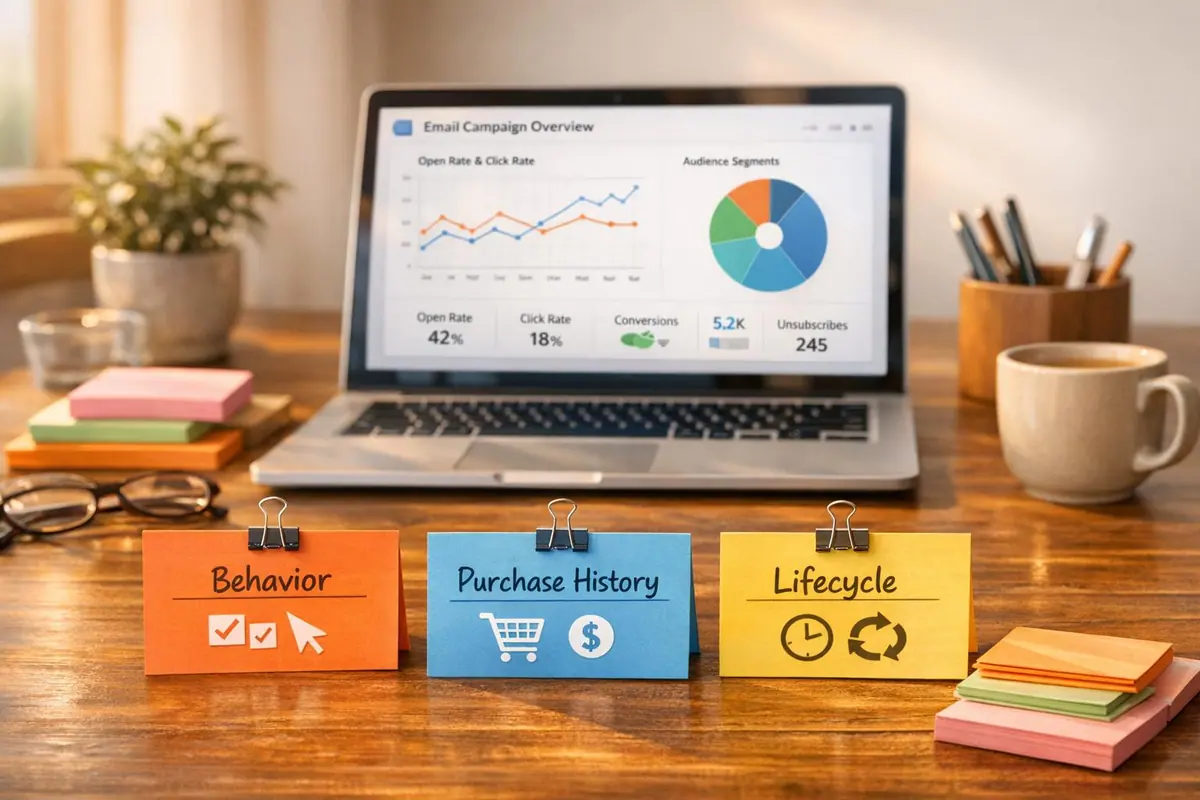
Email segmentation divides your audience into smaller groups based on shared traits like behavior, demographics, or purchase history. This approach leads to higher engagement and better returns, as segmented campaigns generate over three times the revenue per recipient compared to unsegmented ones ($0.19 vs. $0.06). Segmentation also improves open rates, click-through rates, and reduces unsubscribe rates.
Key takeaways:
- Segmented emails achieve an average ROI of 122% versus the general email marketing ROI of $42 for every $1 spent.
- Highly segmented campaigns see a 16.17% open rate and a 1.99% click-through rate, compared to 9.95% and 0.92% for unsegmented emails.
- Behavioral data, purchase history, and customer lifecycle stages are crucial for effective segmentation.
- Automation and clean CRM data are essential for success.
How Does Email Campaign Segmentation Impact ROI? - TheEmailToolbox.com
ROI Gains from Email Segmentation: The Numbers
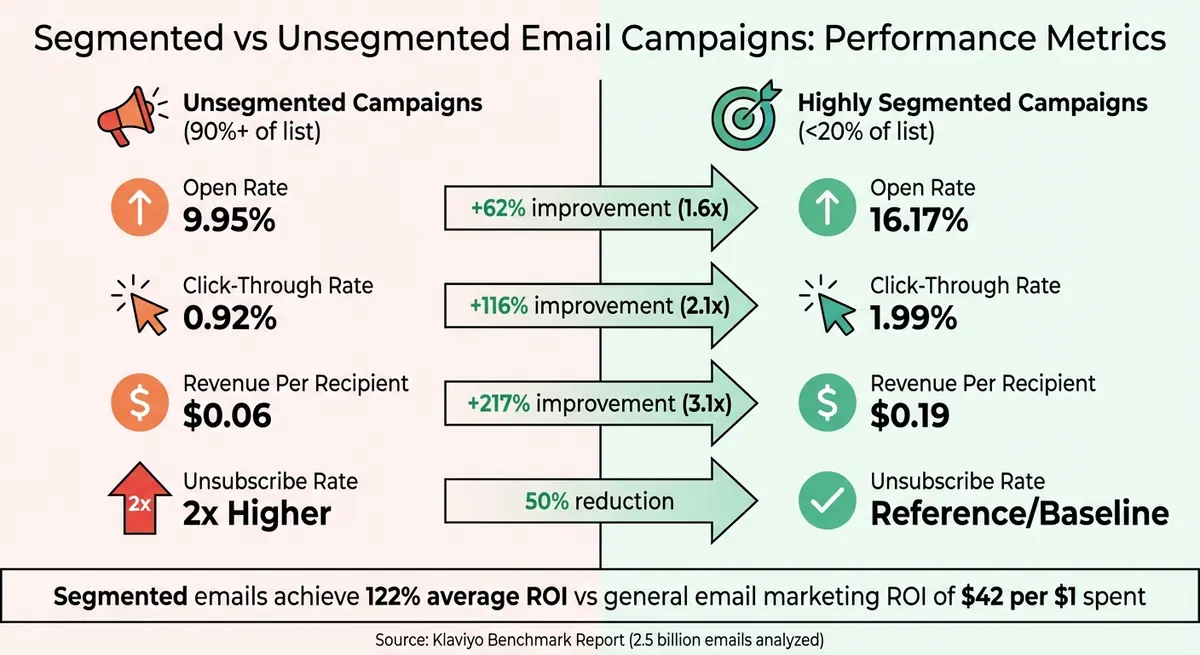
Segmented vs Unsegmented Email Campaign Performance Comparison
Revenue and ROI Growth
The financial benefits of email segmentation are striking. Campaigns that are highly segmented generate over three times the revenue per recipient compared to unsegmented emails - $0.19 versus $0.06. This means businesses can earn significantly more from the same audience.
While general email marketing already boasts impressive returns, delivering around $42 for every $1 spent, segmented emails take it even further, achieving an average ROI of 122%. For ecommerce businesses, segmentation proves its worth by increasing conversion rates from 1.31% to 1.79%.
A case study from Christiana Care Health System between January 2008 and July 2012 showcases the transformative power of segmentation. By categorizing their 64,000-record database based on health risk factors like BMI, smoking habits, age, and gender, the marketing team achieved a staggering 3,000% ROI. This translated to a $30 gross margin for every $1 spent. They also cut advertising expenses by 73% over three years and reduced patient acquisition costs by 58%, with an average gross revenue of $2,104 per converted customer.
"We used to spend a lot of money to advertise in print media, and we wouldn't fill a room (for an event). Now we spend little, if anything, to promote these kinds of events, and we get a more engaged clientele."
- Christopher Johansen, Senior Marketing Communications Manager, Christiana Care Health System
Better Engagement Numbers
The boost in revenue from segmentation is closely tied to improved engagement. Segmented campaigns targeting less than 20% of a list achieve an average open rate of 16.17%, compared to just 9.95% for unsegmented emails. Additionally, 65% of marketers report better open rates when using segmentation.
Click-through rates (CTR) mirror this trend. Highly segmented campaigns see an average CTR of 1.99%, more than doubling the 0.92% for unsegmented emails. Furthermore, 52.9% of marketers report higher CTRs from segmented campaigns. Segmentation also helps maintain a healthier email list - unsubscribe rates for unsegmented, "batch and blast" campaigns are twice as high as those for highly segmented ones. This underscores how relevance not only improves engagement but also safeguards your sender reputation.
Segmentation Performance Comparison
Data from Klaviyo's analysis of 2.5 billion emails highlights the clear performance edge of segmentation. Comparing unsegmented campaigns (sent to over 90% of a list) with highly segmented ones (sent to less than 20%), the differences across key metrics are substantial.
| Metric | Unsegmented (90%+ of list) | Highly Segmented (<20% of list) | Improvement |
|---|---|---|---|
| Open Rate | 9.95% | 16.17% | ~1.6x |
| Click-Through Rate (CTR) | 0.92% | 1.99% | ~2.1x |
| Revenue Per Recipient | $0.06 | $0.19 | ~3.1x |
| Unsubscribe Rate | 2x Higher | Reference | 50% reduction |
Source: Klaviyo Benchmark Report
"A smart segmented strategy drives more revenue and sales than a one-size-fits-all email."
- Klaviyo
CRM Data Types That Improve Segmentation
Behavioral and Purchase Data
Segmentation works best when it’s based on what customers actually do, not just who they are. Behavioral data captures actions like browsing habits, email clicks, cart activity, and site visits. This gives you a dynamic view of customer intent, rather than relying solely on static demographics.
Purchase history adds another layer of insight through RFM modeling - Recency, Frequency, and Monetary value. This method helps identify high-value customers by analyzing how recently they’ve shopped, how often they buy, and their overall spending. For instance, PUMA leveraged behavioral targeting and AI-driven recommendations to achieve triple-digit annual growth and a fivefold increase in email revenue within a year.
"If we send half a million emails, we're sending half a million different emails. Every single email is unique to that individual customer." - PUMA CRM Team
Here’s another example: an online apparel retailer used behavioral segmentation to focus on customers who abandoned their carts within the past week. This approach helped them recover 25% of abandoned carts, bringing in an extra $50,000 in revenue in just one month. Time-sensitive targeting like this often outperforms broad demographic-based campaigns.
Additionally, customizing messages based on where a customer is in their lifecycle can make campaigns even more impactful.
Customer Lifecycle Stage
Taking behavioral data a step further, segmenting customers by their lifecycle stage ensures your messaging aligns with their current needs. A new lead might need educational content to build trust, while a repeat buyer might respond better to loyalty rewards or exclusive offers. Ignoring these differences can hurt your conversion rates.
Lifecycle segmentation typically divides customers into categories like leads, marketing-qualified leads (MQLs), new buyers, repeat customers, or at-risk users. Each group requires a unique approach. For example, a project management software company segmented users into free trial participants, new subscribers, and long-term customers. This strategy converted 35% of trial users into paying customers and reduced churn by 15%.
Babbel, the language-learning platform, took this idea even further by tying segmentation to user progress. Between 2024 and 2025, they sent personalized nudges based on course completion stages. The result? 25% higher engagement among older users and 50% better conversion rates. It’s clear that tailoring messages to fit each stage of the customer journey pays off.
Enhancing Data Quality with Lead Capture Forms
Even the best segmentation strategy can fall apart without clean, reliable data. Poorly captured data can lead to higher unsubscribe rates, emails flagged as spam, and wasted marketing efforts. The problem often starts at the point of data collection - forms that don’t validate inputs or fail to sync with your CRM can lead to messy, unusable data.
Reform addresses this issue with dynamic lead capture forms that ensure data accuracy. These forms include features like email validation, spam prevention, and lead enrichment, ensuring the information entering your CRM is both clean and actionable. Multi-step forms with conditional logic also let you collect detailed data without overwhelming users.
When Rockport optimized their lead capture process using segmentation, they generated 30% more revenue per lead. Reform’s integrations with platforms like HubSpot and Salesforce make it easy to sync behavioral and lifecycle data directly into your CRM, reducing manual work and minimizing errors. Clean data isn’t just a nice-to-have - it’s the foundation for effective segmentation.
sbb-itb-5f36581
How to Implement CRM-Based Segmentation
Setting Up Automated Segmentation
Automation is key to making segmentation work efficiently. Start by defining your segmentation criteria based on your goals - whether you're trying to connect with new leads using demographics and signup sources or aiming to improve retention by analyzing purchase history. Your CRM should act as a Single Customer View (SCV), consolidating every interaction into one place, from website visits to purchase data.
To make the process seamless, integrate your CRM with your email platform so segments can update automatically. With this setup, you can create dynamic segments that adjust in real time. For example, automatically moving contacts to a new segment based on their lead score can increase revenue by 50%.
A great example of this is Taylor Stitch. Their Director of Marketing, Mike Grasewicz, shared how they use dynamic segmentation:
"We're making segments that are dynamic, which allow us to hone in on sending emails to the right people without having an in-house data science team".
These automated workflows depend heavily on accurate, up-to-date data, which we'll dive into next.
Why Data Quality Affects ROI
Automation only works as well as the data it relies on. Inconsistent entries - like mixing abbreviations with full names - can mess up your segmentation efforts. High-quality segmentation pays off: lists targeting less than 20% of your database generate over three times the revenue per recipient compared to unsegmented lists ($0.19 versus $0.06).
But data doesn’t stay fresh forever. In fact, 18% to 25% of B2B contact data becomes outdated annually as people change roles. Plus, manual data entry can have an error rate as high as 4%. To combat this, regular audits - ideally every quarter - are crucial. These audits help weed out outdated or incorrect information before it impacts your campaigns.
How Reform Improves Data Collection
Reform addresses data quality issues at the source, offering tools designed to integrate seamlessly with your CRM. Features like email validation ensure addresses are correctly formatted before they even enter your system, while spam filters block fake entries that could disrupt your segmentation. Reform’s lead enrichment feature automatically fills in missing details, such as company size or industry, saving your team from hours of manual research.
Other tools, like conditional routing and multi-step forms, allow you to gather detailed segmentation data efficiently - perfect for aligning with B2B criteria. Reform also integrates directly with platforms like HubSpot and Salesforce, ensuring a smooth, error-free flow of data. By streamlining data collection, Reform makes it easier to turn your segmentation strategies into measurable results.
How to Measure Segmentation ROI
Once you've implemented segmentation, it’s crucial to measure its impact accurately to understand its effectiveness.
Methods for Testing Segmentation Results
A/B testing is a powerful way to compare segmented and unsegmented emails. This method allows you to test elements like subject lines, send times, and content, giving you clear data on what works best for specific audience groups. It’s a straightforward way to identify which approaches drive better engagement and performance metrics.
Another effective approach is performance benchmarking. This involves comparing the results of your segmented campaigns against previous unsegmented efforts or even industry benchmarks. For instance, if unsegmented emails bring in $0.06 per recipient, but segmented ones generate $0.19, the improvement is undeniable. Longitudinal monitoring is also essential - it tracks metrics over time, helping you spot trends and adjust your segments as customer preferences evolve.
These methods provide the data you need to evaluate segmentation’s success and inform the ROI metrics discussed below.
ROI Metrics That Matter
One of the most critical metrics is Revenue per Recipient (RPR). This calculates the total revenue generated per email delivered, offering a clear view of each email’s value. The Klaviyo Benchmark Report emphasizes that relying solely on total email revenue can lead to poor practices, like sending mass, untargeted campaigns.
Other important metrics include conversion rate and Customer Lifetime Value (CLV). These help you assess both the immediate and long-term effects of segmentation. Notably, unsegmented campaigns often result in double the unsubscribe rates compared to well-segmented ones.
To measure cost-effectiveness, track Customer Acquisition Cost (CAC). This ensures that your segmentation strategy delivers results without overspending. For B2B campaigns, where sales cycles are typically longer, focus on leading indicators like meeting quality or progression through sales stages while waiting for complete revenue data.
ROI Metrics Summary Table
| Metric | Definition | Data Source |
|---|---|---|
| Revenue per Recipient (RPR) | Total revenue generated divided by the number of emails delivered | CRM & Email Platform |
| Conversion Rate | Percentage of recipients who completed a desired action (e.g., purchase) | E-commerce/Web Analytics |
| Customer Lifetime Value (CLV) | Total net profit attributed to the entire future relationship with a customer | CRM |
| Unsubscribe Rate | Percentage of recipients who opted out of the mailing list after a campaign | Email Service Provider (ESP) |
| Customer Acquisition Cost (CAC) | Total campaign cost divided by the number of new customers acquired | Marketing Dashboard |
| Win Rate | Percentage of opportunities or leads that convert to closed-won deals | CRM |
Conclusion
Main Findings
Research shows that email segmentation can dramatically improve ROI. Campaigns targeting smaller, more specific audience groups - less than 20% of your total list - generate over three times the revenue per recipient compared to broad, unsegmented campaigns ($0.19 versus $0.06). Marketers have reported revenue increases as high as 760%, with more than 75% of total email ROI coming from segmented efforts.
Shifting away from generic, one-size-fits-all campaigns to more targeted ones not only boosts performance but also helps maintain your sender reputation and reduces unsubscribe rates. The key to success lies in creating a Single Customer View within your CRM, which consolidates purchase history, site activity, and behavioral data into one place. The most effective segments are built using at least two specific conditions, allowing you to zero in on highly relevant audiences.
With high-quality CRM data, you can set up automated workflows to send timely, personalized messages. Whether it’s a welcome series, an abandoned cart email, or a win-back campaign, these automated efforts ensure your messages reach the right people at the right time.
Next Steps for Email Marketers
The research highlights the importance of refining your segmentation strategy to align with clear business goals. As the Klaviyo Benchmark Report puts it, “The goal isn’t to create segments, the goal is a business need... The segment is the way you execute against your goal and strategy”. Start with basic demographic segments and gradually incorporate behavioral data, such as purchase patterns or website activity, to create more precise targeting.
Accurate and enriched data is the backbone of effective segmentation. Tools like Reform can help by validating email addresses, enriching lead data, and integrating seamlessly with your CRM. This ensures you’re working with reliable information and avoids the pitfalls of poor-quality data.
To optimize your efforts, set up automated workflows for critical customer touchpoints, use A/B testing to fine-tune your campaigns, and maintain list hygiene by regularly removing inactive subscribers. Focus on engaged users - those who have interacted with your emails within the past 120 days - to protect your deliverability and keep your campaigns effective.
FAQs
How does email segmentation help increase revenue per recipient?
Email segmentation helps businesses boost revenue per recipient by delivering tailored, relevant messages to specific audience groups. By personalizing content, businesses can drive higher engagement, improve conversion rates, and encourage customers to spend more.
Studies reveal that segmented email campaigns achieve a 122% higher ROI compared to generic, non-segmented campaigns. This makes segmentation an essential strategy for increasing revenue and amplifying the effectiveness of email marketing efforts.
How can I collect high-quality CRM data to improve email segmentation?
To gather reliable CRM data, the first step is to standardize how information is entered. Stick to uniform formats for key fields like dates (MM/DD/YYYY), phone numbers (U.S. format), and currency (e.g., $ for dollars). Set up validation rules to catch errors early - these might include mandatory fields, email syntax checks, and real-time address verification. On top of that, make it a habit to audit your database regularly. This helps remove duplicates, update outdated records, and keep your data trustworthy.
Bringing together data from various sources - like website activity, purchase history, and customer support logs - can give you a more complete picture of each customer. This unified view makes it easier to segment your audience based on factors such as lifecycle stage, location, or how much value they bring to your business. Don’t forget to collect consent and preference details to not only comply with U.S. privacy laws but also fine-tune your segmentation.
Using tools like Reform, a no-code form builder, can make this process smoother. With features like built-in field validation, conditional routing, and lead enrichment, Reform ensures your data is clean and enriched right from the start. Plus, it syncs seamlessly with your CRM, giving you a solid base for better segmentation and a stronger return on investment for your email campaigns.
How does automation improve email segmentation and ROI?
Automation elevates email segmentation by keeping audience groups up-to-date using real-time CRM data like purchases, website interactions, or form submissions. This means your segments remain accurate without any manual effort, allowing you to deliver the right message to the right people exactly when they need it.
It also powers behavior-driven emails, such as abandoned cart reminders or follow-up product recommendations. These messages are triggered automatically when certain actions occur, creating a tailored experience for each recipient. By blending automation with segmentation, marketers can scale their efforts to reach millions while boosting open rates, click-throughs, and overall return on investment (ROI).
For Reform users, lead data collected through forms is seamlessly integrated into your CRM, automatically organizing contacts into the correct segments. With Reform’s real-time analytics and integrations, you can launch automated, segment-specific email campaigns that drive results - without needing to write a single line of code.
Related Blog Posts
Get new content delivered straight to your inbox

The Response
Updates on the Reform platform, insights on optimizing conversion rates, and tips to craft forms that convert.


Drive real results with form optimizations
Tested across hundreds of experiments, our strategies deliver a 215% lift in qualified leads for B2B and SaaS companies.
