
.webp)
Study: Tech Barriers to Data Privacy in Emerging Markets



Emerging markets face unique challenges in enforcing data privacy laws despite significant legislative progress. Key issues include underfunded regulatory bodies, outdated infrastructure, limited internet access, and workforce shortages. These gaps make compliance with global standards like GDPR difficult, leaving sensitive data vulnerable. For instance:
- Regulatory Weakness: Many Data Protection Authorities (DPAs) in developing regions operate with minimal budgets (e.g., $500,000 in Africa vs. $58 million in North America) and limited independence.
- Infrastructure Issues: Poor internet connectivity, outdated IT systems, and unreliable power supplies hinder the implementation of privacy measures.
- Cybersecurity Gaps: Weak systems and a lack of skilled professionals make emerging markets more susceptible to data breaches, which are rising at a rate of 37% annually.
- Financial Constraints: High compliance costs and limited access to advanced privacy tools strain businesses, particularly small enterprises.
- Talent Shortage: Brain drain and insufficient digital literacy exacerbate enforcement challenges.
Solutions include adopting cost-effective technologies like open-source platforms, improving local expertise through structured training, and fostering public-private partnerships to bridge resource gaps. Addressing these barriers is critical for ensuring data privacy in the rapidly digitalizing economies of emerging markets.
Infrastructure Gaps
Emerging markets often struggle with the infrastructure needed to support data privacy. Reliable internet, modern IT systems, and consistent power are essential, but their absence can render even the strongest privacy laws ineffective. Below, we explore these key challenges in detail.
Internet Connectivity Problems
A stable, high-speed internet connection is critical for real-time encryption and cloud-based security systems. Yet, in countries like Tajikistan, internet access remains a significant hurdle. Fixed-line broadband is virtually nonexistent - just 0.07% penetration, with only about 6,000 subscriptions for a population of over 10 million as of 2025. Mobile internet speeds are also among the slowest globally, ranking 139th out of 143 countries in February 2025, with median download speeds under 10 Mbps.
The cost of mobile data further compounds the issue. While the average price per gigabyte in Tajikistan is $1.65, neighboring countries like Kyrgyzstan and Uzbekistan enjoy far lower rates at $0.17 and $0.30, respectively. As the World Bank succinctly put it:
"Central Asians pay some of the highest prices in the world for internet connections that are slow and unreliable".
Geography also plays a role. In Tajikistan, where 93% of the land is mountainous, maintaining telecommunication lines and cell towers is a logistical nightmare. By late 2022, 4G coverage had reached 72% of the population, but over a quarter of citizens still relied on outdated 2G or 3G networks - or had no signal at all. This leaves many rural areas, home to more than 70% of the population, without reliable connectivity.
State control further complicates the issue. In countries like Tajikistan and Iran, all international internet traffic is routed through government-controlled gateways, such as Tajikistan's Unified Electronic Communications Switching Center. These systems prioritize surveillance over secure data transmission. For instance, in Iran, a 10-day internet shutdown in January 2026 slashed connectivity to just 0.2% of its usual levels. As Professor Alan Woodward of Surrey University observed:
"In Iran there seems to be a move to isolate everyone from any electronic access, unless approved by the government".
Beyond connectivity, outdated technical infrastructure poses additional challenges for enforcing data privacy.
Legacy IT Systems
Outdated IT systems in emerging markets make it difficult to integrate modern privacy technologies. These systems often fail to meet the "technical truth" standard required by regulations like GDPR and CCPA, resulting in what some experts call "privacy theater".
In Thailand, for example, government digital systems are plagued by silos and limited interoperability, making it difficult to establish unified data governance frameworks. Researcher Andrew Kweku Conduah from the University of Professional Studies explains:
"The increasing integration of EHRs and digital tools has significantly amplified the risk of data breaches and unauthorized access... systemic vulnerabilities and technological shortcomings can undermine data privacy".
Failures in technical infrastructure have tangible consequences. In late 2025, the California Privacy Protection Agency fined Tractor Supply $1.35 million for violating CCPA regulations by offering a non-functional webform for opting out of data sales - a clear failure to meet the required "technical truth". Under GDPR, organizations risk fines of up to 4% of their global annual revenue for severe breaches.
These outdated systems not only hinder compliance but also exacerbate privacy risks in resource-limited environments.
Power Supply Issues
Unstable electricity presents another major obstacle to safeguarding data. Frequent power fluctuations can damage critical systems, while sudden outages expose vulnerabilities in real-time protection and monitoring. As Dawgen Global notes:
"Many regions still struggle with patchy internet coverage, slow speeds, and unstable power supply".
The cost of mitigating unreliable power is steep. In Tajikistan's rugged terrain, businesses rely heavily on diesel generators to power remote cell towers, significantly driving up operational costs. This is one reason mobile data prices in Tajikistan are 9.5 times higher than in Kyrgyzstan. For businesses, the choice often comes down to investing in expensive backup systems or accepting gaps in their privacy infrastructure.
The stakes go beyond financial costs. National security is also at risk. Researchers Lubna Luxmi Dhirani and colleagues from the University of Limerick warn:
"Situations where the security of critical infrastructures (electric grid, water supply, healthcare facility ransomware, etc.) is compromised by adversaries, directly affecting human lives, is a breach of the social contract theory".
Without a stable power supply, even the most advanced privacy systems can falter, leaving sensitive data exposed during outages.
Cybersecurity Weaknesses
Emerging markets face a double-edged challenge when it comes to cybersecurity: outdated infrastructure and ineffective systems leave sensitive data exposed. These vulnerabilities arise from immature frameworks, a lack of skilled professionals, and limited resources to meet the technical demands of modern privacy regulations. Addressing these issues requires urgent improvements in both detection capabilities and regulatory compliance.
Weak Cybersecurity Systems
Many emerging markets struggle to establish the cybersecurity frameworks needed to identify and respond to data breaches within the tight timelines required by global regulations. For example, laws like GDPR and India's DPDP Act mandate breach reporting within 72 hours, but weak systems often fail to detect incidents in real time, making compliance nearly impossible.
Beyond detection, regulators are now focusing on what they call "technical truth" - ensuring that privacy systems actually perform as advertised. This shift away from superficial compliance, often dubbed "privacy theater", requires organizations to demonstrate that their systems work at a granular, technical level. Unfortunately, many emerging markets are ill-equipped to meet this standard.
Resource constraints exacerbate these challenges. In Africa and the Middle East, Data Protection Authorities (DPAs) operate with a median budget of just $500,000 and a staff of 14. By comparison, North American DPAs have a median budget of $58 million and 647 staff members. This disparity makes it difficult for regulators in emerging markets to enforce laws effectively, a problem highlighted by the Center for Global Development:
"In many countries that have enacted data protection laws, enforcement is weak, regulatory authorities lack independence, and policies are not designed in line with existing resource constraints".
Adding to the problem is a global shortage of cybersecurity professionals - around 4 million experts are needed worldwide. Emerging markets face stiff competition for this talent, leaving regulatory bodies without the skilled personnel necessary to conduct audits or investigate breaches. The World Bank emphasizes the broader implications:
"Cybersecurity is no longer just about protection - it's a vital catalyst for economic growth, particularly for developing nations and rapidly digitalizing industries".
Data Breach Risks
Poor encryption and outdated security measures leave emerging markets especially vulnerable to data breaches. Cyber incidents in developing nations are rising at a staggering 37% annually, nearly double the global average of 21%. Public administration is the hardest hit, accounting for 36% of reported incidents, followed by the finance and communications sectors.
Ironically, data localization laws - meant to safeguard national data - can increase risks when local servers lack adequate protection. Shahzeb Mahmood, Head of Research at Tech Global Institute, warns:
"The concentration of data in servers with poor security would make it susceptible to unauthorised access by malicious actors".
A striking example of this risk occurred in June 2021, when over 92% of LinkedIn user data was scraped and sold on the dark web. Researchers point to this incident as a cautionary tale for countries like Bangladesh, where poorly secured servers housing large volumes of data are prime targets for hackers.
These vulnerabilities have far-reaching economic consequences. Developing nations that reduce cyber incidents could see a 1.5% boost in GDP per capita within a decade. Yet, many organizations continue to rely on outdated IT systems with poor patch management, making them easy prey for ransomware and unauthorized access. Under GDPR, companies risk fines of up to 4% of their global annual revenue or €20 million for major breaches - penalties that could devastate resource-strapped businesses.
Weak enforcement further compounds these risks. In August 2023, the Kenyan government suspended Worldcoin (Tools for Humanity) after the company ignored orders from the Office of the Data Protection Commissioner to halt biometric data collection. Despite the directive, the company continued processing data, exposing how weak enforcement mechanisms allow foreign entities to exploit local vulnerabilities.
With over 90% of cybersecurity research focused on the United States, emerging markets lack tailored solutions for their unique challenges. Addressing these systemic weaknesses is essential for building stronger data privacy frameworks in these regions.
Workforce and Skills Gaps
Emerging markets often face a shortage of trained professionals to enforce data privacy laws. Even with strong regulations in place, the lack of skilled workers makes it difficult to ensure effective protection. This disconnect between regulations and organizational capabilities stems from gaps in education and is worsened by the loss of talent to other regions. These workforce challenges add to the technological and cybersecurity issues already discussed.
Low Digital Literacy
Basic digital skills training is a significant hurdle for many emerging markets, making it difficult for workers to effectively use privacy tools. For instance, Thailand, despite its goal of achieving high-income status by 2037, struggles with adopting AI due to limited digital skills. According to the World Bank, gaps in foundational skills and governance are slowing digital transformation efforts in these regions.
In Kenya, a 2023 study involving 500 participants and 20 key stakeholders revealed that regulatory agencies are unable to fulfill their mandates due to insufficient funding for workforce development. Johnson Masinde from the University of Embu highlighted the issue:
"Insufficient funding causes the commission to struggle with implementing its mandates and investing in proper infrastructure to confront evolving data breaches".
Adding to this problem, rapid technological advancements often outpace the ability of local workforces to keep up, leading to what experts call a "knowledge lag". This lag, combined with inadequate digital skills, creates a significant barrier to enforcing data privacy laws.
Talent Migration
The migration of skilled professionals from emerging markets further widens the expertise gap. For example, in Ukraine, student emigration doubled between 2007 and 2014, reaching approximately 78,000 by 2019. Similarly, Russia faced the loss of an estimated 200,000 skilled individuals by 2022, driven by economic sanctions and political instability.
This "brain drain" has a particularly severe impact on data privacy initiatives. As Investopedia explained:
"Professionals leaving create a gap that is often hard to fill... there may not be enough qualified people to replace them when they leave".
Each departure not only reduces expertise but also affects the economy. High-earning professionals who leave take with them potential tax revenue, which could have been used to build infrastructure and social programs essential for supporting robust data privacy systems. Companies also experience "industrial brain drain" when entire sectors lose skilled workers due to an inability to keep up with technological or regulatory demands.
The situation is especially dire for Data Protection Authorities (DPAs) in regions like Africa and the Middle East. Operating with a median budget of just $500,000 and a staff of 14, these agencies struggle to attract and retain talent when competing with better-funded organizations in developed markets. Access Now underscored this challenge, stating:
"One must wonder how much independence there can be when your budget is not substantively under your control".
Without competitive wages or clear career paths, DPAs often lose their most skilled workers to foreign tech companies or regulators in wealthier nations. This talent drain leaves emerging markets even less equipped to tackle data privacy challenges effectively.
sbb-itb-5f36581
Financial Constraints
Limited budgets present a major obstacle for businesses striving to meet data privacy requirements. While privacy laws set clear expectations, the resources needed to comply often fall short, creating a significant enforcement gap between legal mandates and their practical implementation.
This issue is particularly acute in regions where regulatory bodies operate with minimal funding. For instance, the median annual budget for a Data Protection Authority in Africa and the Middle East is just $500,000, compared to a much larger $58 million in North America. The stark contrast in funding across regions highlights the challenges faced by under-resourced authorities, further complicating efforts to enforce privacy regulations.
Expensive Privacy Tools
Adding to the strain, the high cost of privacy tools makes compliance even more difficult, especially in emerging markets. Many micro, small, and medium enterprises (MSMEs) simply can’t afford the advanced technologies required to navigate complex and ever-changing data privacy laws. The situation becomes even more challenging for businesses operating across multiple jurisdictions, as differing regulations drive up compliance costs.
This financial burden doesn’t just affect individual businesses - it shapes entire markets. Experts Michael Pisa, Pam Dixon, and Ugonma Nwankwo from the Center for Global Development have noted:
"Over-regulation in the form of high compliance costs have the potential to slow innovation by creating an unnecessary disincentive to investment".
When compliance becomes prohibitively expensive, some businesses may choose to ignore the law altogether or avoid operating in regions with stringent requirements.
Unclear Return on Investment
Beyond the upfront costs of privacy tools, businesses also struggle with the challenge of justifying these investments. Even companies with the financial capacity to implement privacy measures often find it difficult to quantify their value. The U.S. Department of Health and Human Services spoke to this issue, stating:
"We are not able to quantify the benefits of the rule due to lack of data and the impossibility of monetizing the value of individuals' privacy and dignity".
Unlike other investments that deliver clear financial returns, the benefits of privacy protections - such as safeguarding a company’s reputation or building trust with users - are harder to measure in monetary terms.
This uncertainty has led Georgetown University Professor of Law Anupam Chander to pose a thought-provoking question:
"Is privacy a luxury for the rich world?".
His query highlights a core issue: without tangible metrics to link data protection efforts to economic gains, businesses operating on tight budgets often deprioritize privacy initiatives.
Regional Comparison of Privacy Barriers
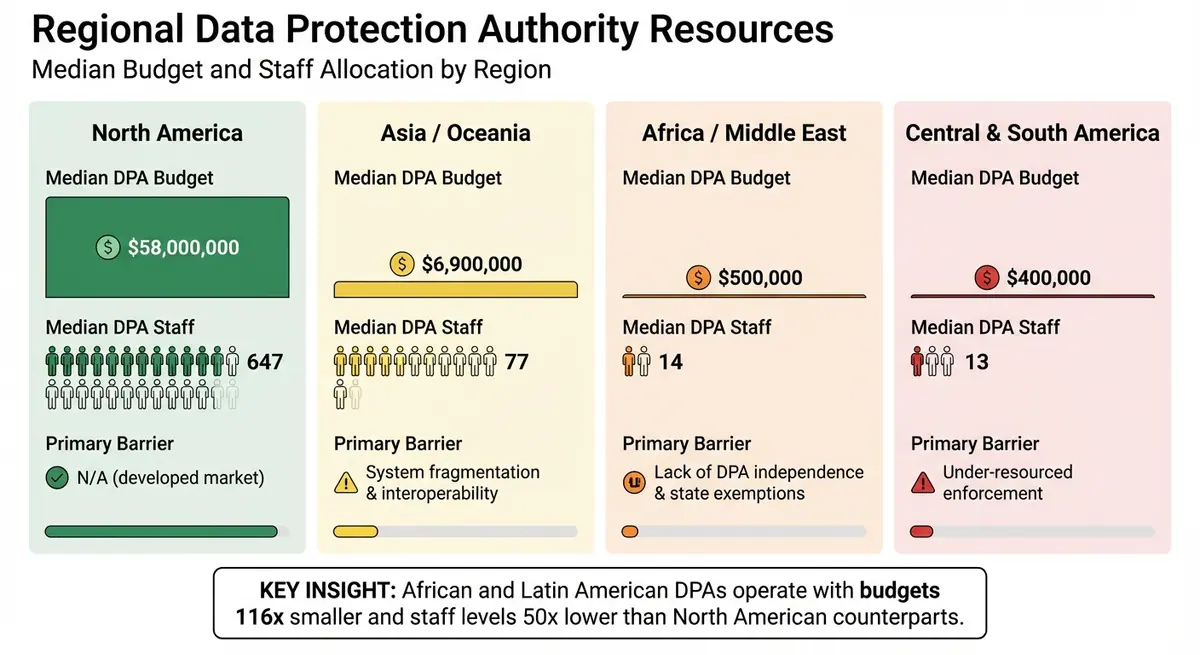
Global Data Protection Authority Resources by Region: Budget and Staffing Comparison
Comparison Metrics
Taking a closer look at regional challenges, it's clear that differences in digital maturity and resource allocation heavily influence how privacy measures are enforced. Across emerging markets, the obstacles to implementing data privacy vary widely. While Africa, Asia Pacific, and Latin America all face enforcement difficulties, the specific barriers are shaped by their unique stages of digital and regulatory development.
These differences highlight distinct regional issues, such as Africa's institutional shortcomings and Asia Pacific's fragmented systems.
Africa's key challenge lies in the lack of institutional independence. Many emerging markets have introduced privacy laws, but enforcing them remains a significant hurdle. According to researchers Bridget Andere and Megan Kathure from Access Now, most regions are still in the "teething stage" of enforcement. The problem isn't the absence of regulations but the limited autonomy of Data Protection Authorities (DPAs). For instance, in Kenya, the DPA operates under the Ministry of Information, Communications, and the Digital Economy, while Uganda's DPA is part of the National Information Technology Authority. This dependency creates conflicts of interest, as seen in Uganda's controversial acquisition of 5,552 Huawei CCTV cameras for mass surveillance. By contrast, Asia Pacific markets contend with a different set of issues - fragmented systems and inconsistent regulations.
Asia Pacific markets face major hurdles in system integration. The World Bank describes Thailand's digital government infrastructure as "siloed systems, overlapping mandates, and limited interoperability, particularly in the social sector". Beyond technical fragmentation, regulatory inconsistency adds another layer of complexity. As Jerome Smail from CX Network explains:
"Some jurisdictions have passed binding legislation, while others have issued voluntary guidance. The approaches vary significantly".
For example, countries like China, South Korea, and Vietnam have enacted binding AI laws, while places like Singapore and Hong Kong rely on voluntary frameworks. This inconsistency creates compliance challenges for businesses operating across multiple jurisdictions.
Regional Data Table
The table below highlights the stark contrasts in DPA resources and the enforcement challenges across regions:
| Region | Median DPA Budget | Median DPA Staff | Primary Barrier |
|---|---|---|---|
| North America | $58,000,000 | 647 | N/A (developed market) |
| Asia / Oceania | $6,900,000 | 77 | System fragmentation & interoperability |
| Africa / Middle East | $500,000 | 14 | Lack of DPA independence & state exemptions |
| Central & South America | $400,000 | 13 | Under-resourced enforcement |
The disparity in resources is striking. African and Latin American DPAs operate with budgets that are 116 times smaller and staff levels 50 times lower than their North American counterparts. Asia Pacific DPAs, while better funded than those in Africa or Latin America, still wrestle with challenges like digital skills shortages and uneven broadband access in rural areas.
Conclusion: Addressing Technology Barriers
Emerging markets can sidestep expensive system overhauls by adopting edge computing and offline-first technologies. These approaches allow data to be processed locally and synced only when connectivity is available, offering a practical solution for regions with limited infrastructure. For areas reliant on outdated systems, AI-driven Natural Language Processing (NLP) can extract privacy-critical details from unstructured records and fragmented reports, tackling the issue of a 70% data deficit caused by inconsistent reporting.
Financial challenges are another hurdle, but they are not insurmountable. Ethiopia's "Fayda" digital ID system is a strong example. By leveraging the open-source Modular Open Source Identity Platform (MOSIP), the country registered over 3 million users by August 2023, avoiding steep licensing fees while maintaining robust privacy protections. Similarly, India's Aadhaar system drastically reduced digital onboarding costs - from about $23 per customer to just $0.15. These cases show that establishing privacy-focused infrastructure can lead to significant cost savings.
Equally important is developing local expertise. Structured initiatives can help build this capacity. Thailand’s Digital Data Infrastructure Roadmap (2025–2029) and the American Bar Association’s "Defending Digital Privacy" training in Southeast Asia are strong examples of how phased planning and education can address skill gaps. For instance, the ABA’s program trained 595 lawyers and experts across Southeast Asia by April 2023, showcasing how targeted training can quickly enhance local expertise.
"Domestic collaboration and international cooperation is indispensable to improving knowledge sharing and providing clarity regarding mandates and rules." - Parma Bains and Tamas Gaidosch, IMF Working Paper Authors
The tools and technologies are available. What remains is strategic implementation - whether through public-private partnerships, open-source solutions, or phased national strategies - tailored to meet the specific needs of each region.
FAQs
What challenges do emerging markets face in enforcing data privacy laws?
Emerging markets encounter several obstacles when it comes to enforcing data privacy laws effectively. Limited resources, both in terms of funding and skilled personnel, make it challenging for regulators to monitor compliance and address violations. This often results in a disconnect between the laws written on paper and their practical enforcement. Adding to this, institutional weaknesses, such as patchy legal frameworks and ambiguous exemptions, undermine the credibility of enforcement efforts.
Another significant challenge lies in the lack of technical expertise. Governments and businesses in these markets often struggle to adopt advanced privacy technologies like encryption or differential privacy. Keeping up with the rapid pace of digital advancements - especially in fast-evolving sectors like fintech - only adds to the difficulty. Compounding these issues is low public awareness about the risks tied to data privacy. Without widespread understanding, individuals and businesses are less likely to demand compliance, reducing the motivation for enforcement.
Overcoming these hurdles - whether it's resource shortages, institutional gaps, technical limitations, or lack of awareness - is critical to moving beyond merely enacting data privacy laws and ensuring they are effectively upheld.
What strategies can emerging markets use to address financial challenges in implementing data privacy measures?
Emerging markets often encounter financial challenges when trying to establish the technical and institutional structures needed for data privacy compliance. The high initial costs, tight budgets for regulatory bodies, and pricey privacy technologies can make this process especially daunting.
However, there are practical ways to navigate these obstacles, such as:
- Using existing digital infrastructure: National ID systems or open-source platforms can help cut costs by sharing resources across multiple services.
- Focusing on key sectors: Prioritizing areas like finance and healthcare and employing lightweight privacy tools, such as encryption libraries or anonymization methods, can deliver significant impact without overspending.
- Partnering with private and global organizations: Collaborations can bring in funding, expertise, and access to affordable compliance tools.
- Regional cooperation: Pooling resources to develop shared guidelines, regulatory frameworks, or technology solutions can help reduce costs and build collective capacity.
By blending these strategies, emerging markets can make the most of their limited budgets while creating effective data privacy systems that align with their specific needs.
How does talent migration impact data privacy efforts in emerging markets?
Talent migration, often called "brain drain", poses a serious challenge to data privacy efforts in emerging markets. When experts like data-security specialists, privacy attorneys, and tech professionals leave for better-paying jobs in developed nations, it creates a significant gap in the local talent pool. This loss makes it increasingly difficult for governments and businesses to establish, enforce, and maintain strong privacy regulations.
Without enough skilled professionals, institutions struggle to build secure data systems, leading to delays and eroding public confidence in privacy protections. This creates a vicious cycle: limited expertise results in weaker enforcement, which slows progress toward developing effective data privacy frameworks.
Related Blog Posts
Get new content delivered straight to your inbox

The Response
Updates on the Reform platform, insights on optimizing conversion rates, and tips to craft forms that convert.




Drive real results with form optimizations
Tested across hundreds of experiments, our strategies deliver a 215% lift in qualified leads for B2B and SaaS companies.
