
.webp)
Third-Party Data Sharing: Compliance Training Guide



When sharing data with third-party vendors, your organization takes on significant legal and financial risks. In 2024, 35.5% of data breaches involved third-party vendors, costing companies an average of $4.8 million per incident. High-profile cases like Delta Air Lines' $350 million loss due to vendor failures underscore the importance of managing these risks.
To protect your business, compliance training is essential. It ensures vendors understand their obligations, helps prevent breaches, and provides evidence of due diligence during audits. This guide covers everything you need to know:
- Key regulations like GDPR, HIPAA, and CCPA
- Contract essentials such as breach notification timelines and data deletion terms
- Training programs tailored to vendor risk levels
- Monitoring practices to ensure ongoing compliance
Key takeaway: Your organization remains accountable for how vendors handle shared data. Without proper safeguards, you risk severe fines, legal trouble, and reputational damage. Here’s how to stay compliant and minimize vendor-related risks.
Preventing non-compliant data sharing to marketing partners
sbb-itb-5f36581
What Third-Party Data Sharing Includes
Third-party data sharing involves a wide range of interactions and relationships. It's essential to define who qualifies as a third party and understand how data flows between entities.
Key Terms and Concepts
Grasping the right definitions is crucial for training vendors effectively.
A critical distinction lies between a data controller and a data processor. According to GDPR, the controller determines why data is collected and how it's used. The processor, on the other hand, works with that data based strictly on the controller's instructions. Think of services like SaaS analytics tools or cloud storage providers - they process data but don't decide its purpose. Importantly, your organization is responsible for the entire processing chain, even when processors involve subprocessors.
"The data controller remains liable for how processors and sub-processors handle data regardless of contractual chain depth." - Marc ten Eikelder, Kiteworks
This chain can extend further than many businesses realize. For instance, if a processor hires another vendor to assist with their work, that vendor becomes a subprocessor (sometimes called a fourth party). Subprocessors require your authorization, and the original processor remains accountable for their compliance.
Corporate structure doesn't exempt companies from compliance. For example, if a European subsidiary accesses customer data stored in a U.S.-based parent company's CRM, GDPR treats it as an international data transfer. This means Standard Contractual Clauses (SCCs) or other approved mechanisms must be in place, even within the same corporate group.
Table: Key Entity Types
| Entity Type | Regulatory Context | Key Requirement |
|---|---|---|
| Data Processor | GDPR (EU) | Written Data Processing Agreement (DPA) required |
| Business Associate | HIPAA (U.S.) | Business Associate Agreement (BAA) required |
| Subprocessor | GDPR / DORA | Controller must authorize; obligations flow down |
| Service Organization | SOX (U.S.) | SOC 1 Type 2 report required |
| Affiliate / Subsidiary | GDPR / Cross-border | Treated as a third-party transfer; SCCs may apply |
Another important distinction: data sharing refers broadly to disclosing information to an external party, while data transfer specifically involves moving personal data across legal jurisdictions. Regulators treat these terms differently.
Common Examples of Third-Party Data Sharing
Third-party data sharing touches nearly every area of business. In healthcare, for example, organizations frequently share Protected Health Information (PHI) with vendors like Epic or Cerner for electronic health records (EHR), billing services, and IT support providers. In finance and operations, sensitive data often passes through payroll processors like ADP or Paychex, cloud platforms such as AWS or Azure, and ERP systems like Workday or SAP.
One often-overlooked area is unstructured data - information shared via email attachments, file-sharing services, or Managed File Transfer (MFT) platforms. These channels carry the same compliance requirements but are less likely to have formal controls in place.
Failing to manage these relationships properly can lead to serious consequences. For example, in August 2016, Advocate Health Care settled for $5.55 million with the Office for Civil Rights (OCR) after failing to secure BAAs with vendors who later experienced data breaches. More recently, in 2024, the Irish Data Protection Commission fined LinkedIn €310 million for compliance failures related to cross-border data transfers at the processor level.
"Your compliance program is only as strong as your weakest vendor relationship." - ComplianceStack Editorial Team
A practical insight: when companies audit their vendor relationships, they typically discover 20–50% more vendor connections than expected. This often happens because individual teams adopt SaaS tools without central approval. This "shadow IT" is where compliance efforts tend to falter first.
Next, we’ll look at the core regulations vendors need to understand.
Core Regulations Vendors Need to Know
Navigating the complex web of laws around third-party data sharing is no small task. Vendors must juggle federal guidelines, state-specific laws, and rules tailored to certain industries. Knowing which regulations apply and understanding their requirements is the first step toward effective compliance.
GDPR Requirements for Vendors
Even if your company is based in the U.S., the General Data Protection Regulation (GDPR) applies if you handle personal data belonging to EU residents. Under Article 28, data processors must sign a Data Processing Agreement (DPA) that outlines the type of data processed, its purpose, and the instructions provided by the data controller. Any use of subprocessors requires the controller’s written approval, and the primary vendor remains responsible for ensuring compliance. This makes thorough vendor training a must.
Cross-border data transfers add another layer of complexity. Moving EU data into U.S. systems requires mechanisms like Standard Contractual Clauses (SCCs). The risks are real: in 2023, Meta faced a €1.2 billion fine for non-compliance.
U.S. Privacy Laws and FTC Guidelines
State-level privacy laws, particularly in California, set the bar high for vendors. Under California’s CCPA/CPRA, entities that receive personal data must be classified as Service Providers, Contractors, or Third Parties - each with distinct contractual obligations. Misclassification can lead to costly consequences.
California’s 11 CCR § 7051 mandates specific terms in contracts, such as prohibiting the sale of personal data, defining clear business purposes, and granting audit rights. Starting January 1, 2026, contracts must also address Automated Decision-Making Technology (ADMT) and include annual cybersecurity audits. Missing these requirements can be expensive. For example, in September 2025, a company faced a $1.35 million fine - the largest CCPA penalty to date - for failing to update vendor contracts on time.
"If the paper isn't right, the transfer becomes a sale or share. That reclassification cascades into opt-out obligations, notice obligations, and downstream liability." - John Tomaszewski and Yana Komsitsky, Editors, The Global Privacy Watch
Other states like Virginia, Colorado, and Connecticut have similar laws, requiring vendors to include processing instructions, confidentiality clauses, subcontractor obligations, and data deletion terms in contracts. For vendors working across multiple states, creating contracts that meet all these requirements is essential.
Industry-Specific Regulations
In addition to general privacy laws, certain industries impose stricter rules on vendors. Here’s a snapshot of key regulations and their vendor requirements:
| Regulation | Key Vendor Document | Primary Requirement |
|---|---|---|
| HIPAA | Business Associate Agreement (BAA) | Safeguard PHI; report breaches; pass obligations to subcontractors |
| GDPR | Data Processing Agreement (DPA) | Follow documented instructions; assist with data subject rights |
| GLBA | Service Provider Contract | Protect nonpublic personal information (NPI); maintain security programs; allow audits |
| SOX | SOC 1 Type 2 Report | Prove internal controls over financial reporting work over time |
| CCPA/CPRA | Service Provider Contract | Ban data sales/sharing; prevent data commingling; address ADMT requirements |
In healthcare, HIPAA mandates a signed BAA before any Protected Health Information (PHI) is exchanged. There’s no grace period - sharing PHI without a BAA is an immediate violation, even if no breach occurs. Penalties can reach up to $71,162 per violation per year.
In financial services, the GLBA Safeguards Rule holds institutions accountable for how their vendors handle sensitive data. A case involving Ascension Data & Analytics highlights this: the company faced charges after its sub-vendor, OpticsML, exposed sensitive mortgage data for an entire year. This shows that vendor liability extends beyond the first tier.
"The modern financial institution looks less like a marble-floored branch and more like a sprawl of cloud providers, data brokers, dialers, and telecoms all quietly swimming in your customer data." - Troutman Amin, LLP
For public companies, SOX compliance requires vendors handling financial reporting controls to provide a SOC 1 Type 2 report. Unlike a Type 1 report, which only verifies that controls exist at a certain point, a Type 2 report confirms they function effectively over at least six months. This highlights the importance of thorough vendor training to meet these expectations.
How to Build a Vendor Compliance Training Program
Understanding regulations is just the beginning; the real challenge lies in turning that knowledge into actionable vendor training. A well-structured program bridges the gap between policy and practice, ensuring compliance becomes a functional part of operations.
Start by identifying which regulations apply to each vendor. For instance, a healthcare vendor managing Protected Health Information (PHI) will need HIPAA-focused training, while a vendor handling data from EU residents must be trained on GDPR Article 28. Once you’ve matched vendors to their regulatory requirements, you can create training content tailored to their specific responsibilities.
"Regulatory compliance training is the bridge between policies on paper and practices in the workplace. Without effective training, even the best compliance programme is just documentation." - Patricia Harned, CEO, Ethics & Compliance Initiative (ECI)
Required Training Elements
Every program should include a few essentials: a signed policy acknowledgment, role-specific training modules, and a confidentiality agreement before granting access to sensitive data. Key topics to cover in training include:
- Data classification and handling
- Phishing and social engineering awareness
- Password and authentication best practices
- Acceptable use policies
- Incident reporting procedures
Role-specific modules are especially important for effective learning. For example, developers could benefit from secure coding practices like the OWASP Top 10, while system administrators might focus on privileged access management and system hardening. Finance teams could learn about wire fraud prevention, and customer support staff might focus on defending against social engineering attacks. This targeted approach helps reduce risks identified during vendor assessments.
Using a Learning Management System (LMS) can simplify the process by automating enrollments, tracking completions, and logging acknowledgments with timestamps. These records provide an audit trail, offering proof of training when regulators request it.
Vendor Access Approval and Controls
Vendors should never gain access to sensitive data until their training is complete. Automating access restrictions until training and acknowledgments are finalized is a smart way to enforce this. Access levels should also align with the vendor’s risk tier. For example:
- High-risk vendors (e.g., those handling PHI) might require multi-factor authentication, restricted API connections, and documented approval workflows.
- Lower-risk vendors may only need basic onboarding verification.
Additionally, access must be revoked immediately when a contract ends - no exceptions or grace periods. These controls help ensure compliance and support effective incident response protocols, which will be covered later.
Incident Reporting and Response Procedures
Vendors must be clear on how to handle incidents before they happen. Training should define what qualifies as a security incident, outline the reporting process, and specify notification timelines.
Regulations like GDPR require vendors acting as processors to notify your organization promptly in the event of an incident. To meet these requirements, establish an internal SLA of 10 business days for vendor notifications, giving your team enough time to respond within regulatory deadlines. Include this timeline in vendor contracts and reinforce it during training to avoid any misunderstandings.
For Tier 1 vendors managing critical infrastructure or regulated data, consider adding annual tabletop exercises to their training. These exercises simulate real-world scenarios like ransomware attacks or credential breaches, testing their ability to contain threats and communicate effectively under pressure. This hands-on approach is vital for validating your incident response strategy.
Controls for Secure Data Sharing
To ensure data sharing remains lawful and secure, you need safeguards that prevent misuse, unauthorized access, and unnecessary data retention. These measures should complement your training programs to create a robust defense.
Data Classification and Purpose Limits
Before sharing data, it’s essential to classify it based on sensitivity, such as PII (Personally Identifiable Information), PHI (Protected Health Information), or financial data. This classification helps you assess the inherent risk tied to the volume and type of data being shared. The higher the sensitivity and volume, the greater the potential risk in that vendor relationship - before applying any security controls.
A key principle to follow is: share only the minimum data required for a specific, documented purpose. This approach, often referred to as "Privacy by Design" or data minimization, emphasizes reducing exposure by sharing only what’s absolutely necessary. Where possible, pseudonymize the data to add an extra layer of protection. As Eike Paulat, VP of Product Strategy at Usercentrics, advises:
"Start by minimizing what you share and why. Then, only pass data to third parties with a clear legal basis, defined purpose, and contractual safeguards in place."
Don’t overlook unstructured data channels, such as emails or file-sharing platforms, when applying classification policies. Once data is classified, vendors must undergo a thorough evaluation process before gaining access.
Vendor Due Diligence and Approval Workflows
Vendors should never access sensitive data without first completing a formal risk assessment. The depth of this assessment should align with the vendor’s risk level. A solid approach includes three layers:
- Security questionnaires to cover a broad range of concerns.
- Document reviews, such as SOC 2 Type II or ISO 27001 certifications, to provide deeper insights.
- Continuous external monitoring to catch issues between formal reviews.
The table below outlines how the assessment process and monitoring should scale based on vendor risk:
| Vendor Tier | Data Sensitivity | Assessment Depth | Monitoring Frequency |
|---|---|---|---|
| Tier 1 (Critical) | PII/PHI of >10,000 records; critical operations | Full on-site + SOC 2 + Pen test | Continuous + Quarterly |
| Tier 2 (High) | PII of 1,000–10,000 records; degraded operations | Detailed questionnaire + SOC 2 | Continuous + Semi-annual |
| Tier 3 (Medium) | Confidential internal data | Standard questionnaire | Annual reassessment |
| Tier 4 (Low) | Public data only | Self-certification | Biennial / Trigger-based |
Source:
To uncover vendors that may have bypassed formal procurement processes (so-called "shadow IT"), cross-reference accounts payable records, IT asset logs, and SSO-connected applications. These steps can help identify vendors with unapproved access to sensitive data. Always require solid evidence, such as SOC 2 Type II reports or penetration test results, rather than relying solely on questionnaire responses.
After completing due diligence, enforce strict retention and deletion policies to manage data lifecycle effectively.
Data Retention and Deletion Policies
Once a vendor has fulfilled its purpose, all shared data must be deleted. Define retention limits upfront in both internal policies and vendor contracts. Use specific deadlines - such as 30 to 90 days after the end of the contract or data use - instead of vague terms like "a reasonable period".
For vendors handling high-risk data, consider implementing customer-owned encryption keys. This ensures that vendors only hold encrypted data (ciphertext) and cannot access readable information, even under legal pressure. This technical safeguard is especially valuable for cross-border data transfers, given the implications of laws like the U.S. CLOUD Act.
Contract Terms for Third-Party Data Sharing
A well-crafted vendor contract is your first line of defense when sharing data with third parties. Regulators hold you accountable for any mistakes vendors make. As Josh Amishav, Founder of BreachSense, explains:
"You can outsource the processing, but you can't outsource the liability. Most regulations hold the data collector responsible, not the processor."
Clearly defined contract terms strengthen your compliance training efforts and help ensure effective vendor oversight.
Security Requirements and Breach Notification
Vendor agreements should outline detailed security measures, including encryption for data at rest and in transit, access controls, and regular penetration testing. Breach notification timelines must be specific - 48 to 72 hours for initial notice is recommended, aligning with GDPR's 72-hour requirement. For HIPAA, while the maximum allowed is 60 days, a tighter window of 10 business days is advisable.
The timing of breach notifications is critical. Contracts should require vendors to inform you of "any actual or reasonably suspected" security incidents, not just confirmed breaches. Delays in notification can hinder your ability to respond effectively. Contracts must also specify who bears the costs of a breach, such as forensic investigations, credit monitoring, regulatory fines, and legal fees. These responsibilities should be clearly outlined in the indemnification section.
Here’s a quick look at key contractual requirements and deadlines under various regulations:
| Regulation | Key Contract Requirement | Notification Deadline |
|---|---|---|
| HIPAA | Business Associate Agreement (BAA) | 60 days (10 days recommended) |
| GDPR | Data Processing Agreement (DPA) | "Without undue delay" (72-hour regulatory clock) |
| CCPA/CPRA | Service Provider/Contractor Contract | Notice if unable to comply |
| DORA | ICT Third-Party Risk Provisions | Incident accessibility/SLA |
Failing to include these agreements can lead to severe penalties. For instance, in 2016, Advocate Health Care paid a $5.55 million settlement to the Office for Civil Rights (OCR) due in part to missing Business Associate Agreements with vendors who later experienced breaches.
Additionally, contracts should address subcontracting and cross-border data transfers to fully cover compliance needs.
Subcontractor Approvals and Cross-Border Transfers
When vendors use subcontractors, your data may face increased risks. Contracts must require prior written approval before vendors can engage any sub-processors. Furthermore, all obligations in your primary agreement must extend to these subcontractors. Vendors should also maintain and share a list of sub-processors, securing your authorization for any changes.
For cross-border data transfers outside the European Economic Area (EEA), contracts need to include Standard Contractual Clauses (SCCs) or reference the EU-U.S. Data Privacy Framework. Neglecting these requirements can be costly: in 2023, Meta was fined €1.2 billion for non-compliance with cross-border data transfer rules at the processor level.
These provisions are essential to ensure compliance and protect your data throughout its lifecycle.
Data Return and Deletion at Contract End
When a contract ends, it should require vendors to either return personal data in a machine-readable format or securely delete it within 30 to 90 days. The term "secure deletion" must be clearly defined - methods like overwriting, degaussing, or physically destroying storage media should be specified to eliminate ambiguity. Additionally, backups must be isolated from active systems and deleted on a fixed schedule within the same timeframe.
Contracts should include a clause requiring vendors to provide written certification confirming that all copies of the data have been removed. Under GDPR Article 28, failing to include these provisions in a Data Processing Agreement can lead to fines of up to €10,000,000 or 2% of total worldwide annual turnover. In the U.S., California's CPRA regulations take it a step further: missing mandatory terms like deletion requirements can reclassify the data transfer as a "sale", triggering additional opt-out and notice obligations.
Monitoring Vendor Compliance Over Time
Signing a contract and completing onboarding are just the beginning when it comes to managing vendor relationships. Vendors evolve, regulations shift, and what seems low-risk today could look entirely different in just a few months. The Verizon 2025 DBIR highlights this, noting that 62% of data breaches involve third-party vectors. This makes ongoing oversight a must.
Regular Compliance Reviews
Vendors aren't a "set it and forget it" kind of deal. High-risk vendors should be reviewed annually - or even more often - while lower-risk ones might only need a check every few years or when something significant happens, like a breach, merger, or change in services.
Each review should include updated documents like SOC 2 Type II reports, ISO 27001 certificates, and refreshed security questionnaires. Pay close attention to Complementary User Entity Controls (CUECs) in SOC 2 reports. These outline what your organization needs to do to ensure the vendor’s controls are effective. As Ray Watts of Neutral Partners puts it:
"A review that never repeats is not a program."
Automated tools can make this process smoother. Use platforms that monitor security ratings, flag dark web credential exposures, and track updates to privacy policies or sub-processor lists. These tools are critical given how often things change - 67% of sub-processor pages and 41% of privacy policies shifted in just a 90-day span.
By combining periodic reviews with automated monitoring, you create a system that’s always on top of vendor compliance.
Tracking Training Completion
A solid vendor training program is only effective if you actively track its progress. It’s one thing to know a vendor completed training, but how do you know they actually learned anything? For every session, document details like dates, topics, durations, and participant attestations. Adding comprehension checks - like short quizzes - can confirm that the material is sinking in, not just being skimmed through.
Keep all training records, certifications, and expiration dates in one centralized, auditable system. Set automated reminders - 90 days, 30 days, and 7 days before anything expires - to avoid lapses. Organizations using automated compliance tracking save 60% on audit prep compared to those relying on manual methods. Match training frequency to vendor risk tiers: annually for Tier 1 vendors, every 18 months for Tier 2, and every 24 months for Tier 3. Retain training records for 5–7 years, or as long as the contract lasts plus 3 years. For HIPAA compliance, specifically, keep them for 6 years. If a vendor’s certification expires mid-cycle, request a bridge letter to maintain uninterrupted compliance documentation.
These steps ensure training remains relevant and effective over time.
Keeping Up with Regulatory Changes
Regulations rarely stay still. By March 2026, 20 U.S. states will have enacted comprehensive privacy laws, with Indiana, Kentucky, and Rhode Island among the latest to join. Meanwhile, in 2024, EU regulators issued over €2.1 billion in GDPR fines. Clearly, staying informed is non-negotiable.
Assign a Compliance Officer or General Counsel to stay on top of legal changes across all jurisdictions you operate in. When regulations shift, update training materials and retrain affected vendor personnel immediately - don’t wait for the next scheduled session.
Contract renewals are a great time to refresh Data Processing Agreements and Business Associate Agreements with the latest legal language. If you’re managing vendors across multiple regions, aim for compliance with the strictest global standard - often GDPR - and adjust for regional specifics from there. This approach simplifies oversight while ensuring a strong compliance baseline.
Vendor Risk Tiering and Customized Training
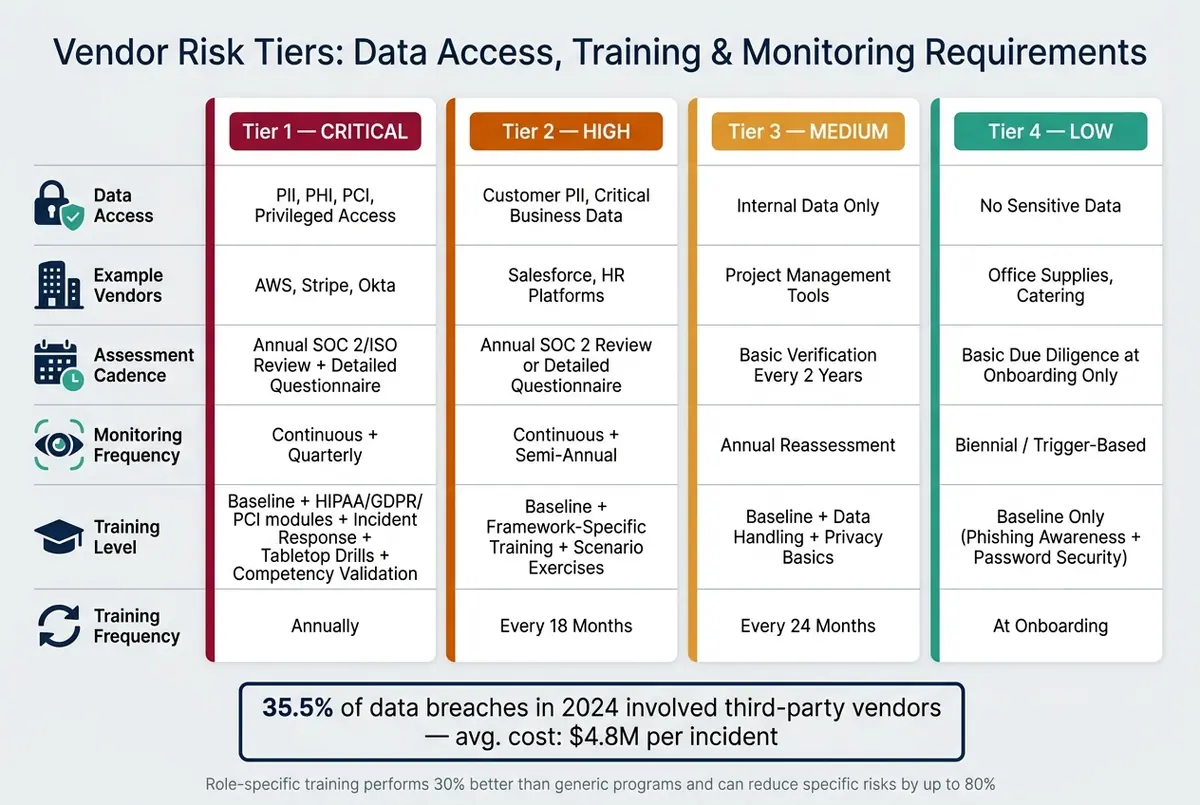
Vendor Risk Tiers: Data Access, Training & Monitoring Requirements
Not all vendors pose the same risks, so your scrutiny should match the level of exposure. For example, applying the same training program to a cloud infrastructure provider and an office supply vendor is a waste of resources. A risk-tiered strategy ensures your most rigorous compliance efforts focus on vendors with the highest potential for impact - an approach that complements the risk management principles outlined earlier.
Risk Classification Framework
Vendors are categorized into tiers based on four key factors:
- Data access: Does the vendor handle sensitive information like PII, PHI, or payment card data?
- System integration depth: Are they connecting to your systems via API, VPN, or direct database access?
- Business criticality: How would a breach or outage affect operations?
- Regulatory scope: Are they subject to regulations like HIPAA, GDPR, or PCI DSS?
The more of these factors a vendor meets, the higher their risk tier. Here's how this framework translates into actionable tiers:
| Tier | Risk Level | Data Access | Examples | Assessment Cadence |
|---|---|---|---|---|
| Tier 1 | Critical | PII, PHI, PCI, privileged access | AWS, Stripe, Okta | Annual SOC 2/ISO review + detailed questionnaire |
| Tier 2 | High | Customer PII, critical business data | Salesforce, HR platforms | Annual SOC 2 review or detailed questionnaire |
| Tier 3 | Medium | Internal data only, easily replaceable | Project management tools | Basic verification every 2 years |
| Tier 4 | Low | No sensitive data access | Office supplies, catering | Basic due diligence at onboarding |
To streamline the assessment process, define a vendor's criticality and data access scope before procurement begins. Once tiers are established, you can focus on tailoring training to fit the risk level.
Training Variations by Risk Level
Customizing training ensures that your compliance efforts remain targeted and effective. Research shows that role-specific training programs perform 30% better than generic ones, and in high-risk areas, this approach can reduce specific risks by up to 80%.
All vendors start with baseline training, which covers essentials like phishing awareness and password security. From there, training escalates based on risk:
- Medium-risk vendors: Add modules on data handling and privacy basics.
- High-risk vendors: Include framework-specific training (e.g., HIPAA, GDPR, PCI DSS), incident response procedures, and competency checks through scenario-based exercises or e-signatures.
Verification also scales with risk. For Tier 4 vendors, a simple quiz might suffice, while Tier 1 vendors require structured digital checklists and documented competency validations.
AI service providers introduce unique challenges, such as prompt injection risks, training data provenance, and model hallucinations. Until a thorough assessment is complete, treat AI vendors as Tier 1 or Tier 2. By incorporating AI-specific criteria into your tiering model, you can ensure a more robust and tailored risk management approach.
Vendor Compliance Training Checklist
With risk tiers clearly outlined and tailored training programs in place, a thorough checklist is essential to avoid missing any critical steps. This structured approach builds on existing training and monitoring efforts to ensure compliance is fully addressed. In 2024, third-party vendors were involved in 35.5% of breaches, with an average cost of $4.8 million per incident. A well-maintained checklist can help reduce penalties by 40–60%. Use the checklist below to confirm all key elements are covered before onboarding vendors or during periodic evaluations.
| Checklist Category | Required Elements | Documentation Needed |
|---|---|---|
| Governance | TPRM Policy, RACI Matrix, Risk Appetite Statement | Signed policy, governance charter |
| Training Content | Privacy basics (GDPR, HIPAA, CCPA), breach reporting, DSR recognition, examples of prohibited conduct | Content version log, assessment results |
| Vendor Controls | Sub-processor approval workflows, data return/deletion protocols, prior written authorization requirements | Signed DPAs/BAAs, deletion certificates |
| Monitoring | Refresher schedule, KRI tracking (security ratings, SLA breach frequency, fourth-party change notifications) | Attendance logs, KRI dashboards |
This checklist isn’t just for onboarding - it’s a living document that supports ongoing compliance efforts. For instance, ensure vendor staff can recognize Data Subject Requests (DSRs), such as emails requesting, “delete my account.” On the documentation front, maintain detailed audit trails, including digital signatures, assessment scores, and completion timestamps. These records should be organized so they can be verified by a third party within four hours during an inspection.
Make this checklist part of a continuous review cycle. Plan for annual refresher training, and conduct unscheduled reviews whenever sub-processors change, security incidents occur, or new regulations are introduced. One highly effective practice is running tabletop breach notification drills with your highest-risk vendors. These drills help ensure that meeting the 72-hour GDPR notification deadline is not just a theoretical goal but a practical reality.
Conclusion: Next Steps for Vendor Data Sharing Compliance
Staying on top of vendor compliance training isn’t just a task - it’s a necessity. With the average cost of a data breach projected to hit $4.88 million globally in 2024 and GDPR penalties surpassing €5.5 billion by 2025, the financial risks of falling behind are impossible to ignore.
To keep your training effective, adopt a multi-trigger update cycle. This means refreshing training materials whenever there are regulatory updates, audit findings, or internal incidents. As soon as these triggers arise, update your content and require immediate retraining for employees who completed outdated modules. By aligning these updates with regulatory shifts, as outlined in vendor risk tiering, you strengthen your compliance strategy.
When it comes to measuring success, focus on understanding - not just participation. Set a minimum passing score of 80% for all assessments and follow up with shorter refresher tests 3–6 months later to identify and address any lingering knowledge gaps. For businesses operating across multiple jurisdictions, design your core program around GDPR standards and then add local-specific rules like CCPA opt-outs or state mandates. This avoids the complexity of running separate programs.
Looking ahead to 2026 enforcement priorities, regulators are zeroing in on areas like AI training data scraping, cookie consent practices, and cross-border data transfers. Proactively update your vendor training to cover these topics now, so you’re prepared before they become red flags during audits. Incorporating these insights into your training ensures your compliance efforts remain risk-focused and future-ready.
FAQs
Which vendors count as “third parties” for compliance?
Third-party vendors for compliance are external organizations that manage, process, or access sensitive or nonpublic information on your behalf. Examples include analytics providers, CRM platforms, e-commerce vendors, marketing platforms, IT service providers, payment processors, and insurance claims management services. These vendors are integral to handling data or services that are essential for your business operations and meeting compliance standards.
What contract terms are most important before sharing sensitive data?
When reviewing a contract, pay close attention to terms related to data processing obligations, confidentiality, data deletion timelines, audit rights, and restrictions on selling or sharing data. These details are usually spelled out in Data Processing Agreements (DPAs) or similar documents. Clear and well-defined terms in these areas are essential for safeguarding sensitive information and staying compliant with regulations.
How do we monitor vendor compliance after onboarding?
Keeping tabs on vendor compliance is an ongoing process that involves a mix of scheduled reviews, incident tracking, and timely reassessments. Here’s how it typically works:
- Regular Security Reviews: This includes going over updated security reports like SOC 2 to ensure vendors maintain the required standards.
- Incident Monitoring: Stay alert for service disruptions, breaches, or any other incidents that could signal potential risks.
- Reassessments After Key Events: Major changes, such as data breaches or acquisitions, call for a fresh evaluation of the vendor’s compliance and risk profile.
To maintain consistent oversight, it's crucial to build an evidence library and set up alerts for key risk indicators (KRIs). These steps help you stay informed and ready to act. Additionally, formal reviews should be scheduled based on the vendor’s risk tier, ensuring high-risk vendors get the attention they require.
Related Blog Posts
Get new content delivered straight to your inbox

The Response
Updates on the Reform platform, insights on optimizing conversion rates, and tips to craft forms that convert.


Drive real results with form optimizations
Tested across hundreds of experiments, our strategies deliver a 215% lift in qualified leads for B2B and SaaS companies.
