
.webp)
GDPR vs CCPA: Consent Rules for Global Leads


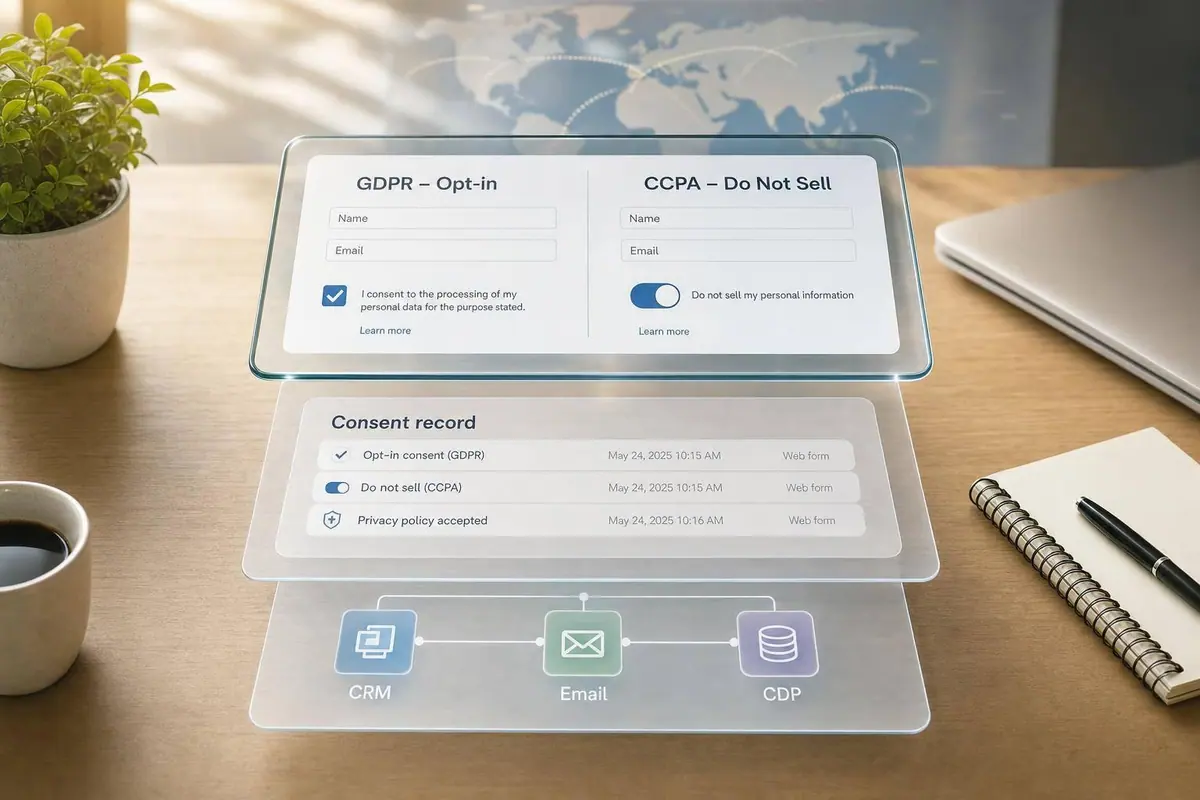
If you collect leads from the EU and California, you can’t use one consent flow for both.
Here’s the short version: GDPR usually needs opt-in before marketing starts, while CCPA usually allows collection first but gives people the right to opt out of sale or sharing. That one split affects your forms, privacy notices, email flows, CRM fields, ad tools, and how you store proof of consent. And the risk is not small: GDPR fines can reach €20 million or 4% of annual global revenue, and intentional CCPA violations can reach $7,500 per violation.
If I had to sum up the article in a few points, it would be this:
- GDPR = opt-in first for many marketing uses
- CCPA = notice first, then a clear opt-out
- GDPR needs proof: time, source, purpose, and consent text shown
- CCPA needs working opt-out controls, including Global Privacy Control (GPC)
- Your CRM and ad tools must honor the same choice after the form submit
- The main risk often starts after handoff, not on the form itself
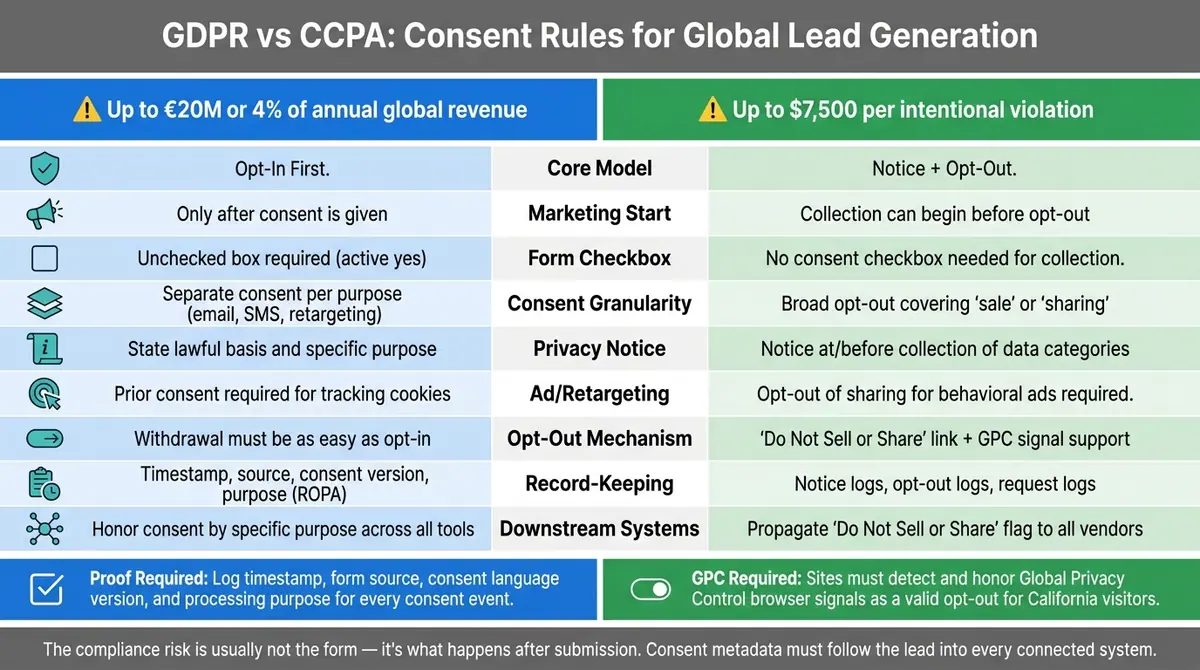
GDPR vs CCPA: Key Consent Rules for Global Lead Generation
GDPR vs CCPA: How US and EU Privacy Law Differ
sbb-itb-5f36581
Quick Comparison
| Topic | GDPR | CCPA |
|---|---|---|
| Main model | Opt-in | Notice + opt-out |
| Marketing start point | Usually after consent | Collection can start before opt-out |
| Form checkbox | Unchecked box or other clear yes action | No consent box needed for collection |
| Privacy notice | Clear purpose and lawful basis | Notice at or before collection |
| Ad/retargeting use | Prior consent is often needed | Opt-out of sale/sharing must be available |
| User control | Withdrawal must be easy | Opt-out must be easy and no dark patterns |
| Proof/logging | Keep detailed consent records | Keep notice, request, and opt-out logs |
| Downstream systems | Must honor consent by purpose | Must honor “Do Not Sell or Share” signals |
Bottom line: if your lead flow does not pass region, consent status, purpose, and opt-out data into every connected system, your compliance process can fail even when the form looks fine.
GDPR Consent Rules for Lead Generation
Under GDPR, lead capture will usually need a strict opt-in flow before any marketing processing starts. That shapes both your form design and the data you pass into downstream tools.
Consent Definition and Lawful Basis Under GDPR
Consent must be freely given, specific, informed, and unambiguous. In plain English, that means the person has a real choice, the consent is tied to one purpose, the privacy notice is clear at the point of collection, and the person takes an affirmative action to say yes.
Legitimate interest has a limited role in marketing use cases. Regulators put tight limits on its use for marketing, especially for behavioral advertising. The EDPB's 2024 guidance reinforced this point for behavioral advertising in particular.
Opt-In, Withdrawal, and Record-Keeping Requirements
Use an unchecked box or another clear affirmative action. Pre-checked boxes, silence, and inactivity don't count.
Withdrawal also has to be just as easy as opting in. A visible footer link or a "change preferences" button is the kind of control GDPR expects. And the job doesn't stop at the form. If someone withdraws consent, that preference needs to move across downstream tools too. If the opt-out doesn't sync, your CRM, email platform, and ad tools may keep processing data anyway. That's where teams get into trouble.
That is why the consent trail needs to stay intact after handoff.
Record-keeping is non-negotiable. For each consent event, store the timestamp, source form, the exact consent language version shown, and the processing purpose. Here's what a complete consent record should include:
| Record Type | Required Data Points |
|---|---|
| Consent Event | Timestamp, banner/notice version |
| Preference State | Specific purposes (e.g., marketing, analytics, sharing) |
| Withdrawal Log | Date of request, source, confirmation of sync to downstream tools |
CCPA works differently. Collection can begin without opt-in, but notice and opt-out controls still apply.
CCPA Consent Rules for Lead Generation
For lead generation, CCPA lets you collect data with notice first as part of your broader lead generation strategies, then give people a way to opt out of sale or sharing. In plain English: your lead forms need clear notice, and the tools that receive that lead need a working opt-out path.
Collection, Notice, and Consumer Rights Under CCPA
For lead forms, the notice must appear at or before collection. Under CCPA, you do not need affirmative opt-in before collecting lead contact details. What you do need is a notice at or before the point of collection that explains the categories of personal information you collect and the business purposes for which you will use it.
CCPA also gives consumers the right to:
- access their data
- request deletion
- correct inaccurate records
- opt out of the sale or sharing of their information
Those rights also apply to archived, dormant, and cold-storage data, including dormant leads, nurture lists, and backups. So if someone makes a request, it can't stop at the active CRM. The request needs to follow the lead wherever that data lives.
Opt-Out of Sale or Sharing
After the lead comes in, the next issue is whether sale or sharing is turned on. If your business meets any of these three thresholds, you must post a clear "Do Not Sell or Share My Personal Information" link on your website:
- more than $25 million in annual gross revenue
- handling the personal information of 100,000 or more California residents
- getting 50% or more of annual revenue from selling or sharing personal information
The wording here matters. Sale means disclosing personal information for money or other value. Sharing means disclosing it for cross-context behavioral advertising, even if no payment changes hands. That's where many marketing setups run into trouble. Passing lead data to retargeting pixels or marketing cooperatives can trigger these rules.
Once a consumer opts out, businesses must generally wait at least 12 months before asking again for permission to sell or share that person's data. And the opt-out can't live only on a policy page. It needs to flow into CRM, ad, and vendor systems too.
Businesses must also honor Global Privacy Control (GPC) browser signals as a recognized opt-out signal for California visitors. If your site doesn't detect GPC, then it isn't honoring that California opt-out.
GDPR vs CCPA: Opt-In, Opt-Out, and Form Design Differences
Opt-In vs Opt-Out for Global Campaigns
This difference changes how a form needs to work before a lead ever gets to sales.
Under GDPR, you can't send marketing until the person opts in. Under CCPA, you can collect data first, but you must give notice and offer a clear way to opt out of sale or sharing.
If you're running global campaigns, region-based routing has to happen before leads enter the CRM. Teams working across both regions need geography-aware logic built into forms and CRM workflows from day one.
At the form level, that means different defaults, different disclosures, and different routing paths.
Form Fields, Checkboxes, and Privacy Notices
Under GDPR, every marketing checkbox must be unchecked by default and tied to one clear purpose. If you're asking for consent for email, SMS, and retargeting, each one needs its own consent state. Rolling all of that into one marketing checkbox doesn't meet the specificity rule.
Under CCPA, the form doesn't need a checkbox for data collection. What it does need is a "Do Not Sell or Share My Personal Information" link that's easy to find on your site, along with notice at collection that explains what data you collect and why. The opt-out path also needs to stay low-friction. CCPA rejects dark patterns that make opting out harder than opting in.
That means your form logic can't stop at the front end. Conditional routing and CRM integrations should pass regional consent metadata with each lead. If the CRM can't read region and consent state, the workflow breaks.
GDPR vs CCPA Form Requirements: Comparison Table
| Form Element | GDPR Requirement | CCPA Requirement |
|---|---|---|
| Default Checkbox State | Unchecked - active opt-in required | No checkbox required for collection; opt-out must be clear and low-friction |
| Consent Granularity | Separate consent per purpose (email, SMS, retargeting) | Broad opt-out covering "sale" or "sharing" as a category |
| Disclosure Copy | Must state the specific lawful basis and purpose of processing | Notice at collection disclosing categories of data and business purpose |
| Privacy Links | Link to a full Privacy Policy | Privacy Policy + "Do Not Sell or Share" link where applicable |
| Withdrawal / Opt-Out | Must be as easy to withdraw as it was to give | Must avoid dark patterns or asymmetrical design |
| Retargeting | Requires prior consent for non-essential tracking cookies | Requires a mechanism to opt out of sharing for cross-context behavioral ads |
| Record-Keeping | Detailed Records of Processing Activities (ROPA) required | Notice, opt-out, and request logs required |
These form choices only hold up if consent data moves with the lead. In practice, that makes consent metadata and downstream sync part of lead capture itself, not something to patch in later.
Cross-Border Consent Management and Lead Handoff
What Consent Metadata Should Follow the Lead
After capture, the next job is simple in theory and messy in practice: make sure the person’s choice follows the lead everywhere.
Each lead record should carry the details needed to enforce that choice across every system that touches it. That includes source, region, purpose, lawful basis, consent version, and opt-out status. For CCPA leads, that means a clear "Do Not Sell or Share" flag. For GDPR leads, it means recording the lawful basis tied to that lead and what the person agreed to.
If an opt-out never reaches downstream systems, those systems can keep processing the lead in a way that goes against the recorded preference.
How to Standardize Workflows Across Regions
A centralized consent and preference management system helps keep those choices in sync across regions and tools.
You’ll also want conditional routing and CRM integrations that pass region, lawful basis, and marketing permissions into connected systems. That handoff step is where global workflows often break. Using powerful form templates ensures the form collects the right data, but if the data doesn’t move cleanly, the process falls apart.
Here’s how GDPR- and CCPA-oriented handoff practices differ in day-to-day use:
| Handoff Element | GDPR-Oriented Practice | CCPA-Oriented Practice |
|---|---|---|
| Primary requirement | Document lawful basis and affirmative opt-in | Capture and propagate a "Do Not Sell or Share" flag |
| Downstream focus | Process data only for specific, consented purposes | Ensure opt-out signals reach third-party sale or sharing partners |
| Rights fulfillment | GDPR: portability, objection, restriction | CCPA: access, deletion, correction |
| Operational risk | Processing without a documented lawful basis | Friction in the opt-out flow or failure to sync opt-out signals |
| AI/automation | Flag data used in automated decision-making or profiling | Connect opt-outs to AI systems used for lead scoring or routing |
Conclusion: The Core Rule for Global Lead Teams
The compliance risk usually isn’t the form itself. It’s what happens after submission.
Once those fields sync the right way, the lead can move through sales and marketing without breaking the original consent terms. Clear consent capture only works when that data passes cleanly into every tool that touches the lead.
FAQs
Which law applies if I collect leads globally?
The rules you need to follow depend on where your leads live, not just where your business operates.
GDPR covers data from people in the EU or EEA, even if your company is based in the United States or somewhere else. CCPA/CPRA applies to certain for-profit businesses that meet set thresholds and collect data from California residents.
That cross-border piece matters a lot. If you collect lead data from people in more than one place, you may need to follow the laws in each place where those people reside.
When do I need separate consent for email, SMS, and retargeting?
Under GDPR, you need separate opt-in consent for each purpose, such as email, SMS, and retargeting. You can't roll those into one catch-all permission.
Why? Because consent has to be specific, informed, unambiguous, and granular. If someone wants email updates but not SMS, or agrees to one type of tracking but not another, your setup needs to reflect that choice.
Under CCPA, data can often be collected by default. But users must have a clear way to opt out of the sale or sharing of their personal information. And under CPRA, retargeting and audience matching count as sharing, so your system needs to honor those opt-out requests too.
How should I store and sync consent across my CRM and ad tools?
Treat consent data as a core lead attribute that moves with the lead across every system. When data flows into your CRM or marketing tools, automatically send the user’s consent status, the purpose tied to that consent, and any retention safeguards along with it.
Keep a verifiable record of what users clicked and when. That click trail matters. It gives your team something concrete to point to if questions come up later.
Use secure API integrations with OAuth and exact field mapping so consent tracking stays consistent during each handoff. If one system labels a field one way and another system handles it differently, things can get messy fast. Tight mapping helps keep the record clean and intact.
Related Blog Posts
Get new content delivered straight to your inbox

The Response
Updates on the Reform platform, insights on optimizing conversion rates, and tips to craft forms that convert.




Drive real results with form optimizations
Tested across hundreds of experiments, our strategies deliver a 215% lift in qualified leads for B2B and SaaS companies.
