
.webp)
Tools for GDPR and CCPA Consent Record Management


If your business collects personal data, managing consent records is not optional - it’s mandatory. Failing to comply with GDPR or CCPA can result in heavy fines: up to €20 million under GDPR or $7,500 per violation under CCPA. Consent management tools simplify compliance by automating consent tracking, creating audit-ready records, and ensuring proper handling of user preferences across platforms.
This article reviews four popular consent management platforms:
- Osano: Offers a "No Fines, No Penalties" guarantee, focusing on simplicity and automated compliance.
- OneTrust: Designed for large enterprises needing advanced features for global compliance.
- Usercentrics: Affordable and scalable for growing businesses, with support for multiple regulations and languages.
- Didomi: Highly customizable, ideal for businesses managing complex consent needs across multiple devices.
Each platform provides unique features, from real-time consent logging to multi-region compliance support. Below is a quick comparison to help you choose the right tool for your needs.
Quick Comparison
| Tool | Starting Price | Key Strength | Main Limitation |
|---|---|---|---|
| Osano | $199/month | Financial guarantee for compliance | Limited banner customization |
| OneTrust | ~$50,000/year | Advanced enterprise-level features | High cost, complex setup |
| Usercentrics | $8/month | Budget-friendly, multi-language support | Fewer enterprise features |
| Didomi | Custom pricing | Deep customization options | No self-service onboarding |
Choosing the right platform depends on your business size, compliance needs, and technical resources. Keep reading for a detailed breakdown of each tool.

GDPR CCPA Consent Management Platform Comparison: Features, Pricing & Ratings
What is a Consent Management Platform (CMP)?
sbb-itb-5f36581
1. Osano
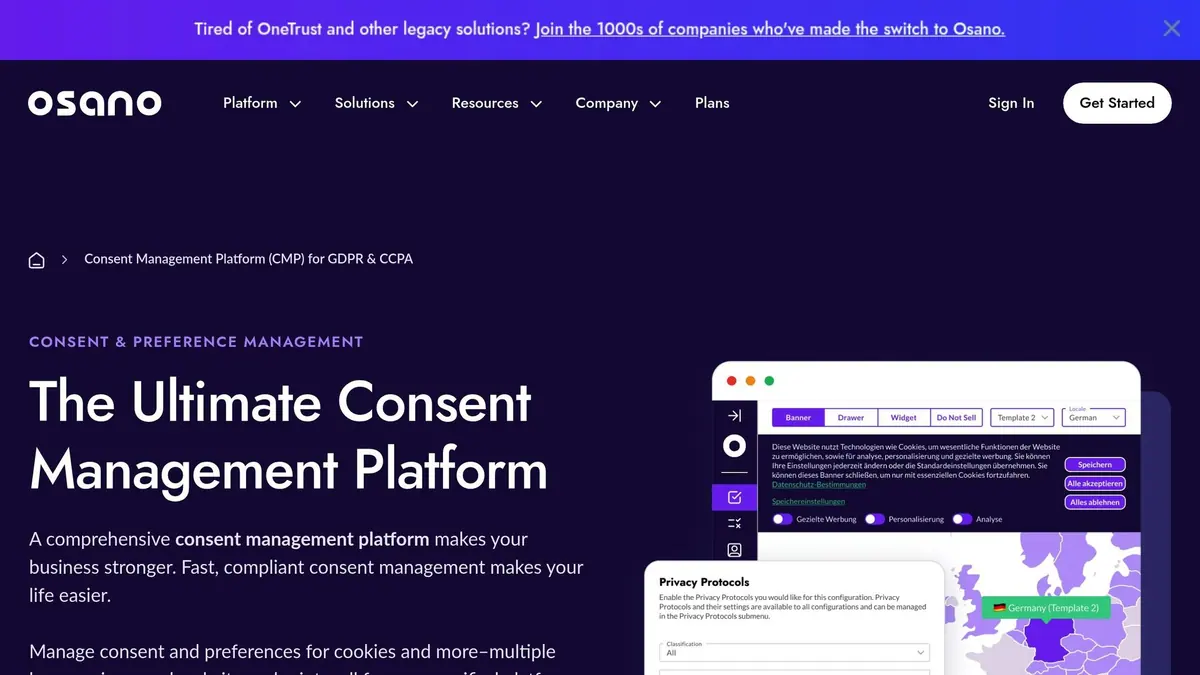
Osano is a platform designed for businesses that want straightforward and reliable legal compliance. One standout feature is its "No Fines, No Penalties" guarantee, which promises to cover regulatory penalties up to $500,000 - provided you follow their best practices. This kind of financial assurance is a rarity in the consent management world.
Consent Logging
Every time a user interacts with your consent banner, Osano captures key details like the timestamp, banner version, device type, and the specific cookie categories accepted or rejected. All this information is stored in the "Unified Consent & Preference Hub", a centralized system that tracks cookie consents, "Do Not Sell/Share" requests, and marketing preferences. With over 1 billion consents processed each month, Osano uses AI to classify cookies automatically, reducing manual errors and avoiding questionable "dark patterns".
Audit Capabilities
When it comes to regulatory inquiries, Osano has you covered with its "Audit Defense" support. The platform keeps detailed, auditable records, including consent statuses, IP-based location data, and user agreement details. Additionally, the TrustHub feature organizes all your privacy documentation in one secure space. Customers have reported saving between $5,000 and $20,000 per jurisdiction on legal fees by leveraging these compliance tools.
"The Osano team is very knowledgeable, helpful, and accessible. I know I can expect a thoughtful and prompt response to all my questions. The platform is intuitive, easy to implement, and enables us to holistically monitor privacy compliance."
- Ivanna C., G2 Reviewer
Compliance Coverage
Osano supports compliance in over 50 countries and offers consent banners in more than 40 languages, complete with automatic localization. It covers 95+ global privacy laws, including GDPR, CCPA, CPRA, and others. As a certified Google CMP partner, it integrates seamlessly with Google Consent Mode v2 for ad and analytics compliance. The platform also supports Global Privacy Control (GPC) signals, automatically managing tracker permissions.
Integrations
Osano makes implementation easy with its one-line JavaScript code, simplifying integration with websites and tag managers. It also connects with tools like Vanta to embed consent data into broader risk strategies and integrates with SSO providers to map systems that process personal data automatically.
"Osano is simplifying our international expansion and giving our exec team peace of mind with privacy compliance. It also has allowed us to conserve developer resources with its 'one line JS' model."
- Ryan W., CEO
Reporting
Osano provides real-time analytics on consent rates and user preferences, helping you track which banner versions perform best and how users in different regions interact with your privacy notices. Its continuous monitoring feature scans your site for new trackers, ensuring consent logs stay up-to-date even as your tech stack evolves.
Pricing
Osano offers three pricing tiers. The Free Plan supports websites with up to 5,000 monthly visitors. For $199 per month, the Plus Plan accommodates up to 30,000 visitors and includes features like geo-targeting and analytics for GDPR and CCPA compliance. Larger organizations with high traffic can opt for the Enterprise Plan, which offers advanced features like cross-domain consent and dedicated support, with custom pricing. Osano holds a 4.5/5 rating on G2, with users praising its ease of use and expertise in legal compliance, though some note limited customization options for banners.
2. OneTrust
OneTrust is a high-level platform trusted by over 14,000 customers to manage consent across websites, mobile apps, and streaming platforms.
Consent Logging
OneTrust uses an anonymous cookie called OptanonConsent to log consent decisions. It tracks four interaction states: Confirmed, Opt-out, Not Given, and No Choice. All these entries are stored in a centralized database, complete with change histories, ensuring that consent is recorded right at the point of interaction. The platform also includes advanced analytics that capture details like browser type, device type, and user location.
"Consent is the gatekeeper of all marketing, and OneTrust helped us unlock a trust and transparency strategy worth at least billions of dollars a year."
- Director of Digital Trust, Pharmaceuticals
Audit Capabilities
OneTrust offers self-service audit logs with detailed tracking of every consent change. Users can search for specific consent receipts using either the Receipt GUID or the Data Subject Identifier stored in the OptanonConsent cookie. Alternatively, the OneTrust.getDataSubjectId() console command can retrieve this information. For larger-scale needs, the platform supports bulk exports in CSV and Excel formats, handling up to 500,000 rows. This makes it easier to prepare audit-ready documentation for regulatory inquiries.
Compliance Coverage
OneTrust supports compliance with over 50 global privacy laws and provides consent banners in nearly 200 languages. It integrates seamlessly with the IAB Transparency and Consent Framework (TCF) 2.3 to ensure compliance with digital advertising standards. A 2024 Forrester Consulting Total Economic Impact™ study revealed that organizations using OneTrust's granular consent tools achieved a 3% revenue boost from digital marketing campaigns. These features allow businesses to manage compliance efficiently while maintaining detailed reporting capabilities.
"When we did our assessment, we wanted to have one single application across all the business functions and all the countries that we operate in. This is important to us because, in terms of consent management, we want to have consistency across all our websites and apps."
- Octavio Ponce, Strategic Customer Engagement and Marketing Director, Carrefour Group
Integrations
OneTrust provides access to a marketplace with over 113 pre-built integrations for consent and preference management. It connects with leading CRMs, marketing automation platforms, and data warehouses. By unifying consent profiles across both known and anonymous users, the platform ensures a consistent experience across websites, mobile apps, and streaming services.
Reporting
The Cookie Consent Dashboard offers real-time analytics on opt-in and opt-out rates. Users can filter this data by domain, template, or time frame. For further analysis, data can be exported to CSV or Excel, making it easy to store and examine trends over time. These reporting tools complement the platform’s broader enterprise capabilities.
Pricing
OneTrust does not publicly disclose its pricing. However, industry estimates suggest that enterprise contracts typically start at around $50,000 annually. Costs are influenced by the number of domains managed and the specific modules selected. The platform holds a 4.3/5 rating on G2 and a 4.1/5 rating on Gartner Peer Insights. While users appreciate its extensive legal coverage and ability to handle complex enterprise needs, many note that implementation can be time-consuming and often requires technical expertise or external consultants.
3. Usercentrics
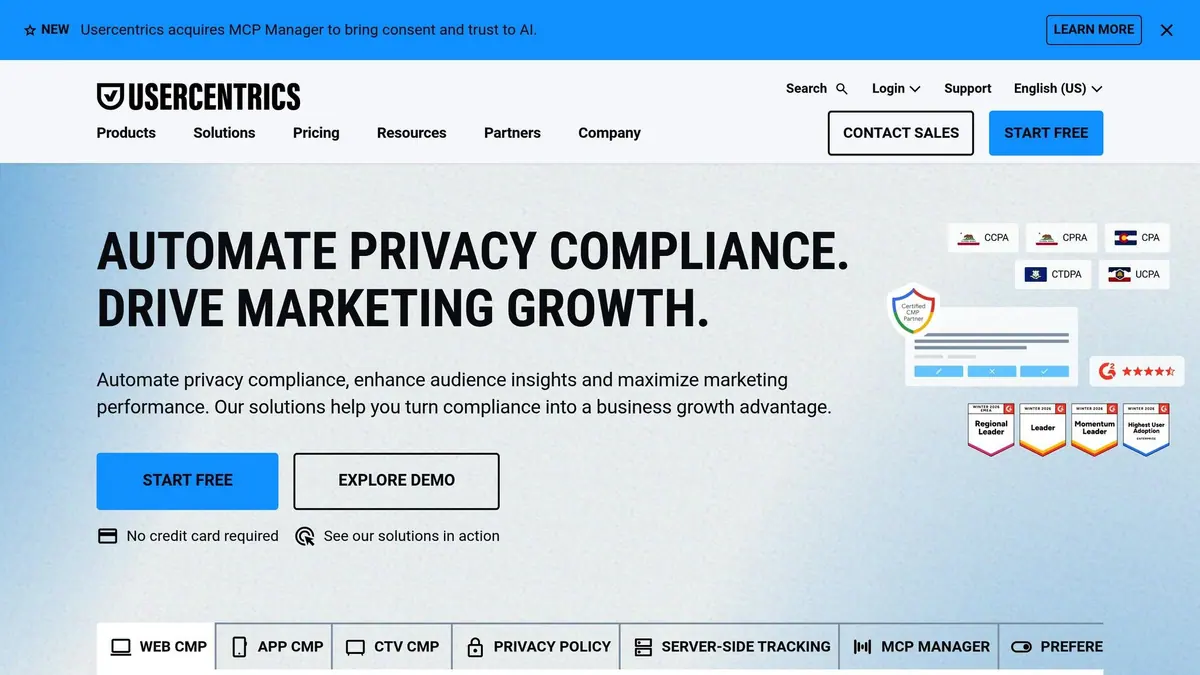
Usercentrics is a consent management platform (CMP) used by 2.4 million websites and apps across 195 countries, processing a staggering 8.8 billion consents every month. The platform simplifies compliance by automatically detecting, categorizing, and managing trackers while applying the appropriate legal framework based on the visitor's location - whether it's GDPR for the European Union or CCPA for California. Here's a closer look at its features, including consent logging, audit tools, compliance support, integrations, reporting, and pricing.
Consent Logging
Usercentrics maintains detailed consent logs, which include timestamps and versions of consent text, stored for 12 months to support audits and Data Subject Access Requests (DSARs). Using geolocation, the platform ensures that visitors see the correct regulatory banner before their consent is logged.
"We are confident that the information in the CMP is up to date and relevant."
- Ekaterina Kolbasova, Head of IT, AMBOSS
Audit Capabilities
The platform offers self-service audit logs to track every consent change, with premium plans featuring a "Review & Release" option to approve updates before they go live, ensuring a clear audit trail. Additionally, Usercentrics' automated website scanner regularly detects new cookies and trackers, helping to keep consent records accurate.
Compliance Coverage
Usercentrics supports a wide range of regulations, including GDPR, CCPA/CPRA, LGPD, POPIA, VCDPA, and the Digital Markets Act (DMA). It is both Google-certified and IAB-certified for TCF 2.2, and its consent banners are available in over 60 languages. The platform also offers more than 2,200 legal templates, reducing the manual workload involved in maintaining compliance, often by using multi-step forms.
"We chose Usercentrics because it meets the highest data protection standards, offers an intuitive user interface with great features, and was easy to integrate into our system."
- Ann-Kathrin Meyer, Product Owner Webshops
Integrations
Usercentrics integrates seamlessly with many popular marketing and CMS platforms, making deployment straightforward. It connects with tools like HubSpot, Mailchimp, and CMS platforms such as WordPress, Shopify, and Wix. For added convenience, it includes a Google Tag Manager template, allowing for simplified implementation without direct code access. Enterprise users benefit from a 99.9% uptime Service Level Agreement, ensuring reliability.
Reporting
The platform's dashboards provide detailed insights, tracking consent and acceptance rates by domain and timeframe. Higher-tier plans offer advanced features like A/B testing and cross-region analytics, with data retention for up to 90 days.
Pricing
Usercentrics offers a range of pricing plans to accommodate businesses of all sizes:
| Plan | Price (Monthly) | Sessions | Domains | Key Features |
|---|---|---|---|---|
| Essential | $7.60 | Up to 1,500 | 1 | 1 regulation, 2 languages |
| Plus | $16.30 | Up to 3,000 | 1 | Unlimited regulations, 5 languages |
| Pro | $32.50 | Up to 15,000 | 3 | 60 languages |
| Business | $54.20 | Up to 50,000 | 10 | Comparative analytics |
| Advanced | From $108.40 | 100,000+ | Traffic-based | A/B testing |
| Corporate | Custom | 1M+ | Unlimited | Priority support, SSO |
With a 4.3/5 rating on G2 and a 4.5/5 usability score on Capterra, Usercentrics has earned a strong reputation. The platform boasts a customer retention rate exceeding 99%. Users often highlight its smooth integration with Google Tag Manager and its intuitive interface. However, some note that initial manual setup can require significant effort, and priority support is only available for higher-tier plans.
4. Didomi
Didomi powers consent management for over 29,000 websites and apps, delivering a boost in consent rates - up to 10% with optimized banners. Supporting more than 45 languages and holding an impressive 4.6/5 rating on G2, Didomi combines dependable logging, audit trails, and regulatory compliance into one comprehensive platform.
Consent Logging
Didomi captures detailed "Events" for every consent interaction. These records include user ID, timestamp, consent status, and notice configuration, all stored for up to five years. To meet audit requirements, proofs of consent are saved in digitally encoded formats like PDF, PNG, or JPG. This meticulous approach ensures that organizations have the documentation needed for compliance.
Audit Capabilities
The platform's "Versions & Proofs" feature keeps a detailed archive of every consent notice version, including any modifications made by delegates. This ensures a precise audit trail.
"Your data management and privacy teams can access consent history and access specific consent UI versions agreed to by any user at any point in time. This is critical in maintaining a compliance audit trail." - Didomi
To ensure accurate versioning, Didomi recommends managing notices through its Console rather than local files, as the latter are not preserved for version tracking. For organizations handling high volumes of data or needing internal backups, the batch export feature provides daily updates of all consent records to AWS S3 or GCP Storage. These robust audit tools pave the way for seamless integrations, which are covered below.
Compliance Coverage
Didomi’s platform is built to align with a wide range of regulations, including GDPR, CCPA/CPRA, VCDPA (Virginia), CTDPA (Connecticut), CPA (Colorado), LGPD (Brazil), and more. It integrates with IAB TCF v2.2/v2.3, Google Consent Mode V2, Microsoft UET Consent Mode, and supports Global Privacy Control (GPC) signals. Companies like Société Générale have implemented Didomi across hundreds of websites to serve their 30 million customers, while Gaming1 uses it to centralize compliance across 14 websites.
Integrations
Didomi offers three methods for syncing consent data: Webhooks (real-time), Batch Export (daily updates), and Consents API (custom solutions). The platform integrates seamlessly with Google Tag Manager to manage data collection based on user preferences and connects with top tools like Adobe, Meta Conversions API, and various CRMs and analytics platforms. SDKs are available for web, mobile (iOS/Android), and Connected TV environments, including Amazon Fire TV and OTT platforms.
| Integration Method | Delivery Lag | Scalability | Best Use Case |
|---|---|---|---|
| Consents API | Real-time | One user at a time | Internal services, custom UI |
| Webhooks | Real-time | One user at a time | Vendor sync, marketing triggers |
| Batch Export | >= 24 hours | All choices at once | BI, reporting, backups |
Reporting
Didomi’s reporting dashboard tracks consent rates across regions and regulations, offering A/B testing tools to refine banner performance. Compliance reports can be scheduled, executed, and downloaded via the Didomi API. Each consent record includes detailed data, such as event ID, timestamp, user ID, country, device type, browser version, and - when applicable - the specific TCF string. For organizations needing advanced metrics or integrating consent data with internal systems, the Batch Export option is recommended over the API to avoid scalability issues.
Pricing
Didomi provides three main pricing tiers:
- Essential: Covers multi-regulation compliance, customized branding, and cross-device synchronization.
- Advanced: Adds compliance auditing, monitoring, and customizable scans for vendor risk assessment.
- Premium: Offers granular management of user choices with native integrations for consent data distribution.
Additional features, like the Consents API and integrations such as Webhooks and Batch Exports, are priced separately. For smaller-scale needs, a free plan is available through Addingwell for server-side tagging, supporting up to 100,000 requests.
Users often praise Didomi’s intuitive interface, responsive customer support, and high level of customization. However, some note that it is a premium solution and lacks a self-service signup option, requiring a demo with the sales team before onboarding.
Strengths and Weaknesses
Looking at the detailed analyses above, here's a streamlined comparison of the strengths and challenges for each tool, helping you decide which aligns best with your organization's needs.
Each platform caters to different business sizes and compliance priorities.
Osano provides a legal guarantee, making it a solid choice for businesses seeking peace of mind. However, its banner customization options are quite limited. Pricing starts at $199/month, with a free tier available for single domains receiving fewer than 5,000 monthly visitors. Access to advanced features requires upgrading to higher-tier plans.
OneTrust stands out for its ability to unify consent across multiple digital channels. It also offers a robust audit-ready database with detailed change histories and centralized, exportable logs for GDPR and CCPA/CPRA reporting. The platform's DataGuidance portal ensures same-day updates on regulatory changes. However, it comes with a steep learning curve - onboarding often requires technical support, and enterprise contracts typically start at around $50,000/year.
Usercentrics is a budget-friendly option, starting at just $8/month per domain. It supports over 60 languages and includes features like in-depth analytics and A/B testing. Designed for scaling businesses, it offers straightforward, no-code integrations with tools like HubSpot, Mailchimp, and Google Tag Manager. Despite its accessibility, it lacks the robust enterprise features found in some of its competitors. The platform holds a G2 rating of 4.2/5.
Didomi earns the highest G2 rating at 4.6/5 and is ideal for organizations with complex technical needs, thanks to its deep customization options. However, it doesn’t offer a self-service signup and requires potential clients to schedule a demo with the sales team before onboarding. Pricing is only available through custom quotes, which may deter smaller businesses.
Here’s a quick comparison of the key features and drawbacks for each platform:
| Tool | Starting Price | G2 Rating | Key Strength | Main Limitation |
|---|---|---|---|---|
| Osano | $199/month | 4.5/5 | Legal guarantee coverage | Limited banner customization |
| OneTrust | ~$50,000/year | 4.3/5 | Cross-platform consent unification | Complex setup, high cost |
| Usercentrics | $8/month | 4.2/5 | 60+ languages, affordable pricing | Limited enterprise features |
| Didomi | Custom quote | 4.6/5 | Highest G2 rating, deep customization | No self-service, premium pricing |
These distinctions are essential when determining which platform best supports your consent management strategy while meeting regulatory demands.
Conclusion
Selecting the right consent management platform boils down to your business's size, technical expertise, and compliance goals. Each tool caters to specific needs, with unique features designed for different market segments. Here's a quick breakdown to help guide your decision.
For large enterprises, OneTrust offers an all-encompassing solution. It handles consent management, AI governance, and vendor risk, but comes with a hefty price tag of approximately $50,000 per year and requires a complex implementation process. As Octavio Ponce from Carrefour Group shared:
"OneTrust is one of the leaders in the market. When we did our assessment, we wanted to have one single application across all the business functions and all the countries that we operate in".
For growing businesses, Usercentrics provides a scalable and budget-friendly option. With pricing between $8 and $56 per month, it supports over 60 languages and includes access to 2,200 legal templates. This makes it a great choice for companies expanding globally without breaking the bank.
Small to medium-sized businesses might find Osano appealing due to its simplicity and ease of use. At $199 per month, it comes with a $500,000 "No Fines, No Penalties" guarantee and can be implemented with just a single line of code. Meanwhile, for those requiring advanced customization and multi-device synchronization, Didomi stands out. However, its custom pricing may pose a challenge for smaller budgets.
Ultimately, the best platform is the one that aligns with your compliance needs, technical capabilities, and growth plans. With 75% of websites failing to honor user opt-outs, ensuring your business meets these standards is more important than ever.
FAQs
What should businesses look for in a consent management platform to comply with GDPR and CCPA?
When picking a consent management platform (CMP) to meet GDPR and CCPA requirements, it's crucial to focus on features that simplify compliance while keeping your operations running smoothly. A solid CMP should automate consent collection, storage, and enforcement across all your digital channels, ensuring you stay aligned with ever-changing privacy regulations.
Key features to consider include granular consent options that let users control their preferences, robust record-keeping to document compliance, and smooth integration with your existing marketing and CRM tools. A platform with a user-friendly interface and customizable design can make life easier for your team and create a better experience for users. Scalability is another must-have, ensuring the platform can adapt as your business grows. Finally, check the platform’s track record, certifications, and ability to meet regional regulatory standards to ensure it delivers the reliability and legal compliance your business needs.
How do consent management tools ensure compliance with GDPR, CCPA, and other regional privacy laws?
Consent management tools play a crucial role in helping businesses adhere to privacy laws such as GDPR and CCPA, ensuring they meet the specific requirements of different regions. These tools are designed to handle cookie consent, manage user privacy preferences, and address subject rights, all while staying aligned with local regulations.
A key feature of these tools is their ability to scan websites for cookies, classify them according to regional standards, and present customized consent pop-ups. This process ensures that user preferences are not only recorded but also implemented correctly. For businesses with a global reach, these capabilities are indispensable for staying compliant, earning user trust, and respecting privacy expectations across diverse jurisdictions.
How do Osano, OneTrust, Usercentrics, and Didomi differ in terms of pricing and features?
Osano, OneTrust, Usercentrics, and Didomi each bring something different to the table, offering features and pricing designed to meet a variety of business needs.
Osano stands out as an all-in-one solution, providing tools like cookie consent management, data mapping, and vendor risk management. Its straightforward platform is a solid pick for growing businesses looking for broad compliance tools without added complexity.
OneTrust is built with large enterprises in mind. It offers extensive integrations, modular workflows, and advanced customization options, making it a go-to for businesses that require a highly adaptable and scalable solution.
Usercentrics shines when it comes to region-specific compliance. With user-friendly consent recording and granular controls, it’s a great fit for businesses that prioritize flexibility and need to adapt to varying regulations.
Didomi focuses on simplicity and scalability. It automates consent collection, manages user preferences, and provides detailed audit logs, making it a practical choice for businesses across different industries.
Ultimately, the best option will depend on your company’s size, compliance requirements, and how much customization you need.
Related Blog Posts
Get new content delivered straight to your inbox

The Response
Updates on the Reform platform, insights on optimizing conversion rates, and tips to craft forms that convert.




Drive real results with form optimizations
Tested across hundreds of experiments, our strategies deliver a 215% lift in qualified leads for B2B and SaaS companies.
