
.webp)
Ultimate Guide to BCR Employee Training



Binding Corporate Rules (BCRs) simplify cross-border data transfers within multinational companies by creating a unified, legally binding framework. However, compliance hinges on one critical factor: employee training. Here's why it matters and what you need to know:
- BCRs and GDPR: Under GDPR Article 47, BCRs must include a structured training program for employees handling personal data.
- Why Training Matters: Regulators require training to ensure employees understand and follow BCRs. Poor training can lead to fines, as seen in cases like Meta's $1.2 billion penalty.
- Who Needs Training: Employees across HR, IT, marketing, legal, and frontline roles must be trained, especially those regularly handling EU personal data.
- What to Include: Training should cover GDPR basics, BCR-specific rules, security measures, breach reporting, and role-specific responsibilities.
- Tracking Compliance: Organizations must maintain records, monitor training completion, and provide evidence to regulators when required.
Effective training not only ensures compliance but also reduces risks tied to human error, which accounts for 82% of data breaches. This guide offers practical steps to build a training program that aligns with regulatory expectations and protects your organization.
Regulatory Requirements for BCR Training
GDPR Training Requirements
Under Article 47 of the GDPR, training is a mandatory component for obtaining Binding Corporate Rules (BCR) approval. Organizations must establish a formal training program for all employees who regularly handle personal data. Supervisory authorities review this program as part of the approval process for BCR compliance.
The training should focus specifically on the rules outlined in the BCR framework rather than general privacy principles. As the Finnish Data Protection Ombudsman explains: "The rules are legally binding on both the companies belonging to the group of enterprises and to the employees of these companies". Because these rules carry legal weight within the organization, training becomes the key tool for ensuring employees understand and fulfill their obligations under the BCR framework. These standards set the foundation for regulatory and internal compliance expectations.
What Supervisory Authorities Expect
When reviewing BCR applications, supervisory authorities closely examine the policies and procedures that outline how training will be delivered. The UK Information Commissioner's Office (ICO) highlights the importance of these measures: "Policies and procedures also demonstrate the process you and your staff will follow to ensure protections are not undermined".
Regulators require tangible evidence to assess compliance, including training materials, attendance records, and completion certificates. Organizations must also provide a clear reference table within their BCR documentation that pinpoints where training policies are described. Additionally, the ICO reserves the right to request training records at any time to confirm adherence to GDPR standards.
Governance and Accountability in Training Programs
Effective BCR training relies on a well-defined governance structure. This includes assigning clear roles and responsibilities to ensure compliance. Organizations must designate a central office or an EU/UK-registered member to oversee the training program and manage data protection responsibilities. A network of Data Protection Officers or similarly qualified personnel should monitor the program’s effectiveness, address any gaps in understanding, and ensure ongoing compliance.
The French data protection authority, CNIL, specifies that organizations must outline in their BCRs how they will implement a staff training program tailored to the rules within the BCR framework. This involves integrating training into internal audit processes and providing annual updates to supervisory authorities. Companies must also document how training is enforced - whether through employment contracts, internal codes of conduct, or other binding mechanisms - and explain how instances of non-compliance are handled.
What Are Binding Corporate Rules? - CountyOffice.org

Building a BCR Training Curriculum
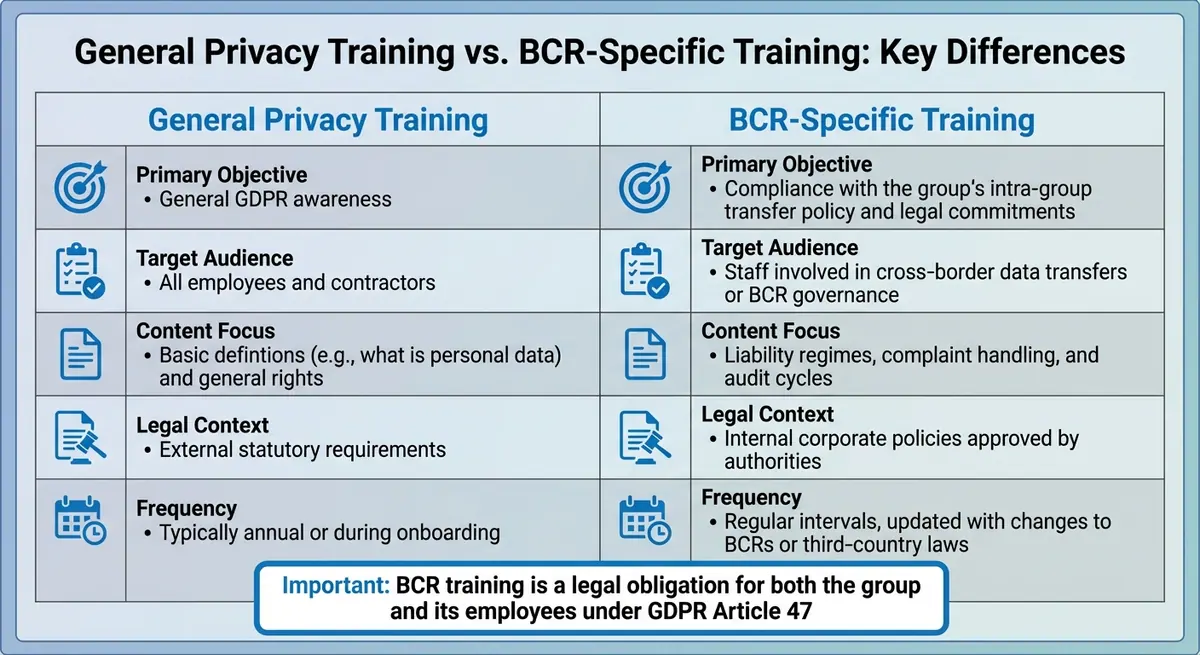
General Privacy Training vs BCR-Specific Training Comparison
Core Topics to Cover
Creating a solid BCR (Binding Corporate Rules) training program starts with the basics of GDPR. Employees need to understand key principles like purpose limitation, data minimization, storage periods, data quality, and the legal basis for processing. They should also be familiar with procedures for handling data subject rights, such as access, rectification, erasure, and providing necessary information. These principles form the backbone of day-to-day data handling, especially when dealing with cross-border transfers.
Beyond the fundamentals, your training should dive into BCR-specific topics. For instance, it’s important to clarify your group’s liability regime - who is accountable in case of breaches (usually the EU headquarters), how the Data Protection Officer (DPO) network operates, and the structure of your internal audit program. Employees must also be trained on operational procedures like managing internal complaints, conducting Privacy Impact Assessments (PIAs), and reporting personal data breaches. If your organization uses Processor BCRs, the training should explain the responsibilities processors have toward controllers.
Another critical area is security. Employees need to grasp the security and confidentiality measures in place to protect transferred data. They should also understand how to evaluate non-EU legislation under Schrems II and navigate adequacy frameworks such as the EU-U.S. Data Privacy Framework. Once these topics are covered, role-specific modules can tailor the training to meet the unique needs of each department.
Role-Based Training Modules
Tailoring your training to specific roles ensures that each department gets the information they need to support BCR compliance. For example, HR teams should focus on managing employee data and handling HR-related data transfers. Meanwhile, IT and security teams need to dive deeper into technical safeguards and breach response protocols. Marketing and product teams should familiarize themselves with privacy by design principles and understand how customer data moves across borders.
A training needs analysis can help identify which departments handle sensitive data and require more in-depth training. If your organization applies both Controller (BCR-C) and Processor (BCR-P) rules, employees should be able to distinguish between the two and know which operations fall under each. Specialized training is also essential for DPOs or those tasked with managing complaints and monitoring compliance across global offices.
All employees should receive basic training as part of their onboarding - ideally before they ever handle personal data and within their first month on the job. For those in governance or compliance roles, ongoing updates are critical, especially when regulations change, roles shift, or audits reveal areas for improvement. Tools like self-assessments from CNIL can help employees measure their understanding of BCR requirements.
General vs. BCR-Specific Training
To make the most of your resources, it’s important to separate general privacy training from BCR-focused content. Here’s how the two compare:
| Feature | General Privacy Training | BCR-Specific Training |
|---|---|---|
| Primary Objective | General GDPR awareness | Compliance with the group’s intra-group transfer policy and legal commitments |
| Target Audience | All employees and contractors | Staff involved in cross-border data transfers or BCR governance |
| Content Focus | Basic definitions (e.g., what is personal data) and general rights | Liability regimes, complaint handling, and audit cycles |
| Legal Context | External statutory requirements | Internal corporate policies approved by authorities |
| Frequency | Typically annual or during onboarding | Regular intervals, updated with changes to BCRs or third-country laws |
BCR training isn’t just a best practice - it’s a legal obligation for both the group and its employees. As Luke Irwin from GRCI Law explains:
BCRs contain a set of internal rules (like a code of conduct) that all organisations that are a party to the information must agree to.
This distinction is key. While general data protection training covers broader legislation, BCR training focuses specifically on your organization’s internal framework and commitments. This ensures everyone understands their role in maintaining compliance and protecting data across borders.
sbb-itb-5f36581
Implementing and Managing Your Training Program
Training Lifecycle and Delivery Methods
Under GDPR Article 47, Binding Corporate Rules (BCRs) must include a well-structured data protection training program for employees who regularly access personal data. To design an effective training program, follow a detailed process: assess needs, set clear goals, develop content, run pilot sessions, and conduct regular audits.
Your training should focus on three key areas: Motivation (why privacy is crucial), Definition (what constitutes personal and sensitive data), and Responsibilities (how to safeguard data). The Fair Information Practice Principles (FIPPs) provide a solid foundation for addressing data minimization, security, and individual rights - especially valuable for organizations working across different legal frameworks.
Instead of relying on a single annual training session, opt for shorter, more frequent sessions (every two months or quarterly) to help employees retain information. Reinforce learning with practical tools like cheat sheets, checklists, and memory aids that employees can easily integrate into their daily tasks.
As Professor Daniel J. Solove from George Washington University aptly states:
The choice is simple: Train . . . or pain!
For those in governance or compliance roles, staying updated is essential. Whether it’s due to regulatory changes, role transitions, or audit findings, these employees need continuous training. To ensure compliance with your BCRs, evaluate training effectiveness through a formal audit program.
These strategies not only support compliance but also set the stage for cultivating a workplace culture that values privacy - a topic we’ll explore further in the next section.
Building a Privacy-Aware Culture
Effective training is just one piece of the puzzle; fostering a privacy-aware culture requires consistent reinforcement. This means going beyond meeting compliance requirements and embedding privacy principles into the organization's DNA. Use diverse communication channels like newsletters, intranet hubs, posters, and mentorship programs to keep privacy top of mind. Establishing a network of Data Protection Officers (DPOs) or trained employees to oversee compliance and address questions locally can also be highly effective.
Turn mistakes or near-misses into teachable moments, offering real-time learning opportunities instead of defaulting to disciplinary measures. Create an accessible intranet hub where employees can find BCR policies, training materials, and quick-reference resources.
Interestingly, companies with robust training programs report a 24% higher profit margin, proving that training is not just about compliance - it’s an investment in overall growth. In 2023, U.S. companies spent an average of $1,207 per employee on training and development. While this may seem like a significant cost, it pales in comparison to the potential fines and reputational harm that can result from inadequate training.
Adapting Training for U.S.-Based Staff
When applying global BCR training to U.S. employees, it’s crucial to address specific challenges. GDPR’s definition of "personal data" is broader than what U.S. laws typically recognize, which can lead to misunderstandings. To bridge this gap, use localized examples and terminology that align with U.S. employees’ daily responsibilities.
The UK Information Commissioner’s Office advises:
When drafting the BCR Policy, you should ensure that people can easily understand it by keeping your audience at the forefront of your mind through your choice of approach, content, language, and tone.
This means avoiding a direct translation of EU legal text into your training materials. Instead, customize the content with relatable business scenarios and clear, straightforward language.
U.S. employees should understand that BCR compliance usually takes precedence unless local laws provide stronger protections. For organizations certified under the EU-U.S. Data Privacy Framework (effective July 10, 2023), training should underscore how BCRs serve as a global "gold standard" that complements or even replaces DPF self-certification. Make sure U.S. employees know exactly who to contact - whether it’s a local privacy lead or the Group DPO - for any questions about BCR compliance.
Conduct a thorough training needs analysis for U.S. staff to ensure the content is relevant to their job roles and data handling responsibilities. Use a two-step monitoring process: have U.S. local entities complete a "Local Entity" questionnaire to assess training effectiveness, and then let the Group DPO review and consolidate this feedback to maintain global consistency. This method ensures a unified governance structure while addressing specific national and industry requirements.
Measuring and Documenting Training Compliance
Tracking Completion and Effectiveness
To ensure compliance with Binding Corporate Rules (BCR), it's crucial to track both the completion and comprehension of training programs. The Information Commissioner's Office (ICO) emphasizes:
If staff do not complete training, as well as a lack of evidence that training is completed in line with organisational requirements, there is a risk that they are not sufficiently trained to ensure compliance.
Start by setting clear key performance indicators (KPIs). For instance, aim for 95% of new hires to complete BCR training within their first 30 days. Regularly share training completion rates with senior management and department heads. To assess understanding, use tools like post-training surveys, comprehension quizzes, or anonymous feedback. Incorporate data protection and BCR objectives into annual appraisals and personal development plans to keep these principles front and center.
Tie these metrics into your broader BCR governance framework to maintain continuous oversight and compliance.
Integrating Training into BCR Governance
Training should seamlessly fit into your overall BCR governance strategy. The French data protection authority (CNIL) suggests a structured, three-step monitoring process. First, select entities for review. Next, have these entities complete a standardized questionnaire about their training practices. Finally, the Group Data Protection Officer (DPO) should analyze the responses to pinpoint areas that may need formal audits. This method provides a clear picture of governance across different regions. If training completion rates are low or feedback highlights knowledge gaps, use these insights to initiate targeted action plans or audits.
Keep in mind that regulators like the ICO may request training records, risk assessments, or processing activity logs at any time. To simplify this, centralize all relevant documentation - training records, risk assessments, and BCR policies - into a "BCR Pack" that can be readily shared during regulatory reviews.
Using Forms to Streamline Compliance Tracking
Managing training compliance across multiple regions can get complicated, but digital forms can make the process smoother. Standardized forms are especially helpful for tasks like training registration, policy acknowledgments, and completion confirmations. For example, after employees finish a training module, have them complete a form that records their name, date, department, and confirmation of understanding. For U.S.-based employees, tailor intake forms to account for their specific roles and any state-level privacy requirements.
Tools like Reform can simplify this process. These platforms allow you to create branded, multi-step forms with conditional logic, making it easy to design adaptive training workflows. Real-time analytics can quickly highlight gaps in completion rates, while integrations with CRM and HR systems ensure that training records are automatically updated in your governance dashboards. You can even enable file uploads for certificates and use response tracking to follow up on incomplete submissions.
Conclusion
Training employees on Binding Corporate Rules (BCRs) goes beyond merely checking a box - it's a regulatory mandate under Article 47 of the GDPR and a key element of your organization's accountability framework. Regulatory bodies have recognized BCRs as a leading standard for data transfer compliance.
We continue to regard binding corporate rules (BCRs) as the "gold standard" transfer mechanism. Using them demonstrates your commitment to implementing appropriate safeguards.
- Information Commissioner's Office (ICO)
However, obtaining approval for BCRs is just the beginning. A robust training program strengthens your compliance efforts and fosters a culture of accountability. It’s crucial to maintain detailed records, monitor training completion rates, and ensure that employees at every level understand how to safeguard data during international transfers. This aligns with the governance structure discussed earlier, enabling effective compliance oversight.
Well-structured training programs unify data protection practices across multinational subsidiaries, creating the cohesive governance framework that regulators expect. To simplify this process, digital tools can help manage ongoing training. Platforms like Reform offer features such as standardized forms, real-time analytics, conditional logic, and CRM integration to keep compliance efforts on track.
Comprehensive BCR training does more than meet legal requirements - it fosters a culture where data protection is a core ethical commitment. Treating training as an ongoing initiative, rather than a one-off event, ensures sustained compliance. This approach demonstrates to clients, partners, and regulators that your organization is serious about data protection, embedding it into everyday operations and reinforcing your commitment to ethical practices.
FAQs
Why is training on Binding Corporate Rules (BCRs) important for GDPR compliance?
Training on Binding Corporate Rules (BCRs) is essential for helping employees manage personal data in line with GDPR requirements. These rules, which are legally binding, ensure secure and lawful data transfers within multinational organizations and promote consistent data handling practices across borders.
When employees are properly trained, businesses can reduce compliance risks, build trust with stakeholders, and streamline operations for managing international data transfers effectively.
What are the essential elements of a successful BCR training program?
An effective Binding Corporate Rules (BCR) training program revolves around three main components:
- General Privacy Training: Every employee should complete a foundational privacy awareness course. This covers essential topics like data protection principles, the company’s policies on data use, and the obligations tied to BCR. To keep everyone up to speed, this training should be refreshed annually.
- Role-Specific Training: For employees who handle personal data more frequently - such as those in HR, legal, IT, or marketing - additional, tailored training is a must. These sessions dive into the legal requirements, procedural safeguards, and best practices that align with their specific duties.
- Ongoing Reinforcement: To maintain compliance and awareness, regular updates, workshops, and refresher sessions are key. These ensure employees stay informed about changes in regulations and internal policies.
By focusing on these areas, organizations can not only meet GDPR’s data protection training requirements but also foster a workplace culture that prioritizes privacy awareness at every level.
How can businesses maintain compliance with BCR training requirements?
To stay on track with Binding Corporate Rules (BCR) training requirements, businesses should establish a well-organized, ongoing program. Start by making sure every employee completes an annual training module that covers BCR principles. For team members who work directly with personal data or design data systems, offer additional, role-specific training tailored to their responsibilities. Utilize tools like learning management systems to monitor training completion and maintain accountability.
Keep compliance front and center by conducting regular audits, updating training materials whenever regulations evolve, and clearly communicating any policy changes. Integrating training into onboarding, performance evaluations, and daily workflows builds a compliance-focused culture, ensuring BCR obligations are consistently understood and effectively managed.
Related Blog Posts
Get new content delivered straight to your inbox

The Response
Updates on the Reform platform, insights on optimizing conversion rates, and tips to craft forms that convert.




Drive real results with form optimizations
Tested across hundreds of experiments, our strategies deliver a 215% lift in qualified leads for B2B and SaaS companies.
