
.webp)
Vendor Compliance Checklist for GDPR and CCPA


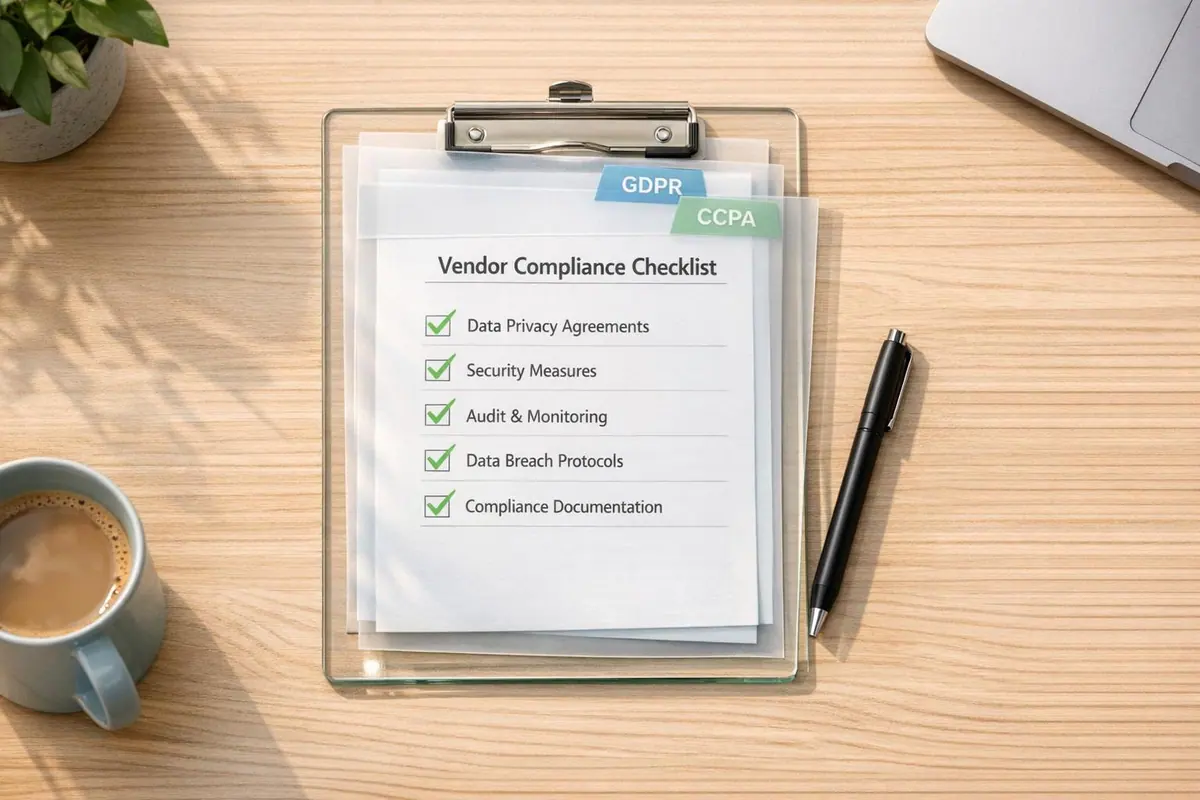
When working with vendors, your compliance with GDPR and CCPA depends on their adherence to privacy laws. Non-compliance can result in steep fines: up to €20 million or 4% of global revenue under GDPR, and $7,500 per violation under CCPA/CPRA, especially for mishandling children’s data.
Here’s how to protect your business:
- Classify Vendors: Identify vendors handling sensitive data or those with high-risk practices (e.g., selling personal data).
- Secure Contracts: Ensure contracts include breach notification timelines, data usage limits, and audit rights.
- Verify Security: Confirm vendors follow GDPR and CCPA security standards, like encryption and access controls.
- Monitor Continuously: Conduct regular audits and track changes in vendors’ privacy practices.
- Document Everything: Maintain up-to-date records, including contracts, vendor assessments, and processing activities.
Vendor compliance isn’t optional - it’s a legal and financial safeguard. The article provides a detailed checklist to help you manage risks, verify compliance, and ensure proper oversight of your vendors.
Vendor Risk Assessment and Classification
Identifying High-Risk Vendors
Vendors that handle Sensitive Personal Information (SPI) should be flagged as high risk. Under CCPA/CPRA guidelines, vendors fall into this category if they process excessive consumer data, deal with information from individuals under 13 years old, or generate 50% or more of their revenue by selling or sharing personal information.
Another red flag is the absence of recognized certifications like SOC 2 or ISO 27001, or a history of data breaches within the past three years. For example, a major breach in such cases can lead to significant financial penalties.
Additionally, vendors who repurpose your data - such as creating user profiles or enhancing their own products - without adhering to your instructions should be classified as high risk. This risk assessment is critical for determining how vendors are categorized for compliance purposes.
Classifying Vendors by Data Access Level
Once risks are identified, vendors should be categorized based on their level of data access and usage. Here’s how:
- Processors/Service Providers: These vendors process data strictly according to your instructions. They are generally exempt from the "sale" definition under CCPA/CPRA.
- Contractors: These entities receive data under contract terms but are not permitted to collect it themselves.
- Third Parties: These are vendors that use data for their own purposes, such as advertising networks. They do not qualify as service providers or contractors.
It’s also important to account for sub-processors (fourth-party vendors). For instance, tools like Google Analytics 4 or Meta pixels often act as "Third Parties" because they utilize collected data within their advertising ecosystems, even if you’re paying for the service.
To maintain compliance, document each processor's data categories and usage in your Record of Processing Activities (ROPA). These classifications are essential for conducting targeted contract reviews and ensuring ongoing compliance.
Managing Data Privacy and Security Compliance (GDPR, CCPA) | Exclusive Lesson
Contract Review and Data Processing Agreements
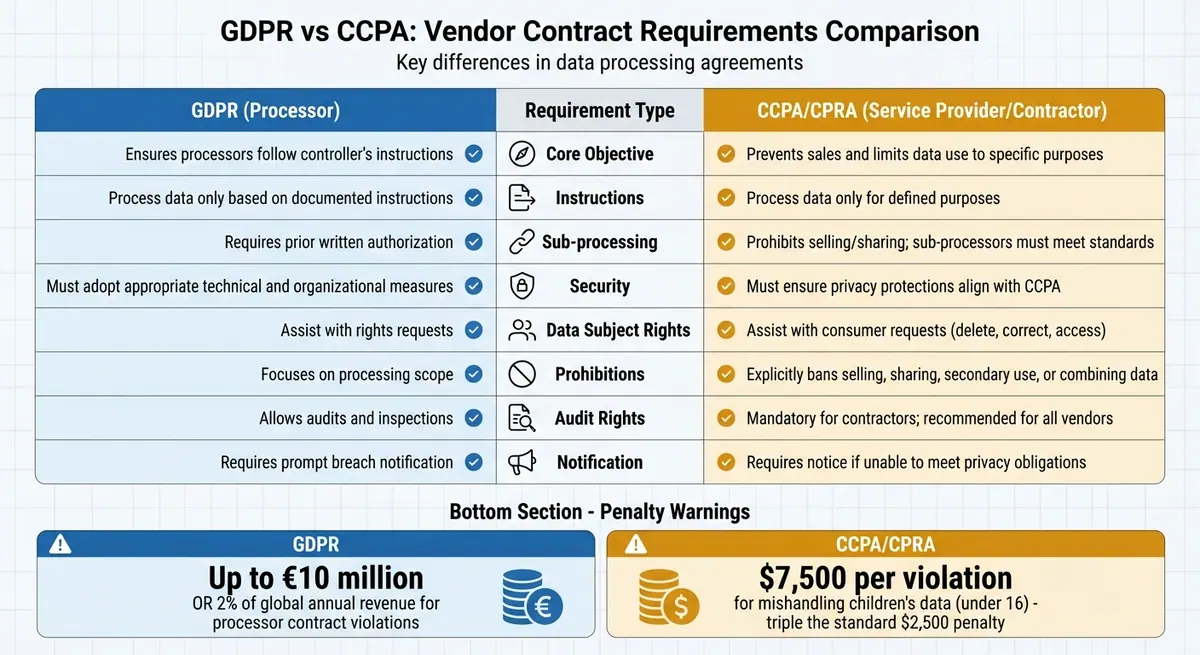
GDPR vs CCPA Vendor Contract Requirements Comparison
Once you've classified your vendors, the next step is securing contracts that clearly define how data will be handled. Both GDPR and CCPA require binding agreements to ensure vendors manage data appropriately. Without these terms in place, data sharing could be considered a "sale" or "sharing" under CCPA, which could trigger consumer opt-out rights. Below, we'll break down the necessary clauses and compare how GDPR and CCPA handle these agreements.
Required DPA Clauses
GDPR Requirements
Under GDPR Article 28, your Data Processing Agreement (DPA) must outline several key details, including the subject matter, duration, nature, and purpose of processing, as well as the type of data and categories of data subjects. The regulation states:
"Processing by a processor shall be governed by a contract... that sets out the subject-matter and duration of the processing, the nature and purpose of the processing, the type of personal data and categories of data subjects."
– GDPR Article 28
The agreement must also ensure that vendors:
- Process data only according to your instructions.
- Implement strong security measures.
- Support data subject rights.
- Maintain confidentiality.
- Seek your approval before using sub-processors.
- Allow audits and inspections.
Additionally, when the service ends, vendors must delete or return all personal data unless legal obligations require its retention.
CCPA/CPRA Requirements
For compliance with CCPA/CPRA, contracts must explicitly prohibit vendors from selling, misusing, or combining data for purposes beyond what's defined in the agreement. The California Code of Regulations emphasizes specificity:
"The business purpose(s) shall not be described in generic terms, such as referencing the entire contract generally. The description shall be specific."
– California Code of Regulations §7051
A unique CCPA requirement is that vendors, referred to as "Contractors", must provide written certification confirming they understand and will adhere to the contractual restrictions. Contracts should also grant you the right to take steps to stop and address any unauthorized use of personal data.
To meet CCPA deadlines, specify a breach notification timeframe (e.g., 48 or 72 hours). Vendors must also notify you immediately if they fail to meet their privacy obligations.
For international data transfers from the EU or UK to countries without an adequacy decision, include the 2021 Standard Contractual Clauses (SCCs) in your DPA. These clauses can help protect you from liability for vendor-related breaches, provided you were unaware of any intent to violate the law.
GDPR vs. CCPA Requirements Comparison
While GDPR and CCPA share the goal of safeguarding personal data, they take different approaches to vendor agreements. Here's a side-by-side look at their key requirements:
| Requirement Type | GDPR (Processor) | CCPA/CPRA (Service Provider/Contractor) |
|---|---|---|
| Core Objective | Ensures processors follow controller's instructions | Prevents sales and limits data use to specific purposes |
| Instructions | Process data only based on documented instructions | Process data only for defined purposes |
| Sub-processing | Requires prior written authorization | Prohibits selling/sharing; sub-processors must meet standards |
| Security | Must adopt appropriate technical and organizational measures | Must ensure privacy protections align with CCPA |
| Data Subject Rights | Assist with rights requests | Assist with consumer requests (delete, correct, access) |
| Prohibitions | Focuses on processing scope | Explicitly bans selling, sharing, secondary use, or combining data |
| Audit Rights | Allows audits and inspections | Mandatory for contractors; recommended for all vendors |
| Notification | Requires prompt breach notification | Requires notice if unable to meet privacy obligations |
Getting these contracts right is critical. Violations of GDPR processor contract rules can lead to fines of up to €10 million or 2% of global annual revenue. Under CPRA, penalties for mishandling children's data (under 16) are steep, at $7,500 per violation - triple the $2,500 fine for other violations.
Data Processing and Security Practices Verification
Once contracts are in place, it's essential to ensure vendors stick to their commitments regarding security and data handling. Regulations like GDPR and CCPA mandate specific protections, so you’ll need to check their security protocols and confirm they only process the data necessary for agreed-upon purposes.
Evaluating Security Protocols
GDPR’s Article 32 outlines the need for Technical and Organizational Measures (TOMs), such as pseudonymization and encryption of personal data. Similarly, under CCPA/CPRA, contracts must require vendors to implement "reasonable security procedures and practices" tailored to the nature of the data.
Start by reviewing the vendor's DPA (often labeled "Schedule B" or "Information Security Measures"). This document should detail encryption practices, VPN usage, and secure password storage. If a vendor can’t provide this documentation, that’s a warning sign.
Access controls are another critical area. Conduct regular reviews (monthly or quarterly) to ensure sensitive data access is limited to authorized personnel, following the principle of least privilege. When vendors handle consumer rights requests, such as access or deletion requests, they must verify identities without collecting unnecessary additional data.
Given that 90% of organizational data is unstructured, vendors need strong data discovery and classification tools to identify hidden or "shadow data." This is increasingly important as 48% of global CISOs cite growing risks from AI systems, which often work with unstructured data.
For vendors handling high-risk activities - such as processing sensitive information, managing data for over 100,000 consumers, or earning 50% of revenue from selling or sharing personal information - schedule annual cybersecurity audits. If confidentiality limits access to full audit details, request a "Summary Audit Report" confirming a third-party review within the past year.
Beyond technical controls, assess whether vendors are limiting data collection to what’s strictly necessary for agreed-upon purposes.
Verifying Data Minimization and Purpose Limitation
Once security measures are verified, evaluate whether vendors comply with data minimization and purpose limitation principles. Data minimization ensures vendors collect only the data needed for a specific purpose, while purpose limitation prevents them from using that data for unrelated purposes. These principles are central to GDPR and CCPA compliance.
A data mapping exercise can help. Document each category of personal data, its legal basis, and its intended use. Your DPA should explicitly prohibit vendors from "selling" or "sharing" personal information or using it for purposes beyond what’s outlined in your agreement.
Here’s a quick look at common practices:
| Bad Practice (Avoid) | Better Practice (Compliance) |
|---|---|
| Collecting full date of birth for a newsletter signup | Collecting only email and first name for delivery |
| Requiring phone numbers for whitepaper downloads | Offering downloads in exchange for email only |
| Storing inactive user accounts indefinitely | Deleting or anonymizing accounts after a defined retention period |
| Using one form to collect every possible field "just in case" | Tailoring forms so each field matches the stated purpose |
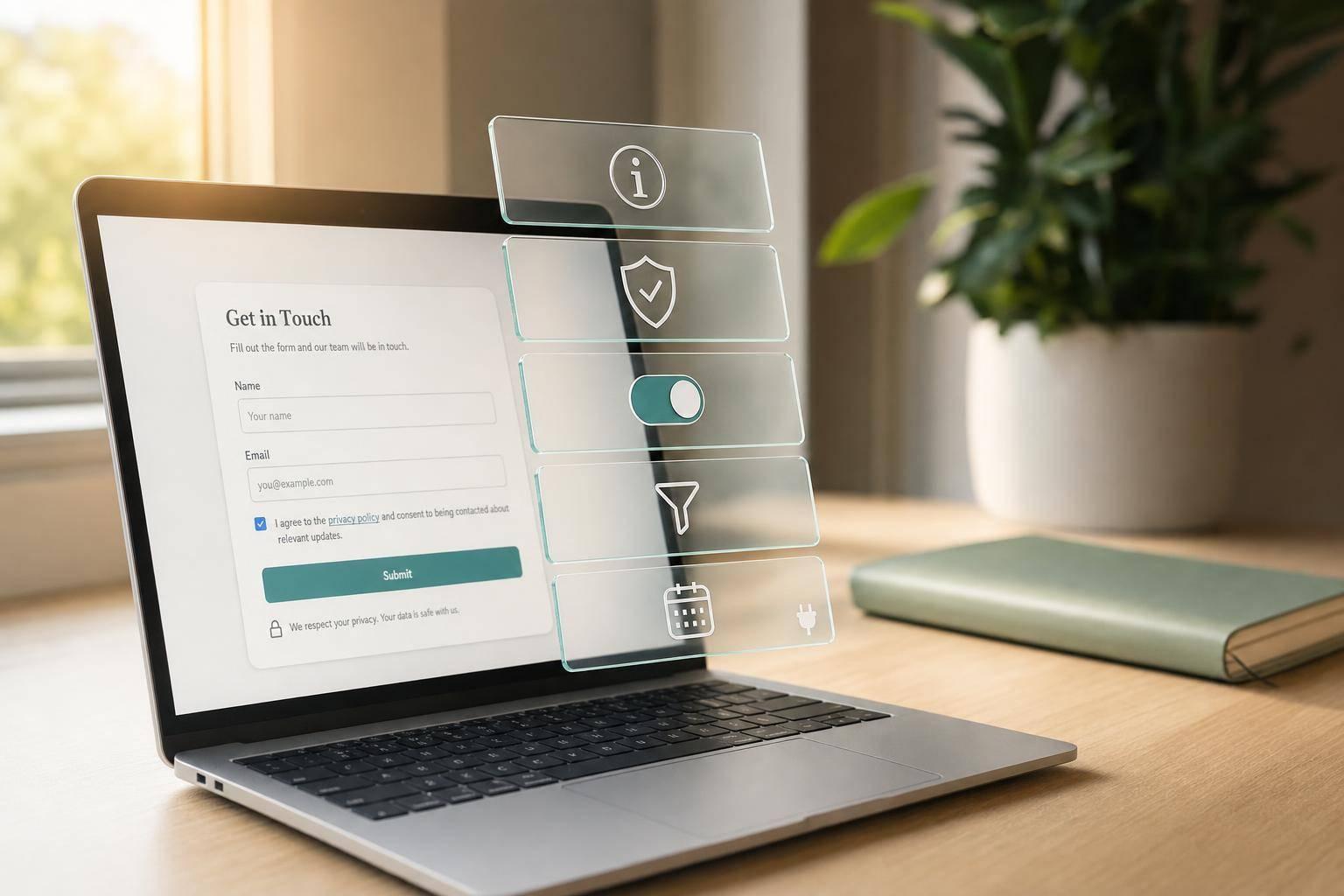
If your business uses forms to collect data processed by vendors, ensure every field is tied to a specific purpose mentioned in your Notice at Collection. Tools like Reform can simplify this process. With features like conditional routing and multi-step forms, you can collect only the necessary information based on user inputs. Its email validation and spam prevention features also help ensure the data shared with vendors is accurate, reducing unnecessary or fraudulent entries.
Vendors must also uphold storage limitation by deleting or anonymizing data once the retention period ends. Include clauses in your contracts that allow you to take "reasonable and appropriate steps" to stop and address unauthorized use of personal information. Vendors must notify you immediately if they can no longer meet their privacy obligations.
For ongoing oversight, consider using automated vendor monitoring tools to track changes in privacy policies or data access levels. Technology for data discovery and classification can also help you monitor "shadow data" and confirm vendors aren’t accessing more information than needed. Under CPRA, mishandling children’s personal information carries a hefty $7,500 fine per violation - triple the standard $2,500 penalty. This makes thorough verification especially important when vendors deal with users under 16.
sbb-itb-5f36581
Monitoring, Auditing, and Compliance Checks
Contracts and initial verifications are just the starting point. To ensure vendors stick to their commitments and maintain security standards, ongoing monitoring and audits are essential. These checks become even more critical as privacy policies evolve, new sub-processors are introduced, or security measures fall short. Both GDPR (Article 32) and CPRA emphasize the importance of regular testing and evaluation of technical and organizational safeguards.
Skipping these steps can be costly - non-compliance expenses are nearly three times higher than the cost of regular oversight.
Conducting Regular Compliance Audits
Under CPRA, vendors that pose a "significant risk" to consumer privacy must undergo annual cybersecurity audits. Vendors typically fall into this category if they generate 50% or more of their revenue from selling or sharing personal data, process sensitive information, or handle data from children under 13.
Your Data Processing Agreement (DPA) should include audit rights as outlined in GDPR Article 28. This ensures processors provide the necessary information to demonstrate compliance and allow inspections. Don’t stop at direct vendors - extend your audits to fourth-party providers since they might also have access to customer data.
A great example of automated compliance comes from Rocketlane, which streamlined its SOC 2 and GDPR processes in 2024 using Sprinto. CTO Deepak Balasubramanyam led the initiative, automating evidence collection and policy management. This approach saved the company around 50 hours annually on compliance tasks and shaved 30 minutes off each security questionnaire.
"Putting my compliance on autopilot is what I wanted to do, and Sprinto made that happen."
– Deepak Balasubramanyam, CTO, Rocketlane
To maintain consistency, use standardized GDPR and CCPA questionnaire templates for vendor evaluations. Keep a centralized repository of audit documentation to quickly demonstrate compliance if regulators come knocking. After audits, rely on continuous monitoring to catch any changes as they happen.
Tools for Continuous Monitoring
Manual audits offer only a moment-in-time view. Automated platforms, on the other hand, provide ongoing management of policies, controls, and evidence. These tools help maintain continuous visibility by checking control effectiveness, identifying deviations, and sending alerts when compliance requirements are at risk.
Vendor Risk Management (VRM) software can track privacy policy updates, lawsuits, and sub-processor changes in real time. Osano, for example, uses a 163-item framework based on NIST and ISO standards to calculate a proprietary Vendor Score. Automated evidence collection tools also integrate with cloud platforms, HR systems, and identity providers to keep audit proof up-to-date.
Set up real-time alerts for data breaches or unauthorized access to reduce compliance risks. Businesses using automated compliance tools have reported up to a 99.9% reduction in compliance efforts. Tools with data discovery features can map and document personal data flows across systems, helping identify unauthorized storage or processing activities.
"GDPR requires continuous visibility, real proof, and the ability to show how your website handles personal data. CMPs, audits, and DPIA tools solve parts of the problem, but they don't give you live client-side control."
– Ivan Tsarynny, CEO, Feroot Security
Pay close attention to client-side activities like scripts, pixels, and trackers. Third-party vendors can push silent updates that alter data collection practices without notice. Traditional server-side logs often miss this browser-level data collection.
If your business uses forms to collect data processed by vendors, ensure you're capturing only what’s necessary. Reform, for instance, integrates compliance workflows with real-time analytics and CRM systems, helping you track data flows. Its email validation and spam prevention features also ensure that only accurate and relevant information is shared with vendors, reducing the risk of processing unnecessary or fraudulent data.
For vendors handling sensitive data, implement automated retention policies that enforce timely deletion to meet GDPR’s data minimization requirements. Look for platforms that align controls across regulations - for instance, mapping a GDPR control to a CCPA requirement - to avoid duplicating work.
Documentation and Record-Keeping Requirements
Clear and concise documentation isn't just a good practice - it's a regulatory must. While monitoring vendors is a critical step, regulators also require businesses to maintain audit-ready records. For instance, under GDPR, companies with 250 or more employees or those involved in high-risk data processing must maintain an up-to-date Record of Processing Activities (ROPA) for inspections. Meanwhile, CCPA penalties can hit $2,663 per unintentional violation and $7,988 per intentional one. These numbers highlight why keeping thorough records is about more than compliance - it's about protecting your bottom line.
Maintaining Vendor Assessment Records
Start with the essentials: keep signed contracts, Data Processing Agreements (DPAs), and Standard Contractual Clauses (SCCs) for cross-border data transfers. Maintain a detailed inventory of all vendors, including their access levels, geographic locations, and specific data processing roles. Don’t forget to document fourth-party providers - those your vendors rely on.
Your ROPA should cover the purpose of data processing, categories of data involved, third-party access, and plans for data retention or deletion. For high-risk processing activities, GDPR requires Data Protection Impact Assessments (DPIAs), while CCPA/CPRA compliance demands regular risk assessments. Under CPRA, vendors posing "significant risk" must undergo annual cybersecurity audits, and those reports need to be stored for potential review.
"The best way to demonstrate GDPR compliance is using a data protection impact assessment." – GDPR.eu
Annual reviews of privacy policies and vendor contracts are essential. The California Privacy Protection Agency recently filed legal action against a company whose privacy notice hadn’t been updated since 2021. To avoid similar issues, schedule yearly reviews and adjust immediately if you introduce a new product, change data usage, or onboard a new vendor.
Proper documentation not only ensures ongoing compliance but also simplifies regulatory reviews when they arise.
Preparing Documentation for Regulators
Centralizing your contract and audit records is key to staying ready for regulatory reviews. When regulators request documentation, they expect it to be "concise, transparent, intelligible and easily accessible", written in plain and clear language. Using a centralized platform to store vendor contracts, DPAs, and audit records can streamline this process and make compliance checks far less stressful. Contract management tools can help by extracting key clauses, tracking changes, and automating DPA renewals.
For data transfers outside the EU/EEA, make sure your records include signed SCCs or proof of participation in the Data Privacy Framework (DPF). These records should also demonstrate the instructions given to processors and the steps taken to ensure compliance by recipients. With GDPR fines reaching up to 4% of global annual turnover or €20 million - whichever is higher - audit-ready records are non-negotiable.
If your business collects data through forms processed by vendors, ensure you're only documenting what's necessary. Tools like Reform can help by offering real-time analytics and CRM integrations to track data flows and maintain compliance. Features like email validation and spam prevention reduce the risk of processing irrelevant data, keeping your documentation requirements straightforward and manageable.
Conclusion and Key Takeaways
Vendor compliance isn’t a one-and-done deal - it’s an ongoing effort to shield your business from regulatory fines and data breaches. Both GDPR and CCPA impose hefty penalties for non-compliance, making it crucial to stay vigilant.
Start by mapping out how vendor data flows through your systems. Ensure you have Data Processing Agreements (DPAs) in place, complete with strict timelines for breach notifications (72 hours) and consumer requests (30 days for GDPR, 45 days for CCPA). For international data transfers, use Standard Contractual Clauses (SCCs) or the EU-U.S. Data Privacy Framework to stay compliant.
A strong contract framework is foundational:
"Vendor contracts are the backbone of GDPR compliance, defining responsibilities, safeguards, and data-handling rules." – Auditive Team
Make it a habit to conduct annual cybersecurity audits for high-risk vendors. Centralize records of contracts, DPAs, and assessments to stay organized. If you’re collecting data through online forms, tools like Reform can help with compliance by offering email validation and real-time analytics.
Vendor compliance is an evolving process. Regularly update privacy policies, vendor contracts, and your Records of Processing Activities as relationships change. Don’t forget to extend your compliance efforts to your entire supply chain, including fourth-party providers, ensuring everyone meets the standards you’ve established.
FAQs
What are the main differences between GDPR and CCPA requirements for vendor contracts?
The GDPR and CCPA take different approaches when it comes to vendor contracts, reflecting their distinct philosophies on data privacy. Under the GDPR, businesses need to establish a clear legal basis for processing personal data. Vendor agreements must include specific provisions like data protection responsibilities, breach notification requirements, and accountability measures to ensure compliance.
On the other hand, the CCPA focuses on consumer rights. Contracts must explicitly prohibit the sale of personal data without clear consent. With the CPRA now in effect, additional requirements have been introduced, such as audit rights, compliance confirmations, and safeguards to ensure vendors and contractors meet privacy standards.
While both frameworks aim to safeguard personal data, the GDPR takes a more detailed and rule-based approach, whereas the CCPA leans toward broader, consumer-oriented protections.
What steps can businesses take to ensure their vendors stay compliant with GDPR and CCPA over time?
To keep vendors aligned with GDPR and CCPA requirements, businesses need a strong vendor risk management program. This means routinely checking vendor practices through audits and privacy assessments to confirm they meet data protection and security standards.
Here’s how to approach it:
- Use standardized checklists or questionnaires to assess compliance.
- Clearly define contractual obligations for data protection and how incidents should be handled.
- Monitor vendor activities with automated tools or third-party assessments to spot changes or potential breaches.
Staying vigilant and adjusting to regulatory updates helps businesses manage risks effectively and maintain compliance with privacy laws over time.
What key elements should a Data Processing Agreement include for GDPR and CCPA compliance?
A Data Processing Agreement (DPA) plays a key role in meeting GDPR and CCPA requirements when collaborating with vendors. It should define the scope and purpose of data processing, detail security measures such as encryption, and lay out protocols for managing data breaches, including how and when notifications should be made.
The agreement should also cover sub-processor approvals, outline policies for data deletion or return once the contract concludes, and provide audit rights to confirm compliance. These components are crucial for safeguarding sensitive information and ensuring clear accountability between businesses and their vendors.
Related Blog Posts
Get new content delivered straight to your inbox

The Response
Updates on the Reform platform, insights on optimizing conversion rates, and tips to craft forms that convert.

Drive real results with form optimizations
Tested across hundreds of experiments, our strategies deliver a 215% lift in qualified leads for B2B and SaaS companies.
