
.webp)
2025 Privacy Laws: Impact on Lead Generation


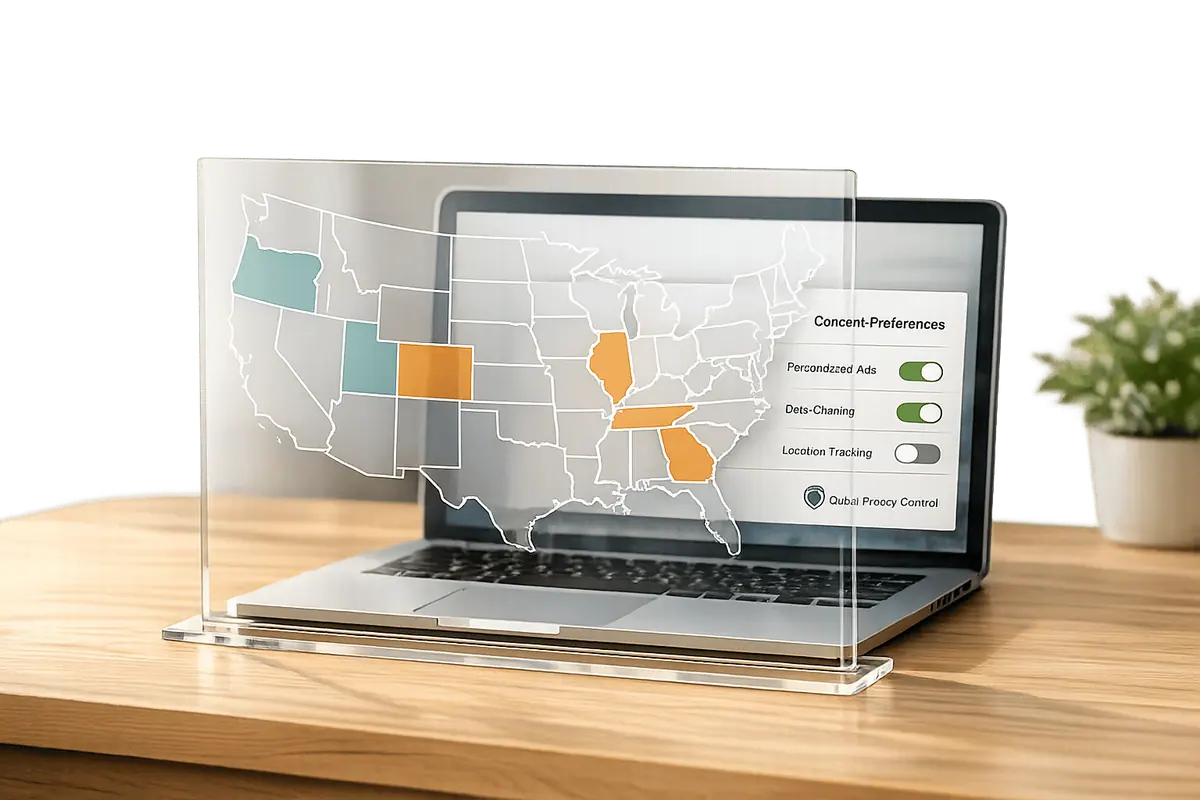
The privacy laws introduced in 2025 have reshaped how businesses handle consumer data, especially in lead generation. With eight new state laws enacted, companies now face stricter rules on consent, data collection, and storage. Key changes include:
- Explicit opt-in consent: Required for sensitive data like health, location, and financial details.
- Global Privacy Control (GPC): Businesses must honor browser-based opt-out signals in several states.
- State-specific rules: Laws vary widely, creating compliance challenges for companies operating in multiple states.
Penalties for violations are steep, such as up to $7,500 per incident in California and $10,000 for first offenses under Maryland’s new law. To stay compliant, businesses need clear consent processes, limit data collection to what's necessary, and invest in automated compliance tools. These changes demand a shift in how lead generation campaigns are planned and executed.
Privacy compliance is no longer optional - it's a legal and trust-building necessity for businesses in 2026 and beyond.
US Privacy Regulation 2025 Review & 2026 Preview
sbb-itb-5f36581
Major 2025 Privacy Laws Affecting Lead Generation
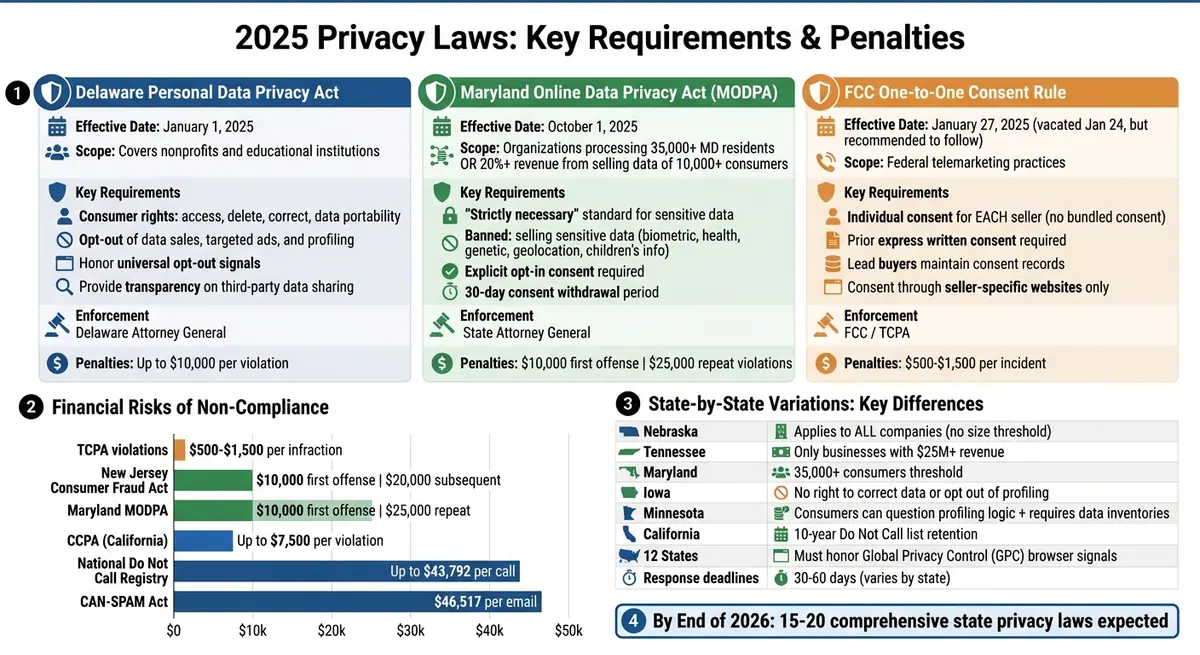
2025 State Privacy Laws Comparison: Requirements and Penalties
In 2025, three new laws reshaped how businesses handle data collection for lead generation. These regulations introduced stricter requirements for consent, data management, and communication practices.
Delaware Personal Data Privacy Act
Starting January 1, 2025, the Delaware Personal Data Privacy Act brought sweeping changes to data practices, even covering nonprofit organizations and educational institutions. The law grants consumers key rights, including access to their data, the ability to delete or correct it, and data portability. Consumers can also opt out of data sales, targeted ads, and profiling that results in significant decisions, such as legal or financial outcomes.
For businesses, this means reworking consent workflows and using multi-step forms to comply with these provisions. Companies must honor universal opt-out signals and provide a transparency mechanism, allowing consumers to request a list of third parties with whom their data has been shared. Enforcement of this law falls under the jurisdiction of the Delaware Attorney General.
Maryland Online Data Privacy Act
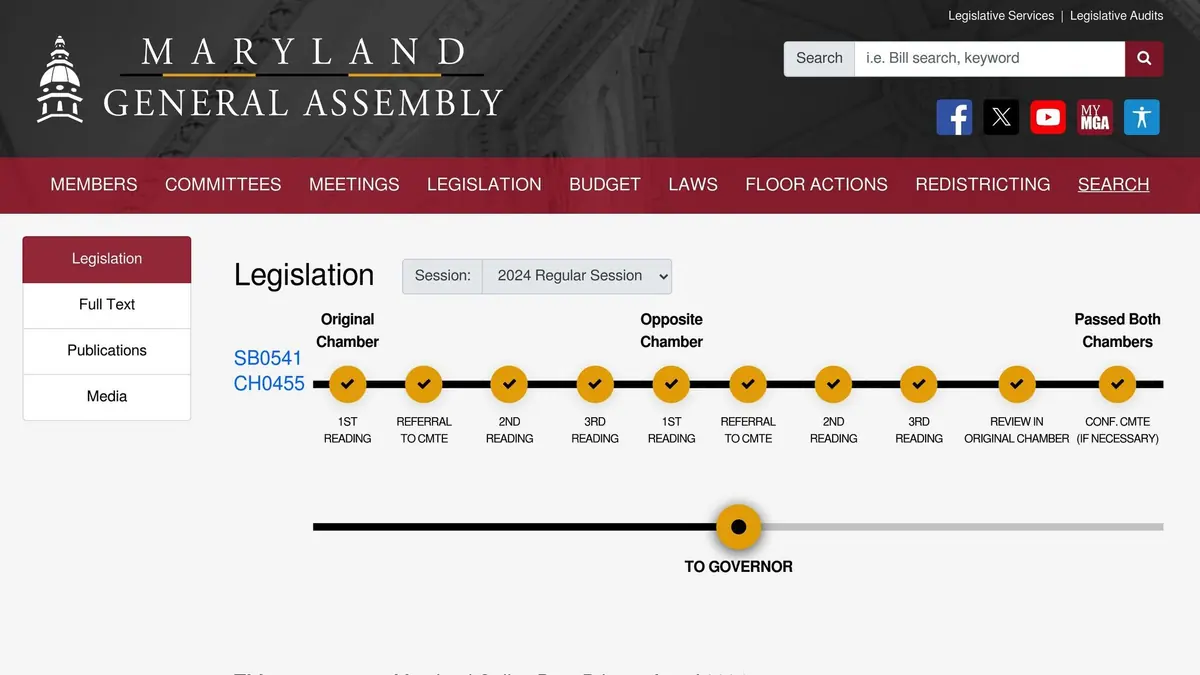
Building on Delaware's consumer protections, Maryland introduced the Maryland Online Data Privacy Act (MODPA), effective October 1, 2025. This law applies to organizations processing data from at least 35,000 Maryland residents annually or earning over 20% of their revenue from selling data of at least 10,000 consumers.
MODPA enforces a "strictly necessary" standard for sensitive data, such as biometric, health, genetic, precise geolocation, and children's information. This data can only be collected or processed if it is essential to provide a requested service. Selling sensitive data is outright banned, and consumer consent cannot override this restriction. Businesses must secure explicit opt-in consent for sensitive data and any secondary uses, while also allowing consumers to withdraw consent within 30 days. Noncompliance can result in hefty fines - up to $10,000 for a first offense and $25,000 for repeat violations.
FCC One-to-One Consent Rule
At the federal level, the FCC introduced a new rule impacting telemarketing practices. Effective January 27, 2025, the FCC's one-to-one consent rule requires telemarketers to obtain "prior express written consent" for each individual seller. This eliminates bundled consent, where one agreement could previously cover multiple brands. As Bryan Cave Leighton Paisner LLP noted:
"The consumer must individually consent to be contacted by each business - no more bundle deals."
This rule closes a loophole that allowed lead generators to share consent across multiple brands. Now, consent must be obtained directly through websites tied to the seller's specific products or services. Utilizing a lead generation form template can help ensure these capture points are clear and compliant. Lead buyers are responsible for maintaining accurate consent records, and older databases containing leads gathered before January 27, 2025, may not comply with the new standards. Violations of the Telephone Consumer Protection Act (TCPA) can result in damages ranging from $500 to $1,500 per incident.
Interestingly, on January 24, 2025, the U.S. Court of Appeals for the Eleventh Circuit vacated the one-to-one consent rule. However, businesses are still advised to adhere to these standards to align with broader TCPA requirements and prepare for potential future FCC actions.
Problems Created by 2025 Privacy Laws
The latest privacy regulations introduce three major challenges for businesses running lead generation campaigns. These laws now demand explicit, activity-specific consent for email marketing, analytics tracking, and social media advertising.
More Complex Consent and Record-Keeping Requirements
Gaining permission to contact leads has become a lot trickier. The new One-to-One consent rule mandates written consent tailored to each organization receiving the data. Gone are the days of blanket approvals.
Maryland's MODPA law takes it a step further by enforcing a "strictly necessary" standard. This prevents businesses from collecting data for purposes unrelated to the product or service being offered - even if the consumer consents , though using dynamic lead generation forms can help ensure data collection remains relevant to the user's specific path. For example, lead information can't be gathered for general research or future marketing campaigns.
Minnesota has set a new precedent, becoming the first state to require comprehensive data inventories by law. California, meanwhile, demands businesses maintain internal Do Not Call lists for a decade, while Connecticut requires detailed consent and call records to be available for state inspections.
These stricter consent and record-keeping requirements also bring higher financial risks for non-compliance.
Higher Risk of Penalties and Legal Action
The financial consequences of non-compliance are steep. Here's a breakdown of potential penalties:
- TCPA violations: $500 to $1,500 per infraction
- National Do Not Call Registry violations: Up to $43,792 per call
- CAN-SPAM Act violations: $46,517 per email
- CCPA breaches: Up to $7,500 per violation
- New Jersey Consumer Fraud Act: $10,000 for the first offense, $20,000 for subsequent ones
Anders Uhl from ClickPoint Software explains the gravity of the One-to-One rule:
"The one-to-one rule means companies must get clear consent for each business that contacts a consumer. This applies no matter the state's telemarketing laws".
Businesses also face vicarious liability for the actions of third-party call centers or lead vendors. Under TCPA, even business owners and executives can be held personally liable for violations. Adding to the pressure, states are eliminating "cure periods", which means Attorneys General can enforce penalties immediately without giving companies a chance to address violations.
Managing Different State Privacy Requirements
On top of consent and penalty challenges, businesses must navigate conflicting state laws. For instance, Nebraska's rules apply to all companies, regardless of size, while Tennessee enforces its laws only on businesses generating over $25 million in revenue. Maryland's threshold is even lower, affecting companies with just 35,000 consumers.
The differences don't stop there. Iowa doesn't give consumers the right to correct data or opt out of profiling, but Minnesota allows consumers to question the logic behind profiling decisions. Deadlines for responding to consumer requests also vary, ranging from 30 to 60 days depending on the state.
Twelve states now require businesses to honor browser-based universal opt-out signals, like Global Privacy Control. This forces companies to implement specific technical solutions in some states, while others don't require them. These inconsistencies make it nearly impossible to standardize lead generation workflows.
As F. Paul Pittman and Hope Anderson from White & Case point out:
"By the end of 2026, we're likely looking at 15-20 comprehensive state privacy laws across the United States - each with its own requirements, exemptions, and enforcement mechanisms".
This patchwork of regulations leaves businesses juggling compliance protocols for each state, creating a logistical nightmare for lead generation efforts.
How to Maintain Compliant Lead Generation
Navigating the privacy laws of 2025 doesn’t have to stop your lead generation efforts in their tracks. By embedding privacy protections into your data collection processes and leveraging modern tools, businesses can stay compliant while still running effective campaigns.
Building Consent into Data Collection Forms
Collecting explicit, verifiable consent is non-negotiable. Every lead form should clearly tie opt-ins to your brand and the specific purpose of data collection. This isn’t just about a checkbox - it’s about creating a full record of what users agreed to, when they agreed, and under what circumstances.
Using multi-step forms with conditional routing can simplify compliance. Instead of bombarding users with every possible consent disclosure, these forms tailor the information to match the user’s specific request. For instance, if someone is seeking a home insurance quote, they’ll only see consent language relevant to insurance providers.
It’s also crucial to document every lead capture. This includes recording the source URL, timestamp, session data, and the exact disclosures presented at the time. Alexandra Krasovec of Manatt, Phelps & Phillips emphasizes the importance of this approach:
"If you are making marketing outreach, again, get that heightened prior express written consent... if you obtain it, that is 'as good as gold.'"
Pre-checked boxes? Forget them. Consent must be affirmative. And don’t stop there - your forms should also allow users to opt out through simple methods like SMS, email, or phone calls, with requests processed within 10 business days.
Once you’ve nailed down consent, the next step is handling only the data you truly need.
Using Privacy-Centric Data Handling
After securing clear consent, focus on collecting only what’s absolutely necessary. Many states now legally require this approach. Maryland, for example, has a law effective October 1, 2025, that limits data collection to what is "reasonably necessary and proportionate" for the requested service. This means auditing your lead forms and removing any unnecessary fields.
Shifting to zero-party and first-party data is another smart move. Zero-party data is information shared directly by consumers, while first-party data comes from interactions on your own platforms. Both reduce the risks tied to third-party cookies and purchased data lists.
Email validation at the point of capture is another way to ensure data accuracy while respecting privacy.
Taryn Crane from BDO explains why collecting less data can be a game-changer:
"In all breaches that I've supported clients through, the running theme is 'if we didn't have half this data, this may have been a much smaller problem.'"
Using Technology to Simplify Compliance
Technology can take much of the headache out of compliance. Automated solutions help manage multi-state privacy requirements and streamline record-keeping. For example, IP geolocation can adjust forms to display the correct privacy notices based on the user’s location.
Spam prevention and email validation not only improve data quality but also ensure compliance. Integrating your CRM with consent management systems ensures that opt-outs are automatically updated in suppression lists within the required 10-day window.
Another key requirement is recognizing Global Privacy Control (GPC) signals. These browser-based settings allow users to opt out across multiple platforms automatically. As of now, six states - including Delaware, Nebraska, and Maryland - require businesses to honor these signals.
Compliance-focused form builders can also make a big difference. These tools use conditional logic to trigger state-specific consent disclosures, ensuring that compliance is built into the process. Platforms like Reform, a no-code form builder, make it easier to automate these features while still optimizing lead generation efforts. By automating compliance, businesses can focus on growth without constantly worrying about manual updates or legal pitfalls.
Conclusion: Adjusting Lead Generation for Privacy Laws
By late 2025, 20 states will have comprehensive privacy laws in place, making it clear that compliance is no longer optional for businesses. With changes like the move from opt-out to opt-in for sensitive data, the requirement to honor Global Privacy Control signals in six states, and Maryland's strict data minimization standards, lead generation strategies must evolve to meet these new demands.
Fortunately, compliance doesn’t have to come at the cost of conversions. Incorporating clear consent mechanisms, limiting data collection to what’s essential, and using automated compliance tools can help businesses stay effective while avoiding hefty penalties - up to $10,000 per violation in states like Delaware and New Jersey. Experts agree that taking a proactive stance on compliance not only reduces legal risks but also strengthens customer trust.
As Bill Tolson, President at Tolson Communications LLC, explains:
"Compliance is now a core business priority. Organizations that treat privacy as a reactive process risk not only fines but also the loss of customer trust and brand credibility."
To address these challenges, many companies are already implementing integrated compliance solutions. Tools like Reform streamline state-specific consent flows, recognize universal opt-out signals, and maintain detailed audit trails - all while ensuring multi-step forms remain optimized for conversions. These efforts align with the growing public demand for stronger privacy protections, with more than 75% of Americans supporting stricter data laws.
Adapting to these changes isn’t just about avoiding penalties - it’s about fostering trust and staying ahead in a privacy-conscious world. Businesses that embrace these shifts today will be better positioned for success tomorrow.
FAQs
What counts as “sensitive data” in 2025 privacy laws?
Under the privacy laws set to take effect in 2025, sensitive data covers a broad range of categories. This includes health-related information not governed by HIPAA, location data, app telemetry, and various other data types that fall under state-specific restrictions. These regulations focus on imposing stricter rules to ensure better protection of consumer privacy.
How do I honor Global Privacy Control (GPC) on my lead forms?
To honor Global Privacy Control (GPC) signals on lead forms, you need to detect the GPC signal, which is sent through either HTTP headers or the DOM. Once detected, automatically respect the user's request to opt out of data sale or sharing. This approach aligns with legal requirements, such as the California Consumer Privacy Act (CCPA), and keeps pace with evolving privacy standards. By doing so, you not only ensure compliance but also strengthen trust with your users.
What records should I keep to prove consent across states?
Keeping thorough records of explicit, informed consent is crucial. Document the date, method of consent (e.g., written, electronic, verbal), and the specific purpose for collecting the data. These records not only help meet the requirements of different state privacy laws but also provide a clear trail of accountability if ever called into question.
Related Blog Posts
Get new content delivered straight to your inbox

The Response
Updates on the Reform platform, insights on optimizing conversion rates, and tips to craft forms that convert.



Drive real results with form optimizations
Tested across hundreds of experiments, our strategies deliver a 215% lift in qualified leads for B2B and SaaS companies.
