
.webp)
Ultimate Guide to Employee Data Sharing Training



95% of data breaches are caused by human error. This statistic underscores why training employees on secure data sharing isn't optional - it's a necessity for safeguarding your business. From avoiding costly fines to protecting sensitive information, a well-structured training program can transform employees into your strongest defense against breaches.
Key Takeaways:
- Why It Matters: Data breaches cost businesses millions, with 60% of small companies shutting down within six months of a breach.
- Regulations to Know: US businesses face laws like HIPAA, GDPR, and state-specific rules (e.g., CPRA in California).
- Core Training Focus: Teach employees to identify sensitive data, share it securely, and respond effectively to breaches.
- Effective Delivery: Combine short online modules with role-specific, practical scenarios to increase retention.
This guide explains how to build a training program that not only meets legal requirements but also reduces risks by empowering employees to handle data responsibly.
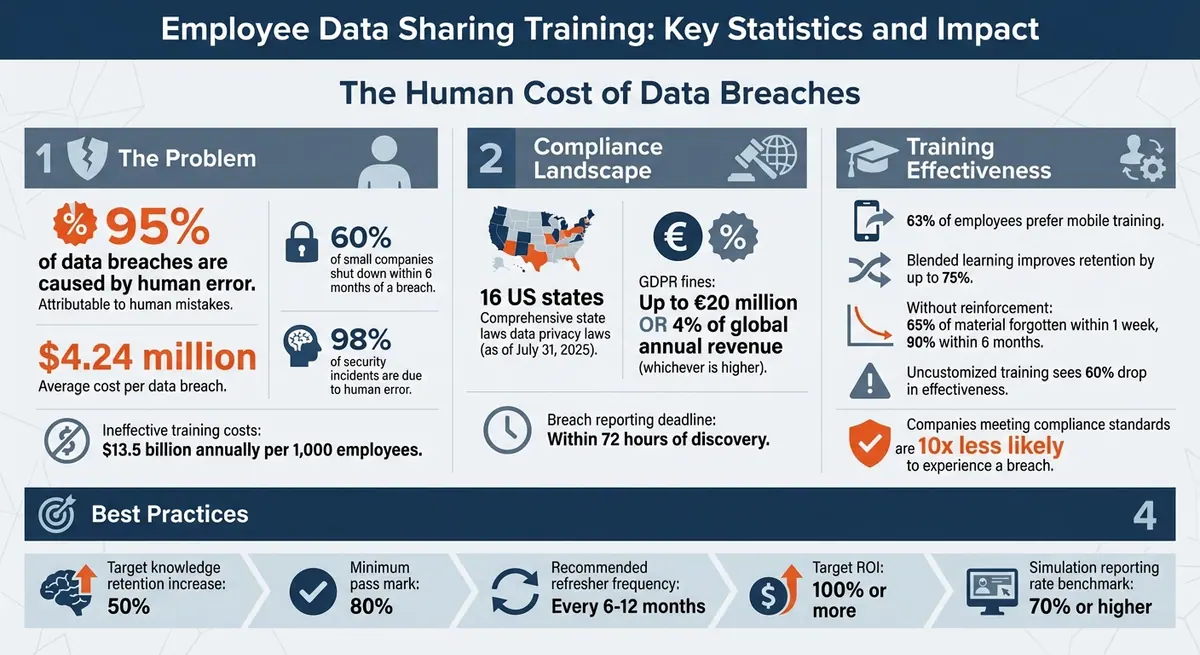
Employee Data Sharing Training: Key Statistics and Impact
Create Your Staff Data Protection Training Programme (a how to guide)
sbb-itb-5f36581
Major Data Sharing Regulations for US Businesses
In the United States, data sharing laws are a complex web of federal and state regulations, unlike the unified GDPR framework in Europe. Employees must navigate these overlapping rules based on their industry, location, and the types of data they handle. For instance, HIPAA governs healthcare data, GLBA focuses on financial services, and COPPA protects children's online privacy. As of July 31, 2025, 16 states have enacted comprehensive data privacy laws, including California, Colorado, and Connecticut.
The Federal Trade Commission (FTC) plays a significant enforcement role through the FTC Act, targeting "deceptive practices" (e.g., not adhering to a published privacy policy) and "unfair practices" (e.g., poor data security). This means employees must treat privacy commitments as legally enforceable obligations.
State-level rules add further layers of responsibility. For example, Massachusetts' regulation 201 CMR 17.00 requires businesses to implement formal information security programs, including mandatory employee training on information security. Meanwhile, New York's SHIELD Act mandates "reasonable" safeguards - administrative, technical, and physical - to protect private information. Training programs must address these varied requirements based on a company's location and customer base. Together, these state regulations complement international standards like the GDPR.
GDPR Basics and Core Principles
International standards like the GDPR also affect US businesses. This regulation applies to any company that collects or processes personal data from individuals in the European Union, regardless of where the company is based. Even without a physical presence in Europe, US businesses are obligated to comply if they handle such data. This includes employee information like payroll, performance reviews, and sensitive health or biometric data.
"If you process the personal data of EU citizens or residents, or you offer goods or services to such people, then the GDPR applies to you even if you're not in the EU." - Ben Wolford, Editor in Chief, GDPR.eu
Every data processing activity must have a lawful basis. Collecting data "just in case" is not permissible. Processing must be justified by explicit consent, contractual obligations, legal requirements, or legitimate business interests. Employees must understand and adhere to these principles to avoid violations. GDPR also grants individuals seven key rights, including access to their data, corrections of errors, erasure (the "right to be forgotten"), and protection from automated decision-making.
The penalties for non-compliance are steep. Fines can reach €20 million or 4% of global annual revenue, whichever is higher. Additionally, data breaches must be reported to supervisory authorities within 72 hours of discovery. Employees should follow the data minimization principle, collecting only the data necessary for a specific purpose. This "privacy by design" approach should be embedded into every new product, service, or process from the start.
HIPAA Requirements for Healthcare Data
The healthcare industry operates under similarly stringent standards. The HIPAA Privacy Rule, finalized on December 28, 2000, sets national guidelines for protecting "protected health information" (PHI) - any identifiable health information in electronic, paper, or oral form. Employees must understand that PHI includes not only medical records but also billing details, appointment schedules, and even conversations about a patient's condition.
"A major goal of the Privacy Rule is to assure that individuals' health information is properly protected while allowing the flow of health information needed to provide and promote high quality health care and to protect the public's health and well being." - U.S. Department of Health and Human Services
PHI can be shared without individual authorization for Treatment, Payment, and Health Care Operations (TPO). For example, consultations between providers, billing activities, and quality assessments fall under these categories. However, the "Minimum Necessary" standard requires employees to limit data use to what's essential for the intended purpose. For instance, when referring a patient, confirm whether the full medical history is needed or just a summary.
The HIPAA Security Rule imposes additional obligations for electronic PHI (ePHI). Employees must use encryption for ePHI during transmission, apply access controls to limit record access, and securely dispose of data through methods like shredding or clearing electronic media. Before sharing PHI with contractors or third parties, a Business Associate Agreement (BAA) must be in place to ensure they also protect the data. Employees should always verify these agreements before sharing any information.
| Disclosure Category | Authorization Required? | Examples |
|---|---|---|
| Treatment | No | Consultation between providers; patient referrals |
| Payment | No | Determining eligibility; billing; obtaining reimbursement |
| Health Care Operations | No | Quality assessment; case management; audits; employee training |
| Public Interest | No | Public health reporting; law enforcement; workers' compensation |
| Marketing | Yes | Sharing PHI with a pharmaceutical firm for their marketing purposes |
| Non-Routine Requests | Yes | Disclosures to a life insurer for coverage purposes |
Core Topics for Employee Data Sharing Training
An effective training program for employee data sharing revolves around three key areas: identifying sensitive data, ensuring secure data sharing, and responding to breaches. These areas are essential for maintaining compliance and safeguarding sensitive information.
Recognizing Personal and Sensitive Data
Understanding what constitutes Personally Identifiable Information (PII) is crucial. Employees need to distinguish between direct identifiers (like Social Security numbers, driver's licenses, and passport numbers) and indirect identifiers (such as ZIP codes, birth dates, or genders) that can potentially reveal someone's identity.
The difference between sensitive and non-sensitive PII plays a big role in managing risks. Sensitive PII includes biometric data (e.g., fingerprints), financial details (e.g., bank accounts), and medical records - information that could cause serious harm if exposed. On the other hand, non-sensitive PII refers to publicly available details like names, phone numbers, or emails. However, context matters - a name on a patient list for a specific condition, for example, could elevate its sensitivity.
"PII historically refers to two or three dozen identifiers like name, address, SSN, driver's license, or credit card number."
– Bart Willemsen, Analyst, Gartner
To minimize risks, employees should follow the principle of least privilege, accessing only the information necessary for their roles. Businesses must also regularly inventory devices where sensitive data is stored and monitor how this data is used within the organization.
Once employees understand how to identify sensitive data, they must be equipped with the tools and methods to protect it.
Secure Data Sharing Methods
Preventing data breaches requires robust security practices. Sensitive data should always be encrypted - both in transit (when sent over public networks) and at rest (when stored on devices like laptops or USB drives). Employees should stick to approved corporate tools like SharePoint, Box, or NetDocuments for sharing files instead of personal accounts. Additionally, Multi-Factor Authentication (MFA) should be mandatory for accessing file-sharing systems.
When sharing data externally, employees should use secure methods, such as password-protected links with expiration dates or the option to revoke access.
"Data protection law requires you to process personal data securely, with appropriate organisational and technical measures in place."
– Information Commissioner's Office (ICO)
Before handing data over to external parties, verify that they have strong security measures in place. Employees should also maintain a clear boundary between work and personal accounts to minimize accidental leaks. Physical security measures, like locking file cabinets, logging off computers, and keeping sensitive documents out of sight, are equally important.
Reporting Incidents and Responding to Breaches
Knowing how to act during a data breach is just as important as preventing one. Employees should be able to recognize breaches, such as unauthorized access, accidental loss, or sending data to the wrong person, and report them immediately to the designated response team. Quick action can prevent further damage - this includes taking affected devices offline without shutting them down and updating credentials for authorized users.
"A personal data breach means a breach of security leading to the accidental or unlawful destruction, loss, alteration, unauthorised disclosure of, or access to, personal data."
– Information Commissioner's Office (ICO)
Training should outline clear steps for containment. For example, employees should secure physical areas by locking rooms and changing access codes. If data is mistakenly posted online, contacting search engines to remove cached versions is critical. And when taking devices offline, employees should avoid powering them down to preserve evidence for forensic analysis. Organizations are required to notify the relevant supervisory authority about reportable breaches within 72 hours of discovery.
Simple habits, like adopting a "check twice, send once" approach and disabling email autofill, can prevent accidental data sharing. Encouraging employees to report near misses without fear of reprimand also helps identify vulnerabilities before they escalate. Since human error is a leading cause of data breaches, thorough documentation of every incident is essential for improving future protocols.
Methods for Delivering Data Sharing Training
The way training is delivered plays a big role in how well employees understand and apply data sharing practices.
In-Person Workshops vs. Online Training
In-person workshops are great for diving into complex topics that need detailed explanations and group discussions. They work especially well for role-playing exercises aimed at fostering a privacy-conscious work environment. However, they often come with higher costs due to travel, facilities, and instructor fees.
Online training, on the other hand, is more flexible and scalable. With 63% of employees preferring to complete training on mobile devices, this method is convenient and accessible. A blended approach - combining online modules with in-person sessions - can significantly boost knowledge retention. For instance, using online modules for foundational concepts and following up with in-person workshops for hands-on exercises has been shown to improve retention by up to 75%.
"The goal of privacy training isn't necessarily to make everyone a privacy expert. The main goal is to raise awareness to a level where employees are better issue spotters."
– Jodi Daniels, Founder and CEO, Red Clover Advisors
Microlearning is another effective option. These short, 5-minute training sessions often lead to higher completion rates and are especially useful for just-in-time learning.
Picking the right delivery method is the first step toward tailoring the training to specific job roles.
Customizing Training by Job Role
Tailoring training content to specific departments ensures employees focus on the risks most relevant to their roles. Without customization, training effectiveness can drop by as much as 60%.
Here’s how different teams can benefit from role-specific training:
- HR teams: Should focus on handling recruitment data, health records, and payroll information.
- Marketing teams: Need to understand consent management, profiling, and opt-out rights.
- IT staff: Require in-depth training on privacy by design, access controls, and vendor management.
- Sales teams: Benefit from learning about lead generation practices and consent management.
Start with a core module that covers the basics - like data types, security practices, and incident reporting. Then, build on that with specialized modules tailored to each team’s high-risk activities. Adding real-world scenarios, such as the impact of mishandled consent documentation, makes the training more relatable and memorable.
Monitoring Progress and Testing Knowledge
It’s not enough to just deliver training - tracking how well employees understand and apply the material is equally important. Pre- and post-training assessments can measure knowledge improvement, with a target of at least a 50% increase in scores. Setting a minimum pass mark, typically around 80%, ensures employees grasp the material before certification. Including scenario-based questions in assessments can better gauge how employees will apply their training in real situations.
Learning Management Systems (LMS) make it easier to track progress. They can automatically monitor completion rates, time spent on modules, and test performance. In fact, 85% of businesses report better training outcomes when they use LMS data tracking.
| Measurement Method | Target Goal | Recommended Frequency |
|---|---|---|
| Knowledge Retention Tests | 50% increase in scores | Annually |
| Incident Reduction | 30% decrease in breaches | Yearly |
| Employee Satisfaction Surveys | 80% or higher confidence | Bi-annually |
| Reported Security Concerns | Increase in proactive reports | Quarterly |
Tracking behaviors is just as important as assessments. Regular training sessions have been linked to a 20% improvement in compliance with security protocols. Without reinforcement, retention can drop by 70% within a week, so refresher courses every 6 to 12 months are crucial. Anonymous surveys can also provide honest feedback - 75% of participants are more likely to share candid opinions when their responses are anonymous.
Steps to Build a Data Sharing Training Program
Creating a training program for data sharing isn't just about checking a box - it's about addressing real gaps, tailoring content to specific roles, and ensuring measurable results.
Evaluating Your Organization's Training Needs
Start by conducting a Training Needs Analysis (TNA) to pinpoint which roles require specialized training and which need general guidance. This analysis acts as your blueprint and provides documentation for audits.
Break down your workforce into groups based on their level of data access. Pay particular attention to roles that involve data sharing decisions or one-time disclosures, as they require focused training on legal and compliance standards.
Review your Data Protection Impact Assessments (DPIAs) and past incident reports to identify recurring issues. For example, if email-related breaches are common, this should become a top training priority. Low compliance with information governance policies can also signal areas where employees need more guidance.
Align your findings with relevant regulations like GDPR or CCPA. Collaborate with your Data Protection Officer and information governance teams to ensure the training aligns with your organization's strategy and legal obligations. This groundwork helps you create targeted, effective training content.
Creating Training Content
Once you’ve identified the gaps, focus on building concise, role-specific training modules. A helpful framework is the 70-20-10 rule: 70% of learning stems from real-world challenges, 20% from mentoring or collaboration, and 10% from structured courses.
Develop content tailored to job responsibilities. For instance, marketing teams should focus on topics like consent management and GDPR compliance, while IT staff need deeper training on security protocols and access controls. Customizing content is crucial - organizations that skip this step often see a 60% drop in training effectiveness.
Make the training practical by incorporating problem-based learning. Use real-life scenarios from your organization, like mishandling consent documentation or sending sensitive data to the wrong recipient. Given that 98% of security incidents are due to human error, realistic examples can make the training more impactful.
Keep modules short - aim for 5–7 minutes each. Shorter segments help maintain attention and improve retention. Since employees forget 65% of training material within a week and 90% within six months without reinforcement, plan for regular refreshers to keep the knowledge fresh.
Selecting Delivery and Tracking Tools
With your content ready, the next step is choosing tools for delivery and tracking. A blended approach works well: use online modules for foundational topics and follow up with in-person sessions for hands-on learning.
Tools like Reform (https://reform.app) can simplify tracking and feedback collection. Reform allows you to create forms for monitoring training completion and gathering employee feedback. Features like real-time analytics, multi-step forms, and seamless integrations with existing systems make it user-friendly. Accessibility options ensure everyone can participate, and email validation helps maintain data quality.
Set up automated reminders for overdue or upcoming training sessions. Keep centralized logs to demonstrate compliance during audits. Some organizations go a step further by linking training completion to annual performance reviews or even restricting access to personal data for employees who fail to meet training requirements.
Monitor key metrics like completion rates and generate regular reports for senior management. Use anonymous feedback forms to evaluate the program - 75% of participants are more honest when their responses are anonymous. This feedback can guide improvements and ensure your training program stays effective and relevant.
Evaluating Training Effectiveness and Making Improvements
Once your training program is up and running, the real work begins. Measuring its effectiveness and making adjustments based on the data you gather are essential steps to ensure your efforts aren't wasted.
Important Metrics to Monitor
Relying solely on completion rates to assess training effectiveness is a common pitfall - about 50% of companies do this, but it barely scratches the surface. Completion rates might tell you who showed up, but they don’t reveal whether employees actually understood or retained anything.
"Completion isn't the same as comprehension, and it rarely translates to better decisions or safer behavior." - Absorb LMS
To track meaningful progress, follow up at 30, 60, and 90-day intervals and aim to minimize retention decay to less than 15%. Why is this so important? Ineffective training costs organizations an estimated $13.5 billion annually per 1,000 employees.
Pay close attention to behavioral metrics, such as simulation reporting rates. For programs with extensive coverage, a 70% or higher reporting rate is a solid benchmark. Another critical metric is "dwell time", or the time it takes for an employee to report a threat after it’s detected. Shortening this gap from hours to minutes is a clear sign that your training is making employees more vigilant.
From a business perspective, track data incidents and audit results. With the average cost of a data breach now sitting at $4.24 million per incident, this metric is not one to overlook. Calculate your Return on Investment (ROI) by comparing the cost of training against reductions in incidents and financial losses. A well-designed program should aim for an ROI of 100% or more.
Finally, measure employee sentiment. Use tools like Net Promoter Scores and anonymous feedback to gauge whether employees feel the training is relevant. Alarmingly, only 10% of employees report that compliance training has a meaningful impact on their day-to-day work. If your training doesn’t resonate, it’s unlikely to drive the behavior changes you’re aiming for.
Once you’ve gathered these insights, the next step is to refine your program based on detailed feedback from your employees.
Updating Training Based on Feedback
Employee feedback is a goldmine for improvement. Use post-training surveys, anonymous suggestion boxes, pulse surveys, and one-on-one interviews to gather input. Collect immediate reactions right after the training, then follow up 30–90 days later to assess whether employees are applying what they’ve learned.
Feedback can help you identify specific roadblocks. Are employees overwhelmed by dense legal jargon? Do they lack practical examples that show how to apply data-sharing rules? Cross-check this feedback with incident reports to find areas where your training might be falling short.
"Training that is aimed only at creating awareness - without any expectation that behavior should change - is training that is likely a waste of time." - Will Thalheimer, Creator of the Learning-Transfer Evaluation Model
Regularly updating your training materials is another must. This ensures your content reflects the latest regulations and emerging risks. For instance, the Data (Use and Access) Act, which became law on June 19, 2025, highlights why periodic reviews are so important. Assign your Data Protection Officer or Information Governance manager to oversee and approve updates.
For deeper insights, interview your top and bottom performers. This approach, known as the "Success Case Method", can uncover valuable lessons that surveys might miss. Use what you learn to refine your content, tweak delivery methods, or introduce new modules to address knowledge gaps.
Conclusion
Training employees on data sharing isn't just a legal requirement - it's a lifeline for businesses. GDPR Article 39 clearly states that staff involved in data processing must receive proper training on their responsibilities. And the numbers speak for themselves: human error is behind 95% of data breaches. Without adequate training, organizations may face accusations of negligence during regulatory reviews.
"The cost of comprehensive training programs is typically far less than a single significant data breach." – Kevin Yun, ComplyDog
Staying compliant also comes with a major advantage: companies that meet compliance standards are 10 times less likely to experience a data breach than those that fail audits. This makes a strong case for implementing actionable and effective training strategies.
To meet these demands, training programs must go beyond surface-level compliance. Start by ensuring all new hires complete training within their first month, particularly before gaining access to sensitive data. Use assessments with minimum passing scores to confirm understanding, and tailor training to specific roles - especially for high-risk departments like HR, IT, and marketing. Refresher courses are equally critical, as knowledge fades over time. Failing to update staff can even violate UK GDPR Articles 5(1)(f) and 32.
As highlighted throughout this guide, well-designed training can turn potential weak points into a strong defense. Build a workplace culture where data security is a shared responsibility. Instead of punishing privacy mistakes outright, treat them as learning opportunities to encourage prompt reporting of incidents. Reinforce formal training with team discussions, posters, and regular internal updates to keep data protection front and center. Since human error remains a leading risk, your employees can either be your Achilles' heel or your greatest asset. The right training makes all the difference.
FAQs
What should an effective employee data sharing training program include?
A strong employee data sharing training program should prioritize compliance, security, and practical skills. The goal is to ensure that every team member involved in handling data knows how to manage it responsibly and within legal boundaries. This includes covering key topics like:
- Data sharing protocols
- Responding to data requests
- Understanding legal frameworks such as GDPR and CCPA
To make the training stick, practical methods like simulations and real-world scenarios can be incredibly useful. These hands-on approaches help employees connect theory with practice, making the lessons more engaging and easier to remember.
Clear Policies and Ongoing Updates
Alongside training, it's crucial to establish and communicate clear policies and procedures. When everyone understands their responsibilities, it reduces the risk of mistakes. Regular updates on regulatory changes and ongoing assessments ensure the program stays relevant. Encouraging open discussions about security concerns also fosters a proactive approach to safeguarding data.
Tools like Reform can further streamline the process. With features like branded forms and real-time analytics, Reform helps businesses maintain compliance while improving efficiency.
What impact do regulations like GDPR and HIPAA have on employee data sharing?
Regulations like GDPR and HIPAA significantly influence how companies manage employee data, setting clear standards for privacy and security.
GDPR, applicable across the European Union, requires organizations to prioritize transparency and limit the data they collect. Businesses must clearly inform employees about how their data is being used, ensure secure storage, and respect employees' rights to access or request corrections to their information.
On the other hand, HIPAA, which governs the U.S. healthcare sector, focuses specifically on safeguarding sensitive health information. It enforces strict security protocols, mandates workforce training, and requires robust policies to prevent unauthorized access or data breaches.
Both regulations share a common goal: to protect employee data by ensuring privacy, accountability, and secure handling practices.
What are the most effective ways to train employees on data sharing to improve retention?
The best way to teach employees about data sharing is through hands-on, engaging, and ongoing learning methods. Activities like simulations and role-playing give employees a chance to practice what they’ve learned in scenarios they might actually face. This makes the training not just informative but also easier to remember. Adding regular assessments, like quizzes or real-time scenario reviews, helps reinforce key points and identify areas where more focus is needed.
It’s also important to make data sharing practices a natural part of your company’s culture. Offering continuous learning opportunities - such as refresher courses and awareness campaigns - keeps employees updated on changing regulations and potential risks. Keeping training materials current and encouraging open conversations about data security concerns can help employees retain what they’ve learned and stay compliant over the long term.
Related Blog Posts
Get new content delivered straight to your inbox

The Response
Updates on the Reform platform, insights on optimizing conversion rates, and tips to craft forms that convert.


Drive real results with form optimizations
Tested across hundreds of experiments, our strategies deliver a 215% lift in qualified leads for B2B and SaaS companies.
