
.webp)
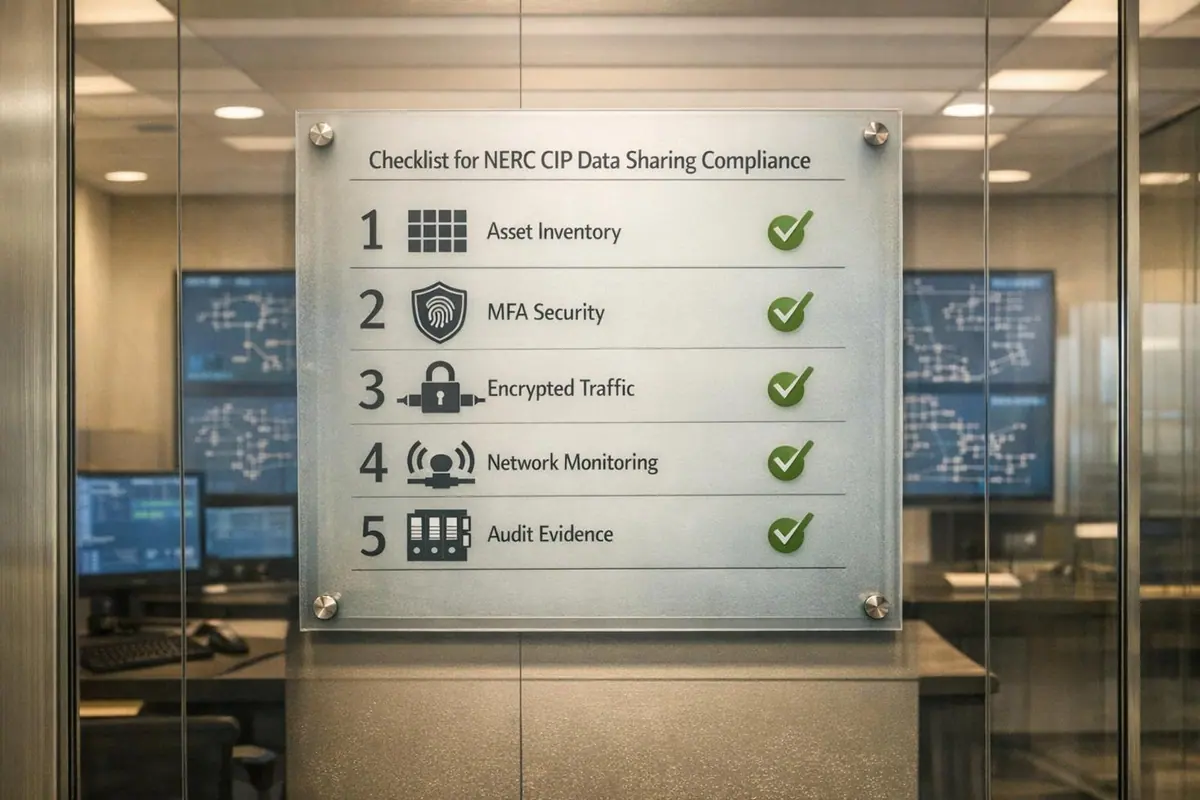
Checklist for NERC CIP Data Sharing Compliance


The NERC CIP standards are mandatory for safeguarding the North American power grid, which powers over 75% of the U.S. electric energy. Non-compliance can lead to fines of up to $1 million per day. In January 2026, updates were approved to expand protections for data sharing, particularly for inverter-based resources (IBRs), distributed energy aggregators, and third-party operators.
Here’s a quick breakdown of what you need to do to meet compliance:
- Identify and Classify Data: Inventory all BES Cyber Assets, categorize them by impact level (high, medium, low), and map data flows across Electronic Security Perimeters (ESPs).
- Access Controls: Enforce multi-factor authentication (MFA), conduct personnel risk assessments, and secure ESP boundaries.
- Data Transmission Security: Encrypt communications (e.g., TLS 1.3, IPsec) and safeguard SCADA and operational data.
- Incident Response: Set up continuous monitoring, develop a structured response plan, and test regularly.
- Documentation and Audits: Maintain up-to-date policies, conduct vulnerability assessments, and compile audit-ready evidence.
The 2026 updates bring stricter requirements, including internal network monitoring and extended protections for low-impact systems. Regular reviews and vendor validation are critical for staying compliant and protecting grid operations.
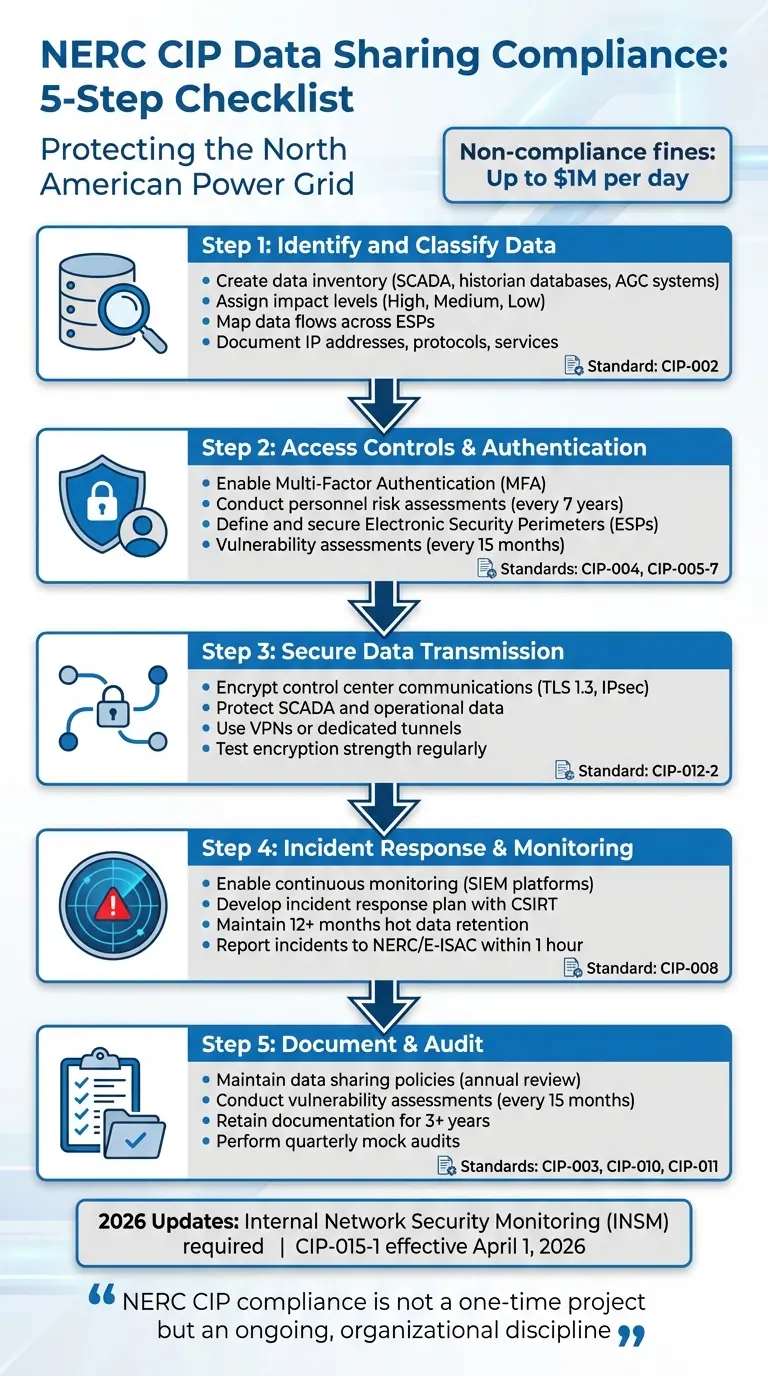
5-Step NERC CIP Data Sharing Compliance Process
Understanding NERC's CIP Standards: A Comprehensive Overview

sbb-itb-5f36581
Step 1: Identify and Classify Your Data
Pinpointing all BES Cyber Assets within your ESP is essential to avoid any oversight that auditors might flag.
Create a Data Inventory
Start by cataloging every BES Cyber Asset that handles data within your Electronic Security Perimeters. This includes systems like SCADA, historian databases, automatic generation control systems, and cloud-hosted operational data. For each asset, document critical details such as IP addresses, MAC addresses, communication protocols, and active services. Instead of relying on manual spreadsheets, consider using automated asset discovery tools to keep track of changes in real time.
As Amruta Telang from Network Intelligence explains, "NERC CIP compliance is not a one-time project but an ongoing, organizational discipline".
Assign Impact Levels to Data
Once your assets are inventoried, classify them based on their potential impact on grid reliability. Group them into high, medium, and low impact categories, depending on how essential they are to operational stability. Make sure to document your classification criteria thoroughly for auditor review.
Map Data Flows Across ESPs
Understanding the movement of data within and beyond your ESPs is crucial for identifying weak points. Develop detailed network diagrams to illustrate system boundaries, ESP limits, and the flow of data between IT and OT environments. Include specifics like protocols and ports (e.g., TCP 443 for encrypted traffic or TCP 102 for Siemens S7) and provide justifications for every interconnection across the ESP.
Pay close attention to External Routing Connectivity (ERC), which involves traffic that can connect to external networks, including the internet. To comply with FERC Order No. 887, implement Internal Network Security Monitoring (INSM) to establish traffic baselines within trusted zones and detect unauthorized connections. Configure your SIEM systems to log network activity and flag any unusual patterns across your perimeters.
As noted by Network Intelligence, "If it's not documented, it didn't happen in an auditor's eyes".
Step 2: Set Up Access Controls and Authentication
Managing access and authentication is a key part of safeguarding data and meeting compliance requirements. By controlling who can access shared data systems, you significantly reduce the risk of unauthorized use.
Enable Multi-Factor Authentication (MFA)
CIP-005-7 mandates the use of MFA for interactive remote access to high- and medium-impact BES Cyber Systems. The 2026 NERC CIP Roadmap also suggests expanding this requirement to low-impact systems. Single-factor authentication, such as just a password, leaves systems vulnerable to credential theft - especially for remote SCADA access.
To strengthen security, implement tokens or equivalent methods that combine a username/password with a 6-digit time-based code. Make sure your MFA solution works seamlessly with operational technology protocols like DNP3. Once remote access is secured, verify that personnel are suitable for system access before granting permissions.
Conduct Personnel Risk Assessments
Before allowing access to BES Cyber Systems, confirm personnel identities through criminal background checks. For control room operators and third-party access, also verify employment histories. These checks should be repeated every seven years to maintain compliance.
Follow the principle of least privilege - only grant access necessary for each individual’s role. For third-party vendors, require proof of their security practices. Additionally, keep accurate and up-to-date training records to ensure your organization is prepared for audits.
Once personnel are verified, the next step is to establish and secure network boundaries.
Define and Secure Electronic Security Perimeters
An Electronic Security Perimeter (ESP) provides a logical or physical boundary around critical cyber assets, helping to block unauthorized access and limit lateral movement across interconnected systems. For instance, SCADA firewalls should only allow specific ports, such as TCP 443 or TCP 102, from authorized management stations. Make sure to document the ESP boundaries for all generation control systems, including every asset that uses routable protocols.
However, the 2026 Roadmap emphasizes that perimeter defenses alone are no longer enough. Monitoring internal networks is crucial for detecting anomalies within trusted zones, especially as more communications rely on public networks. Perform vulnerability assessments at least every 15 months to spot weaknesses, such as unpatched remote access tools or potential MFA bypasses. Address and record any issues you find during these assessments.
Step 3: Secure Data Transmission and Encryption
Once access controls are established, the next step is to secure data transmissions. This ensures compliance with NERC CIP standards and safeguards grid reliability.
Encrypt Communication Between Control Centers
CIP-012-2 requires encryption, authentication, and monitoring for communications between control centers. These measures are designed to protect against unauthorized access or tampering during data transmission, which is critical for maintaining BES reliability. Cryptographic methods play a key role in ensuring both data integrity and confidentiality.
Use end-to-end encryption protocols like TLS 1.3 or IPsec for all control center data exchanges. Regular testing of encryption strength is vital to stay ahead of evolving cyber threats. These practices create a secure communication channel, keeping operational data safe.
Protect SCADA and Operational Data
SCADA and operational data must also be encrypted to prevent interception, aligning with CIP-012 requirements for control center data exchanges. Use VPNs or dedicated tunnels to secure this data, and configure ESP firewalls to allow only essential ports, like TCP 102. Protocol-specific encryption methods, such as DNP3 Secure Authentication, should also be implemented.
For additional protection, install endpoint security with real-time scanning on SCADA HMIs. Update these systems using air-gapped servers to avoid exposing operational networks. Tools like Xage can further enhance remote access security and provide supply chain oversight, helping to meet CIP requirements for third-party interactions. Network segmentation is another effective strategy, reducing exposure and ensuring data integrity during transmission. Alongside encryption, continuous monitoring is essential to detect and address potential vulnerabilities.
Perform Vulnerability Assessments
CIP-010 mandates vulnerability assessments at least every 15 months to identify and address weaknesses in data transmission security, including encryption vulnerabilities in SCADA and operational data flows. These assessments help uncover unpatched flaws in control center links and SCADA communications.
Start by inventorying all data transmission paths and scanning for east-west traffic anomalies using CIP-015-compliant tools. Test encryption protocols for strength and identify weak ciphers. Address any vulnerabilities by patching them promptly, documenting baselines, and resolving deviations within 35 days. Quarterly retesting ensures ongoing security and compliance. This proactive approach is especially important as updates like CIP-015-1, effective April 1, 2026, will expand monitoring requirements to include EACMS and PACS outside ESPs.
Step 4: Set Up Incident Response and Monitoring
Once your data transmission is secure, the next step is to establish constant monitoring and a structured incident response plan. This ensures threats are detected promptly, and grid operations remain protected.
Enable Continuous Monitoring
Continuous monitoring plays a critical role in identifying unauthorized access as it happens. Modern Security Information and Event Management (SIEM) platforms gather security data from across your network, including Electronic Security Perimeters (ESPs), to flag potential and confirmed threats using automated rules. For example, Vertiv's transition to a cloud-native SIEM in 2025 demonstrated the impact of advanced monitoring: logging 22 times more data, tripling event detection, and reducing investigation time by 65% while cutting response time by half.
Maintaining at least 12 months of hot data retention is equally important. It supports audit requirements and provides the ability to conduct forensic analysis when new threat indicators emerge. This real-time data feeds directly into your incident response strategy, enabling faster detection of emerging threats.
Develop an Incident Response Plan
A well-structured incident response plan is essential for meeting NERC CIP compliance standards. Start by outlining the plan's purpose, scope, and the specific systems it covers, including all ESPs. Form a Cybersecurity Incident Response Team (CSIRT) with a designated Incident Response Lead and representatives from security operations, legal, and privacy teams.
The plan should follow a standardized workflow: Preparation, Detection and Analysis, Containment, Eradication, Recovery, and Post-Incident Activity. Use a risk classification matrix to assess the severity of incidents - like ransomware attacks or data breaches - and determine when to activate full response protocols. This approach ensures critical grid operations are protected by addressing threats quickly and effectively. Secure communication protocols for both internal teams and external organizations, such as E-ISAC, should also be part of the plan. Regularly test the plan with annual tabletop exercises or full-scale simulations, and track metrics like Mean Time to Detect (MTTD) and Mean Time to Recovery (MTTR) to refine your processes.
| Incident Response Phase | Key Activities for Data Sharing Compliance |
|---|---|
| Preparation | Develop policies, train the CSIRT, and deploy monitoring tools (SIEM/EDR). |
| Detection & Analysis | Monitor ESPs for unauthorized access and decide if escalation is needed. |
| Containment | Restrict the spread of threats and isolate affected systems. |
| Eradication | Address the root cause of the incident and fix vulnerabilities. |
| Recovery | Restore systems to normal and verify their integrity. |
| Post-Incident | Document the incident and report to relevant entities (e.g., E-ISAC). |
By having a robust incident response plan, you can enhance your ability to mitigate threats and safeguard operations.
Enable Threat Detection in ESPs
Detecting threats in real-time within ESPs involves integrating Security Orchestration, Automation, and Response (SOAR) with your SIEM platform. This combination provides a unified interface for detection, investigation, and automated responses. Automated engines can quickly correlate data and apply detection rules to flag threats. Using frameworks like MITRE ATT&CK helps identify gaps in your detection coverage, while automated SOAR playbooks streamline responses to common alerts, easing the workload on human analysts.
Incorporating curated threat intelligence sources, such as Mandiant and VirusTotal, can further improve detection by identifying connections to active threat campaigns.
"In simple terms, Google SecOps is a mass risk-reducer. Threats that would have impacted our business no longer do, because we have greater observability, better mean time to detect, and better mean time to respond."
– CISO, Insurance Company
Consider the scale of the challenge: over 23% of exposures involve critical IT and security infrastructure, such as internet-accessible admin login pages for routers, firewalls, and VPNs. On top of that, organizations add more than 300 new services to their attack surface every month. Advanced threat detection tools powered by AI can help manage these risks, reducing the time it takes for security teams to reach full productivity by up to 70%.
Step 5: Document and Audit Compliance Measures
To prepare for audits, it's crucial to maintain a well-organized evidence system. Since NERC conducts regular audits, the quality and thoroughness of your documentation can significantly affect the outcome. Below, you'll find key areas to focus on, including policy maintenance, vulnerability assessments, and evidence compilation, to ensure your compliance measures are audit-ready.
Maintain Data Sharing Policies
Your data sharing policies should clearly define how shared data is identified, classified, and secured within Electronic Security Perimeters (ESPs). This includes specific requirements like encryption protocols, access controls, and vendor remote access management, as outlined in the CIP-003 updates effective April 1, 2026. To streamline this process:
- Store policies in a centralized system with version control.
- Review and update policies annually or whenever significant changes occur, such as new standards from the 2026 Roadmap expansions.
- Include details on multi-factor authentication (MFA) enforcement and CIP-012 communication protections.
- Document review dates, reasons for updates, and stakeholder approvals to demonstrate governance.
These steps ensure your policies remain current and compliant with evolving standards.
Conduct Regular Vulnerability Assessments
Vulnerability assessments are a cornerstone of compliance. Start by cataloging all shared data paths and ESPs, then perform quarterly scans using automated tools. These scans should identify cyber risks, such as unencrypted operational data transmitted over public networks. Key actions include:
- Testing encryption and MFA on SCADA/DNP3 traffic.
- Documenting findings with risk ratings and timelines for remediation.
- Addressing gaps in low-impact systems, as highlighted in the 2026 Roadmap, which emphasizes the importance of securing "last mile" communications.
By conducting these assessments regularly, you'll not only reduce risks but also ensure you're ready for audits.
Compile Audit Evidence
When preparing for NERC audits, your documentation must be thorough, well-organized, and retained for at least three years, as required by CIP standards. Essential components of your audit package include:
- Policy manuals, risk assessments, and vulnerability scan reports.
- Access logs showing MFA enforcement and encryption configuration proofs.
- Incident response test results and penetration test summaries.
For the 2026 updates, be sure to include vendor attestations and INSM evidence for EACMS/PACS under CIP-015-2. Use screen captures with visible timestamps for added credibility, as attestations alone may not suffice without corroborating evidence.
Store this documentation in a centralized compliance portal and conduct quarterly mock audits to validate its completeness.
NERC CIP Data Sharing Compliance Checklist
The table below outlines key NERC CIP standards to help ensure compliance with data sharing requirements. This checklist can guide your organization in implementing controls, maintaining proper documentation, and scheduling regular reviews. As Network Intelligence emphasizes, "NERC CIP compliance is not a one-time project but an ongoing, organizational discipline".
| Standard | Control Description | Implementation Steps | Required Documentation | Audit/Review Frequency |
|---|---|---|---|---|
| CIP-002 | Asset Identification & Categorization | Identify all BES Cyber Assets and assign impact levels (High, Medium, or Low). | Asset inventory, risk assessment methodology, network diagrams. | Annual review of categorization. |
| CIP-004 | Personnel & Training | Conduct background checks and provide security training tailored to roles. | Training records, background check attestations, access lists. | Annual training/recertification. |
| CIP-005 | Electronic Security Perimeters (ESP) | Use firewalls and EAPs; enforce MFA for remote access. | ESP boundary documentation, remote access logs, firewall configurations. | 90-day log retention; Annual review. |
| CIP-007 | Systems Security Management | Manage patches, enable malware defenses, and monitor for unauthorized changes. | Patch history, baseline configurations, malware scan results. | Continuous/Annual. |
| CIP-008 | Incident Reporting & Response | Report cyber incidents to NERC/E-ISAC within required timelines. | Incident response plan, incident logs, post-incident analysis. | Annual testing (tabletop or drill). |
| CIP-010 | Configuration Change Management | Establish baselines, perform vulnerability assessments, and manage changes. | Change logs, vulnerability assessment reports, TFE documents. | Every 15 months. |
| CIP-011 | Information Protection | Classify BCSI and ensure secure handling, storage, and disposal. | Information protection program, disposal records, classification list. | Annual review of policies. |
| CIP-012 | Control Center Communications | Encrypt data in transit between control centers. | Encryption protocols, communication pathway diagrams. | Annual review of protection methods. |
| CIP-013 | Supply Chain Risk Management | Evaluate vendor risks and validate software integrity. | Supply chain risk management plan, vendor assessments, SBOMs. | Periodic/Annual vendor validation. |
This checklist serves as a quick reference for verifying compliance with NERC CIP standards. It’s essential to retain both physical and electronic access logs for at least 90 days and report security breaches to the NERC hotline within one hour of detection. Keep this resource handy during internal reviews and external audits to ensure all necessary documentation is up to date and readily available.
Maintaining Compliance and 2026 Updates
Keeping up with compliance isn't a one-and-done task. It's a continuous process that evolves alongside changing standards and emerging threats. For organizations aiming to meet NERC CIP requirements, this means embedding regular reviews into daily operations and staying on top of regulatory updates that impact data sharing and system security.
Review and Update Policies Annually
NERC CIP guidelines recommend a structured schedule for policy reviews and updates. For example:
- Asset categorization: Reviewed every 15 months.
- Baseline configurations and security patches: Monitored every 35 days.
- Vulnerability assessments: Conducted every 15 months.
To streamline this process, consider using automated asset tracking tools. These tools can send programmable alerts to help identify new devices and flag unauthorized changes, ensuring that nothing slips through the cracks.
Validate Vendor Compliance
Outsourcing certain tasks doesn’t absolve you of responsibility. As Industrial Defender Staff puts it:
"Outsourcing does not transfer accountability. Entities must document third‐party responsibilities, monitor execution, and retain evidence of oversight".
This means you can't rely solely on vendor attestations. FERC audits have highlighted cases where entities failed to independently verify vendor-performed work. To avoid this pitfall, implement your own checks, such as software integrity testing and vulnerability scans.
When it comes to cloud services, the challenge grows. Current CIP standards don’t explicitly cover cloud environments, and FERC Audit Staff has pointed out that:
"It is unlikely that entities can provide the measures needed to demonstrate compliance" when using cloud providers.
Before transitioning BES Cyber Systems to the cloud, thoroughly evaluate whether your systems can meet compliance standards, including baseline configuration requirements. These steps are essential for maintaining accountability and aligning with network monitoring practices.
Monitor Emerging Standards
Big changes are on the horizon. On September 2, 2025, CIP-015-1 became effective, introducing Internal Network Security Monitoring (INSM) requirements for high-impact BES Cyber Systems and medium-impact systems with external routable connectivity. By September 2, 2026, NERC is tasked with expanding these requirements to include EACMS and PACS located outside the security perimeter.
The Federal Energy Regulatory Commission explains:
"INSM provides insight into east-west (i.e., lateral) network traffic happening inside the network perimeter, which enables a more comprehensive picture of the extent of an attack compared to data gathered from the network perimeter alone".
This marks a shift in focus - moving beyond perimeter defense to monitoring internal activity for potential threats. To prepare, start by establishing a baseline of your network activity. Additionally, conduct audits of EACMS and PACS systems outside your electronic security perimeter, as these are likely to fall under mandatory INSM requirements with the 2026 updates. Taking proactive steps now will make the transition smoother as these new standards come into effect.
Conclusion
Achieving and maintaining NERC CIP data sharing compliance is far from a one-time task - it requires constant vigilance and adaptation. As Amruta Telang highlights, continuous monitoring and automated documentation are critical for staying compliant in an ever-changing landscape. Compliance today isn’t just about annual checklists; it’s about embedding security practices into everyday operations.
By following the outlined steps - from identifying critical assets under CIP-002 to safeguarding communications with CIP-012 - you can build a robust framework that not only protects the Bulk Electric System but also aligns with regulatory expectations.
The stakes are high. Non-compliance fines have surged since 2025, with penalties reaching as much as $10 million or 2% of global turnover. Beyond avoiding fines, these practices are essential for defending critical infrastructure against increasingly advanced cyber threats. New requirements, like Internal Network Security Monitoring under FERC Order No. 887, reflect the ongoing evolution of standards to address emerging risks.
To keep pace, make regular policy reviews a priority, verify vendors and third parties through independent assessments, and stay ahead of new standards like those under Project 2025-06, which focus on supply chain risk management. These steps are crucial for maintaining compliance into 2026 and beyond.
Streamline compliance efforts by centralizing evidence collection, conducting mock audits, and assigning clear responsibilities for self-certifications and spot-checks. Staying proactive is the key to navigating evolving standards and protecting critical systems.
FAQs
What are the main updates to NERC CIP standards for data sharing compliance in 2026?
The 2026 updates to NERC CIP standards bring important changes to improve the security of data sharing. Two key updates stand out:
- CIP-003-9: Focuses on bolstering the application and monitoring of security controls, particularly in lower-risk environments.
- CIP-012-2: Aims to ensure the protection of real-time operational data exchanged between control centers.
These updates target the growing challenges of cybersecurity threats, helping energy and utility companies not only stay compliant but also better protect their critical infrastructure.
What steps should organizations take to ensure effective incident response and monitoring under NERC CIP standards?
To meet NERC CIP standards, organizations need a comprehensive incident response plan that addresses every stage of handling cybersecurity incidents. This means covering the essentials: detection, reporting, containment, recovery, and post-incident analysis. Such a plan is crucial for minimizing risks to the Bulk Electric System (BES) and aligns with standards like CIP-008-6 and CIP-008-7. The goal is to act quickly and effectively during incidents, with clear steps for reporting and mitigation.
Additionally, continuous monitoring tools are key to staying ahead of potential threats. These tools enable real-time data tracking, protect information through encryption, and enforce access controls to block unauthorized changes. Regular vulnerability assessments and strict configuration management, as outlined in CIP-010-4, add another layer of protection. Together, these practices enhance an organization's ability to spot and address risks before they become serious issues, ensuring both system security and reliability.
How do I classify and secure BES Cyber Assets within Electronic Security Perimeters?
To protect BES Cyber Assets (BCAs) within Electronic Security Perimeters (ESPs), the first step is identifying and categorizing critical assets. This process focuses on evaluating their impact on the reliability of the Bulk Electric System (BES). The classification helps determine the necessary security measures for each asset.
After classification, it's essential to implement both physical and cyber security controls. For physical security, use measures like access controls, monitoring systems, and intrusion detection to block unauthorized access. On the cyber side, document all assets and ESPs thoroughly and follow compliance standards to ensure system security and reliability.
By understanding the criticality of each asset and applying appropriate safeguards, you can effectively secure BES Cyber Assets within their respective ESPs.
Related Blog Posts
Get new content delivered straight to your inbox

The Response
Updates on the Reform platform, insights on optimizing conversion rates, and tips to craft forms that convert.




Drive real results with form optimizations
Tested across hundreds of experiments, our strategies deliver a 215% lift in qualified leads for B2B and SaaS companies.
