
.webp)
CJIS Compliance for SaaS: Best Practices


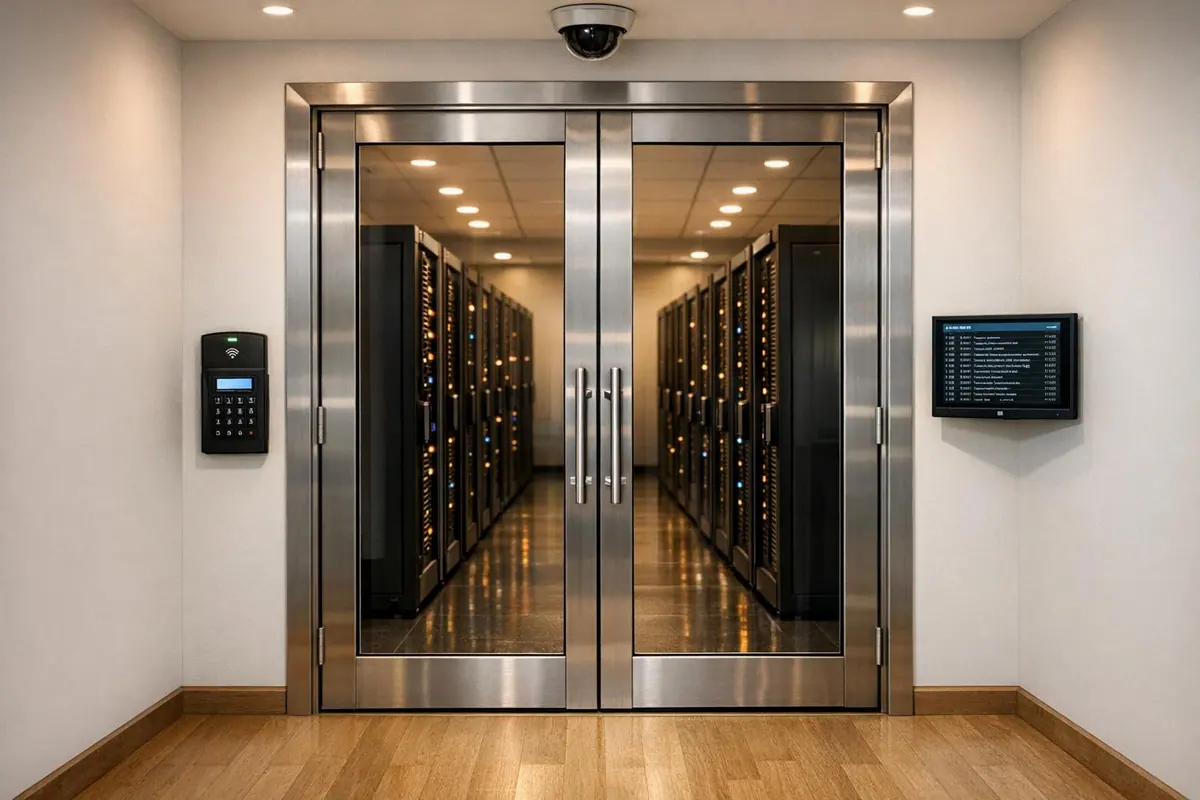
If your SaaS platform handles criminal justice data, CJIS compliance is mandatory. Without it, you can’t work with law enforcement or public sector agencies. Worse, non-compliance can lead to fines or criminal charges.
Here’s what you need to know:
- CJIS Compliance: A set of FBI security policies covering 13 areas and over 580 controls to protect Criminal Justice Information (CJI).
- Core Requirements: Encryption (FIPS 140-validated), multi-factor authentication (AAL2), audit logging, incident response plans, and U.S.-based data storage.
- Employee Screening: Background checks and mandatory security training (70% pass score minimum).
- Version Updates: CJIS Security Policy v6.0, introduced in December 2024, emphasizes continuous monitoring and automation.
The article explores best practices for SaaS providers, including encryption, access control, vendor management, and continuous compliance monitoring. Following these guidelines ensures your platform meets legal standards and protects sensitive data.
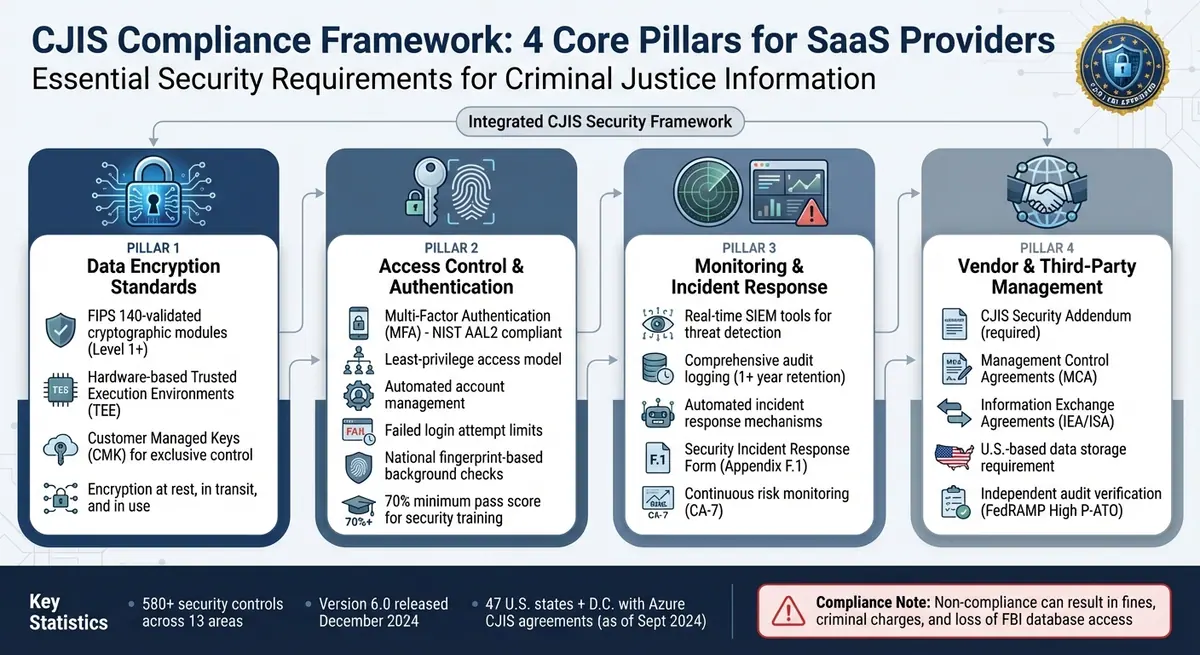
CJIS Compliance Framework: 4 Core Pillars for SaaS Providers
Best Practices for CJIS Compliance in SaaS
To meet CJIS compliance, SaaS providers must adopt technical measures that safeguard Criminal Justice Information (CJI) throughout its lifecycle. This includes securing data whether it’s being transmitted or stored. Below are some key practices for implementing these safeguards effectively.
Data Encryption Standards
Using FIPS 140-validated cryptographic modules is a must. For multi-factor authentication (MFA) systems, ensure that authenticators and verifiers comply with FIPS 140 Level 1 or higher.
When processing data, rely on hardware-based Trusted Execution Environments (TEE) or enclaves. These tools prevent cloud personnel from accessing unencrypted CJI, offering what the policy terms "absolute assurance" that provider staff cannot view sensitive data.
Additionally, agencies should maintain exclusive control over encryption keys by utilizing Customer Managed Keys (CMK). For instance, Microsoft Azure Government has established CJIS Management Agreements with 47 U.S. states and the District of Columbia as of September 2024.
Access Control and Authentication
Encryption alone isn’t enough - strong access controls are equally important. Implement MFA that meets NIST SP 800-63's Authenticator Assurance Level 2 (AAL2) standards. Ensure these authentication methods are resistant to replay attacks.
Adopt a least-privilege model, where users only access the data and tools necessary for their roles. No single individual should have the ability to bypass critical security controls. Automated systems can help by disabling inactive or high-risk accounts, enforcing device locks, and setting session timeouts to prevent unauthorized access.
To further enhance security, limit the number of failed login attempts and regularly review user privileges to reduce the risk of brute-force attacks.
Network Monitoring and Segmentation
Encryption and access controls should be complemented by robust network management. Start with boundary protection by using managed access points and firewalls configured with a "deny by default" policy, as outlined in the CJIS Security Policy.
Deploy Intrusion Detection and Prevention Systems (IDPS) to monitor network traffic for unauthorized activities. Automated tools can analyze traffic in real time and issue alerts when suspicious behavior is detected.
For remote access, avoid split tunneling by routing all traffic through authenticated proxy servers. Network segmentation can further enhance security by isolating systems that handle CJI from other organizational traffic. To meet the latest encryption and security standards, ensure modern networking hardware, such as routers used in mobile setups, are FIPS 140-3 certified.
Compliance Monitoring and Incident Response
Keeping up with continuous monitoring and having a sharp incident response strategy are key to meeting CJIS compliance standards. SaaS providers must keep a close eye on system activity in real time and act quickly when threats arise.
Audit Logging and Real-Time Monitoring
After setting up strong encryption and access controls, the next step is maintaining constant monitoring. Every security event must be logged, capturing details like the user ID, event type, timestamp, and outcome. This includes tracking successful and failed logins, access to Criminal Justice Information (CJI), and any changes made to security settings.
To keep things running smoothly, use Security Information and Event Management (SIEM) tools. These tools analyze system activity in real time and send alerts when they detect unusual patterns, such as repeated failed login attempts or unauthorized access to CJI. Make sure all system clocks are synced to a reliable source, limit log access to only privileged users, and store logs for at least one year.
Incident Response Plans
Real-time monitoring is only part of the equation; a well-thought-out incident response plan is just as important. Create a plan that complies with IR-8 standards, outlining steps for detecting, containing, mitigating, and reporting security incidents. The CJIS Security Policy v6.0 emphasizes:
"The agency shall employ automated mechanisms to help maintain the continuity of the incident response process".
Your plan should incorporate the standardized Security Incident Response Form (Appendix F.1) to document and report incidents to the CJIS Systems Agency (CSA). Align this plan with your organization’s contingency and business continuity strategies, and regularly conduct drills to ensure your team is prepared.
| CJIS Control | Key Requirement |
|---|---|
| AU-2 / AU-3 | Log security events with detailed metadata (User ID, Timestamp, Event Type) |
| SI-4 | Trigger real-time alerts for security-related events |
| IR-4 | Use automated processes for managing and documenting incidents |
| IR-6 | Report security incidents to the appropriate CSA or authorities |
| CA-7 | Continuously monitor risks and perform independent assessments |
Vendor and Third-Party Management
Managing vendor and third-party access is just as crucial as having strong internal controls when it comes to CJIS compliance. Vendors and contractors with access to Criminal Justice Information (CJI) must be carefully monitored, and their security practices documented through formal agreements. Every third party interacting with CJI is required to sign the CJIS Security Addendum - an agreement approved by the U.S. Attorney General that binds them to federal and state security standards. These agreements serve as the foundation for ensuring vendors follow secure data practices.
Formal Agreements and Compliance Verification
When non-criminal justice vendors manage infrastructure that supports CJI, it's essential to establish Management Control Agreements (MCA). These agreements clearly define who has administrative control and who holds legal responsibility for shared assets. Assign an Agency Coordinator to manage vendor relationships and an Agency Liaison to oversee security compliance.
Vendor personnel with unescorted access to unencrypted CJI must undergo national fingerprint-based record checks. However, if encryption is applied to data in transit, at rest, and in use - with sole control over encryption keys (Customer Managed Keys) - these background checks may not be necessary. This policy, introduced in CJIS Security Policy v5.9.1, can ease the administrative burden of managing third-party access.
To confirm vendor compliance, review independent audit reports and FedRAMP High Provisional Authorization to Operate (P-ATO) documentation. These reviews provide insights into how vendors implement security controls. Such measures complement other strategies like audit logging and real-time monitoring. For example, as of September 27, 2024, Microsoft has signed CJIS Management Agreements with criminal justice agencies in 47 states and the District of Columbia, highlighting how large cloud providers operate under these requirements. After formal agreements are in place, ongoing monitoring of vendor access becomes a critical step.
Monitoring Third-Party Access
Monitoring third-party access involves both technical measures and administrative oversight. Vendor remote access should be routed exclusively through managed access control points (AC-17), and the principle of least privilege (AC-6) should be enforced to ensure vendors only access what is necessary. Real-time analysis tools can monitor inbound and outbound communications traffic (SI-4) to detect any unauthorized access attempts.
To formalize the technical and security requirements for system interfaces, establish Information Exchange Agreements (IEA) or Interconnection Security Agreements (ISA). These agreements outline how data is shared, define responsibilities, and set penalties for violations. Keep detailed records of all vendor activities, including proof of security awareness training (AT-4) and background checks. Additionally, confirm that all vendors store and process CJI exclusively within the United States.
sbb-itb-5f36581
Maintaining Continuous Compliance
CJIS compliance isn’t a one-and-done task; it requires ongoing effort to monitor security controls, update documentation, and train personnel. The release of CJIS Security Policy Version 6.0 in December 2024 highlights the move toward a continuous monitoring framework, closely aligned with NIST SP 800-53 Rev. 5 controls. By building on practices like encryption, access controls, and monitoring, this approach ensures your security measures stay effective over time.
Regular Security Assessments
Frequent security assessments are critical to spotting and addressing vulnerabilities quickly. For instance, Control Assessments (CA-2) require organizations to bring in independent assessors to objectively evaluate their security controls. These assessments should also include vulnerability scanning (RA-5), using up-to-date signatures to counter emerging threats.
Automated tools make it easier to maintain real-time visibility into your systems. Use automated monitoring for system integrity (SI-4) and flaw remediation tracking (SI-2) to ensure patches are applied within the timeframes set by CJIS. Keep a Plan of Action and Milestones (POA&M) to document security gaps and show auditors that you’re actively addressing them. These assessments also support smoother change management processes.
Change Management Processes
Every SaaS update needs to be tested and documented before it goes live. Configuration Change Control (CM-3) requires testing, validation, and documentation of all system changes to avoid compliance issues. Additionally, performing a Security Impact Analysis (CM-4) before and after changes ensures that your security controls remain effective and no new vulnerabilities are introduced.
A well-defined Configuration Management Plan (CM-9) is essential. This plan should outline roles, responsibilities, and procedures for managing changes. Automated tools, such as baseline management (CM-2), can help maintain consistent configurations across your SaaS environment. Similarly, automated inventory detection (CM-8) can identify unauthorized components - like shadow IT - that may compromise compliance. These processes ensure updates don’t disrupt the security measures required by CJIS.
Documentation and Training
Clear documentation and regular training are non-negotiable. Your System Security and Privacy Plan (SSPP) should always reflect the current state of your security and privacy controls. Detailed records of system components, policies, and change management activities not only support compliance but also simplify audits.
Training is just as important as documentation. Every employee should complete annual security awareness training (AT-2), covering topics like insider threats and social engineering. Staff in sensitive roles - such as system administrators or those handling Personally Identifiable Information (PII) - should also receive specialized role-based training (AT-3). Automated systems can help track training completion and send reminders for renewals, ensuring certifications stay current. Maintain training records (AT-4) for all employees to demonstrate compliance during audits. Additionally, regular incident response drills can prepare your team to handle real-world scenarios effectively.
| Compliance Activity | CJIS v6.0 Control | Key Requirement |
|---|---|---|
| Control Assessments | CA-2 | Independent evaluations of security controls |
| Change Validation | CM-3 | Testing and documenting changes before rollout |
| Impact Analysis | CM-4 | Verifying security controls after system updates |
| Vulnerability Scanning | RA-5 | Regular scans using updated vulnerability data |
| Training Records | AT-4 | Detailed documentation of staff training |
Conclusion
By adopting strong encryption, strict access controls, and continuous monitoring, your platform aligns with the rigorous demands of CJIS compliance. The strategies outlined here form a solid framework for ensuring security and meeting regulatory requirements.
CJIS compliance is not optional for SaaS platforms handling Criminal Justice Information. Failure to comply can result in losing access to FBI databases, which could completely halt your ability to serve law enforcement clients.
"CJIS compliance requirements protect national security while safeguarding the civil liberties of individuals and businesses and shielding private and sensitive information." - Compass IT Compliance
Achieving compliance involves addressing a wide range of security measures. These include using FIPS 140-2/3 validated encryption, deploying multi-factor authentication, conducting fingerprint-based background checks, and maintaining detailed audit logs. As of September 27, 2024, cloud providers have entered CJIS Management Agreements with criminal justice agencies across 47 states and the District of Columbia, showcasing the industry’s broad adoption of these standards.
Compliance is a shared responsibility. While you deliver the infrastructure and technical safeguards, your law enforcement clients rely on your dedication to upholding these security standards. Signing the CJIS Security Addendum is just the starting point - it initiates an ongoing process of monitoring, evaluation, and training to keep systems secure and clients confident. Regular assessments and continuous education are key to protecting sensitive data and maintaining trust.
FAQs
What are the main technical requirements for ensuring CJIS compliance in a SaaS platform?
To meet CJIS compliance requirements in a SaaS platform, providers need to enforce strict access controls that regulate and monitor who can access Criminal Justice Information (CJI). This involves implementing secure authentication methods, such as multi-factor authentication, and maintaining detailed auditing systems to log data access and modifications. Protecting data with encryption is also non-negotiable - it must be safeguarded both at rest and during transmission using secure protocols like HTTPS.
Providers must also focus on configuration management to ensure system integrity, media protection to secure both physical and virtual storage, and develop incident response plans to address and document any security breaches swiftly. For cloud-based platforms, adhering to CJIS standards for cloud environments is crucial. Leveraging compliance tools provided by cloud service providers can simplify this process. Staying compliant requires regular audits and proactive security strategies to protect sensitive information effectively.
What does CJIS Security Policy version 6.0 mean for continuous monitoring practices?
The CJIS Security Policy version 6.0 highlights the importance of continuous monitoring as a key element in maintaining security and compliance. This approach aligns with the guidelines outlined in NIST SP 800-137, prioritizing ongoing operational oversight, effective change management, and prompt responses to incidents.
When agencies adopt these practices, they can regularly assess and refine their security measures to stay in line with CJIS standards. This not only helps protect sensitive information but also supports better decision-making during the authorization process.
Why is managing vendors and third parties important for CJIS compliance?
Managing relationships with vendors and third parties is a critical part of maintaining CJIS compliance. It ensures that any external partners adhere to the strict security measures needed to protect sensitive criminal justice information (CJI) during access, transmission, and storage.
By applying consistent security policies and controls to all third-party entities, organizations can reduce risks like unauthorized access, data breaches, or penalties for non-compliance. Keeping a close watch on vendor activities and maintaining clear communication helps preserve the integrity and confidentiality of CJI at every stage.
Related Blog Posts
Get new content delivered straight to your inbox

The Response
Updates on the Reform platform, insights on optimizing conversion rates, and tips to craft forms that convert.


Drive real results with form optimizations
Tested across hundreds of experiments, our strategies deliver a 215% lift in qualified leads for B2B and SaaS companies.
