
.webp)
How AI Improves Lead Quality with Enrichment



AI-powered lead enrichment transforms basic contact data into detailed profiles by adding insights like job titles, company info, and behavioral signals. This process helps businesses:
- Increase conversion rates by analyzing high-value signals like budgets and timelines.
- Shorten sales cycles by automating data collection and lead routing.
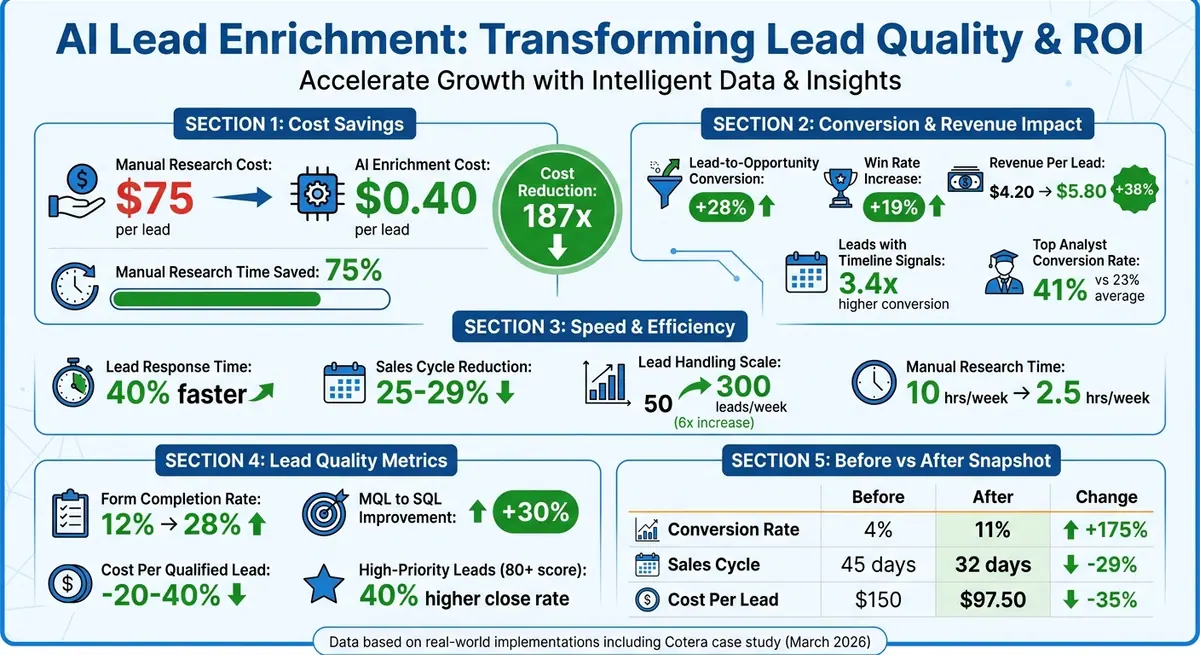
- Reduce costs, cutting manual research from $75 per lead to $0.40.
- Improve lead prioritization with AI-driven scoring for better focus on high-potential prospects.
For example, companies like Cotera scaled lead handling by 6x and boosted revenue per lead by 38%. AI tools like Reform simplify this process with real-time data enrichment, CRM integration, and lead scoring, ensuring higher-quality leads and better sales outcomes.
Key Benefits:
- Higher conversions: Leads with timeline signals convert 3.4x more often.
- Faster sales: Lead response times cut by 40%.
- Cost savings: Manual research time reduced by 75%.
AI-powered enrichment optimizes lead management, helping businesses focus on leads that matter most while saving time and money.
AI Lead Enrichment Impact: Key Performance Metrics and ROI
Benefits of AI-Powered Lead Enrichment
Better Conversion Rates and ROI
AI-powered lead enrichment makes it easier to identify behavioral signals and intent that indicate a higher likelihood of conversion. By analyzing CRM notes, call transcripts, and email threads, AI uncovers critical details like timelines, budget mentions, and competitive insights - information that external databases often miss.
Take Cotera as an example. In March 2026, its founder, Ibby Syed, shared that adding an AI enrichment layer allowed the company to scale from handling 50 leads per week to over 300, without increasing staff. This change led to a 28% jump in lead-to-opportunity conversions, a 19% boost in win rates, and an increase in revenue per lead from $4.20 to $5.80. One analyst, Rashid, reported a 41% conversion rate for leads he enriched with AI insights, compared to the 23% average for the broader pool. These improvements translate directly into stronger ROI.
By enhancing lead quality and enabling smarter outreach, AI doesn’t just improve conversions - it speeds up the entire sales process.
Shorter Sales Cycles
With detailed lead profiles generated by AI, sales teams can immediately engage with prospects in a more informed and personalized way. This eliminates the need for time-consuming manual research and cuts lead response time by about 40%. Reaching out while leads are still warm increases the chances of closing deals.
AI also automates lead routing across multiple channels - web, ads, chat, and CRM - removing delays caused by manual distribution. This allows sales reps to focus on personalized outreach right away. For instance, identifying three or more stakeholders in a deal can increase conversion rates by 2.1 times, and AI simplifies spotting these multi-threaded opportunities early.
The result? Faster deal cycles and reduced resource strain.
Lower Lead Management Costs
Manually enriching leads can cost around $75 per lead in labor. In contrast, AI enrichment costs approximately $0.40 per lead, delivering a 187x cost reduction while maintaining accuracy and scalability. This efficiency makes it possible to handle higher lead volumes without sacrificing quality.
"The CRM already has the data. The conversations your team is having every day contain more enrichment value than any third-party database. The gap is extraction and structure. That's what AI agents close."
- Ibby Syed, Founder, Cotera
AI eliminates the bottleneck that occurs when manual research becomes unsustainable as lead volume grows. Instead of relying on additional staff or outdated bulk tools, AI autonomously extracts structured data from unstructured sources like call notes, emails, and meeting transcripts. By prioritizing fresh internal data over aging third-party records, AI ensures accuracy while scaling effortlessly.
sbb-itb-5f36581
How AI-Powered Lead Enrichment Works
Collecting Initial Lead Data
The process kicks off by gathering basic information from prospects through web forms. Tools like Reform simplify this step by using multi-step forms with conditional logic, tailoring questions based on user responses to reduce drop-offs. By focusing on essential details - like name, email, phone number, and company domain - the user experience is streamlined, minimizing form abandonment. Reform also includes features like real-time email validation and spam prevention to ensure only legitimate contacts are captured. Plus, its form shortening functionality hides fields when data can be retrieved from verified sources. For instance, if a work email is provided, the system might auto-fill job title and company details. Once this initial data is collected, AI steps in to fill in the gaps.
Adding Data with AI
With a key identifier like an email address in hand, AI gets to work by pulling additional details from sources like LinkedIn, company websites, and firmographic databases. These details can include job titles, revenue, industry, and even the technology stack. For example, in Q1 2023, Zapier integrated Clearbit's AI enrichment into their lead forms. This allowed them to automatically append job titles and revenue data via real-time API integrations. The result? A 2.5× increase in qualified leads, jumping from 20% to 50%, and a 35% reduction in sales cycle time over six months. Similarly, Reform’s lead enrichment feature pulls data from verified sources, ensuring compliance with regulations like GDPR and CCPA while achieving 92% accuracy. Once enriched, the data is ready for the next step: lead scoring.
Scoring and Ranking Leads
AI evaluates these enriched profiles against historical conversion data, assigning scores from 0–100 based on firmographics, demographics, behavioral signals, and technographics. Leads scoring above 80 are flagged as high-priority. For instance, a B2B SaaS company might configure its model so that a VP-level title at a company with 50+ employees and multiple page views earns a score of 92 out of 100. This system helps sales teams zero in on the top 20% of leads that drive 80% of conversions. When these ranked leads are synced to CRMs like HubSpot or Salesforce, the top 10% of scored leads often achieve a 40% higher close rate. This targeted strategy ensures sales teams focus their efforts on prospects with the highest potential to convert.
Build an AI agent with me! Ep. 10: Lead Enrichment
How to Implement AI Lead Enrichment with Reform
Follow these steps to transform basic form submissions into actionable, high-quality leads using Reform's AI-powered enrichment tools.
Step 1: Build Your Reform Forms for Lead Capture
Start by designing your form with Reform's no-code editor. Focus on gathering key details like name, email address, and company domain - these are essential for AI enrichment. Reform also includes real-time email validation, ensuring you're collecting accurate contact information from the beginning.
The idea is to keep the form simple. For instance, capturing a work email can unlock a wealth of additional data points through AI. There's no need to ask for details like job title or company size upfront. This streamlined approach sets the stage for effective enrichment while reducing form abandonment.
Step 2: Enable Reform's Lead Enrichment Features
To access enrichment and form shortening, you'll need Reform's Pro Plan ($35/month or $350/year). Have your Team Owner set up the enrichment data source by navigating to Team Settings > Enrichment. Then, activate enrichment in the form sidebar by mapping fields like company size or industry using the "Add Mapping" button.
The "Shorten Forms" feature, enabled by default, automatically hides fields when AI successfully retrieves data. If enrichment fails, the fields remain visible as a fallback. A/B testing has shown that shorter, enriched forms perform better by creating a smoother user experience.
Step 3: Connect Reform to Your CRM and Analytics Tools
Once enrichment is active, integrate Reform with your CRM or marketing automation platform. Reform works seamlessly with tools like HubSpot, Salesforce, and Zapier, transferring enriched data in real time. Use hidden fields to send backend information - such as company revenue or technographics - directly to your CRM without cluttering the visible form.
Test your setup with a mix of "known" and "unknown" leads to confirm that data flows correctly. This ensures that top-tier leads are routed to sales teams right away, while mid-tier prospects can enter nurturing workflows. Proper mapping of enriched data is key to powering lead scoring models.
Step 4: Use AI for Lead Scoring and Prioritization
Leverage the enriched data to refine your lead scoring system. For example, assign higher scores to VP-level contacts at companies with 50+ employees. Sync this scored data with your CRM so sales teams can focus on the most promising leads - the top 20% that typically drive 80% of conversions.
Prioritize enriching details like Company Info (name, size, industry), Personal Details (occupation, seniority), and Geographic Info to improve lead qualification.
Step 5: Optimize with A/B Testing and Analytics
Take advantage of Reform's A/B testing to fine-tune your enrichment setup. Experiment with which fields to hide or show, try different mapping configurations, and measure how form shortening affects completion rates. Reform's real-time analytics dashboard provides insights into user behavior, such as drop-off points and which variations yield the best leads.
Use this data to refine your strategy. Expand fields that improve conversions and tweak fallback settings where enrichment isn't performing as expected. Continuous testing ensures your forms stay optimized for capturing high-quality leads.
Measuring the Impact of AI-Powered Lead Enrichment
Once you've implemented AI enrichment with Reform, the next step is all about measuring its effectiveness. Focus on specific metrics like conversion rates, lead quality scores (on a 0–100 scale), and the time saved on manual research. For example, conversion rates often see a jump of 15–50%, with some SaaS companies reporting an increase in form submissions from 12% pre-enrichment to 28% after incorporating AI-verified emails and job titles. Lead quality scores, which factor in firmographics, technographics, and intent signals, are particularly useful - leads scoring above 80 are typically high-quality prospects. Additionally, AI tools can improve the transition from marketing qualified leads (MQL) to sales qualified leads (SQL) by as much as 30%.
Reducing manual research time is another key benefit. Traditionally, sales reps may spend 10 hours per week on research, but with automation, that time can drop to less than an hour - a reduction of 70–80%. Track these improvements using Reform's analytics dashboard to ensure your lead enrichment strategy is on target. Other measurable gains include a 20–40% drop in cost per qualified lead (CPL) and a shorter sales cycle, often reduced by about 25%.
Key Metrics to Track
In addition to the primary metrics, keep an eye on these indicators to get a fuller picture of performance:
- Lead Volume vs. Quality Ratio: Expect a potential 20% reduction in lead volume but a 40% boost in quality.
- Email Open and Reply Rates: Accurate targeting can increase these rates by approximately 25%.
- Form Completion Rates: Use Reform's real-time analytics dashboard to track conversion rates and identify where users drop off.
- Pipeline Velocity and Bounce Rates: Enhanced personalization can reduce landing page bounce rates by about 15% while improving pipeline velocity.
Together, these metrics help you build a clear picture of how AI enrichment impacts your lead generation efforts.
Before and After Comparison
Comparing data before and after implementing AI enrichment is one of the most effective ways to demonstrate its impact. Allow 60–90 days to observe meaningful trends. Use your CRM (like HubSpot or Salesforce) to gather baseline data, and then monitor changes using Reform's integrated reporting tools. Running A/B tests with lead cohorts ensures your results are statistically reliable and tied to meaningful KPIs rather than vanity metrics.
| Metric | Before AI Enrichment | After AI Enrichment | Improvement |
|---|---|---|---|
| Conversion Rate | 4% | 11% | +175% |
| Sales Cycle | 45 days | 32 days | -29% |
| Cost Per Lead | $150 | $97.5 | -35% |
| Manual Research Time | 10 hrs/week | 2.5 hrs/week | -75% |
Conclusion
AI-driven tools are reshaping every stage of lead management, making it easier for businesses to handle lead generation efficiently. By automating the process of enriching basic contact details with data like firmographics, technographics, and intent signals, companies can move away from tedious manual research. The result? Improved conversion rates, faster sales cycles, reduced costs, and more time for your team to focus on high-impact activities.
Key Takeaways
The benefits of AI-powered lead enrichment are clear and measurable. For example:
- Conversion rates can increase by up to 30%.
- Sales cycles may shorten by 20–25%, thanks to automated lead scoring that identifies high-intent prospects.
- Time spent on manual research is cut by 40–60%, allowing teams to focus on what matters most.
- Businesses often see a 25% reduction in lead validation costs.
Reform simplifies this process with high-quality lead forms, real-time data enrichment, and seamless CRM integration. From the moment a lead submits a form to the final conversion, Reform helps create an efficient, scalable system that aligns marketing and sales teams around actionable, data-driven metrics.
Next Steps for Businesses
Getting started with AI-driven lead enrichment doesn't have to be complicated. Here’s how you can take the first steps:
- Sign up for Reform's Pro Plan and build your first enriched form using the drag-and-drop editor.
- Integrate your CRM (like Salesforce or HubSpot) to ensure enriched data flows smoothly into your sales pipeline.
- Start small by A/B testing your forms and use Reform's analytics dashboard to measure improvements in conversion rates and costs per qualified lead.
- Set specific goals, such as "generate 100 enriched leads in 30 days", and track your progress using clear KPIs.
FAQs
What lead data should I collect first for AI enrichment to work?
To make the most of AI-driven enrichment and lead scoring, it’s crucial to gather key demographic and firmographic details. Focus on collecting information such as:
- Job title: Understand the role and decision-making authority of the individual.
- Company size: This helps tailor approaches based on the scale of operations.
- Industry: Knowing the sector provides context for challenges and opportunities.
- Location: Geographic data can influence outreach strategies and personalization.
These details lay the groundwork for more precise targeting and better-informed decisions.
How accurate is AI enrichment, and how do I handle missing data?
AI enrichment works best when it relies on trusted data sources and incorporates real-time validation. To address missing data, consider using automated updates and enrichment tools that can seamlessly fill in the gaps. This ensures your data remains reliable and complete, improving lead quality while minimizing database errors.
How long until I see measurable results from AI lead enrichment?
Most companies see noticeable improvements in lead quality and save time within 30 to 45 days after adopting AI lead enrichment. However, the exact results can differ based on factors like the quality of the data and how well the integration is handled.
Related Blog Posts
Get new content delivered straight to your inbox

The Response
Updates on the Reform platform, insights on optimizing conversion rates, and tips to craft forms that convert.



Drive real results with form optimizations
Tested across hundreds of experiments, our strategies deliver a 215% lift in qualified leads for B2B and SaaS companies.
